
Investigation · Foundations
Corroboration: Testing Whether Independent Sources Agree
Agreement between sources is persuasive only when the sources are truly independent. This article explains what corroboration is, why it strengthens conclusions, how it is faked or undermined, and how to test whether apparent agreement is real.
When two witnesses who have never met describe the same car, or a bank statement matches an entry in a suspect's diary, investigators feel on firmer ground. Agreement between sources is one of the most powerful kinds of evidence, because it is hard to explain unless what the sources describe actually happened. This is the logic of corroboration. But agreement is only as strong as the independence of the sources. Two witnesses who discussed the event, two documents generated from the same flawed spreadsheet, or a confession that repeats details supplied by the police, can agree perfectly and still be wrong. This article explains why corroboration works, how it fails, and how investigators can tell real corroboration from an echo.
Why agreement is persuasive
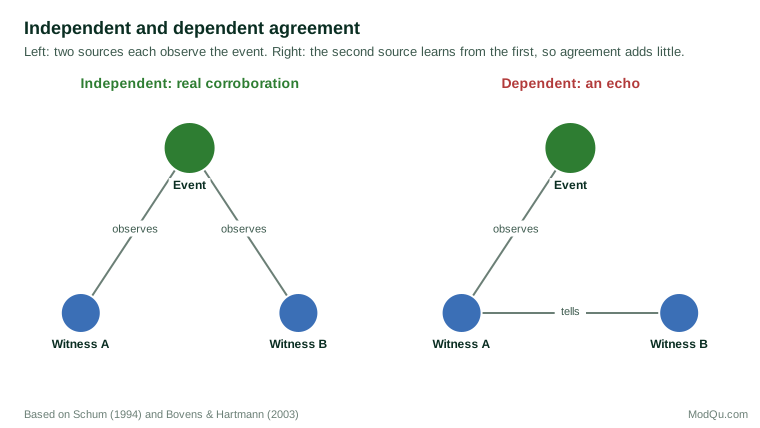
Suppose each of two witnesses is only moderately reliable: either might be wrong. If they are independent, the chance that both are wrong in exactly the same way is much smaller than the chance that either is wrong on their own. When they agree on a specific detail, the most plausible explanation is that the detail is true. Schum (1994) analyses this formally, distinguishing corroboration, where several sources report the same event, from convergence, where different events each point towards the same conclusion. Both gain their force from independence. Cohen (1977) made a similar argument in his analysis of legal proof, noting that agreement between independent witnesses can produce a high degree of support even when each witness alone would not.
Philosophers working on the logic of evidence have shown that this effect depends heavily on assumptions about independence and reliability. Bovens and Hartmann (2003) demonstrate that the extra confidence produced by agreement falls sharply as the sources become less independent, and Olsson (2005) argues that coherence among reports supports truth only under fairly specific conditions. The practical message is clear: the value of agreement lies not in the number of sources, but in their independence.
Forms of independence
Sources can depend on one another in several ways:
- Shared origin. Two news reports that both rely on the same press release are one source, not two.
- Contamination. A witness who hears another witness's account, sees media coverage or is shown a suspect's photograph may incorporate that information into their own memory. Gabbert et al. (2003) found that when pairs of witnesses who had seen slightly different versions of an event discussed it, many later reported details that only their partner had seen.
- Common method. Two forensic tests carried out by the same laboratory using the same flawed procedure may agree because they share the same error.
- Expectation. An expert who knows what result the investigators expect may be influenced towards it, so that the expert's conclusion echoes the investigators' theory rather than independently testing it (Kassin et al., 2013). Kukucka and Kassin (2014) showed that people who were told a suspect had confessed were more likely to judge that handwriting samples matched.
- Circular reporting. In intelligence work, the same piece of information can travel through several channels and arrive looking like multiple confirmations.
When corroboration has misled
False confessions with "insider" details
A confession that contains details only the offender could know seems to be strongly corroborated by the crime scene. Garrett (2010) examined the first 40 cases in which DNA testing exonerated people who had falsely confessed in the United States. In 38 of them, the confession included specific, non-public details about the crime, which were presented at trial as proof that the confession was genuine. The likely explanation is that the details were communicated to the suspect, deliberately or inadvertently, during questioning. The apparent corroboration was in fact contamination.
Intelligence on weapons of mass destruction
Official reviews of the intelligence that preceded the 2003 invasion of Iraq found that assessments had relied on a small number of sources whose reports were treated as more independent, and more reliable, than they were. The United Kingdom's Butler Review found that some intelligence was based on sources whose reporting was later withdrawn or found to be unreliable (Review of Intelligence on Weapons of Mass Destruction, 2004). The United States commission that examined the same issue found that much of the reporting on mobile biological weapons laboratories traced back to a single source, and that its reliability had not been adequately tested (Commission on the Intelligence Capabilities of the United States Regarding Weapons of Mass Destruction, 2005).
Corroboration in law
Some legal systems make corroboration a formal requirement. Scots criminal law has long required that the essential facts of a case be proved by evidence from at least two independent sources. The Carloway Review (2011) recommended abolishing the general requirement, arguing that it prevented some meritorious prosecutions and that the quality of evidence matters more than its quantity; the recommendation proved controversial and was not implemented in full. In other common law systems, corroboration is no longer a general requirement, but judges may warn juries about relying on uncorroborated evidence from certain kinds of witnesses.
How to test corroboration
Investigators can assess whether apparent agreement is real by asking a series of questions:
- How did each source come to know what it reports? Trace each account back to its origin: direct observation, a document, a conversation or a media report.
- Could the sources have influenced each other? Find out whether witnesses spoke before giving statements, whether documents share an underlying data source, and whether experts were told the expected result.
- Are the details specific? Agreement on general features, such as "a tall man", adds little. Agreement on specific, unusual details that would be hard to guess is much more persuasive.
- Was the information already public? A detail that appeared in the news cannot corroborate a later account that contains it.
- Do the sources disagree on anything? Perfect agreement on every detail can be a warning sign of contamination or collusion, since independent honest accounts usually differ in minor respects.
- Is there a common point of failure? If both sources depend on the same instrument, database, laboratory or person, an error there will affect both.
Lagnado et al. (2013) describe recurring patterns of evidential reasoning, including the dependency between reports, that can be represented explicitly when cases are analysed formally. In everyday practice, a simple diagram showing how each source obtained its information often reveals dependencies that are invisible in a list of statements.
Investigators should also design their work to preserve independence. Witnesses should be separated and interviewed before they can compare accounts. Experts should be given only the information they need. Holdback evidence, details of the crime deliberately withheld from the public and from suspects, allows later confessions or tips to be tested. And verification by a second examiner should be blind to the first examiner's conclusion.
A worked example
Consider a hypothetical workplace complaint. An employee alleges that a team leader made a threatening remark at a meeting. Three colleagues who attended later give statements that support the complaint. On the face of it, the allegation is corroborated three times.
The investigator traces each account. The first colleague says they heard the remark directly. The second says they were in the room but did not hear it clearly, and learned what was said when the complainant described it afterwards. The third says they did not attend the meeting at all but "heard about it from everyone". The three statements came in a single email chain, in which the complainant's original description was quoted at the top. Of the three apparent corroborations, only one is independent evidence of what was said; the other two mainly confirm that the complainant told people about it.
The investigator then looks for evidence with a different origin. The meeting was held online, and the platform's automatic transcript is available. It records a sharp exchange but not the words alleged. A fourth attendee, interviewed separately and before seeing any statements, recalls the exchange and describes the remark in terms similar to, but milder than, the complaint. The picture that emerges is more nuanced than either the complaint or the team leader's denial, and it rests on sources whose independence can be shown.
Corroboration and confirmation bias
Corroboration interacts with confirmation bias in a particular way. Once investigators believe a theory, they tend to seek and give weight to information that supports it (Nickerson, 1998). Sources that agree with the theory are readily accepted as corroboration, while sources that disagree are scrutinised for flaws. A disciplined approach applies the same independence tests to all sources, whichever way they point, and treats unexplained disagreement as information to be explained rather than noise to be dismissed.
Corroboration beyond investigations
Journalists use corroboration as a core verification method. Many newsrooms expect important facts to be confirmed by more than one independent source, and verification guides stress tracing material back to its original creator rather than counting how many accounts repeat it (Kovach & Rosenstiel, 2014; Silverman, 2014). Intelligence analysts are trained to consider whether apparently separate reports share a source and whether some might be deliberate deception (Heuer, 1999).
Science treats replication as a form of corroboration. A finding reproduced by independent teams using new data deserves more confidence than one confirmed repeatedly by the original team. A large collaborative effort to repeat 100 published psychology experiments found that many effects were weaker or absent when tested independently (Open Science Collaboration, 2015), which shows how much apparent confirmation can depend on shared methods and expectations.
The same principle applies to research and business intelligence. A trend that appears in a survey, in sales data and in customer complaints is far more credible than one that appears only in a single dataset, provided the three were collected independently. When they all draw on the same customer list or the same flawed classification, their agreement says less than it seems.
Conclusion
Corroboration is one of the strongest tools an investigator has, and one of the easiest to misuse. Its strength comes from independence, not from the number of sources. Every time agreement is cited as support for a conclusion, the investigator should be able to show how each source came to its knowledge and why the sources could not simply be echoing one another.
References
Bovens, L., & Hartmann, S. (2003). Bayesian epistemology. Oxford University Press.
Carloway Review. (2011). The Carloway Review: Report and recommendations. Scottish Government.
Cohen, L. J. (1977). The probable and the provable. Clarendon Press.
Commission on the Intelligence Capabilities of the United States Regarding Weapons of Mass Destruction. (2005). Report to the President of the United States. U.S. Government Printing Office.
Gabbert, F., Memon, A., & Allan, K. (2003). Memory conformity: Can eyewitnesses influence each other's memories for an event? Applied Cognitive Psychology, 17(5), 533–543. https://doi.org/10.1002/acp.885
Garrett, B. L. (2010). The substance of false confessions. Stanford Law Review, 62(4), 1051–1119.
Heuer, R. J., Jr. (1999). Psychology of intelligence analysis. Center for the Study of Intelligence, Central Intelligence Agency.
Kassin, S. M., Dror, I. E., & Kukucka, J. (2013). The forensic confirmation bias: Problems, perspectives, and proposed solutions. Journal of Applied Research in Memory and Cognition, 2(1), 42–52. https://doi.org/10.1016/j.jarmac.2013.01.001
Kovach, B., & Rosenstiel, T. (2014). The elements of journalism: What newspeople should know and the public should expect (3rd ed.). Three Rivers Press.
Kukucka, J., & Kassin, S. M. (2014). Do confessions taint perceptions of handwriting evidence? An empirical test of the forensic confirmation bias. Law and Human Behavior, 38(3), 256–270. https://doi.org/10.1037/lhb0000066
Lagnado, D. A., Fenton, N., & Neil, M. (2013). Legal idioms: A framework for evidential reasoning. Argument & Computation, 4(1), 46–63. https://doi.org/10.1080/19462166.2012.682656
Nickerson, R. S. (1998). Confirmation bias: A ubiquitous phenomenon in many guises. Review of General Psychology, 2(2), 175–220. https://doi.org/10.1037/1089-2680.2.2.175
Olsson, E. J. (2005). Against coherence: Truth, probability, and justification. Oxford University Press.
Open Science Collaboration. (2015). Estimating the reproducibility of psychological science. Science, 349(6251), aac4716. https://doi.org/10.1126/science.aac4716
Review of Intelligence on Weapons of Mass Destruction. (2004). Report of a committee of Privy Counsellors (HC 898). The Stationery Office.
Schum, D. A. (1994). The evidential foundations of probabilistic reasoning. Wiley.
Silverman, C. (Ed.). (2014). Verification handbook: A definitive guide to verifying digital content for emergency coverage. European Journalism Centre.