
Investigation · Scientific and technical investigation
Accident Investigation: Lessons From Aviation Safety
Commercial aviation became one of the safest forms of transport partly because of the way it investigates accidents. This article explains how air accident investigations are organised, the methods and models they use, why they focus on learning rather than blame, and what other fields can learn from them.
Commercial air travel is today one of the safest ways to travel. This was not always so. In the early decades of jet travel, fatal accidents were far more frequent relative to the number of flights. The improvement has many causes, including better aircraft, engines, navigation and training, but one of the most important is a system for investigating accidents and serious incidents and turning the findings into changes across the industry. Syed (2015) uses aviation as the leading example of a field that learns systematically from failure, contrasting it with fields in which errors are hidden or attributed to individuals.
This article explains how air accident investigations are organised, the methods used to find out what happened, the models used to understand why, and the principles that make the system effective. It ends with lessons for other kinds of investigation.
An international system
Air accident investigation is governed by an international framework. Annex 13 to the Convention on International Civil Aviation sets out standards for investigating accidents and serious incidents (International Civil Aviation Organization [ICAO], 2020). The state in which an accident occurs leads the investigation, and the states of the aircraft's registration, operator, design and manufacture have the right to take part. This ensures that the people with the most relevant knowledge, including the aircraft's manufacturer, contribute to the investigation.
Annex 13 states that the sole objective of an investigation is the prevention of future accidents and incidents, and that it is not the purpose of this activity to apportion blame or liability. Investigations are carried out by bodies that are independent of the aviation authorities that regulate airlines and of any party whose interests could conflict with the investigation, such as the National Transportation Safety Board (NTSB) in the United States and the Bureau d'Enquêtes et d'Analyses (BEA) in France. In the European Union, a regulation requires each member state to have an independent permanent investigation authority and protects certain safety information from being used for other purposes (Regulation (EU) No 996/2010, 2010).
How an investigation proceeds
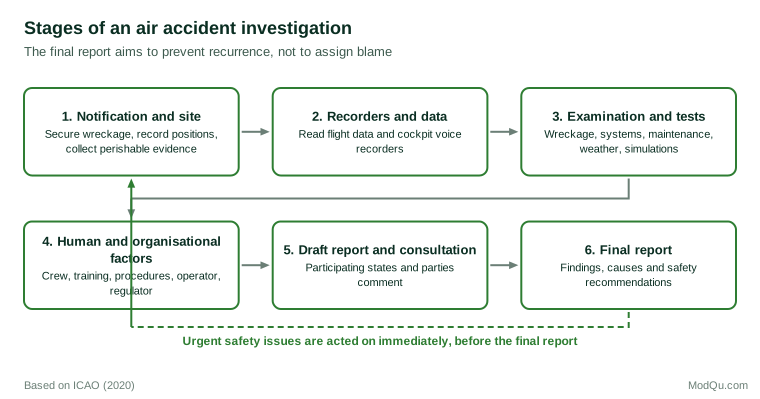
Site and evidence. Investigators arrive at the accident site as soon as possible to secure the wreckage and gather evidence that may be lost, such as marks on the ground, the positions of parts, fluids and witness memories. The distribution of wreckage can show whether an aircraft broke up in the air or on impact.
Flight recorders. Commercial aircraft carry a flight data recorder, which records hundreds or thousands of parameters such as altitude, speed, control positions and engine settings, and a cockpit voice recorder, which records the crew's conversation and sounds in the cockpit. These "black boxes" are built to survive severe impacts and fires, and they are often the most important evidence in an investigation.
Technical examination. Components are examined in laboratories for signs of fatigue cracking, corrosion, fire or manufacturing defects. Maintenance records, weather data, air traffic control recordings and radar data are gathered. Investigators may use simulators to reproduce the flight.
Human and organisational factors. Investigators examine the crew's training, experience, rest and workload; the design of the cockpit and procedures; the airline's policies and safety culture; and the oversight provided by regulators.
Reporting. A draft final report is sent to participating states and parties for comment, and the final report is published. It sets out the facts, analysis, findings and causes, and safety recommendations addressed to manufacturers, airlines, regulators or others.
The search for AF447
The investigation into the loss of Air France flight 447 shows how demanding this work can be. In June 2009, an Airbus A330 flying from Rio de Janeiro to Paris disappeared over the Atlantic Ocean with 228 people on board. Some wreckage was recovered within days, but the flight recorders lay on the ocean floor at a depth of nearly 4,000 metres and were not found until 2011, after several search phases. The recorders showed that the aircraft's speed sensors had briefly frozen in ice crystals, disconnecting the autopilot, and that the crew, surprised and confused by the situation, had made control inputs that caused the aircraft to stall and fall into the sea. The final report made recommendations on sensors, training in manual flying at high altitude, the handling of alarms and cockpit displays (Bureau d'Enquêtes et d'Analyses [BEA], 2012).
From individual error to systems
Early accident investigations often concluded that the pilot had made an error. Modern investigation still identifies errors, but treats them as the starting point of analysis rather than its conclusion. The question becomes why the error occurred and why the system did not catch it.
Reason (1990, 1997) developed the influential idea that accidents in complex organisations arise when several weaknesses line up. "Active failures", such as errors by pilots or mechanics, have immediate effects, while "latent conditions", such as poor design, inadequate training, time pressure and weak oversight, lie dormant in the system until they combine with active failures. His model, often illustrated as layers of Swiss cheese whose holes occasionally align, directs investigators to look at every layer of defence.
Shappell and Wiegmann (2000) built on Reason's ideas to develop the Human Factors Analysis and Classification System (HFACS), which classifies the human contributions to an accident at four levels.
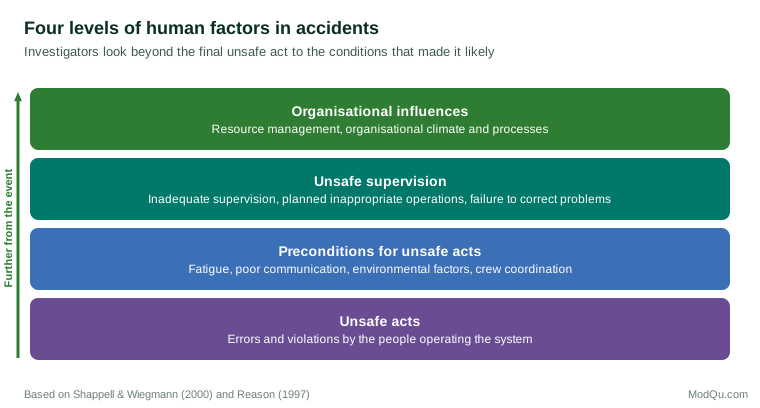
Wiegmann and Shappell (2003) applied HFACS to large numbers of aviation accidents and showed that it could reveal patterns, such as the frequency of decision errors and the role of crew coordination, that individual reports did not make obvious.
Other researchers have argued that even these models are too linear. Leveson (2011) proposes treating safety as a problem of control in a complex system, in which accidents result from unsafe interactions among components, including people, software and organisations, rather than from chains of failures. Dekker (2014) argues that "human error" is a label that hides more than it explains, and that investigators should try to understand why people's actions made sense to them at the time, given what they knew and the pressures they faced. Woods et al. (2010) similarly argue that error is a symptom of deeper problems in the design of systems and work.
Learning beyond the report
Investigation reports are only valuable if their recommendations lead to change. One of the clearest examples is crew resource management. In 1978, a United Airlines DC-8 ran out of fuel and crashed near Portland, Oregon, while the crew dealt with a landing gear problem; the flight engineer had warned about fuel, but the captain did not act in time. The NTSB found that the captain had failed to monitor the fuel state and respond to the crew's advisories (National Transportation Safety Board [NTSB], 1979). This and similar accidents led to training in communication, teamwork, assertiveness and decision-making for flight crews. Helmreich et al. (1999) describe how such training developed over several generations and became standard throughout commercial aviation.
Aviation also learns from events that did not cause accidents. Confidential reporting systems allow pilots, controllers and mechanics to report errors and hazards without fear of punishment. The United States Aviation Safety Reporting System, run by NASA as an independent body since 1976, receives many thousands of reports a year and uses them to identify emerging problems (Reynard et al., 1986). Macrae (2014) studied how airline safety teams analyse such reports and found that their skill lay in recognising, from small and ambiguous signals, the weaknesses that could one day contribute to an accident. Safety management systems, now required by ICAO, make this kind of continuous monitoring a formal responsibility of airlines and other organisations (ICAO, 2018).
Just culture
Reporting systems and honest investigation depend on people trusting that they will not be punished for ordinary mistakes. Aviation has developed the idea of a "just culture" to describe this balance. Reason (1997) argued that an organisation cannot have an effective reporting culture unless people believe they will be treated fairly, and that fairness requires a clear line between acceptable and unacceptable behaviour. Honest errors and the reasonable actions of people working in difficult conditions should not be punished; reckless conduct, deliberate violations and wilful damage can be.
Drawing this line is difficult. Dekker (2014) warns that hindsight makes errors look more obvious and more culpable than they were, and that the question of where the line falls is itself a matter of judgement and power within an organisation. In practice, organisations with a just culture involve staff and their representatives in deciding how incidents will be handled, separate safety investigations from disciplinary processes, and explain their decisions openly. The result is more reports, more honest accounts during investigations, and therefore more opportunities to find and fix weaknesses before they cause harm.
When the system fails
Aviation's system is not perfect. The two crashes of Boeing 737 MAX aircraft, Lion Air flight 610 in Indonesia in October 2018 and Ethiopian Airlines flight 302 in March 2019, killed 346 people. The Indonesian investigation found that a flight control system had repeatedly pushed the aircraft's nose down in response to a faulty sensor, and that its design, the information given to pilots and the certification process had all contributed (Komite Nasional Keselamatan Transportasi [KNKT], 2019). A United States congressional investigation concluded that the crashes were the result of a series of faulty technical assumptions by the manufacturer, a lack of transparency, and insufficient oversight by the Federal Aviation Administration (House Committee on Transportation and Infrastructure, 2020). The cases showed how commercial and organisational pressures can weaken the defences that investigation is meant to strengthen, and they led to major changes in the aircraft, in pilot training and in certification.
Similar lessons have emerged in other fields that adopted aviation's methods. The investigation of the 2003 loss of the space shuttle Columbia found that NASA's organisational culture and decision-making had contributed as much as the technical failure, echoing the earlier analysis of the 1986 Challenger disaster by Vaughan (1996), who described how deviations from safety standards had gradually come to be accepted as normal (Columbia Accident Investigation Board [CAIB], 2003). Perrow (1984) had argued earlier that in some highly complex and tightly coupled systems, accidents are to be expected however carefully they are managed, which is a reason for investigators to consider whether a system's design itself is the problem.
Lessons for other investigations
Aviation's experience suggests several principles that apply to investigations in healthcare, industry, transport, finance and elsewhere:
- Separate learning from blame. Investigations aimed at prevention should be independent of disciplinary and legal processes, so that people can speak honestly.
- Preserve evidence quickly and systematically. Perishable evidence, including memories, is lost fast.
- Look beyond the last error. Ask why the error occurred and why defences did not catch it, at every level of the organisation.
- Learn from near misses. Confidential reporting of incidents that did not cause harm provides far more opportunities to learn than accidents alone.
- Make specific, tracked recommendations. Findings are useful only if they lead to changes that someone is responsible for implementing.
- Share lessons widely. Publishing reports allows the whole industry, not just one organisation, to learn.
A short example
The following hypothetical case shows these principles applied outside aviation. A hospital patient receives ten times the intended dose of a drug and becomes seriously ill. An initial review blames the nurse who gave the dose. An independent investigation, modelled on aviation methods, interviews the nurse without threat of discipline and examines the circumstances. It finds that the drug was stocked in two strengths in similar packaging, that the electronic prescribing system displayed the dose in a confusing format, that the ward was short of staff that night, and that two similar near misses had been reported by other staff in the previous year without action. Its recommendations address packaging, the software display, staffing and the handling of incident reports, rather than only the nurse's actions. Similar errors elsewhere in the hospital are prevented.
Conclusion
Air accident investigation shows how a field can become dramatically safer by investigating failures systematically and acting on the results. Its key features are independence, a focus on prevention rather than blame, rigorous collection of evidence, models that look beyond individual error to the organisation and system, confidential reporting of near misses, and recommendations that are tracked and shared. Failures such as the 737 MAX crashes show that these defences can be weakened, but also that thorough investigation can identify what went wrong and drive change. These principles offer a model for any field that wants to learn from its mistakes.
References
Bureau d'Enquêtes et d'Analyses pour la sécurité de l'aviation civile. (2012). Final report on the accident on 1st June 2009 to the Airbus A330-203 registered F-GZCP operated by Air France flight AF 447 Rio de Janeiro–Paris. BEA.
Columbia Accident Investigation Board. (2003). Report (Vol. 1). National Aeronautics and Space Administration.
Dekker, S. (2014). The field guide to understanding 'human error' (3rd ed.). Ashgate.
Helmreich, R. L., Merritt, A. C., & Wilhelm, J. A. (1999). The evolution of crew resource management training in commercial aviation. The International Journal of Aviation Psychology, 9(1), 19–32. https://doi.org/10.1207/s15327108xap0901_2
House Committee on Transportation and Infrastructure. (2020). Final committee report: The design, development & certification of the Boeing 737 MAX. U.S. House of Representatives.
International Civil Aviation Organization. (2020). Annex 13 to the Convention on International Civil Aviation: Aircraft accident and incident investigation (12th ed.). ICAO.
International Civil Aviation Organization. (2018). Safety management manual (Doc 9859, 4th ed.). ICAO.
Komite Nasional Keselamatan Transportasi. (2019). Aircraft accident investigation report: PT. Lion Mentari Airlines Boeing 737-8 (MAX); PK-LQP; Tanjung Karawang, West Java, Republic of Indonesia; 29 October 2018. KNKT.
Leveson, N. G. (2011). Engineering a safer world: Systems thinking applied to safety. MIT Press.
Macrae, C. (2014). Close calls: Managing risk and resilience in airline flight safety. Palgrave Macmillan.
National Transportation Safety Board. (1979). Aircraft accident report: United Airlines, Inc., McDonnell-Douglas DC-8-61, N8082U, Portland, Oregon, December 28, 1978 (NTSB-AAR-79-7). NTSB.
Perrow, C. (1984). Normal accidents: Living with high-risk technologies. Basic Books.
Reason, J. (1990). Human error. Cambridge University Press.
Reason, J. (1997). Managing the risks of organizational accidents. Ashgate.
Regulation (EU) No 996/2010 of the European Parliament and of the Council of 20 October 2010 on the investigation and prevention of accidents and incidents in civil aviation. (2010). Official Journal of the European Union, L 295, 35–50.
Reynard, W. D., Billings, C. E., Cheaney, E. S., & Hardy, R. (1986). The development of the NASA aviation safety reporting system (NASA Reference Publication 1114). National Aeronautics and Space Administration.
Shappell, S. A., & Wiegmann, D. A. (2000). The human factors analysis and classification system—HFACS (DOT/FAA/AM-00/7). Federal Aviation Administration.
Syed, M. (2015). Black box thinking: Why most people never learn from their mistakes—but some do. Portfolio.
Vaughan, D. (1996). The Challenger launch decision: Risky technology, culture, and deviance at NASA. University of Chicago Press.
Wiegmann, D. A., & Shappell, S. A. (2003). A human error approach to aviation accident analysis: The human factors analysis and classification system. Ashgate.
Woods, D. D., Dekker, S., Cook, R., Johannesen, L., & Sarter, N. (2010). Behind human error (2nd ed.). Ashgate.