
Investigation · Scientific and technical investigation
John Snow and the Broad Street Pump: The First Modern Investigation of Disease
In 1854, the London physician John Snow traced a deadly cholera outbreak to a single water pump and showed, through a large natural experiment, that cholera spread through contaminated water. This article explains what Snow did, why his methods mattered, how the story has been simplified, and what it still teaches investigators.
In late August 1854, cholera struck the Soho district of London with terrible speed. Within ten days, more than 500 people living within a few hundred metres of one another had died. The physician John Snow, who lived nearby, suspected that the cause was water from a public pump on Broad Street. He collected information about the deaths, persuaded the local authorities to remove the pump's handle, and later published the evidence in a book that also reported a much larger study of London's water supply (Snow, 1855). Snow's work is often described as the founding investigation of modern epidemiology. It is also a model of how to investigate any problem: by forming a clear hypothesis, gathering evidence systematically, testing the hypothesis against alternatives and acting on the results.
This article explains the scientific context, what Snow did at Broad Street and in his study of London's water companies, how his work was received, and why it remains a reference point for investigators today.
Cholera and the miasma theory
Cholera, a disease that causes severe diarrhoea and can kill within hours through dehydration, reached Britain in 1831 and returned in several epidemics. At the time, most doctors and officials believed that diseases such as cholera were caused by "miasma", poisonous air arising from decaying organic matter, sewage and filth. The theory was not unreasonable: cholera was most common in crowded, dirty and foul-smelling areas. It led to important sanitary reforms, but it pointed to the wrong mechanism.
William Farr, the leading statistician at the General Register Office, analysed cholera deaths in the 1848–49 epidemic and found that mortality was strongly related to the elevation of districts above the River Thames: low-lying districts had much higher death rates. He interpreted this as support for the miasma theory, since low-lying areas were thought to have more polluted air (Farr, 1852). Eyler (2001) notes that Farr's statistical work was careful and influential, and that he later came to accept the importance of water.
Snow had developed a different hypothesis. In the first edition of his essay on cholera in 1849, he argued that because the disease first affected the digestive system rather than the lungs, its cause must be swallowed, not breathed. He proposed that a living agent in the evacuations of cholera patients contaminated water and food, and that people became ill by ingesting it (Snow, 1849). His evidence at that stage was suggestive but not conclusive, and most authorities were unconvinced.
The Broad Street outbreak
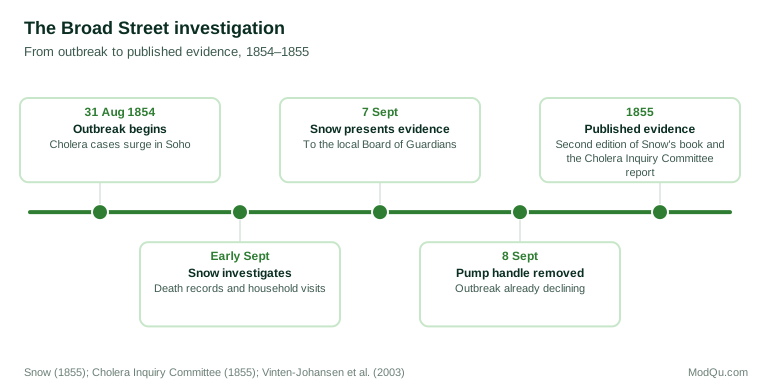
The Soho outbreak began on 31 August 1854. Snow, who suspected the Broad Street pump, obtained a list of deaths from the General Register Office and visited the homes of the people who had died. He found that nearly all the deaths had occurred near the pump, and that in many cases the dead had drunk its water. He also investigated the exceptions, which proved especially informative (Snow, 1855).
The exceptions were where Snow's reasoning was strongest. Workers at a nearby brewery, who were given beer and had their own well, were largely spared. A workhouse close to the pump, with more than 500 inmates, had few deaths; it had its own well. On the other hand, a widow living in Hampstead, far from Soho, died of cholera; Snow learned that she had preferred the taste of the Broad Street water and had it delivered to her home, and that her niece, who visited her and drank the water, also died. Each of these cases tested the hypothesis: people near the pump who did not drink its water were protected, while people far away who did drink it became ill.
On 7 September, Snow presented his evidence to the Board of Guardians of St James's parish, and on 8 September the pump handle was removed. Snow himself acknowledged that the outbreak had already been declining, partly because many residents had fled and partly perhaps because the contamination had diminished, so the removal of the handle could not by itself prove his case (Snow, 1855).
Snow later prepared a map showing each death as a bar at its address, with the locations of the public pumps. The map, reproduced in countless textbooks, shows deaths clustering around the Broad Street pump. Koch (2005) and Tufte (1997) discuss how the map presents spatial evidence, and Snow also drew a line showing the points that were closer by walking distance to the Broad Street pump than to any other, a technique that anticipated later methods of spatial analysis.
A parish inquiry and a curate's evidence
The local parish appointed its own inquiry. One of its members, the Reverend Henry Whitehead, a curate in the parish, initially doubted Snow's theory and set out to disprove it. He interviewed residents systematically and found evidence that convinced him Snow was right. He also identified what may have started the outbreak: a baby living at 40 Broad Street had fallen ill with diarrhoea just before the outbreak, and her mother had washed the nappies and emptied the water into a cesspool only a few feet from the pump's well (Cholera Inquiry Committee, 1855; Whitehead, 1865). Excavation found that the cesspool was leaking into the well.
The Cholera Inquiry Committee's report accepted that the pump water had been the cause of the outbreak, although the national General Board of Health's own inquiry continued to favour atmospheric explanations. Paneth et al. (1998) describe how the official and unofficial investigations reached different conclusions and how the parish inquiry, combining Snow's analysis with Whitehead's local knowledge, produced the more convincing account.
The Grand Experiment
Snow's most powerful evidence did not come from Broad Street at all, but from a larger study of south London that he called the "Grand Experiment". Two private companies supplied water to many of the same districts, with their pipes running down the same streets, so that neighbouring houses might receive water from different companies. In 1852, the Lambeth Company had moved its intake upstream on the Thames, above the main sewage outfalls of London, while the Southwark and Vauxhall Company continued to draw water from the river in central London, where it was heavily contaminated with sewage.
Snow realised that this created what would now be called a natural experiment. Households were not chosen to receive one company's water rather than the other's because of their wealth, location or habits; in many streets, the choice had been made years earlier by landlords or the companies themselves. If cholera was spread by contaminated water, the customers of the Southwark and Vauxhall Company should have much higher death rates than those of the Lambeth Company, even when they lived side by side.
To test this, Snow identified the water supplier for every house where a cholera death occurred during the 1854 epidemic, often by testing the salt content of the water, which differed between the two sources. He then compared death rates.
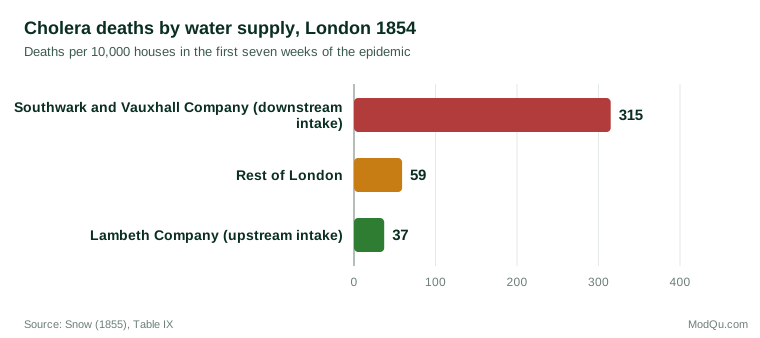
The results were striking. In the first seven weeks of the epidemic, houses supplied by the Southwark and Vauxhall Company had 315 deaths per 10,000 houses, compared with 37 per 10,000 for houses supplied by the Lambeth Company, a difference of more than eight times (Snow, 1855). Because the two groups of customers were so similar in other respects, Snow argued, the difference could only be explained by the water.
Freedman (1991) used Snow's study as the leading example of what he called "shoe leather" research: careful, labour-intensive collection of data designed to rule out alternative explanations, which he contrasted favourably with statistical modelling that tries to adjust for differences after the fact. Dunning (2012) cites the Grand Experiment as an early and exemplary natural experiment, in which circumstances rather than the investigator assign the exposure in a way that is close to random.
Reception and vindication
Snow's conclusions were not widely accepted in his lifetime. Officials and many physicians continued to favour the miasma theory, and Snow died in 1858. In the same year as the Broad Street outbreak, the Italian anatomist Filippo Pacini described a comma-shaped organism in the intestines of cholera victims (Pacini, 1854), but his work attracted little notice. In 1884, the German scientist Robert Koch identified the cholera bacterium and confirmed its transmission through contaminated water (Koch, 1884).
In the meantime, London had begun to build a new sewerage system designed by Joseph Bazalgette, prompted in part by the "Great Stink" of 1858, when the smell of the Thames became unbearable. The system diverted sewage downstream of the city and, although built partly on miasmatic reasoning, greatly reduced the contamination of the water supply (Halliday, 1999). When cholera struck east London in 1866, Farr investigated and traced it to water from a company that had been drawing from an unfiltered source, adopting Snow's reasoning (Eyler, 2001).
Myth and history
The Broad Street story is often told in a simplified form: Snow drew a map, saw that deaths clustered around a pump, removed the handle and stopped the epidemic. Historians have shown that this version is misleading. Brody et al. (2000) found that the famous map was produced after the outbreak, to illustrate conclusions Snow had already reached, rather than as the tool by which he discovered the source. McLeod (2000) argued that the myth of Snow as a pioneering medical geographer overstates the role of mapping in his work. Koch and Denike (2009) remade Snow's map with modern methods and showed that the spatial evidence supports his conclusion, while also explaining why some contemporary critics were not persuaded by the map alone.
The real lesson is in Snow's reasoning rather than his map: a clear hypothesis drawn from the nature of the disease, systematic collection of data, attention to exceptions, a comparison designed to rule out alternative explanations, and willingness to act before the explanation was universally accepted.
Lessons for investigators
Vinten-Johansen et al. (2003), in their biography of Snow, emphasise that he combined clinical knowledge, careful observation and a willingness to collect his own data. Hempel (2006) and Johnson (2006) describe how Snow worked against the prevailing view of the medical establishment. Several lessons stand out for investigators in any field.
- Start from mechanism. Snow's hypothesis came from reasoning about how the disease affected the body. A plausible mechanism helps an investigator decide what evidence to look for.
- Examine the exceptions. The brewery workers, the workhouse and the Hampstead widow were more informative than the many cases that fitted the obvious pattern.
- Compare like with like. The Grand Experiment was persuasive because the two groups differed mainly in their water supply. Good comparisons rule out alternative explanations before analysis rather than after.
- Use local knowledge. Whitehead's knowledge of the parish and its residents found the likely origin of the contamination, which Snow's analysis alone could not.
- Act on the balance of evidence. Snow persuaded the authorities to remove the pump handle on evidence that was strong but not complete. Waiting for certainty would have risked further deaths.
- Distinguish association from cause. Snow's evidence met many of the considerations that Hill (1965) later proposed for judging causation, including strength, consistency, temporality and a plausible mechanism.
Conclusion
John Snow's investigation of cholera combined a clear hypothesis, painstaking data collection, attention to exceptions and an ingenious natural experiment. It showed, decades before the cholera bacterium was confirmed, that the disease was spread by contaminated water. Although the familiar story of the pump handle and the map has been simplified over time, the underlying method remains a model for epidemiologists and for investigators of every kind: reason from mechanism, test hypotheses against well-chosen comparisons, take exceptions seriously and act on the weight of the evidence.
References
Brody, H., Rip, M. R., Vinten-Johansen, P., Paneth, N., & Rachman, S. (2000). Map-making and myth-making in Broad Street: The London cholera epidemic, 1854. The Lancet, 356(9223), 64–68. https://doi.org/10.1016/S0140-6736(00)02442-9
Cholera Inquiry Committee. (1855). Report on the cholera outbreak in the parish of St. James, Westminster, during the autumn of 1854. J. Churchill.
Dunning, T. (2012). Natural experiments in the social sciences: A design-based approach. Cambridge University Press.
Eyler, J. M. (2001). The changing assessments of John Snow's and William Farr's cholera studies. Sozial- und Präventivmedizin, 46(4), 225–232. https://doi.org/10.1007/BF01593177
Farr, W. (1852). Report on the mortality of cholera in England, 1848–49. Her Majesty's Stationery Office.
Freedman, D. A. (1991). Statistical models and shoe leather. Sociological Methodology, 21, 291–313. https://doi.org/10.2307/270939
Halliday, S. (1999). The great stink of London: Sir Joseph Bazalgette and the cleansing of the Victorian metropolis. Sutton.
Hempel, S. (2006). The medical detective: John Snow and the mystery of cholera. Granta.
Hill, A. B. (1965). The environment and disease: Association or causation? Proceedings of the Royal Society of Medicine, 58(5), 295–300. https://doi.org/10.1177/003591576505800503
Johnson, S. (2006). The ghost map: The story of London's most terrifying epidemic—and how it changed science, cities, and the modern world. Riverhead Books.
Koch, R. (1884). Über die Cholerabakterien. Deutsche Medizinische Wochenschrift, 10, 725–728.
Koch, T. (2005). Cartographies of disease: Maps, mapping, and medicine. ESRI Press.
Koch, T., & Denike, K. (2009). Crediting his critics' concerns: Remaking John Snow's map of Broad Street cholera, 1854. Social Science & Medicine, 69(8), 1246–1251. https://doi.org/10.1016/j.socscimed.2009.07.046
McLeod, K. S. (2000). Our sense of Snow: The myth of John Snow in medical geography. Social Science & Medicine, 50(7–8), 923–935. https://doi.org/10.1016/S0277-9536(99)00345-7
Pacini, F. (1854). Osservazioni microscopiche e deduzioni patologiche sul cholera asiatico. Gazzetta Medica Italiana: Toscana.
Paneth, N., Vinten-Johansen, P., Brody, H., & Rip, M. (1998). A rivalry of foulness: Official and unofficial investigations of the London cholera epidemic of 1854. American Journal of Public Health, 88(10), 1545–1553. https://doi.org/10.2105/AJPH.88.10.1545
Snow, J. (1849). On the mode of communication of cholera. John Churchill.
Snow, J. (1855). On the mode of communication of cholera (2nd ed.). John Churchill.
Tufte, E. R. (1997). Visual explanations: Images and quantities, evidence and narrative. Graphics Press.
Vinten-Johansen, P., Brody, H., Paneth, N., Rachman, S., & Rip, M. (2003). Cholera, chloroform, and the science of medicine: A life of John Snow. Oxford University Press.
Whitehead, H. (1865). The Broad Street pump: An episode in the cholera epidemic of 1854. Macmillan's Magazine, 13, 113–122.