
Investigation · Scientific and technical investigation
Root Cause Analysis Methods: Fishbone, Fault Tree and Five Whys
Root cause analysis tries to find the underlying reasons why a problem occurred, so that it can be prevented rather than merely fixed. This article explains three widely used methods, the fishbone diagram, fault tree analysis and the five whys, with their strengths and weaknesses.
When something goes wrong, such as a product defect, a hospital error or a system failure, the obvious response is to fix the immediate problem. Root cause analysis (RCA) asks a further question: why did it happen, and what underlying conditions must change to stop it happening again? Andersen and Fagerhaug (2006) describe RCA as a structured search for the most basic causes that, if corrected, would prevent recurrence.
Many methods exist. Three of the most widely used are the fishbone diagram, fault tree analysis and the five whys. Each organises the search for causes in a different way.
The fishbone diagram
The fishbone diagram, also called a cause-and-effect or Ishikawa diagram, was popularised by the Japanese quality expert Kaoru Ishikawa (1976). The problem is written at the "head" of the fish, and the main categories of possible causes form the "bones", such as methods, machines, materials, people, measurement and environment. Team members brainstorm specific causes under each category.
The diagram's strength is breadth. It encourages a team to consider many kinds of cause rather than settling on the first plausible one, and it makes the team's thinking visible. Its weakness is that it lists possible causes without testing them or showing how they interact. Each branch is a hypothesis to be checked against data, not a finding.
Fault tree analysis
Fault tree analysis works backwards from a defined undesired event, the "top event", through the combinations of lower-level events that could cause it. Events are linked by logic gates: an "OR" gate means that any one of the events below is enough to cause the event above, while an "AND" gate means that all must occur together. The method was developed in the early 1960s for missile safety and has become standard in aerospace, nuclear power and other high-hazard industries (Vesely et al., 1981).
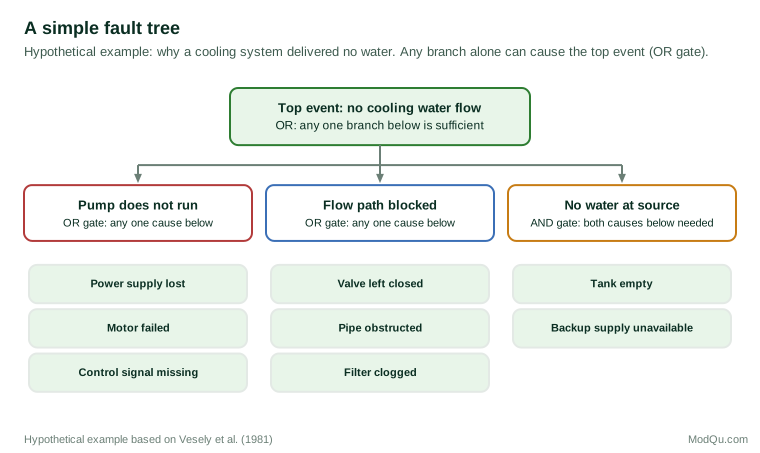
Fault trees are rigorous and can be quantified: if the probability of each basic event is known, the probability of the top event can be calculated. They also show where a single failure can cause disaster and where redundancy provides protection. Their limits are that they require detailed knowledge of the system, become very large for complex systems, and handle human and organisational factors less easily than technical failures (Ericson, 2005).
The five whys
The five whys technique, associated with the Toyota Production System, involves asking "why?" repeatedly, usually about five times, until the underlying cause is reached (Ohno, 1988). For example: the machine stopped; why? A fuse blew because of an overload; why? The bearing was not lubricated; why? The lubrication pump was not working; why? Its shaft was worn; why? There was no strainer, so metal scrap got in. The remedy is to fit a strainer, not merely to replace the fuse.
The technique is quick and requires no special tools. Its weaknesses are serious, however. Card (2017) argues that it pushes investigators towards a single linear chain of causes, when most problems have several contributing causes; that different people asking the same questions reach different answers; and that it tends to stop at whatever cause the investigator already suspected.
Using RCA well
Research in healthcare, where RCA is widely used, has found that it often fails to prevent recurrence. Wu et al. (2008) noted that hospital RCAs frequently produced weak recommendations, such as retraining or new policies, rather than stronger changes to systems and equipment. Peerally et al. (2017) identified further problems, including poor-quality investigations, a focus on individual events rather than patterns, and recommendations that were never implemented.
These findings suggest that the choice of method matters less than how it is used. Good practice combines methods, for example using a fishbone to generate possibilities and a fault tree or data to test them; looks for several contributing causes rather than one; considers organisational as well as technical factors, as Reason (1997) recommended; and tracks whether the actions taken actually reduce the problem.
Choosing a method
The three methods suit different situations. The five whys is useful for small, everyday problems where a quick team discussion is enough and the stakes are low. The fishbone diagram suits problems with many possible causes, where a team needs to think broadly before collecting data. Fault tree analysis suits high-hazard systems where failures must be understood precisely and their probabilities estimated, and where the investigator has detailed technical knowledge. For serious incidents, investigators often use all three in sequence.
Conclusion
The fishbone diagram encourages breadth, fault tree analysis brings logical rigour, and the five whys offers speed and simplicity. None is sufficient on its own. Root cause analysis works best when it treats possible causes as hypotheses, tests them with evidence, accepts that most problems have several causes, and leads to changes that are checked for effect.
References
Andersen, B., & Fagerhaug, T. (2006). Root cause analysis: Simplified tools and techniques (2nd ed.). ASQ Quality Press.
Card, A. J. (2017). The problem with '5 whys'. BMJ Quality & Safety, 26(8), 671–677. https://doi.org/10.1136/bmjqs-2016-005849
Ericson, C. A., II. (2005). Hazard analysis techniques for system safety. Wiley.
Ishikawa, K. (1976). Guide to quality control. Asian Productivity Organization.
Ohno, T. (1988). Toyota production system: Beyond large-scale production. Productivity Press.
Peerally, M. F., Carr, S., Waring, J., & Dixon-Woods, M. (2017). The problem with root cause analysis. BMJ Quality & Safety, 26(5), 417–422. https://doi.org/10.1136/bmjqs-2016-005511
Reason, J. (1997). Managing the risks of organizational accidents. Ashgate.
Vesely, W. E., Goldberg, F. F., Roberts, N. H., & Haasl, D. F. (1981). Fault tree handbook (NUREG-0492). U.S. Nuclear Regulatory Commission.
Wu, A. W., Lipshutz, A. K. M., & Pronovost, P. J. (2008). Effectiveness and efficiency of root cause analysis in medicine. JAMA, 299(6), 685–687. https://doi.org/10.1001/jama.299.6.685