
Investigation · Scientific and technical investigation
Failure Analysis in Engineering and Products
When a bridge cracks, a component breaks or a product catches fire, failure analysis finds out why. This article explains how engineers investigate failures, the common ways that materials and products fail, landmark cases, and how the findings are used to prevent future failures.
Every engineered product eventually fails, but some fail too soon, unexpectedly or dangerously. Failure analysis is the systematic investigation of why a component, structure or product did not perform as intended. Its findings matter to manufacturers who need to fix designs, to users who need to know whether similar items are safe, to insurers and courts deciding who is responsible, and to engineers more generally. Petroski (1985) argues that failure has been the most important teacher in engineering: designs advance when engineers understand why earlier ones failed.
The investigative process
Failure analysis follows a structured sequence that moves from the least destructive examination to the most destructive, so that evidence is not lost before it has been recorded (ASM International, 2002).
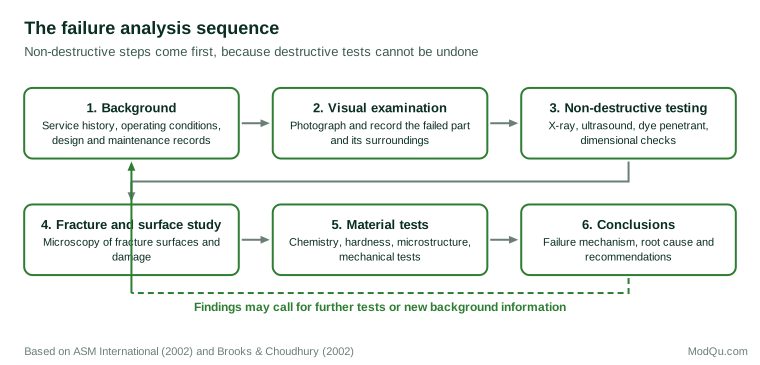
The investigator first collects background: how the item was designed, made, installed, used and maintained, and what happened when it failed. The failed part is then photographed and examined visually, often with a low-power microscope. Non-destructive tests, such as X-rays, ultrasound and dye penetrant inspection, can find internal cracks and hidden defects. Fracture surfaces are examined at high magnification, including with scanning electron microscopes, because their features reveal how the crack grew. Finally, samples may be cut for chemical analysis, hardness testing and examination of the material's internal structure, to check whether the material met its specification.
How things fail
Failure analysts recognise a number of common failure mechanisms (Wulpi, 1999; Brooks & Choudhury, 2002).
- Overload occurs when a single load exceeds the strength of the part. Ductile materials stretch and tear, while brittle materials snap with little deformation.
- Fatigue occurs when repeated loads, each well below the material's strength, cause a crack to start and grow gradually until the remaining section breaks. Fatigue is the most common cause of mechanical failure in service, and fracture surfaces often show characteristic "beach marks" recording the crack's progress (Suresh, 1998).
- Corrosion is chemical attack by the environment, which can thin a part or combine with stress to cause cracking.
- Wear is the gradual removal of material from surfaces in contact.
- Creep is slow deformation under load at high temperature, as in engine and power plant components.
Identifying the mechanism is not the end of the analysis. The investigator must find why it occurred: a design that concentrated stress, a material defect, a manufacturing error, improper maintenance or use beyond design limits.
Landmark cases
The de Havilland Comet, the world's first jet airliner, suffered two fatal breakups in 1954. Investigators recovered wreckage from the sea and tested a complete fuselage in a water tank, repeatedly pressurising it to simulate flights. It failed after far fewer cycles than expected, with fatigue cracks starting at the corner of a window opening where stresses were concentrated (Withey, 1997). The findings changed how aircraft are designed and tested for fatigue.
The loss of the space shuttle Challenger in 1986 was traced to the failure of rubber O-ring seals in a solid rocket booster joint, which lost their resilience in the cold weather on the morning of launch. The presidential commission found that engineers had raised concerns about the seals and cold temperatures, and that the decision to launch reflected flaws in NASA's decision-making as well as in the joint's design (Presidential Commission on the Space Shuttle Challenger Accident, 1986).
Consumer products also require failure analysis. In 2016, Samsung recalled its Galaxy Note7 smartphone after reports of batteries overheating and catching fire. Independent analysis of failed batteries identified internal defects that could allow the battery's positive and negative electrodes to come into contact, causing short circuits (Loveridge et al., 2018).
Beyond the broken part
A common mistake is to stop once the physical mechanism has been identified. Finding that a bolt failed by fatigue explains how it broke, but not why a bolt in that position was exposed to repeated loads it could not withstand. The answer may lie in a design calculation that underestimated vibration, a supplier that substituted a cheaper material, an assembly worker who could not reach the bolt with the correct tool, or a maintenance schedule that was quietly extended to save money. Challenger is the clearest example: the O-ring failure was the physical cause, but the decision process that allowed a launch in conditions outside the seals' tested range was the deeper one.
Failure analysts therefore work alongside designers, production staff, maintenance personnel and managers, and ask how the failure could have been prevented at each stage. They also check whether the same failure has occurred elsewhere. A single failure may be a rare defect, but several similar failures suggest a systematic problem that calls for a recall, a design change or new inspection requirements. Records of failures across a product's whole service life are often the best evidence of whether a problem is isolated or widespread.
Preventing failure
Failure analysis feeds back into design through methods such as failure mode and effects analysis (FMEA), in which engineers list the ways each component could fail, the effects of each failure and how likely and severe it would be, and then change the design or controls to reduce the highest risks (Stamatis, 2003; International Electrotechnical Commission [IEC], 2018). Findings from failures in service supply the evidence that makes these predictions realistic.
Good failure analysis also requires care with evidence. Failed parts may become evidence in legal disputes, so investigators document every step, keep a chain of custody and, where possible, agree test plans with all interested parties before destructive testing.
Conclusion
Failure analysis combines background investigation, careful examination and laboratory testing to establish how and why something failed. Its findings protect users, improve designs and allocate responsibility. Cases from the Comet to modern smartphones show that understanding failure is one of the most reliable ways for engineering to advance.
References
ASM International. (2002). ASM handbook: Vol. 11. Failure analysis and prevention. ASM International.
Brooks, C. R., & Choudhury, A. (2002). Failure analysis of engineering materials. McGraw-Hill.
International Electrotechnical Commission. (2018). Failure modes and effects analysis (FMEA and FMECA) (IEC Standard No. 60812:2018).
Loveridge, M. J., Remy, G., Kourra, N., Genieser, R., Barai, A., Lain, M. J., Guo, Y., Amor-Segan, M., Williams, M. A., Amietszajew, T., Ellis, M., Bhagat, R., & Greenwood, D. (2018). Looking deeper into the Galaxy (Note 7). Batteries, 4(1), Article 3. https://doi.org/10.3390/batteries4010003
Petroski, H. (1985). To engineer is human: The role of failure in successful design. St. Martin's Press.
Presidential Commission on the Space Shuttle Challenger Accident. (1986). Report to the President (Vol. 1). U.S. Government Printing Office.
Stamatis, D. H. (2003). Failure mode and effect analysis: FMEA from theory to execution (2nd ed.). ASQ Quality Press.
Suresh, S. (1998). Fatigue of materials (2nd ed.). Cambridge University Press.
Withey, P. A. (1997). Fatigue failure of the de Havilland Comet I. Engineering Failure Analysis, 4(2), 147–154. https://doi.org/10.1016/S1350-6307(97)00005-8
Wulpi, D. J. (1999). Understanding how components fail (2nd ed.). ASM International.