
Intelligence · Analysis and tradecraft
"Scenario Planning: Preparing for Several Futures"
Scenario planning prepares organisations for an uncertain future by developing several plausible stories of how it might unfold, rather than a single forecast. This article explains where the method came from, how it is done, what research says about its benefits and limits, and how to use it well.
Most planning assumes a single future. A budget forecasts next year's sales; a strategy assumes that the market will grow at a certain rate; an intelligence estimate gives the most likely outcome. When the future turns out differently, as it often does, plans built on one expected path can fail badly. Scenario planning takes a different approach. Instead of predicting what will happen, it develops several distinct, plausible stories of what could happen, and asks how the organisation would fare in each. The aim is not to be right about the future but to be ready for more than one version of it.
This article explains the origins of scenario planning, the main steps in building scenarios, what research says about its effects, its limitations and how intelligence and business teams can use it.
Risk, uncertainty and the limits of forecasting
Knight (1921) drew a distinction that remains central to scenario thinking. Risk applies when the possible outcomes and their probabilities can be estimated, as in insurance or games of chance. Uncertainty applies when they cannot, because the situation is new or depends on choices not yet made. Forecasting works reasonably well under risk. Under deep uncertainty, a single forecast can create false confidence.
Research on expert prediction reinforces the point. Tetlock (2005), in a long study of political and economic forecasts, found that experts were often little better than simple rules at predicting long-range outcomes, and that those with a single grand theory did worst. Taleb (2007) argued that history is shaped disproportionately by rare, high-impact events that standard forecasting methods ignore. Scenario planning responds to these limits by replacing the question "what will happen?" with "what could happen, and what would we do?".
Origins
Scenario thinking has two main roots. The first is military and policy planning in the United States after the Second World War. Herman Kahn, at the RAND Corporation and later at the Hudson Institute, used detailed stories about possible futures, including nuclear war, to force planners to think through situations that seemed unthinkable. Kahn and Wiener (1967) applied the approach to long-range social and economic change, describing a "standard world" and several alternatives for the year 2000.
The second root is corporate planning, above all at Royal Dutch Shell. Pierre Wack, who led Shell's planning group in the early 1970s, developed scenarios that included the possibility of a sharp rise in oil prices driven by producer countries. When the 1973 oil crisis came, Shell was better prepared than many competitors. Wack (1985a, 1985b) described the lessons in two influential articles. Wack argued that scenarios succeed only when they change the mental models of decision-makers: it is not enough to describe alternative futures; managers must come to see the world differently. Wilkinson and Kupers (2013) review Shell's experience over four decades and show how the company's scenarios evolved and how they were used in strategy.
A third tradition developed in France under the name la prospective, which emphasised that the future is shaped by human choices and that scenarios should help societies choose desirable futures. Bradfield et al. (2005) trace these schools and distinguish the "intuitive logics" approach associated with Shell from more quantitative approaches that modify trend forecasts with probabilistic judgements.
Quantitative models also produced scenarios. Meadows et al. (1972), in The Limits to Growth, ran a computer model of world population, resources and pollution under several sets of assumptions, producing contrasting futures that sparked an international debate. Their work showed that scenarios could be generated by models as well as by workshops.
What a scenario is
A scenario is not a forecast. It is a coherent, plausible story about how the future might unfold, built from an analysis of the forces that shape it. Schoemaker (1995) describes good scenarios as plausible (they could happen), internally consistent (their elements fit together), relevant (they bear on the decision at hand) and challenging (they stretch current thinking). A set of scenarios should be distinct enough that each tells the organisation something different.
Ramírez and Wilkinson (2016), describing the Oxford approach to scenario planning, emphasise plausibility rather than probability. Assigning probabilities to scenarios tends to draw attention to the "most likely" one and defeats the purpose of considering several. The point is to use the set of scenarios to reframe the organisation's understanding of its situation.
How scenarios are built
Many variants exist. Amer et al. (2013) reviewed the literature and found dozens of methods, but most share a common core. Schwartz (1991) and Schoemaker (1995) describe versions of the following sequence.
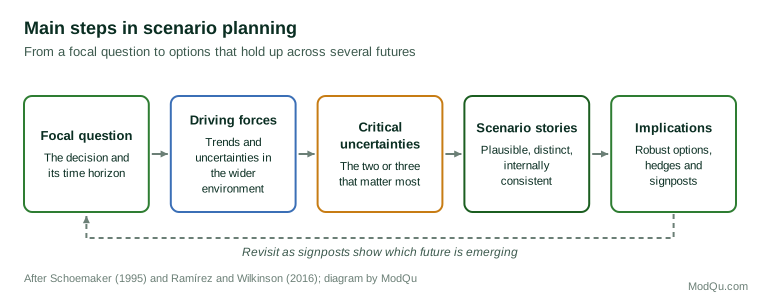
1. Define the focal question. Scenarios should serve a decision: whether to build a plant, enter a market or change a policy. The question sets the time horizon and the scope.
2. Identify the driving forces. List the social, technological, economic, environmental and political forces that will shape the answer. Separate predetermined elements, which are fairly certain (an ageing population, for example), from critical uncertainties, which could go in very different directions.
3. Select the critical uncertainties. Rank the uncertainties by their importance to the focal question and by how uncertain they are. The two most important and most uncertain often become the axes of the scenario set.
4. Write the scenario stories. Crossing two uncertainties gives four combinations, each of which becomes the frame for a scenario. Each story describes how the world gets from today to the future, who the main actors are and what the organisation would face. Memorable names help people refer to the scenarios later.
5. Draw out implications. For each scenario, ask what it would mean for the organisation: which strategies would succeed, which would fail, what risks and opportunities would arise. Look for robust options that work reasonably well in all scenarios, hedges that protect against the worst outcomes and signposts that would show which scenario is emerging.
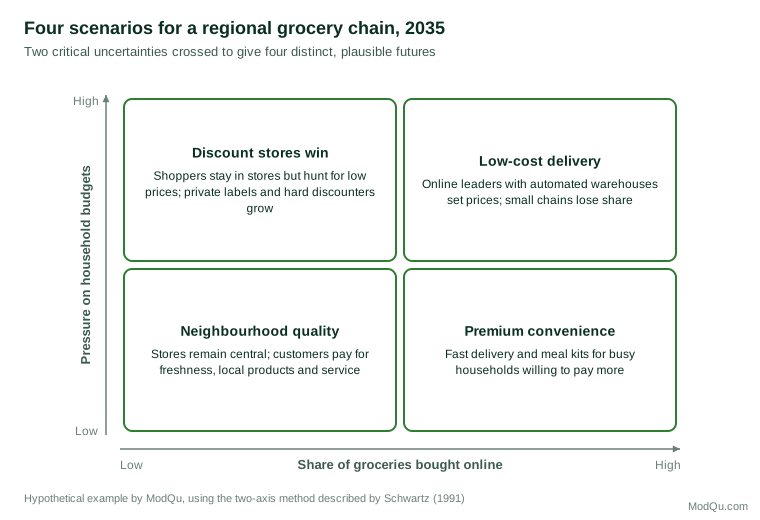
The two-by-two matrix is the best-known format but not the only one. Some teams build three scenarios around a central uncertainty, while others use more elaborate methods that combine many factors. Amer et al. (2013) note that between two and five scenarios is typical; fewer gives too little variety, while more becomes hard to use.
Organising a scenario project
Scenario projects vary from a single afternoon workshop to studies lasting many months. A practical middle course for most organisations has four phases. In the first, a small core team interviews senior managers and outside experts about the focal question, asking what they believe will shape the future and what keeps them awake at night. Schwartz (1991) recommends seeking out "remarkable people" with unusual perspectives, since conventional experts tend to share the organisation's own assumptions. In the second phase, a workshop of perhaps fifteen to twenty people sorts the driving forces, agrees the critical uncertainties and sketches the scenarios. In the third, the core team writes the stories in full, checks them for consistency and adds supporting data. In the fourth, a second workshop with decision-makers works through the implications for current strategy.
Participation matters as much as analysis. Ramírez and Wilkinson (2016) argue that the main product of scenario work is a shared reframing of the situation among those who must act, and this happens only if they take part. External facilitators can help, because they are free to challenge senior people and are not invested in existing plans. The written scenarios should be short enough to be read: a page or two for each, with a memorable name and a few signposts.
Quantitative support can strengthen the stories. For each scenario, the team can estimate key figures such as market size, prices or costs, and test the financial results of current plans. This keeps scenarios concrete and connects them to the numbers that managers use, without turning them into forecasts.
Scenarios and signposts
Scenarios become far more useful when they are linked to monitoring. For each scenario, the team identifies early signs that it is beginning to unfold. These signposts are then tracked over time. Dewar (2002) describes the same approach in assumption-based planning, where signposts warn that a key assumption is failing. Schoemaker et al. (2013) propose a strategic radar that combines scenarios, the scanning of weak signals and the networks of people who notice them. Day and Schoemaker (2006) argue that scenarios improve an organisation's peripheral vision, because they suggest where to look for signals that would otherwise be ignored.
Linking scenarios to signposts turns them from a one-off exercise into a continuing intelligence process. When signposts move, the organisation can adjust its plans in good time, choosing among options it has already considered.
What the research shows
Evidence on the effects of scenario planning has grown, though it is still limited. Meissner and Wulf (2013), in an experiment with managers, found that scenario planning reduced susceptibility to framing effects and improved the quality of strategic decisions. Phadnis et al. (2015) asked supply chain experts to judge long-range investment decisions before and after working with scenarios. The scenarios changed the experts' judgements about which investments were appropriate, suggesting that the method does influence how practitioners think about the future, as Wack had argued.
Pherson and Heuer (2021) include alternative futures analysis among the structured analytic techniques used in intelligence, recommending it for problems with many interacting variables and high uncertainty, where a single estimate would be misleading.
Limitations and criticisms
Scenario planning has well-known weaknesses.
Vivid stories can distort judgement. Tversky and Kahneman (1974) showed that people judge an event more likely when it is easy to imagine. Detailed scenarios are easy to imagine, which can inflate their perceived probability. Tetlock (2005) found that when experts were asked to work through scenarios for several possible outcomes, the probabilities they assigned to the outcomes added up to well over 100 per cent: each story made its outcome seem more plausible. Users should remember that scenarios are tools for exploring possibilities, not estimates of likelihood.
Scenarios may miss discontinuities. Postma and Liebl (2005) argued that conventional scenario methods, which combine known trends and uncertainties, struggle to capture sudden breaks and contradictory developments. The futures that most surprise organisations are often those no one thought to include. Deliberately adding a "wild card" scenario, or testing plans against shocks outside the matrix, can help.
The exercise can become ritual. Wack (1985b) warned that scenarios which do not connect to decisions are quickly forgotten. Many organisations produce attractive scenario reports that have little effect because managers were not involved in building them and no one asked what they meant for current choices.
The axes may be poorly chosen. If the two critical uncertainties are not truly independent or not truly the most important, the resulting scenarios may be redundant or miss the issues that matter. Mason and Mitroff (1981) stress the value of surfacing and debating assumptions before settling on a framework.
Scenario planning in intelligence
Intelligence organisations use scenarios in several ways. Long-range assessments of global trends often present several alternative worlds rather than a single forecast. Warning analysts use scenarios to imagine how a crisis could develop and what indicators would show each path. Analysts working on a particular country or company may develop scenarios to structure a discussion with decision-makers about the range of possible outcomes.
Scenarios also complement probabilistic estimates. An estimate can give the most likely outcome and its probability, while scenarios describe the alternatives in enough detail for planners to prepare. Used together, they give decision-makers both a best judgement and a sense of what else could happen.
Common mistakes
- Starting without a decision. Scenarios that serve no specific question tend to be generic and unused.
- Choosing a "most likely" scenario. This brings back the single forecast that scenario planning is meant to replace.
- Making one scenario the obvious good one. If one future is clearly desirable and the others are disasters, participants rally around the good one instead of preparing for all.
- Excluding decision-makers. Wack (1985a) found that scenarios changed thinking only when managers took part in developing them.
- Never revisiting. The world changes; scenarios and their signposts should be reviewed at least annually.
- Too many scenarios. Beyond four or five, people cannot hold the set in mind, and discussion drifts towards the familiar ones.
- Ignoring the organisation's own actions. Competitors, regulators and customers will respond to what the organisation does, so scenarios should consider how its own moves could shape which future emerges.
An illustration
A regional grocery chain in Canada wants to decide whether to invest in a large automated warehouse for home delivery. Its planning team identifies many driving forces and selects two critical uncertainties for the next ten years: how much grocery shopping moves online, and how much pressure household budgets come under. Crossing these gives four scenarios (Figure 2).
In a "neighbourhood quality" world, the warehouse would be a costly mistake. In a "low-cost delivery" world, failing to build it could threaten the chain's survival. Rather than betting on either, the team identifies a robust strategy: invest in store-based fulfilment and a delivery partnership now, which works in three of the four scenarios, and secure an option on a warehouse site that can be used if signposts point towards the low-cost delivery world. The signposts include the online share of grocery spending, the expansion plans of the largest online grocers and survey data on how households choose where to shop. The board approves the plan with a commitment to review the signposts every six months.
Conclusion
Scenario planning is a disciplined way to think about futures that cannot be predicted. It developed in military planning and at Shell, and it is now used by governments, intelligence agencies and companies around the world. Its value lies less in the stories themselves than in what they do to the people who build and use them: widening the range of futures considered, exposing assumptions and identifying options that hold up whatever happens. Research shows that it can reduce some biases and change expert judgement, though vivid scenarios can also distort estimates of likelihood. Used with clear decisions in mind and linked to signposts that are monitored over time, scenario planning helps organisations prepare for several futures rather than betting on one.
References
Amer, M., Daim, T. U., & Jetter, A. (2013). A review of scenario planning. Futures, 46, 23–40. https://doi.org/10.1016/j.futures.2012.10.003
Bradfield, R., Wright, G., Burt, G., Cairns, G., & van der Heijden, K. (2005). The origins and evolution of scenario techniques in long range business planning. Futures, 37(8), 795–812. https://doi.org/10.1016/j.futures.2005.01.003
Day, G. S., & Schoemaker, P. J. H. (2006). Peripheral vision: Detecting the weak signals that will make or break your company. Harvard Business School Press.
Dewar, J. A. (2002). Assumption-based planning: A tool for reducing avoidable surprises. Cambridge University Press.
Kahn, H., & Wiener, A. J. (1967). The year 2000: A framework for speculation on the next thirty-three years. Macmillan.
Knight, F. H. (1921). Risk, uncertainty and profit. Houghton Mifflin.
Mason, R. O., & Mitroff, I. I. (1981). Challenging strategic planning assumptions: Theory, cases, and techniques. Wiley.
Meadows, D. H., Meadows, D. L., Randers, J., & Behrens, W. W., III. (1972). The limits to growth. Universe Books.
Meissner, P., & Wulf, T. (2013). Cognitive benefits of scenario planning: Its impact on biases and decision quality. Technological Forecasting and Social Change, 80(4), 801–814. https://doi.org/10.1016/j.techfore.2012.09.011
Phadnis, S., Caplice, C., Sheffi, Y., & Singh, M. (2015). Effect of scenario planning on field experts' judgment of long-range investment decisions. Strategic Management Journal, 36(9), 1401–1411. https://doi.org/10.1002/smj.2293
Pherson, R. H., & Heuer, R. J., Jr. (2021). Structured analytic techniques for intelligence analysis (3rd ed.). CQ Press.
Postma, T. J. B. M., & Liebl, F. (2005). How to improve scenario analysis as a strategic management tool? Technological Forecasting and Social Change, 72(2), 161–173. https://doi.org/10.1016/j.techfore.2003.11.005
Ramírez, R., & Wilkinson, A. (2016). Strategic reframing: The Oxford scenario planning approach. Oxford University Press.
Schoemaker, P. J. H. (1995). Scenario planning: A tool for strategic thinking. Sloan Management Review, 36(2), 25–40.
Schoemaker, P. J. H., Day, G. S., & Snyder, S. A. (2013). Integrating organizational networks, weak signals, strategic radars and scenario planning. Technological Forecasting and Social Change, 80(4), 815–824. https://doi.org/10.1016/j.techfore.2012.10.020
Schwartz, P. (1991). The art of the long view: Planning for the future in an uncertain world. Doubleday.
Taleb, N. N. (2007). The black swan: The impact of the highly improbable. Random House.
Tetlock, P. E. (2005). Expert political judgment: How good is it? How can we know? Princeton University Press.
Tversky, A., & Kahneman, D. (1974). Judgment under uncertainty: Heuristics and biases. Science, 185(4157), 1124–1131. https://doi.org/10.1126/science.185.4157.1124
Wack, P. (1985a). Scenarios: Uncharted waters ahead. Harvard Business Review, 63(5), 73–89.
Wack, P. (1985b). Scenarios: Shooting the rapids. Harvard Business Review, 63(6), 139–150.
Wilkinson, A., & Kupers, R. (2013). Living in the futures. Harvard Business Review, 91(5), 118–127.