
Intelligence · Analysis and tradecraft
Groupthink and Organisational Barriers to Good Intelligence
Groups of capable people can reach poor conclusions because they value agreement over critical thinking. This article explains groupthink and related organisational barriers, the evidence behind them and practical ways to protect intelligence work from them.
Intelligence is usually produced by teams, and teams can be wiser than individuals: they pool knowledge, catch errors and bring different perspectives. But groups can also go wrong in predictable ways. A team that values harmony may stop questioning its own conclusions. Members may hold back information that does not fit, or keep doubts to themselves. The best-known name for this pattern is groupthink. This article explains the concept, the research on it and related organisational barriers, and the practices that help.
Janis and groupthink
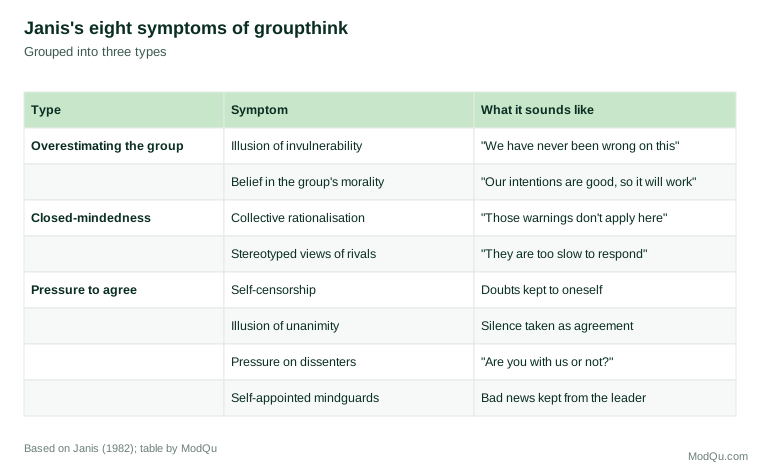
The psychologist Irving Janis studied several American foreign-policy fiascoes, including the failed Bay of Pigs invasion of Cuba in 1961, and compared them with decisions that went well. Janis concluded that in the fiascoes, cohesive groups of able officials had developed a strong desire for agreement that overrode realistic appraisal of alternatives (Janis, 1972). In a later edition Janis set out the conditions that make groupthink more likely: a cohesive group, insulation from outside views, a directive leader who signals a preferred outcome, a lack of methodical procedures and high stress (Janis, 1982).
What the evidence shows
Groupthink became one of the most widely cited ideas in management, but the research support is mixed. Esser (1998) reviewed twenty-five years of studies and found that case studies of historical decisions generally supported Janis's account, while laboratory experiments gave weaker and less consistent results. Cohesion on its own, for example, did not reliably lead to poor decisions. The elements most consistently linked with poor outcomes were directive leadership and a lack of structured procedures for considering alternatives.
Other research has identified related problems that do not depend on cohesion. Stasser and Titus (1985) found that groups tend to discuss information that all members already share and neglect information held by only one member. When the crucial facts are spread among members, groups often fail to find the best answer, even though they collectively hold all the information needed. Sunstein and Hastie (2015) describe further ways in which groups amplify errors: members follow those who speak first, a process known as a cascade, and discussion pushes groups towards more extreme versions of their initial views.
Organisational silence
Groupthink describes what happens in a meeting. Morrison and Milliken (2000) describe a wider problem they call organisational silence: a climate in which employees believe that speaking up about problems is futile or dangerous, so they stay quiet. Silence deprives leaders of information and makes it hard for organisations to detect errors. It is encouraged by managers who fear negative feedback and by structures that concentrate decisions at the top.
For intelligence teams, silence is especially damaging. An analyst who suspects that a source is unreliable, or that the prevailing view is wrong, may decide that raising the issue is not worth the cost. Over time, the organisation hears only what confirms its existing views, and the warnings that might have prevented a failure never reach the people who could act on them.
Remedies
Research and practice suggest several measures:
- Leaders should speak last. A leader who states a view first narrows discussion. Janis (1982) recommended that leaders remain impartial at the start.
- Gather views independently. Ask members to write down their judgements before discussion, so that early speakers do not set the agenda (Sunstein & Hastie, 2015).
- Ask for unshared information. Explicitly invite each member to state what they know that others may not.
- Assign challenge. Use devil's advocacy, red teams or a key assumptions check (Pherson & Heuer, 2021).
- Value authentic dissent. Nemeth et al. (2001) found that genuine disagreement stimulates better thinking than role-played criticism, so organisations should protect people who disagree.
- Bring in outsiders. Experts from outside the team can question assumptions that insiders take for granted.
An illustration
The leadership team of a Canadian consumer goods company meets to review a plan to raise prices by eight per cent. The chief executive opens by saying that the brand is strong enough to carry the increase. The marketing director agrees, and so does finance. The head of insights has survey data showing that a third of regular buyers would switch to a store brand at that price, but the meeting has already moved on, and the head of insights decides that raising it would look disloyal. Each symptom is present: confidence in the brand, a leader who signals the answer, early agreement and a member who self-censors.
The following year the company changes its procedure. Before any pricing decision, each member submits a written view and the evidence for it. The insights team presents its data first, before the executives give their opinions, and one director is asked to argue against the proposal. The next price rise is smaller and better targeted, and it holds.
Conclusion
Groupthink and organisational silence are not signs of incompetence; they arise when capable people work in close-knit teams under pressure. The research suggests that leadership style and process matter more than cohesion itself. Structured procedures, independent judgements and genuine openness to dissent help intelligence teams gain the benefits of working together without its most serious risks.
References
Esser, J. K. (1998). Alive and well after 25 years: A review of groupthink research. Organizational Behavior and Human Decision Processes, 73(2–3), 116–141. https://doi.org/10.1006/obhd.1998.2758
Janis, I. L. (1972). Victims of groupthink: A psychological study of foreign-policy decisions and fiascoes. Houghton Mifflin.
Janis, I. L. (1982). Groupthink: Psychological studies of policy decisions and fiascoes (2nd ed.). Houghton Mifflin.
Morrison, E. W., & Milliken, F. J. (2000). Organizational silence: A barrier to change and development in a pluralistic world. Academy of Management Review, 25(4), 706–725. https://doi.org/10.5465/amr.2000.3707697
Nemeth, C., Brown, K., & Rogers, J. (2001). Devil's advocate versus authentic dissent: Stimulating quantity and quality. European Journal of Social Psychology, 31(6), 707–720. https://doi.org/10.1002/ejsp.58
Pherson, R. H., & Heuer, R. J., Jr. (2021). Structured analytic techniques for intelligence analysis (3rd ed.). CQ Press.
Stasser, G., & Titus, W. (1985). Pooling of unshared information in group decision making: Biased information sampling during discussion. Journal of Personality and Social Psychology, 48(6), 1467–1478. https://doi.org/10.1037/0022-3514.48.6.1467
Sunstein, C. R., & Hastie, R. (2015). Wiser: Getting beyond groupthink to make groups smarter. Harvard Business Review Press.