
Insights · What an insight is
Wallas's Four Stages of Creative Thought
Graham Wallas's 1926 model of preparation, incubation, illumination and verification is still the most cited description of how new ideas form. This article explains the model, its sources, what a century of research says about each stage, and how it applies to insight work in organisations.
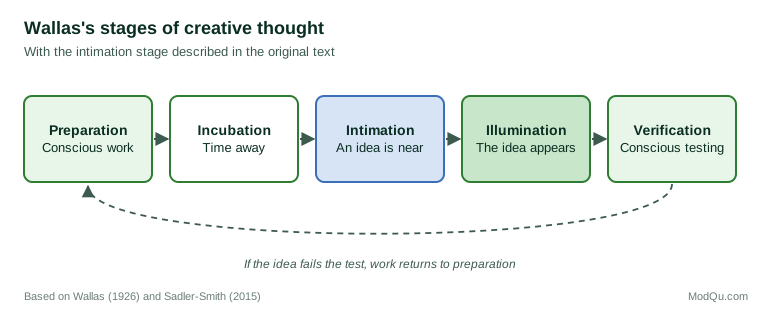
In 1926 the English political scientist Graham Wallas published The Art of Thought, a book about how people produce new ideas. In one short chapter Wallas proposed that creative thinking passes through four stages: preparation, incubation, illumination and verification. The model was not based on experiments. It was drawn from the reports of famous thinkers about how their discoveries had come to them. Yet it became one of the most durable ideas in psychology. It is still taught in courses on creativity and innovation, still used to structure workshops and still the starting point for much research on insight (Lubart, 2001; Sadler-Smith, 2015).
This article explains what Wallas proposed, where the ideas came from, what modern research says about each stage, and what the model offers to people whose work is to find insight in data.
Where the model came from
Wallas (1926) built the model from the accounts of scientists and mathematicians who had written about their own creative work. Two were especially important.
The first was the German physicist Hermann von Helmholtz. At a celebration of Helmholtz's seventieth birthday in 1891, Helmholtz described how the best ideas had come. The first step was to investigate a problem "in all directions" until all its details could be held in mind. Then, after a period of rest, often during a walk in the countryside, the solution would arrive unexpectedly and without effort. Wallas took from this account three of the stages: an initial period of hard work, a period of rest, and a sudden appearance of the idea.
The second was the French mathematician Henri Poincaré, who had described the discovery of a class of mathematical functions in a lecture later published in English as "Mathematical Creation" (Poincaré, 1910). After weeks of unsuccessful work, Poincaré left on a geological excursion and forgot about mathematics. As Poincaré stepped onto a bus, the key idea arrived with complete certainty, although Poincaré had not been thinking about the problem. Back home, Poincaré checked the result at leisure. Poincaré concluded that the mind continues to work on a problem unconsciously and that conscious checking is needed afterwards. This gave Wallas the fourth stage.
The four stages
Preparation
During preparation, the thinker investigates the problem consciously and deliberately. This includes gathering information, learning what is already known, trying obvious approaches and, often, failing. Wallas stressed that preparation requires education and discipline: the mind must be stocked with knowledge and trained in methods before new ideas can be built from them.
Incubation
Incubation is a period in which the thinker does not work consciously on the problem. Wallas distinguished two forms: doing other mental work, or relaxing completely. Wallas thought that some kinds of rest were better than others and was suspicious of passive entertainment such as reading light fiction, which seemed to fill the mind with other people's thoughts. During incubation, Wallas suggested, the mind continues to process the problem below the level of awareness.
Illumination
Illumination is the moment when the idea appears, which Wallas called the "happy idea". It is the stage most closely associated with insight and the "Aha!" experience. Wallas noted that illumination cannot be forced. The thinker can only arrange the conditions that make it more likely.
Verification
Verification is the conscious testing of the idea. Is it correct? Does it solve the problem? Can it be developed into something usable? Like preparation, verification is deliberate, effortful and governed by logic. Poincaré emphasised that many of the ideas that arrive during illumination turn out to be wrong, so checking is essential.
The forgotten fifth stage
Wallas also described a brief stage between incubation and illumination, which Wallas called intimation: the feeling that an idea is about to arrive. Sadler-Smith (2015) re-read Wallas's original text and argued that this stage has been neglected in later summaries. Intimation, Sadler-Smith suggested, links Wallas's model to modern research on intuition, which studies the sense that one is close to an answer before the answer can be stated.
What research says about each stage
Wallas offered the model as a description, not a tested theory. Over the following century, psychologists have tested many of its claims. The results support some parts strongly and others only weakly.
Preparation: necessary but not sufficient
Research consistently supports the importance of preparation. Creative achievement in almost every field depends on extensive knowledge of that field. Amabile (1983) placed "domain-relevant skills", including knowledge and technical ability, at the base of the componential model of creativity. In experiments on incubation, the benefit of a break is larger when people have worked on the problem for longer before it (Sio & Ormerod, 2009). A break before serious work has begun does little. Preparation also includes reaching an impasse. Studies of insight show that people typically feel no closer to a solution until just before it appears (Metcalfe & Wiebe, 1987), so a period of apparently fruitless effort is a normal part of preparation rather than a sign of failure.
Incubation: real, but smaller and more specific than often claimed
Incubation is the most studied and the most debated stage. Early experiments produced mixed results, and some researchers concluded that the effect did not exist. Sio and Ormerod (2009) settled much of this debate with a meta-analysis of 117 studies. They found a positive incubation effect overall. The effect was larger for tasks that require generating many ideas, such as thinking of unusual uses for a brick, than for tasks with a single correct answer. It was also larger when the preparation period was longer, and for some types of problems when the incubation period was filled with an undemanding task rather than with demanding work.
Why does incubation help? Researchers have proposed several explanations, and the evidence suggests more than one may be true.
- Forgetting fixation. During preparation, people often become fixed on a wrong approach. Smith and Blankenship (1989, 1991) gave participants misleading clues that led them toward wrong answers. A break helped, mainly because it allowed the misleading idea to fade. On this account, incubation works less by adding something than by removing an obstacle.
- Unconscious work. Poincaré's explanation was that the mind keeps working on the problem below awareness. Dijksterhuis and Meurs (2006) reported that people distracted from a creative task produced more original ideas than people who thought about it consciously. Gilhooly (2016) reviewed the evidence and concluded that some form of unconscious work probably contributes to incubation effects, alongside other mechanisms.
- Spreading activation. Exposure to a problem may leave related ideas slightly activated, so that clues met by chance during the break are more likely to be noticed. This idea draws on Mednick's (1962) theory that creative ideas come from connecting distant associations.
- Mind wandering. Baird and colleagues (2012) found that an undemanding task, which encouraged mind wandering, improved performance on a creative task that people had already seen more than either a demanding task or rest did. The improvement appeared only for problems that people had worked on before the break.
Some claims about unconscious thought have not survived scrutiny. Dijksterhuis, Bos, Nordgren and van Baaren (2006) reported that people made better complex decisions after a period of distraction than after conscious deliberation, a result that received wide attention. However, Nieuwenstein and colleagues (2015) carried out a meta-analysis and a large replication attempt and found little reliable evidence for this "unconscious thought advantage". The safest conclusion is that breaks help creative problem-solving under certain conditions, but that strong claims about a powerful unconscious mind should be treated with caution.
Sleep as incubation
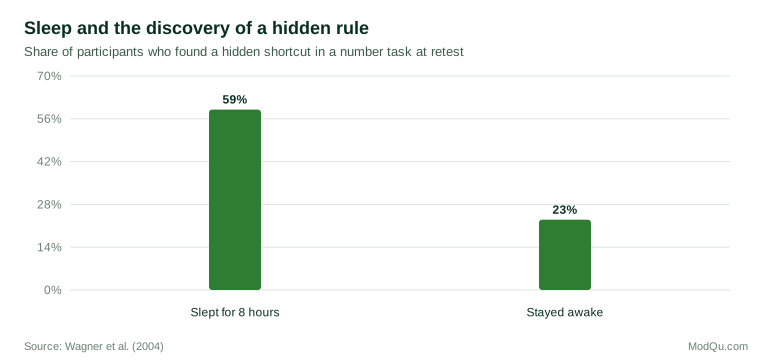
Some of the clearest evidence for incubation comes from studies of sleep. Wagner, Gais, Haider, Verleger and Born (2004) gave participants a number task that contained a hidden shortcut. After initial training, some participants slept for eight hours and others stayed awake for the same period. When retested, 59% of those who had slept discovered the hidden rule, compared with about 23% of those who had stayed awake. Cai, Mednick, Harrison, Kanady and Mednick (2009) found that rapid eye movement (REM) sleep in particular improved performance on remote associates problems, compared with quiet rest or a nap without REM sleep. Sleep appears to help the brain restructure recently learned information in ways that make new connections possible.
Illumination: the Aha! moment
Modern research on insight has largely confirmed Wallas's description of illumination. Insight solutions do appear suddenly, often after an impasse, and are accompanied by a distinctive feeling of certainty and pleasure (Topolinski & Reber, 2010). Neuroscience studies have identified patterns of brain activity that accompany and even precede these moments (Kounios & Beeman, 2014). Salvi, Bricolo, Kounios, Bowden and Beeman (2016) found that solutions reached by insight were more often correct than those reached by step-by-step analysis.
Not everyone accepts that illumination is a special process. Weisberg (2015) argues that many apparently sudden solutions result from ordinary thinking in which knowledge, feedback and gradual changes in approach play the main role. Even so, the subjective experience Wallas described is well documented.
Verification: the underrated stage
Verification receives the least research attention but may be the most important stage for practical work. The confidence that accompanies illumination is not always justified. Danek and Wiley (2017) showed that people can experience strong Aha! moments for incorrect solutions. Poincaré's insistence on checking inspirations is good advice for anyone who works with ideas. In professional settings, Klein and Jarosz (2011) found that insights often had to be tested and defended before they were accepted by colleagues.
Wallas and later process models
Wallas's model was the first of many attempts to describe the creative process in stages. Later models kept the basic structure of Wallas but divided it differently. Guilford (1950) distinguished between divergent thinking, which generates many possible ideas, and convergent thinking, which narrows them down to the best one. In Wallas's terms, divergent thinking dominates preparation and illumination, while convergent thinking dominates verification. Amabile (1983) described a sequence of problem identification, preparation, response generation, response validation and outcome, which adds an explicit first step for defining the problem and a final step for deciding whether to stop or try again. Mumford and colleagues (1991) went further, listing eight core processes that begin with constructing the problem and end with evaluating ideas and planning their implementation.
Two features are shared by nearly all these models. First, each recognises that idea generation and idea evaluation are different activities that benefit from different conditions: generation from openness, distance and delay; evaluation from focus, rigour and scepticism. Second, each treats the process as cyclical. An idea that fails evaluation sends the thinker back to an earlier stage, now with more knowledge about what does not work. Wallas's model survives in these later versions not because its exact stages are correct, but because it was the first to describe this alternation clearly.
Criticisms of the model
Wallas's model has been criticised on several grounds.
It is too linear. Real creative work rarely proceeds neatly from one stage to the next. Thinkers move back and forth, verify partial ideas, return to preparation after a failed test and incubate several problems at once. Lubart (2001) reviewed models of the creative process and concluded that the stages are better seen as sub-processes that recur and overlap than as a fixed sequence. Wallas acknowledged that the stages overlap in practice.
It omits important processes. Later researchers identified processes that Wallas did not name separately. Mumford, Mobley, Reiter-Palmon, Uhlman and Doares (1991) proposed a model with processes such as problem construction, information encoding, category selection, combination and reorganisation of categories, and idea evaluation. Problem construction, the work of defining what the problem is, has received particular attention, because the way a problem is framed limits the solutions that can be found.
It rests on anecdote. The model was built from the recollections of famous men written long after the events. Such accounts may be shaped by memory, by the wish to tell a good story and by the cultural image of the inspired genius. Guilford (1950), in the address that launched modern creativity research, called for experimental study precisely because the field had relied so heavily on such accounts.
It says little about the social context. Wallas focused on individuals. Amabile (1983) and later researchers emphasised that creativity is affected by motivation, by the work environment and by collaboration. In organisations, ideas are developed, challenged and refined by groups, not only by individuals.
Despite these criticisms, the model persists because it captures something that more detailed models confirm: creative work alternates between focused effort and periods away from the problem, and new ideas need testing.
A worked example
Consider a research team asked why sales of a household cleaning product have fallen in one region while holding steady elsewhere.
Preparation. The team gathers sales data by store, a recent customer survey, competitor price records and notes from the regional sales manager. They test the obvious explanations. Prices have not changed; a competitor launched a cheaper product, but in every region, not only this one; the advertising budget was the same everywhere. After a week the team has ruled out the usual suspects and has no answer. This is the impasse that often precedes insight.
Incubation. The project lead deliberately leaves the analysis for two days while working on routine tasks. During that time, a colleague mentions in passing that the region had a long and well-publicised drought the previous summer.
Intimation. The lead has a vague sense that the drought "might matter", without yet knowing how. Rather than dismissing it, they note it down.
Illumination. Returning to the survey, the lead reads the open-ended answers from the region again and notices several mentions of water restrictions. The idea arrives: the product requires diluting with a large amount of water, and customers who were asked to save water had switched to ready-to-use sprays. The fall in sales was not a loss to a competitor but a change in how people cleaned.
Verification. The team checks the idea. Sales of ready-to-use sprays rose in the region during the restrictions. Stores in towns with the strictest restrictions show the largest falls. A short follow-up survey confirms that water saving was a common reason for switching. The insight survives the test and leads to a recommendation to promote a concentrated, low-water version of the product.
The example is simplified, but its shape is typical. The answer came from combining information that was already available, after a period of unsuccessful work, a break and a chance remark from someone outside the analysis. Without verification, however, it would have been only a plausible story.
Applying the model to insight work
Research and analytics teams can use Wallas's stages to plan their work, even though real projects are messier than any model.
- Protect preparation. Insight depends on knowing the data, the market and the business problem in depth. Teams that move straight from data collection to presentation skip the immersion in which ideas form. Time for exploratory analysis, reading open-ended responses and talking to people who know the customers is part of the creative process, not a delay to it.
- Build in incubation. Projects scheduled so that analysis ends the day before the presentation leave no room for incubation. A gap of even one or two days between analysis and interpretation, including a night's sleep, gives the conditions that research suggests help new connections form (Wagner et al., 2004). Switching to an undemanding task, rather than to another demanding project, may help more.
- Notice intimations. Analysts often sense that "something is going on" in a dataset before they can say what it is. That feeling is worth recording and following up, even if it later proves to be wrong.
- Make illumination collective. Workshops in which people with different knowledge look at findings together increase the range of associations available. The Aha! moment often comes from a remark by someone who sees the data from a different angle.
- Never skip verification. Every insight should be tested against the data, ideally with an analysis designed to show it wrong. Insights that feel obvious after they appear are especially prone to escaping proper scrutiny.
Key takeaways
Wallas's model describes creative thought as preparation, incubation, illumination and verification, with a brief stage of intimation before illumination. It was drawn from the reports of Helmholtz and Poincaré rather than from experiments, yet research has broadly supported its main claims. Preparation is essential; incubation helps, especially after substantial preparation and for tasks requiring many ideas; sleep can promote new connections; illumination is sudden and usually, but not always, correct; and verification is indispensable. The model is too linear and too individual to describe real creative work fully, but as a guide to planning insight work it remains useful a century after it was written.
References
Amabile, T. M. (1983). The social psychology of creativity: A componential conceptualization. Journal of Personality and Social Psychology, 45(2), 357–376. https://doi.org/10.1037/0022-3514.45.2.357
Baird, B., Smallwood, J., Mrazek, M. D., Kam, J. W. Y., Franklin, M. S., & Schooler, J. W. (2012). Inspired by distraction: Mind wandering facilitates creative incubation. Psychological Science, 23(10), 1117–1122. https://doi.org/10.1177/0956797612446024
Cai, D. J., Mednick, S. A., Harrison, E. M., Kanady, J. C., & Mednick, S. C. (2009). REM, not incubation, improves creativity by priming associative networks. Proceedings of the National Academy of Sciences, 106(25), 10130–10134. https://doi.org/10.1073/pnas.0900271106
Danek, A. H., & Wiley, J. (2017). What about false insights? Deconstructing the Aha! experience along its multiple dimensions for correct and incorrect solutions separately. Frontiers in Psychology, 7, Article 2077. https://doi.org/10.3389/fpsyg.2016.02077
Dijksterhuis, A., & Meurs, T. (2006). Where creativity resides: The generative power of unconscious thought. Consciousness and Cognition, 15(1), 135–146. https://doi.org/10.1016/j.concog.2005.04.007
Dijksterhuis, A., Bos, M. W., Nordgren, L. F., & van Baaren, R. B. (2006). On making the right choice: The deliberation-without-attention effect. Science, 311(5763), 1005–1007. https://doi.org/10.1126/science.1121629
Gilhooly, K. J. (2016). Incubation and intuition in creative problem solving. Frontiers in Psychology, 7, Article 1076. https://doi.org/10.3389/fpsyg.2016.01076
Guilford, J. P. (1950). Creativity. American Psychologist, 5(9), 444–454. https://doi.org/10.1037/h0063487
Klein, G., & Jarosz, A. (2011). A naturalistic study of insight. Journal of Cognitive Engineering and Decision Making, 5(4), 335–351. https://doi.org/10.1177/1555343411427013
Kounios, J., & Beeman, M. (2014). The cognitive neuroscience of insight. Annual Review of Psychology, 65, 71–93. https://doi.org/10.1146/annurev-psych-010213-115154
Lubart, T. I. (2001). Models of the creative process: Past, present and future. Creativity Research Journal, 13(3–4), 295–308. https://doi.org/10.1207/S15326934CRJ1334_07
Mednick, S. A. (1962). The associative basis of the creative process. Psychological Review, 69(3), 220–232. https://doi.org/10.1037/h0048850
Metcalfe, J., & Wiebe, D. (1987). Intuition in insight and noninsight problem solving. Memory & Cognition, 15(3), 238–246. https://doi.org/10.3758/BF03197722
Mumford, M. D., Mobley, M. I., Reiter-Palmon, R., Uhlman, C. E., & Doares, L. M. (1991). Process analytic models of creative capacities. Creativity Research Journal, 4(2), 91–122. https://doi.org/10.1080/10400419109534380
Nieuwenstein, M. R., Wierenga, T., Morey, R. D., Wicherts, J. M., Blom, T. N., Wagenmakers, E.-J., & van Rijn, H. (2015). On making the right choice: A meta-analysis and large-scale replication attempt of the unconscious thought advantage. Judgment and Decision Making, 10(1), 1–17. https://doi.org/10.1017/S1930297500003144
Poincaré, H. (1910). Mathematical creation. The Monist, 20(3), 321–335. https://doi.org/10.5840/monist19102037
Sadler-Smith, E. (2015). Wallas' four-stage model of the creative process: More than meets the eye? Creativity Research Journal, 27(4), 342–352. https://doi.org/10.1080/10400419.2015.1087277
Salvi, C., Bricolo, E., Kounios, J., Bowden, E., & Beeman, M. (2016). Insight solutions are correct more often than analytic solutions. Thinking & Reasoning, 22(4), 443–460. https://doi.org/10.1080/13546783.2016.1141798
Sio, U. N., & Ormerod, T. C. (2009). Does incubation enhance problem solving? A meta-analytic review. Psychological Bulletin, 135(1), 94–120. https://doi.org/10.1037/a0014212
Smith, S. M., & Blankenship, S. E. (1989). Incubation effects. Bulletin of the Psychonomic Society, 27(4), 311–314. https://doi.org/10.3758/BF03334612
Smith, S. M., & Blankenship, S. E. (1991). Incubation and the persistence of fixation in problem solving. The American Journal of Psychology, 104(1), 61–87. https://doi.org/10.2307/1422851
Topolinski, S., & Reber, R. (2010). Gaining insight into the "Aha" experience. Current Directions in Psychological Science, 19(6), 402–405. https://doi.org/10.1177/0963721410388803
Wagner, U., Gais, S., Haider, H., Verleger, R., & Born, J. (2004). Sleep inspires insight. Nature, 427(6972), 352–355. https://doi.org/10.1038/nature02223
Wallas, G. (1926). The art of thought. Harcourt, Brace.
Weisberg, R. W. (2015). Toward an integrated theory of insight in problem solving. Thinking & Reasoning, 21(1), 5–39. https://doi.org/10.1080/13546783.2014.886625