
Insights · What an insight is
Incubation and the Role of Rest in Generating Insight
Why stepping away from a problem can help solve it, what experiments and meta-analyses show about incubation, sleep and mind wandering, which explanations hold up, and how to build useful breaks into analytical work.
Many people have had the experience of struggling with a problem, giving up for the day and finding the answer in the shower the next morning. Psychologists call the period away from a problem incubation, a term introduced by Graham Wallas (1926) in a four-stage model of creative thought. For decades, incubation was more a piece of folklore than a scientific finding. Today there is a substantial body of experimental evidence about when breaks help, how much they help and why. This article summarises that evidence and draws out its practical lessons for research and analytical work.
The idea of incubation
Wallas (1926) built the description of incubation from the reports of scientists such as Henri Poincaré, who described how a mathematical idea came suddenly while stepping onto a bus during a holiday, after weeks of unsuccessful work (Poincaré, 1910). Poincaré concluded that the mind had been working on the problem without conscious awareness. Wallas took the period of rest to be a necessary stage between conscious preparation and the moment of illumination, and later writers have emphasised that Wallas also described a brief feeling that an idea is approaching, called intimation (Sadler-Smith, 2015).
Researchers test incubation with a simple design. Participants work on a problem for a set time. One group then continues working without a break. Another group takes a break, either resting or doing a different task, before returning to the problem. If the break group solves more problems, or produces more or better ideas, in the same total working time, there is an incubation effect.
What the evidence shows
Early studies gave mixed results, and some researchers doubted that incubation existed at all. The picture became much clearer when Sio and Ormerod (2009) combined the results of 117 studies in a meta-analysis. Their main conclusions were:
- Incubation effects are real. Across studies, taking a break improved problem-solving compared with continuous work. The average effect was modest rather than dramatic.
- The type of task matters. Effects were largest for divergent tasks, which require generating many ideas, such as listing unusual uses for a common object. Effects were smaller for problems with a single correct answer, including classic insight puzzles.
- Preparation matters. Breaks helped more when people had worked on the problem for longer before taking them. A break before engaging with the problem gives the mind little to work on.
- What happens during the break matters. For some types of problems, breaks filled with an undemanding task produced larger effects than breaks filled with demanding work.
These results support Wallas's basic claim while showing that incubation is not a universal remedy. It works best after serious effort, for problems with many possible answers, and when the break does not consume all of a person's mental resources.
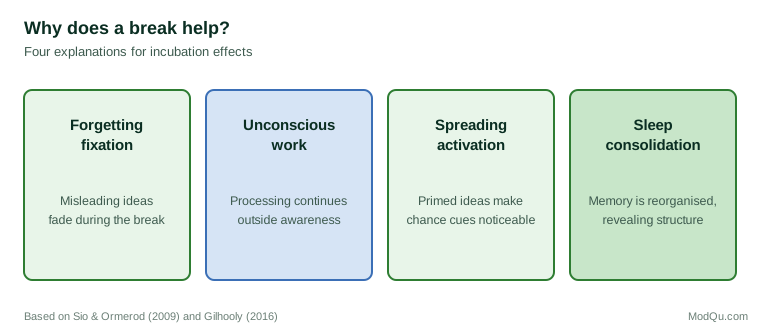
Why breaks help: four explanations
Forgetting fixation
During initial work on a problem, people often become fixed on a wrong approach or a misleading idea. Luchins (1942) showed how a method that worked before can blind people to a simpler one. Smith and Blankenship (1989, 1991) deliberately misled participants by giving them unhelpful clues to word puzzles. People who were misled performed worse, but a break reduced the effect, apparently because the misleading idea faded from memory. On this account, incubation does not add anything new; it removes an obstacle. When the thinker returns, they approach the problem more freshly.
Unconscious work
The explanation favoured by Poincaré and Wallas is that the mind continues to work on the problem outside awareness. Dijksterhuis and Meurs (2006) found that people who were distracted for a few minutes before listing ideas produced more original ideas than people who thought consciously for the same period. Zhong, Dijksterhuis and Galinsky (2008) found that after a period of distraction, the answers to unsolved problems became more accessible in a word-recognition task, even when people could not yet report them. Gilhooly (2016) reviewed this evidence and concluded that some form of unconscious work is likely to contribute to incubation, particularly for divergent tasks.
Claims about unconscious thought need care, however. A widely reported finding that complex decisions are made better after distraction than after deliberation (Dijksterhuis et al., 2006) did not hold up when Nieuwenstein and colleagues (2015) combined many studies and ran a large replication. Ritter and Dijksterhuis (2014) argue that unconscious processes contribute to creativity, but the size of the effect and the conditions in which it appears are still debated.
Spreading activation and chance cues
A third explanation is that working on a problem leaves related ideas slightly activated in memory. During the break, the person may encounter something, such as a remark, an object or a piece of news, that connects with one of these activated ideas. Because the problem is still partly "live", the connection is noticed. This view draws on Mednick's (1962) theory that creative ideas arise from linking remote associations. It explains why solutions often appear to be triggered by something unrelated to the problem, as in Poincaré's bus journey.
Sleep and memory consolidation
Sleep provides some of the strongest evidence for incubation. Wagner, Gais, Haider, Verleger and Born (2004) trained people on a number task that contained a hidden shortcut. After a night's sleep, 59% of participants discovered the shortcut, compared with about 23% of those who stayed awake for the same period. Cai, Mednick, Harrison, Kanady and Mednick (2009) found that a nap containing rapid eye movement (REM) sleep improved performance on remote associates problems that people had been exposed to earlier, while quiet rest and naps without REM did not. These studies suggest that sleep reorganises recently learned material in ways that can reveal structure that was not noticed while awake.
Mind wandering and the quality of rest
If incubation works partly through unconscious processing or spreading activation, the kind of break should matter. Baird and colleagues (2012) tested this. Participants worked on an unusual-uses task and then spent 12 minutes either doing a demanding memory task, doing an undemanding task that encouraged mind wandering, resting, or taking no break. On returning to problems they had already seen, the undemanding-task group improved most. The authors concluded that letting the mind wander, rather than either concentrating hard on something else or simply resting, best supports creative incubation.
Physical activity may help too. Oppezzo and Schwartz (2014) found that walking, whether outdoors or on a treadmill facing a blank wall, increased the number of creative ideas people produced, both while walking and shortly afterwards. The benefit was found for idea generation, not for problems with a single correct answer, which fits the meta-analytic finding that incubation helps most with divergent tasks.
Computational models
Researchers have tried to explain incubation with formal models. Hélie and Sun (2010) proposed a theory in which explicit, rule-based processing and implicit, associative processing run in parallel and interact. During incubation, explicit processing is reduced, which allows implicit processing to explore a wider range of associations. When an implicit association becomes strong enough, it crosses into awareness as an insight. Their model reproduces several known incubation findings, and it fits the neuroscience evidence that insight involves loose, distant associations (Kounios & Beeman, 2014).
How long, and when?
Research gives only partial guidance on the best length of a break. Laboratory studies typically use breaks of a few minutes to half an hour, and Sio and Ormerod (2009) found positive effects across a wide range of durations. Sleep studies show that an overnight break can produce much larger effects than a short pause (Wagner et al., 2004). In real work, where problems are more complex than laboratory puzzles, breaks of hours or days are common, and many professionals report that their best ideas come after a weekend or a holiday.
Timing matters as much as length. The evidence suggests three useful moments for a break. The first is at an impasse, when repeated attempts are producing nothing new; continuing at that point mainly strengthens fixation. The second is after an intensive period of absorbing new information, such as reading hundreds of open-ended responses, when the material needs time to settle. The third is before a final interpretation is written down, so that the first plausible explanation is not locked in before alternatives have had a chance to appear.
Incubation in teams and organisations
Most incubation research studies individuals working alone, but analytical work is usually done in teams. Groups offer both risks and opportunities. A team that meets every day to review the same analysis may reinforce a shared fixation, with each member's comments strengthening the dominant interpretation. On the other hand, a team provides a natural source of the chance cues that spreading-activation accounts describe. A colleague who has been working on a different project, or who brings knowledge from another field, may supply the connection that the analyst could not find alone.
Organisations can therefore support incubation by spacing review meetings so that people have time away between them, by bringing in fresh reviewers at the interpretation stage rather than only at the end, and by avoiding deadlines that leave no gap between finishing the numbers and presenting the conclusions. These practices cost little, and the research suggests they can make a measurable difference to the quality of the ideas that emerge.
Practical lessons for analytical work
The research suggests several practical steps for research teams, analysts and anyone whose job is to find insight in data.
- Prepare first, then pause. Incubation works best after substantial effort. A break taken before the data have been explored thoroughly is just a delay. A break taken after an analyst has reached an impasse is more likely to help.
- Plan time between analysis and interpretation. Project schedules that move straight from the last table to the final presentation leave no room for incubation. Even one night between completing analysis and writing conclusions gives sleep a chance to help.
- Choose undemanding breaks. Switching from one demanding analysis to another may stop progress on both. Routine tasks, a walk or other light activity are more likely to support mind wandering and the connections it brings.
- Keep the problem live. Incubation depends on the problem remaining partly active. Writing down the open question before stepping away, and returning to it deliberately, helps make chance cues noticeable.
- Use breaks to escape fixation. When a team keeps returning to the same explanation, a pause, a change of setting or a fresh colleague can help a misleading idea fade.
- Test what emerges. Ideas that arrive after a break feel convincing. That feeling is not evidence. Every idea produced during incubation still needs verification against the data.
Key takeaways
Incubation, the period away from a problem, reliably improves problem-solving under the right conditions. A meta-analysis of 117 studies found the effect largest for tasks that require many ideas, after substantial preparation and when breaks involve undemanding activity. Breaks help in several ways: by letting misleading ideas fade, by allowing unconscious processing, by keeping related ideas primed so that chance cues are noticed, and, during sleep, by reorganising memory. Strong claims about the power of unconscious thought have not all survived replication. For analytical teams, the lesson is to plan for incubation: work hard on the problem, step away to something undemanding, sleep on it, and then test whatever comes.
References
Baird, B., Smallwood, J., Mrazek, M. D., Kam, J. W. Y., Franklin, M. S., & Schooler, J. W. (2012). Inspired by distraction: Mind wandering facilitates creative incubation. Psychological Science, 23(10), 1117–1122. https://doi.org/10.1177/0956797612446024
Cai, D. J., Mednick, S. A., Harrison, E. M., Kanady, J. C., & Mednick, S. C. (2009). REM, not incubation, improves creativity by priming associative networks. Proceedings of the National Academy of Sciences, 106(25), 10130–10134. https://doi.org/10.1073/pnas.0900271106
Dijksterhuis, A., & Meurs, T. (2006). Where creativity resides: The generative power of unconscious thought. Consciousness and Cognition, 15(1), 135–146. https://doi.org/10.1016/j.concog.2005.04.007
Dijksterhuis, A., Bos, M. W., Nordgren, L. F., & van Baaren, R. B. (2006). On making the right choice: The deliberation-without-attention effect. Science, 311(5763), 1005–1007. https://doi.org/10.1126/science.1121629
Gilhooly, K. J. (2016). Incubation and intuition in creative problem solving. Frontiers in Psychology, 7, Article 1076. https://doi.org/10.3389/fpsyg.2016.01076
Hélie, S., & Sun, R. (2010). Incubation, insight, and creative problem solving: A unified theory and a connectionist model. Psychological Review, 117(3), 994–1024. https://doi.org/10.1037/a0019532
Kounios, J., & Beeman, M. (2014). The cognitive neuroscience of insight. Annual Review of Psychology, 65, 71–93. https://doi.org/10.1146/annurev-psych-010213-115154
Luchins, A. S. (1942). Mechanization in problem solving: The effect of Einstellung. Psychological Monographs, 54(6), i–95. https://doi.org/10.1037/h0093502
Mednick, S. A. (1962). The associative basis of the creative process. Psychological Review, 69(3), 220–232. https://doi.org/10.1037/h0048850
Nieuwenstein, M. R., Wierenga, T., Morey, R. D., Wicherts, J. M., Blom, T. N., Wagenmakers, E.-J., & van Rijn, H. (2015). On making the right choice: A meta-analysis and large-scale replication attempt of the unconscious thought advantage. Judgment and Decision Making, 10(1), 1–17. https://doi.org/10.1017/S1930297500003144
Oppezzo, M., & Schwartz, D. L. (2014). Give your ideas some legs: The positive effect of walking on creative thinking. Journal of Experimental Psychology: Learning, Memory, and Cognition, 40(4), 1142–1152. https://doi.org/10.1037/a0036577
Poincaré, H. (1910). Mathematical creation. The Monist, 20(3), 321–335. https://doi.org/10.5840/monist19102037
Ritter, S. M., & Dijksterhuis, A. (2014). Creativity: The unconscious foundations of the incubation period. Frontiers in Human Neuroscience, 8, Article 215. https://doi.org/10.3389/fnhum.2014.00215
Sadler-Smith, E. (2015). Wallas' four-stage model of the creative process: More than meets the eye? Creativity Research Journal, 27(4), 342–352. https://doi.org/10.1080/10400419.2015.1087277
Sio, U. N., & Ormerod, T. C. (2009). Does incubation enhance problem solving? A meta-analytic review. Psychological Bulletin, 135(1), 94–120. https://doi.org/10.1037/a0014212
Smith, S. M., & Blankenship, S. E. (1989). Incubation effects. Bulletin of the Psychonomic Society, 27(4), 311–314. https://doi.org/10.3758/BF03334612
Smith, S. M., & Blankenship, S. E. (1991). Incubation and the persistence of fixation in problem solving. The American Journal of Psychology, 104(1), 61–87. https://doi.org/10.2307/1422851
Wagner, U., Gais, S., Haider, H., Verleger, R., & Born, J. (2004). Sleep inspires insight. Nature, 427(6972), 352–355. https://doi.org/10.1038/nature02223
Wallas, G. (1926). The art of thought. Harcourt, Brace.
Zhong, C.-B., Dijksterhuis, A., & Galinsky, A. D. (2008). The merits of unconscious thought in creativity. Psychological Science, 19(9), 912–918. https://doi.org/10.1111/j.1467-9280.2008.02176.x