
Insights · What an insight is
Sensemaking Processes and the Emergence of Interpretive Knowledge
Sensemaking is the process by which people turn confusing events and ambiguous data into a working account of what is going on. This article explains the main theories, from Weick's organisational sensemaking to the data/frame model, and what they mean for research and insight teams.
Data rarely explain themselves. A sudden drop in sales, a cluster of unusual complaints or an unexpected survey result has to be interpreted before anyone can act on it. The interpretation is not a mechanical step. People notice some signals and ignore others, compare what they see with what they expected, try out explanations, talk to colleagues and settle on an account that seems good enough to act on. Researchers call this process sensemaking.
Sensemaking has become a central idea in organisation studies, cognitive psychology and information science. Each field uses the term slightly differently, but they share a focus on how people build understanding when the meaning of a situation is not given. This article reviews the main traditions and draws out their lessons for anyone whose work involves producing insight from data.
What sensemaking is
Maitlis and Christianson (2014), in a major review, describe sensemaking as the process through which people work to understand issues or events that are novel, ambiguous, confusing or in some way violate their expectations. Two features of this definition are important. First, sensemaking is triggered by a disruption: something does not fit. Second, it is a process, not a single act of understanding. It unfolds over time, often among several people, and its outcome is a working account rather than a final truth.
Sensemaking differs from decision-making. Decision-making assumes that the situation is understood and asks which option to choose. Sensemaking asks what the situation is in the first place. Weick, Sutcliffe and Obstfeld (2005) summarise the two central questions of sensemaking as "What's the story here?" and "Now what?" Insight, in this view, is one possible outcome of sensemaking: a moment at which a new and better account of the situation becomes available.
Weick's organisational sensemaking
The most influential account of sensemaking comes from the organisational psychologist Karl Weick. In Sensemaking in Organizations, Weick (1995) described seven properties of the process:
- Grounded in identity. How people make sense of events depends on who they think they are. A finance team and a customer service team may interpret the same complaint data differently because each sees itself as responsible for different things.
- Retrospective. People make sense of events after they have happened, by looking back at what they have already done and experienced.
- Enactive. People partly create the environments they then try to understand. A company that defines its market narrowly will collect data only about that market and will then "discover" that it is narrow.
- Social. Sensemaking happens in conversation with others, real or imagined. Accounts are shaped by what can be explained and defended to colleagues.
- Ongoing. There is no starting point at which people first begin to make sense; they are always in the middle of something.
- Focused on extracted cues. People select a few cues from a mass of information and build their account around them. The choice of cues shapes the account that emerges.
- Driven by plausibility rather than accuracy. People settle on an account that is plausible and coherent enough to act on. They rarely have the time or information to establish that it is accurate.
The last property is the most challenging for researchers. Weick argued that in fast-moving situations, a plausible account that allows action is more useful than waiting for certainty. But plausibility is not truth, and accounts that are good enough to act on can also be wrong.
When sensemaking collapses
Weick (1993) illustrated what happens when sensemaking breaks down with an analysis of the Mann Gulch fire of 1949, in which thirteen firefighters died in Montana. The crew had expected a routine fire, and that expectation shaped how they read the early signs. When the fire turned and raced towards them, their understanding of the situation collapsed. The foreman lit an escape fire and lay down in the burned area, calling on the crew to follow. The idea made no sense within their existing understanding, and they did not follow. Weick called such moments cosmology episodes: situations in which people suddenly feel that the world no longer makes sense and that their means of rebuilding understanding have collapsed with it. In an earlier paper on crises, Weick (1988) argued that action itself shapes the understanding people develop, so the way people respond to an emerging crisis can make it better or worse.
Organisations as interpretation systems
Daft and Weick (1984) described organisations as systems that scan their environment, interpret what they find and learn from it. They proposed that organisations differ in two ways: in whether they believe the environment can be analysed, and in how actively they intrude into it to find out. Organisations that see their environment as analysable and search it actively engage in systematic discovery, such as formal market research. Those that see it as unanalysable and wait passively rely on undirected viewing, picking up impressions from informal contacts. Each mode produces a different kind of interpretation. The framework remains useful for diagnosing how a company's insight function actually works.
Triggers: surprise and contradiction
Sensemaking begins when expectations are violated. Louis (1980) studied people starting new jobs and found that surprise, the gap between what newcomers expected and what they experienced, was the main trigger for sensemaking. Newcomers had to explain these surprises and often relied on the accounts of established colleagues to do so.
The same pattern appears in professional insight. Klein and Jarosz (2011) analysed 120 examples of insight among professionals and found that contradictions, observations that did not fit the current account, were among the most common triggers. For research teams, this has a clear implication: the findings that do not fit expectations are the ones most worth examining, because they are the ones most likely to prompt a better account.
Sensemaking as social: sensegiving
Sensemaking in organisations is not only a private process. Leaders and others try to shape how people interpret events. Gioia and Chittipeddi (1991) studied a new university president who wanted to change the institution's strategy. They described a cycle in which the president first made sense of the situation, then engaged in sensegiving, attempting to influence how others understood it, and then made sense of how others had responded. Sensemaking and sensegiving alternated as the strategy developed.
Maitlis (2005) extended this work by studying how organisations make sense of issues collectively. Maitlis found that the form sensemaking took depended on how actively leaders and other stakeholders tried to shape interpretations. When both were active, sensemaking was guided and produced a rich, unified account. When stakeholders were active but leaders were not, it became fragmented, producing many partial accounts. When leaders controlled the process but stakeholders were passive, it was restricted, producing a narrow account. When neither was active, sensemaking was minimal. For insight teams, this suggests that the way findings are discussed with stakeholders shapes the understanding the organisation ends up with, not just the findings themselves.
Cornelissen (2012) showed that professional roles and accountability to particular audiences shape the sense people construct under pressure. People build accounts that they expect to be able to justify to those they answer to, which can lead different professional groups to different interpretations of the same events.
The cognitive view: frames and data
Psychologists studying expert decision-makers have developed a more detailed model of the cognitive side of sensemaking. Klein, Moon and Hoffman (2006a, 2006b) proposed the data/frame model. A frame is an explanatory structure, such as a story, a map or a causal model, that accounts for the available data and tells the person what else to look for. Frames and data shape each other:
- Frames select data. The current frame determines which information seems relevant. Data that do not fit may not even be noticed.
- Data elaborate frames. New information that fits is used to fill in details.
- Data question frames. Information that does not fit raises doubts. People may explain it away, or they may begin to search for a better frame.
- Data trigger reframing. When enough anomalies accumulate, people may abandon the frame and adopt a new one that accounts for the evidence better.
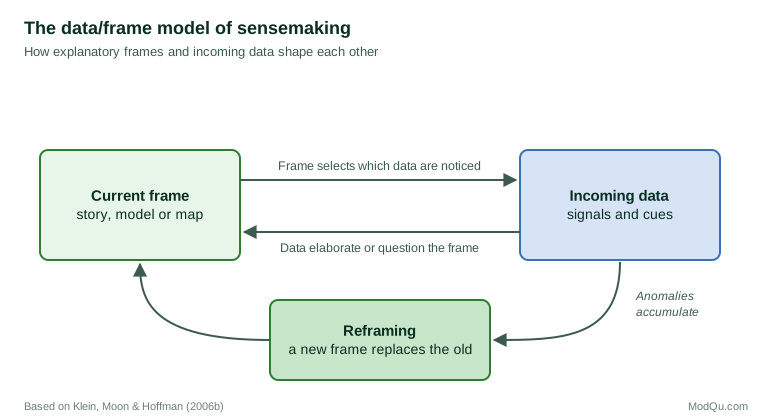
Reframing in this model corresponds closely to the restructuring described by Gestalt psychologists and to the moment of insight. The model also explains why insight is difficult: the current frame filters out exactly the data that would challenge it.
Sensemaking in information work
Information scientists have studied sensemaking in people who analyse large amounts of information. Russell, Stefik, Pirolli and Card (1993) observed analysts and described sensemaking as a cycle of searching for a representation, a schema that organises the information, and then encoding data into that representation. When the representation does not fit the data well, it must be revised. They argued that the cost of finding and revising a good representation is often the main cost of analytical work.
Dervin (1998) developed a different tradition, sense-making methodology, which treats people as moving through situations in which they encounter gaps in their understanding and must build bridges across them. Dervin's approach has been used to design interviews and information services around the gaps people actually experience.
Situation awareness
A closely related concept is situation awareness, developed for pilots, air traffic controllers and others who work in fast-changing environments. Endsley (1995) described it at three levels: perceiving the relevant elements of a situation, understanding what they mean together and projecting what will happen next. Situation awareness is the product of successful sensemaking. Its three levels map neatly onto the work of turning data into findings, findings into insight and insight into forecasts.
From sensemaking to interpretive knowledge
What does sensemaking produce? In the information science tradition, the move from data to information to knowledge is often drawn as a pyramid, with each level adding meaning to the one below (Rowley, 2007). Sensemaking research suggests that the move is not a smooth climb. Knowledge about an ambiguous situation is interpretive: it consists of an account that links selected data into a story about causes, motives and likely consequences. The account depends on the frame used to build it, on the cues extracted and on the people involved in constructing it. Two competent teams can examine the same data and reach different interpretive accounts, and both may be plausible.
This has two consequences for insight work. First, interpretive knowledge is not simply discovered in data; it is constructed, and the construction can be done well or badly. Said, Macdonald, Wilson and Marcos (2015) found that organisations which generated customer insight successfully treated it as a process involving many people across functions, not as a report handed over by a research team. Second, because interpretive knowledge rests on a frame, the most valuable new knowledge often comes from changing the frame rather than from adding data. Cognitive research on insight describes the same thing at the level of individual problem-solving: progress comes when an unnoticed constraint is relaxed or a familiar unit is broken into its parts (Knoblich et al., 1999). Sensemaking theories extend this observation to groups and organisations, where frames are shared, defended and embedded in routines, and are therefore harder to change.
Sensemaking in complex environments
Not all situations can be understood in the same way. Kurtz and Snowden (2003) proposed the Cynefin framework, which distinguishes between environments where cause and effect are known, those where they can be found through analysis, complex environments where cause and effect can only be seen in hindsight, and chaotic environments with no visible cause and effect at all. Each calls for a different approach to sensemaking. In complex environments, the recommended approach is to probe, sense and respond: to try small actions and make sense of the results, rather than to analyse first. Many consumer markets have complex features, which is one reason why experiments and rapid feedback often produce better understanding than ever more elaborate analysis.
Criticisms and open questions
Sandberg and Tsoukas (2015) reviewed the sensemaking literature and identified a core structure shared by most studies: an ambiguous event triggers a process of noticing, interpreting and acting that produces a revised understanding. They also noted limitations. Most research focuses on dramatic episodes, such as crises, rather than on the everyday sensemaking that fills ordinary working life. Studies often look backwards at how sense was made rather than forwards at how people anticipate the future. And the role of language, emotion and the body in making sense is still poorly understood. Brown, Colville and Pye (2015) add that the field has been dominated by a small number of theories and would benefit from greater variety.
Lessons for insight teams
Sensemaking research offers practical guidance for anyone who interprets data.
- Treat surprises as signals. Findings that contradict expectations are the main trigger for better understanding. Highlight them rather than explaining them away.
- Name the current frame. Every analysis is conducted within a frame: an assumed account of the market, the customer or the problem. Writing it down makes it easier to see which data it is filtering out.
- Look for disconfirming data. Because frames select the data that fit them, a deliberate search for data that would contradict the frame is needed to avoid confirmation.
- Remember that plausible is not proven. Sensemaking settles on accounts that are good enough to act on. Insight work should go one step further and test whether the account is true.
- Manage sensegiving deliberately. The way findings are presented and discussed shapes the organisation's understanding. Involving stakeholders actively, as in Maitlis's guided sensemaking, tends to produce richer and more widely shared accounts.
- Probe when the environment is complex. When cause and effect are not stable, small experiments can produce understanding faster than further analysis of existing data.
Key takeaways
Sensemaking is the process by which people build working accounts of ambiguous situations. Weick's organisational tradition emphasises that sensemaking is retrospective, social, driven by plausibility and shaped by identity and action. Cognitive research describes a continuous interplay between frames and data, in which reframing corresponds to insight. Information scientists have shown that much analytical effort goes into finding the right representation for data. Together, these traditions explain both how interpretive knowledge emerges and why it can go wrong: the frames that make sense possible also hide the evidence that would change them. Research teams that recognise their frames, attend to surprises and test plausible accounts are better placed to turn data into reliable insight.
References
Brown, A. D., Colville, I., & Pye, A. (2015). Making sense of sensemaking in organization studies. Organization Studies, 36(2), 265–277. https://doi.org/10.1177/0170840614559259
Cornelissen, J. P. (2012). Sensemaking under pressure: The influence of professional roles and social accountability on the creation of sense. Organization Science, 23(1), 118–137. https://doi.org/10.1287/orsc.1100.0640
Daft, R. L., & Weick, K. E. (1984). Toward a model of organizations as interpretation systems. Academy of Management Review, 9(2), 284–295. https://doi.org/10.5465/amr.1984.4277657
Dervin, B. (1998). Sense-making theory and practice: An overview of user interests in knowledge seeking and use. Journal of Knowledge Management, 2(2), 36–46. https://doi.org/10.1108/13673279810249369
Endsley, M. R. (1995). Toward a theory of situation awareness in dynamic systems. Human Factors, 37(1), 32–64. https://doi.org/10.1518/001872095779049543
Gioia, D. A., & Chittipeddi, K. (1991). Sensemaking and sensegiving in strategic change initiation. Strategic Management Journal, 12(6), 433–448. https://doi.org/10.1002/smj.4250120604
Klein, G., & Jarosz, A. (2011). A naturalistic study of insight. Journal of Cognitive Engineering and Decision Making, 5(4), 335–351. https://doi.org/10.1177/1555343411427013
Klein, G., Moon, B., & Hoffman, R. R. (2006a). Making sense of sensemaking 1: Alternative perspectives. IEEE Intelligent Systems, 21(4), 70–73. https://doi.org/10.1109/MIS.2006.75
Klein, G., Moon, B., & Hoffman, R. R. (2006b). Making sense of sensemaking 2: A macrocognitive model. IEEE Intelligent Systems, 21(5), 88–92. https://doi.org/10.1109/MIS.2006.100
Knoblich, G., Ohlsson, S., Haider, H., & Rhenius, D. (1999). Constraint relaxation and chunk decomposition in insight problem solving. Journal of Experimental Psychology: Learning, Memory, and Cognition, 25(6), 1534–1555. https://doi.org/10.1037/0278-7393.25.6.1534
Kurtz, C. F., & Snowden, D. J. (2003). The new dynamics of strategy: Sense-making in a complex and complicated world. IBM Systems Journal, 42(3), 462–483. https://doi.org/10.1147/sj.423.0462
Louis, M. R. (1980). Surprise and sense making: What newcomers experience in entering unfamiliar organizational settings. Administrative Science Quarterly, 25(2), 226–251. https://doi.org/10.2307/2392453
Maitlis, S. (2005). The social processes of organizational sensemaking. Academy of Management Journal, 48(1), 21–49. https://doi.org/10.5465/amj.2005.15993111
Maitlis, S., & Christianson, M. (2014). Sensemaking in organizations: Taking stock and moving forward. Academy of Management Annals, 8(1), 57–125. https://doi.org/10.5465/19416520.2014.873177
Rowley, J. (2007). The wisdom hierarchy: Representations of the DIKW hierarchy. Journal of Information Science, 33(2), 163–180. https://doi.org/10.1177/0165551506070706
Russell, D. M., Stefik, M. J., Pirolli, P., & Card, S. K. (1993). The cost structure of sensemaking. In Proceedings of the INTERACT '93 and CHI '93 Conference on Human Factors in Computing Systems (pp. 269–276). ACM. https://doi.org/10.1145/169059.169209
Said, E., Macdonald, E. K., Wilson, H. N., & Marcos, J. (2015). How organisations generate and use customer insight. Journal of Marketing Management, 31(9–10), 1158–1179. https://doi.org/10.1080/0267257X.2015.1037785
Sandberg, J., & Tsoukas, H. (2015). Making sense of the sensemaking perspective: Its constituents, limitations, and opportunities for further development. Journal of Organizational Behavior, 36(S1), S6–S32. https://doi.org/10.1002/job.1937
Weick, K. E. (1988). Enacted sensemaking in crisis situations. Journal of Management Studies, 25(4), 305–317. https://doi.org/10.1111/j.1467-6486.1988.tb00039.x
Weick, K. E. (1993). The collapse of sensemaking in organizations: The Mann Gulch disaster. Administrative Science Quarterly, 38(4), 628–652. https://doi.org/10.2307/2393339
Weick, K. E. (1995). Sensemaking in organizations. Sage.
Weick, K. E., Sutcliffe, K. M., & Obstfeld, D. (2005). Organizing and the process of sensemaking. Organization Science, 16(4), 409–421. https://doi.org/10.1287/orsc.1050.0133