
Insights · What an insight is
Insight Versus Analysis: Two Routes to Understanding
People reach new understanding in two broad ways, through sudden insight or through step-by-step analysis. This article explains how the two routes differ, what research shows about their accuracy and the conditions that favour each, and how good research practice combines them.
When people solve a difficult problem or make sense of puzzling evidence, they can arrive at an answer in two quite different ways. Sometimes the answer emerges gradually through deliberate reasoning: each step follows from the last, and the thinker can explain how they got there. At other times the answer arrives suddenly, often after a period of being stuck, and the thinker cannot say exactly where it came from. Psychologists call the first route analysis and the second insight.
The distinction matters well beyond the laboratory. Research teams, analysts and managers rely on both routes, often without noticing which one they are using. Each has typical strengths and typical errors. This article sets out what is known about the two routes, how researchers tell them apart, and how they can be combined in practical work.
Two routes, one destination
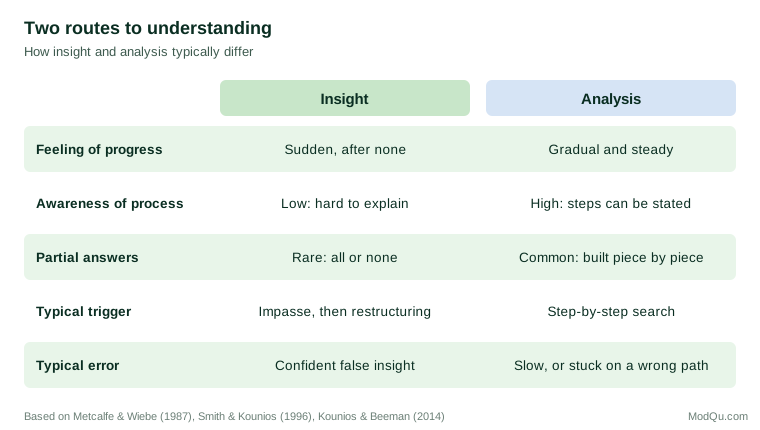
The simplest way to describe the difference is by how progress feels. In analysis, people can sense that they are getting closer to a solution. In insight, they cannot. Metcalfe and Wiebe (1987) asked participants to rate their "warmth", or closeness to a solution, every 15 seconds while working. On algebra problems, warmth rose gradually. On insight problems, it stayed flat until just before the answer appeared. People could also predict which analytic problems they would solve but could not predict their success on insight problems.
A second difference concerns partial information. Smith and Kounios (1996) interrupted people while they worked on anagrams and asked for their best guess. When people later reported solving by insight, the interrupted guesses contained almost no partial information: the solution appeared in an all-or-none way. Analytic solutions, by contrast, could be built up piece by piece.
A third difference concerns awareness of the process. Analytic thinkers can usually describe their reasoning. Insight solvers often cannot. In Maier's (1931) classic experiments, people solved a problem after a hint without noticing the hint at all. Schooler, Ohlsson and Brooks (1993) found that asking people to describe their thoughts aloud while working actually impaired performance on insight problems, but not on analytic problems. Putting thoughts into words seemed to keep people locked into their current, unsuccessful way of seeing the problem. They called this effect verbal overshadowing.
How researchers tell the routes apart
Studying the two routes requires a way of knowing which one a person used. Early research classified problems as insight or analytic, but this proved unreliable, because the same problem can be solved either way. Modern research usually classifies solutions instead, by asking people how each answer came to them.
The standard tool is the compound remote associates problem. People see three words, such as crab, pine and sauce, and must find a fourth word that forms a compound with each (apple). Bowden and Jung-Beeman (2003) published normative data for 144 such problems, which are short enough to present dozens of times in one session. After each answer, participants press one button if the solution came suddenly and was obvious once it appeared, and another if they reached it step by step, for example by trying words one at a time. Because the problems are identical and only the reported route differs, researchers can compare brain activity, accuracy and timing for the two routes directly.
Self-reports of this kind have limits, but they are surprisingly consistent with other evidence. Topolinski and Reber (2010) describe the Aha! experience as combining suddenness, ease of processing, positive feeling and confidence, and people can report these features reliably. The neural and behavioural differences found with this method, such as the all-or-none timing of insight solutions, suggest that people are reporting something real rather than simply guessing.
Is insight a separate process?
Researchers disagree about whether insight and analysis are fundamentally different processes or two experiences of the same underlying process.
The "special process" view
One group argues that insight involves distinctive mechanisms. Neuroscience studies support this. Jung-Beeman and colleagues (2004) found that insight solutions to word problems were accompanied by a burst of activity in the right anterior temporal lobe, a region involved in connecting distant meanings, which did not occur for analytic solutions. Kounios and Beeman (2014) review evidence that insight is preceded by distinctive brain states, including inward attention and reduced processing of visual input. Bowden, Jung-Beeman, Fleck and Kounios (2005) argue that insight depends on weak, distant associations that are held below awareness until one becomes strong enough to reach consciousness.
The "business as usual" view
Another group argues that insight is ordinary thinking that happens to feel sudden. Weisberg (2015) points out that many problems classed as "insight problems" are often solved without any restructuring, and that people's knowledge and feedback from failed attempts explain much of their success. Fleck and Weisberg (2004) recorded people thinking aloud while solving Duncker's candle problem. Some solutions did follow an impasse and a sudden change of view, but many came through ordinary analysis, or through restructuring prompted by the failure of an earlier approach.
A middle position
Much current research takes a middle position. Webb, Little and Cropper (2016) found that people report insight experiences on many types of problems, including those traditionally classed as analytic, and do not always report insight on so-called insight problems. Insight, they concluded, is a property of how a particular person solves a particular problem, not of the problem itself. Gilhooly and Murphy (2005) found that performance on insight and non-insight problems formed partly separate clusters in individual-difference data, which suggests the two routes draw on overlapping but not identical abilities. Weisberg (2015) proposes an integrated theory in which analytic thinking is the default, with restructuring taking over when analysis fails.
What each route relies on
Working memory and attention
Analytic thinking depends heavily on working memory, the limited mental space in which people hold and manipulate information. Dual-process theories describe deliberate, analytic thought as requiring working memory and controlled attention, whereas faster, intuitive processes do not (Evans & Stanovich, 2013).
The role of working memory in insight is more complicated. Chein and Weisberg (2014) found that people with greater working memory capacity solved more remote associates problems, including those they reported solving by insight. But Wiley and Jarosz (2012) reviewed evidence that a strong, narrow focus of attention, which usually helps analysis, can sometimes hinder creative problem-solving, because it prevents people from considering distant possibilities. A striking demonstration came from Jarosz, Colflesh and Wiley (2012), who found that mildly intoxicated participants solved more remote associates problems, and more quickly, than sober participants, and were more likely to report insight. The authors did not recommend alcohol as a research tool; their point was that loosening attentional control can help when the answer lies outside the obvious.
Mood
Mood also appears to shift the balance between the two routes. Isen, Daubman and Nowicki (1987) found that people who had watched a short comedy film were more likely to solve Duncker's candle problem than people in a neutral mood. Subramaniam, Kounios, Parrish and Jung-Beeman (2009) found that people in a more positive mood solved more problems by insight, and that this was linked to activity in a brain region involved in detecting competing ideas. Positive mood seems to broaden attention and make weak associations more available, which favours insight.
Which route is more accurate?
It is often assumed that careful analysis is more reliable than sudden insight. The evidence does not straightforwardly support that assumption. Salvi, Bricolo, Kounios, Bowden and Beeman (2016) analysed several types of problems and found that solutions reported as insights were correct more often than those reported as analytic. The difference was particularly clear when people were working against a deadline. Analytic thinkers under time pressure tended to offer partly worked-out guesses, while insight solutions, being all-or-none, were either complete or absent.
But insight has its own characteristic error. Danek and Wiley (2017) showed that people sometimes experience a strong Aha! moment for a wrong answer. Because the insight feels obvious and certain, it may not be checked. Analysis has the opposite weakness: it can be slow, can get stuck on a wrong path, and can generate a false sense that a conclusion is justified simply because it was reached by a series of logical steps from a flawed starting point.
Insight, analysis and intuition in organisations
In management research, a related debate concerns intuition and analysis in decision-making. Simon (1987) argued that the intuitions of experienced managers are not mysterious: they are "analyses frozen into habit", patterns learned through long experience and recognised rapidly. Dane and Pratt (2007) defined intuition as fast, non-conscious, holistic judgement and argued that its effectiveness depends on the decision-maker's expertise and on the kind of problem.
Kahneman and Klein (2009), writing from opposite traditions, agreed on the conditions under which intuitive expertise can be trusted. Intuitions are reliable when the environment is regular enough to be learned and when the person has had many opportunities to learn it, with timely feedback. A nurse with years of experience may sense that a patient is deteriorating before any measurement shows it. A stock picker's intuitions about next month's market are much less likely to be reliable, because the environment is too irregular to learn.
These conditions apply to insight too. Klein and Jarosz (2011), studying insights from professionals, found that many came from noticing a connection or a contradiction that only someone with deep knowledge of the domain would recognise. Insight is not a substitute for knowledge; it is one of the ways knowledge is used.
Time pressure and the choice of route
Organisations rarely give analysts unlimited time, and deadlines change which route is likely to succeed. Under time pressure, people tend to fall back on familiar analytic procedures, and the incubation and broad attention that favour insight are squeezed out. Yet the evidence on accuracy suggests that this is not always the safer choice. When Salvi and colleagues (2016) imposed deadlines, analytic responses became more error-prone, because people offered half-finished answers, while insight responses remained largely accurate when they appeared at all.
The practical implication is not that analysts should wait for inspiration under deadline, but that research schedules should be planned so that the stage most dependent on insight, interpretation, is not the stage most compressed by time pressure. Projects often allocate generous time to fieldwork and data processing and leave interpretation to the final day. Reversing that balance, or at least protecting a period between finishing the tables and writing the conclusions, gives both routes a chance to contribute. Mood and atmosphere matter too: the evidence linking positive mood to insight (Isen et al., 1987; Subramaniam et al., 2009) suggests that interpretation sessions held in a relaxed, exploratory setting may produce more than sessions held under pressure to deliver a verdict.
A worked example
Consider an analyst trying to understand why customer satisfaction with a bank's mobile app fell sharply after an update.
The analytic route begins with a checklist. The analyst compares ratings before and after the update, breaks them down by device, age group and type of transaction, and reads complaint text for frequent words. The decline turns out to be concentrated among older customers and among people who use the app mainly to check balances. Complaints mention "logging in" more often than before. Step by step, the analyst builds a picture: something about the login process is causing problems for a particular group. Each step can be shown in a table.
But the analysis stalls. The login process did not change in the update, and login times are no faster or slower than before. The analyst has reached an impasse. Over the following days, while doing other work, the analyst keeps returning to a single phrase from one complaint: "I can't find where I'm meant to look." Then the explanation arrives at once. The update moved the account balance from the first screen to a second tab. Customers who opened the app only to check their balance now had to log in and then search for it. What customers called a login problem was a navigation problem experienced immediately after login.
The insight reorganised the existing findings into a coherent account. It also generated a precise prediction that could be tested: customers who used the balance feature most should show the largest fall in satisfaction, and the time between login and first tap should have risen. Both predictions were checked analytically and confirmed. The two routes worked together: analysis narrowed the problem and verified the solution, while insight supplied the explanation that analysis alone had not reached.
Combining the two routes in research practice
The two routes are not rivals. Good research work moves between them deliberately.
Use analysis to prepare. Insight depends on familiarity with the material. Systematic analysis, such as examining distributions, cross-tabulating results and reading open-ended responses in full, builds the knowledge from which insight can emerge. It also defines the impasse: the point at which the obvious explanations have been tested and found wanting.
Make room for insight. When analysis stalls, continuing harder in the same direction often strengthens fixation. A break, a change of perspective, a discussion with someone from outside the project or a deliberate attempt to question the framing of the problem creates the conditions in which restructuring is more likely. Because verbalising can interfere with insight (Schooler et al., 1993), it may help to allow some unstructured thinking time before asking people to explain their ideas.
Use analysis to verify. Every insight should be treated as a hypothesis and tested analytically. Does the explanation fit all the relevant data, or only the striking examples that prompted it? Would a different explanation fit equally well? What result would show it to be wrong? This is where analysis earns its reputation for reliability.
Watch for each route's typical error. For insight, the risk is a confident but wrong explanation that escapes scrutiny. For analysis, the risk is a long chain of reasoning built on an unexamined assumption. Reviewers can ask different questions of each: for an insight, "What evidence would contradict this?"; for an analysis, "What did we assume at the start?"
Value both in the team. Some analysts are drawn to careful, systematic work; others are good at spotting patterns and making unexpected connections. Teams that include both, and that recognise both contributions, are more likely to find insights and less likely to act on false ones.
Key takeaways
Insight and analysis are two routes to understanding. Analysis feels gradual, can be explained step by step and relies heavily on working memory and focused attention. Insight feels sudden, comes with little sense of progress or awareness of process, and often follows an impasse. Researchers still debate whether insight is a special process or ordinary thinking that feels different, but both routes are real experiences with distinctive strengths and errors. Insight solutions are often accurate but can be confidently wrong; analysis is checkable but can be slow and can build on flawed assumptions. Good research practice uses analysis to prepare for insight and to verify it, and makes room for insight when analysis stalls.
References
Bowden, E. M., & Jung-Beeman, M. (2003). Normative data for 144 compound remote associate problems. Behavior Research Methods, Instruments, & Computers, 35(4), 634–639. https://doi.org/10.3758/BF03195543
Bowden, E. M., Jung-Beeman, M., Fleck, J., & Kounios, J. (2005). New approaches to demystifying insight. Trends in Cognitive Sciences, 9(7), 322–328. https://doi.org/10.1016/j.tics.2005.05.012
Chein, J. M., & Weisberg, R. W. (2014). Working memory and insight in verbal problems: Analysis of compound remote associates. Memory & Cognition, 42(1), 67–83. https://doi.org/10.3758/s13421-013-0343-4
Dane, E., & Pratt, M. G. (2007). Exploring intuition and its role in managerial decision making. Academy of Management Review, 32(1), 33–54. https://doi.org/10.5465/amr.2007.23463682
Danek, A. H., & Wiley, J. (2017). What about false insights? Deconstructing the Aha! experience along its multiple dimensions for correct and incorrect solutions separately. Frontiers in Psychology, 7, Article 2077. https://doi.org/10.3389/fpsyg.2016.02077
Evans, J. St. B. T., & Stanovich, K. E. (2013). Dual-process theories of higher cognition: Advancing the debate. Perspectives on Psychological Science, 8(3), 223–241. https://doi.org/10.1177/1745691612460685
Fleck, J. I., & Weisberg, R. W. (2004). The use of verbal protocols as data: An analysis of insight in the candle problem. Memory & Cognition, 32(6), 990–1006. https://doi.org/10.3758/BF03196876
Gilhooly, K. J., & Murphy, P. (2005). Differentiating insight from non-insight problems. Thinking & Reasoning, 11(3), 279–302. https://doi.org/10.1080/13546780442000187
Isen, A. M., Daubman, K. A., & Nowicki, G. P. (1987). Positive affect facilitates creative problem solving. Journal of Personality and Social Psychology, 52(6), 1122–1131. https://doi.org/10.1037/0022-3514.52.6.1122
Jarosz, A. F., Colflesh, G. J. H., & Wiley, J. (2012). Uncorking the muse: Alcohol intoxication facilitates creative problem solving. Consciousness and Cognition, 21(1), 487–493. https://doi.org/10.1016/j.concog.2012.01.002
Jung-Beeman, M., Bowden, E. M., Haberman, J., Frymiare, J. L., Arambel-Liu, S., Greenblatt, R., Reber, P. J., & Kounios, J. (2004). Neural activity when people solve verbal problems with insight. PLoS Biology, 2(4), Article e97. https://doi.org/10.1371/journal.pbio.0020097
Kahneman, D., & Klein, G. (2009). Conditions for intuitive expertise: A failure to disagree. American Psychologist, 64(6), 515–526. https://doi.org/10.1037/a0016755
Klein, G., & Jarosz, A. (2011). A naturalistic study of insight. Journal of Cognitive Engineering and Decision Making, 5(4), 335–351. https://doi.org/10.1177/1555343411427013
Kounios, J., & Beeman, M. (2014). The cognitive neuroscience of insight. Annual Review of Psychology, 65, 71–93. https://doi.org/10.1146/annurev-psych-010213-115154
Maier, N. R. F. (1931). Reasoning in humans. II. The solution of a problem and its appearance in consciousness. Journal of Comparative Psychology, 12(2), 181–194. https://doi.org/10.1037/h0071361
Metcalfe, J., & Wiebe, D. (1987). Intuition in insight and noninsight problem solving. Memory & Cognition, 15(3), 238–246. https://doi.org/10.3758/BF03197722
Salvi, C., Bricolo, E., Kounios, J., Bowden, E., & Beeman, M. (2016). Insight solutions are correct more often than analytic solutions. Thinking & Reasoning, 22(4), 443–460. https://doi.org/10.1080/13546783.2016.1141798
Schooler, J. W., Ohlsson, S., & Brooks, K. (1993). Thoughts beyond words: When language overshadows insight. Journal of Experimental Psychology: General, 122(2), 166–183. https://doi.org/10.1037/0096-3445.122.2.166
Simon, H. A. (1987). Making management decisions: The role of intuition and emotion. Academy of Management Executive, 1(1), 57–64. https://doi.org/10.5465/ame.1987.4275905
Smith, R. W., & Kounios, J. (1996). Sudden insight: All-or-none processing revealed by speed–accuracy decomposition. Journal of Experimental Psychology: Learning, Memory, and Cognition, 22(6), 1443–1462. https://doi.org/10.1037/0278-7393.22.6.1443
Subramaniam, K., Kounios, J., Parrish, T. B., & Jung-Beeman, M. (2009). A brain mechanism for facilitation of insight by positive affect. Journal of Cognitive Neuroscience, 21(3), 415–432. https://doi.org/10.1162/jocn.2009.21057
Topolinski, S., & Reber, R. (2010). Gaining insight into the "Aha" experience. Current Directions in Psychological Science, 19(6), 402–405. https://doi.org/10.1177/0963721410388803
Webb, M. E., Little, D. R., & Cropper, S. J. (2016). Insight is not in the problem: Investigating insight in problem solving across task types. Frontiers in Psychology, 7, Article 1424. https://doi.org/10.3389/fpsyg.2016.01424
Weisberg, R. W. (2015). Toward an integrated theory of insight in problem solving. Thinking & Reasoning, 21(1), 5–39. https://doi.org/10.1080/13546783.2014.886625