
Insights · What an insight is
The Cognitive Science of Insight: The "Aha" Moment
What happens in the mind and brain when a solution arrives suddenly, how researchers measure the Aha moment, and what the findings mean for people whose job is to find insight in data.
Most people know the feeling. You have been stuck on a problem for some time, and then the answer arrives all at once, complete and obviously right. Psychologists call this the "Aha!" experience, and over the past four decades cognitive scientists and neuroscientists have turned it from an anecdote into something that can be measured. This article summarises what they have found.
Measuring suddenness
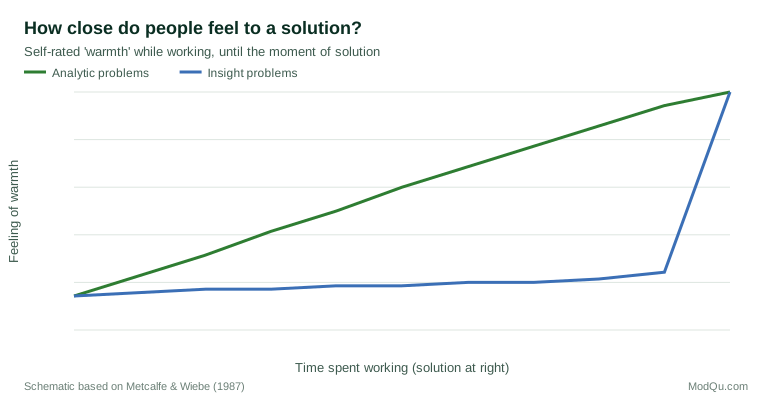
The first challenge was to show that insight is really sudden, rather than simply feeling sudden. Metcalfe and Wiebe (1987) asked people to rate every 15 seconds how "warm" they felt, meaning how close they were to a solution. On algebra problems, warmth ratings rose steadily as people worked toward an answer. On classic insight problems, ratings stayed low and then jumped just before the solution. People could predict their own success on ordinary problems but not on insight problems.
Smith and Kounios (1996) used a more objective method. They interrupted people at different moments while they were solving anagrams and asked for their best guess. For problems solved with insight, people had no partial information before the solution appeared: they either had the answer or did not. This all-or-none pattern supports the idea that insight solutions are assembled outside awareness and then become conscious in a single step.
A standard task: remote associates
Much of the modern research uses compound remote associates problems, a task descended from Mednick's (1962) work on creativity. A person sees three words, such as pine, crab and sauce, and must find a fourth word that forms a compound with each (here, apple). Bowden and Jung-Beeman (2003) published normative data for 144 such problems, making it possible to run many short trials. After each solution, participants report whether the answer came through insight (suddenly, with an Aha! feeling) or through analysis (step by step). The same problems can therefore be solved either way, which lets researchers compare the two routes directly.
What the brain does
Using this method, Jung-Beeman and colleagues (2004) recorded brain activity while people solved remote associates problems. Insight solutions were associated with increased activity in the right anterior superior temporal gyrus, a region involved in integrating distantly related meanings. Electrical recordings showed a sudden burst of high-frequency activity in the same area about a third of a second before people reported an insight solution. Just before the burst there was a change in activity over the visual cortex that the researchers interpreted as the brain briefly reducing visual input, as if "closing the eyes" to allow a weak internal idea to come through.
Bowden, Jung-Beeman, Fleck and Kounios (2005) explain why the right hemisphere might matter. Studies of language processing suggest that the left hemisphere tends to activate a narrow set of closely related meanings for a word, while the right hemisphere activates a broader, weaker set of distant associations. When a problem cannot be solved with the obvious meanings, the distant associations held in the right hemisphere may contain the missing link. Insight, on this account, is the moment when one of those weak associations becomes strong enough to reach awareness.
The brain's state before a problem appears also matters. Kounios and colleagues (2006) found that patterns of resting activity before each problem predicted whether it would later be solved by insight or analysis. Kounios and Beeman (2014) review this and related work, concluding that insight depends on a network of processes, including attention directed inward, loose associations between distant ideas and a readiness to switch away from an unproductive approach.
The feeling itself
The Aha! experience is not only a cognitive event but also an emotional one. Topolinski and Reber (2010) argue that it has four features: the solution appears suddenly, it is processed easily once it appears, it brings a positive feeling, and it brings confidence that it is correct. Danek, Fraps, von Müller, Grothe and Öllinger (2014) asked people to watch magic tricks and work out how they were done. Their self-reports showed that the Aha! feeling varies in strength and has several dimensions, including pleasure, surprise, certainty and relief.
Is the feeling reliable?
A practical question is whether the Aha! feeling can be trusted. Salvi, Bricolo, Kounios, Bowden and Beeman (2016) found that, across several types of problems, solutions reported as insights were correct more often than solutions reached by analysis, especially when people were working under time pressure. This suggests that the feeling of insight often signals a good answer.
However, the feeling is not proof. Danek and Wiley (2017) showed that people also experience Aha! moments for wrong solutions, although these are usually somewhat weaker. In everyday life, and particularly when interpreting data, a sudden conviction that "this explains everything" should be treated as a promising hypothesis rather than a conclusion.
Lessons for insight work
The laboratory findings have practical implications for analysts and researchers:
- Impasses are normal. Getting stuck is part of the process, not a sign that no answer exists. Insight typically follows a period in which the current approach has failed.
- Distance helps. Insight depends on connecting ideas that are not usually linked. Exposure to different datasets, perspectives and analogies increases the material available for those connections.
- Inward attention matters. Constant interruption and information overload may work against the quiet, inward focus that precedes insight.
- Check the Aha. Because the feeling can attach to wrong answers, every insight from data should be tested against the evidence before it is presented.
Key takeaways
Research has shown that insight solutions really are sudden, arriving in an all-or-none way after a period with no sense of progress. Brain studies link them to activity in the right temporal lobe and to a brief inward shift of attention. The Aha! feeling is pleasurable and confident and is often, but not always, a sign of a correct answer. For people who look for insight in data, the lesson is to allow time for impasses and new connections, and to test every sudden conviction before acting on it.
References
Bowden, E. M., & Jung-Beeman, M. (2003). Normative data for 144 compound remote associate problems. Behavior Research Methods, Instruments, & Computers, 35(4), 634–639. https://doi.org/10.3758/BF03195543
Bowden, E. M., Jung-Beeman, M., Fleck, J., & Kounios, J. (2005). New approaches to demystifying insight. Trends in Cognitive Sciences, 9(7), 322–328. https://doi.org/10.1016/j.tics.2005.05.012
Danek, A. H., Fraps, T., von Müller, A., Grothe, B., & Öllinger, M. (2014). It's a kind of magic: What self-reports can reveal about the phenomenology of insight problem solving. Frontiers in Psychology, 5, Article 1408. https://doi.org/10.3389/fpsyg.2014.01408
Danek, A. H., & Wiley, J. (2017). What about false insights? Deconstructing the Aha! experience along its multiple dimensions for correct and incorrect solutions separately. Frontiers in Psychology, 7, Article 2077. https://doi.org/10.3389/fpsyg.2016.02077
Jung-Beeman, M., Bowden, E. M., Haberman, J., Frymiare, J. L., Arambel-Liu, S., Greenblatt, R., Reber, P. J., & Kounios, J. (2004). Neural activity when people solve verbal problems with insight. PLoS Biology, 2(4), Article e97. https://doi.org/10.1371/journal.pbio.0020097
Kounios, J., & Beeman, M. (2014). The cognitive neuroscience of insight. Annual Review of Psychology, 65, 71–93. https://doi.org/10.1146/annurev-psych-010213-115154
Kounios, J., Frymiare, J. L., Bowden, E. M., Fleck, J. I., Subramaniam, K., Parrish, T. B., & Jung-Beeman, M. (2006). The prepared mind: Neural activity prior to problem presentation predicts subsequent solution by sudden insight. Psychological Science, 17(10), 882–890. https://doi.org/10.1111/j.1467-9280.2006.01798.x
Mednick, S. A. (1962). The associative basis of the creative process. Psychological Review, 69(3), 220–232. https://doi.org/10.1037/h0048850
Metcalfe, J., & Wiebe, D. (1987). Intuition in insight and noninsight problem solving. Memory & Cognition, 15(3), 238–246. https://doi.org/10.3758/BF03197722
Salvi, C., Bricolo, E., Kounios, J., Bowden, E., & Beeman, M. (2016). Insight solutions are correct more often than analytic solutions. Thinking & Reasoning, 22(4), 443–460. https://doi.org/10.1080/13546783.2016.1141798
Smith, R. W., & Kounios, J. (1996). Sudden insight: All-or-none processing revealed by speed–accuracy decomposition. Journal of Experimental Psychology: Learning, Memory, and Cognition, 22(6), 1443–1462. https://doi.org/10.1037/0278-7393.22.6.1443
Topolinski, S., & Reber, R. (2010). Gaining insight into the "Aha" experience. Current Directions in Psychological Science, 19(6), 402–405. https://doi.org/10.1177/0963721410388803