
Insights · Generating insight
Jobs to Be Done: Understanding What Customers Hire Products For
The jobs-to-be-done approach to customer insight, its origins, how to uncover jobs through interviews and job mapping, how it relates to earlier research on benefits and values, and its limitations.
Customers do not buy products for their own sake. They buy them to make progress in some part of their lives: to get somewhere, to feel a certain way, to solve a problem, or to be seen in a certain light. The jobs-to-be-done approach to customer insight starts from this observation. Instead of asking who the customer is or what features they want, it asks what job the customer is trying to get done, and what would make them "hire" one product rather than another to do it.
This article explains the origins of the approach, how jobs are uncovered and analysed, how the idea relates to earlier research on benefits and consumer values, and where its limits lie.
Origins
The underlying idea is old. Levitt (1960) warned against "marketing myopia", the tendency of companies to define their business by the product they make rather than by the customer need it serves. Levitt argued, for example, that railroads declined because they saw themselves as being in the railroad business rather than the transportation business. Haley (1968) proposed segmenting markets by the benefits customers seek rather than by their characteristics.
The language of "jobs" was popularised by Christensen and colleagues. Christensen and Raynor (2003) argued that many innovations fail because companies segment markets by product category or customer demographics, which do not explain why people buy. Christensen et al. (2005) developed the argument with a well-known example. A fast-food chain wanted to sell more milkshakes and asked customers how to improve them; changes based on the answers made no difference. Researchers then observed when and why people bought milkshakes and found that many were bought early in the morning by commuters who wanted something to make a long, dull drive more interesting and to keep them full until mid-morning. The milkshake was being "hired" to do that job, and its real competitors were bananas, bagels and boredom, not other milkshakes. Understanding the job suggested quite different improvements.
Christensen et al. (2016) later defined a job as the progress a person is trying to make in a particular circumstance, and emphasised that jobs have functional, social and emotional dimensions. A parallel strand of work, associated with Ulwick (2002, 2016), developed a more structured, quantitative method, treating a job as a process with measurable desired outcomes.
Key ideas
Several ideas distinguish the jobs approach.
The job is stable; solutions change. People have been trying to listen to music, keep in touch with family or get to work for a long time. The products they hire for these jobs have changed many times. Defining the market around the job, rather than the current product, reveals competition and opportunities that a product-based view misses.
Circumstance matters. The same person may hire different products for the same broad goal in different circumstances. The commuter's milkshake job differs from the same person's afternoon treat with a child.
Jobs have several dimensions. Beyond the functional task, there are emotional dimensions, how the customer wants to feel, and social dimensions, how they want to be seen. Sheth et al. (1991) made a related distinction in their theory of consumption values, which identified functional, social, emotional, epistemic and conditional values as influences on consumer choice.
Customers also "fire" products. Understanding why people stop using a product, or switch from one solution to another, reveals as much about the job as understanding why they started.
Uncovering jobs
The main research method is the in-depth interview, but with a different focus from conventional needs research. Rather than asking customers what they want, interviewers reconstruct a recent occasion when the customer hired or fired a product: what was happening, what prompted them to look for something new, what alternatives they considered, what made them hesitate, and what finally led to the choice. Christensen et al. (2016) emphasised that the circumstances and the struggles customers face are often more revealing than their stated preferences.
Observation complements interviews. Leonard and Rayport (1997) argued that watching customers in their own environment reveals needs they would not think to mention, including workarounds they have devised for poorly served jobs. von Hippel (1986) showed that lead users, who experience needs ahead of the market, often build their own solutions, which makes their jobs visible early.
Earlier qualitative techniques also help. Laddering interviews, described by Reynolds and Gutman (1988), move from the attributes customers mention to the consequences those attributes bring and then to the personal values behind them. This method rests on means-end chain theory, which holds that people choose products as means to valued ends (Gutman, 1982). Laddering is a useful way to uncover the emotional and social dimensions of a job.
Why customers switch, or do not
Interviews about hiring and firing decisions often reveal that the main competitor is not another product but the customer's current way of doing things. Practitioners of the jobs approach describe switching as the result of opposing forces: the push of dissatisfaction with the current solution and the pull of a better one, set against anxiety about the new solution and attachment to existing habits (Christensen et al., 2016). Research on decision making supports the weight given to the last two forces. Samuelson and Zeckhauser (1988) showed in a series of experiments and field studies that people disproportionately stick with the current option, a tendency they called status quo bias. Wood and Neal (2009) described how many repeated purchases are driven by habits cued by context rather than by deliberate evaluation, which means that a better product may be ignored simply because the customer never reconsiders the choice.
For insight work, this means that understanding a job includes understanding what holds customers in place. A new product that does the job better may still fail if it raises anxieties it does not address or requires customers to break habits without a strong reason to do so.
Mapping the job
Bettencourt and Ulwick (2008) proposed that most jobs, whatever their content, follow a common sequence of steps, and that mapping these steps helps identify where customers struggle and where innovation could help.
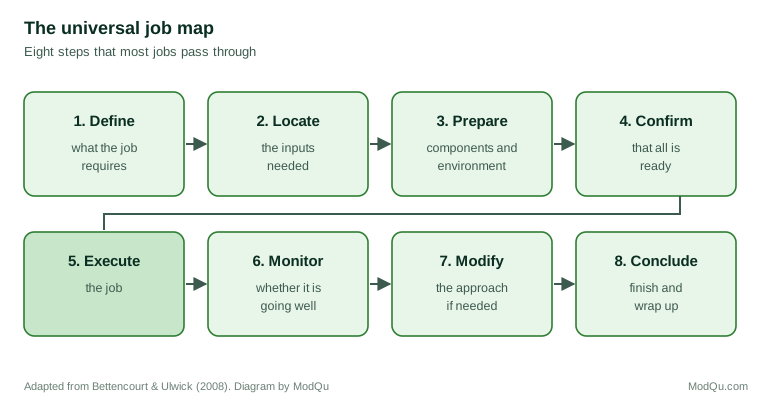
The steps are: define what the job requires; locate the inputs needed; prepare the components and environment; confirm that everything is ready; execute the job; monitor whether it is going well; modify the approach if problems arise; and conclude the job. For a small business owner whose job is "prepare the quarterly tax return", the map might reveal difficulty locating receipts, uncertainty in confirming that figures are complete, and anxiety in monitoring whether the return has been accepted, each an opportunity for a better product or service.
Measuring outcomes
Ulwick (2002) proposed expressing each step of the job as desired outcomes, statements of what customers want to achieve that can be measured, such as "minimise the time it takes to locate receipts". A survey then asks customers to rate how important each outcome is and how satisfied they are with their current ability to achieve it. Outcomes that are important but poorly satisfied indicate opportunities. This quantitative extension turns jobs research into a tool for prioritising innovation and identifying segments of customers who struggle with different parts of the same job. The approach builds on the long-established practice of capturing the voice of the customer in detailed statements of needs. Griffin and Hauser (1993) found that a relatively small number of interviews, typically 20 to 30, was enough to identify most of the needs in a product category.
Jobs and customer value
The jobs approach fits within a broader tradition of research on customer value. Woodruff (1997) defined customer value as the customer's perception of the attributes, performance and consequences that help or hinder them in achieving their goals in use situations. This definition is close to the jobs idea: value lies in progress towards the customer's goal in a particular situation, not in the product's features. Kalbach (2020) brought together several practical variants of jobs-to-be-done and showed how they can be combined with other research methods, such as journey mapping and personas.
Limitations
The approach has attracted criticism as well as enthusiasm. Different practitioners define a "job" in different ways, from the narrow functional task in outcome-based approaches to the broader idea of progress in a person's life, and these definitions lead to different methods and conclusions. Much of the evidence for the approach consists of case examples rather than controlled comparisons with other methods. Defining a job at the right level is a matter of judgement: too broad, and it gives little guidance; too narrow, and it becomes a product feature in disguise. And the emphasis on functional progress can underweight the role of habit, identity and social influence in purchase, although the emotional and social dimensions of jobs are meant to address this.
These limitations do not undermine the core insight, which is consistent with decades of research from Levitt (1960) and Haley (1968) onwards: customers buy outcomes, not products. They do suggest that jobs research should be combined with other methods, such as behavioural data and segmentation, rather than treated as a complete theory of customer behaviour.
Applying the approach
A practical jobs study typically involves several steps. Define the job of interest at an appropriate level, independent of any product. Interview customers who have recently hired or fired a solution for the job, reconstructing the circumstances and struggles. Map the steps of the job and identify where customers struggle. Express struggles as desired outcomes and, where useful, measure their importance and satisfaction. Identify segments of customers who struggle with different parts of the job. And use the results to guide product, service and messaging decisions, testing new solutions against the job they are meant to do.
Key takeaways
The jobs-to-be-done approach asks what progress customers are trying to make in a particular circumstance and what they hire products to achieve it. It builds on older ideas, from Levitt's warning against marketing myopia to benefit segmentation and means-end theory. Jobs are uncovered through interviews that reconstruct real purchase and switching decisions, through observation and through laddering, and can be mapped as a sequence of steps and measured as desired outcomes. The approach reveals competition and opportunities that product-based views miss, but its definitions vary and its evidence is largely based on cases, so it works best in combination with other methods.
References
Bettencourt, L. A., & Ulwick, A. W. (2008). The customer-centered innovation map. Harvard Business Review, 86(5), 109–114.
Christensen, C. M., & Raynor, M. E. (2003). The innovator's solution: Creating and sustaining successful growth. Harvard Business School Press.
Christensen, C. M., Cook, S., & Hall, T. (2005). Marketing malpractice: The cause and the cure. Harvard Business Review, 83(12), 74–83.
Christensen, C. M., Hall, T., Dillon, K., & Duncan, D. S. (2016). Competing against luck: The story of innovation and customer choice. HarperBusiness.
Griffin, A., & Hauser, J. R. (1993). The voice of the customer. Marketing Science, 12(1), 1–27. https://doi.org/10.1287/mksc.12.1.1
Gutman, J. (1982). A means-end chain model based on consumer categorization processes. Journal of Marketing, 46(2), 60–72. https://doi.org/10.1177/002224298204600207
Haley, R. I. (1968). Benefit segmentation: A decision-oriented research tool. Journal of Marketing, 32(3), 30–35. https://doi.org/10.1177/002224296803200306
Kalbach, J. (2020). The jobs to be done playbook: Align your markets, organization, and strategy around customer needs. Two Waves Books.
Leonard, D., & Rayport, J. F. (1997). Spark innovation through empathic design. Harvard Business Review, 75(6), 102–113.
Levitt, T. (1960). Marketing myopia. Harvard Business Review, 38(4), 45–56.
Reynolds, T. J., & Gutman, J. (1988). Laddering theory, method, analysis, and interpretation. Journal of Advertising Research, 28(1), 11–31.
Samuelson, W., & Zeckhauser, R. (1988). Status quo bias in decision making. Journal of Risk and Uncertainty, 1(1), 7–59. https://doi.org/10.1007/BF00055564
Sheth, J. N., Newman, B. I., & Gross, B. L. (1991). Why we buy what we buy: A theory of consumption values. Journal of Business Research, 22(2), 159–170. https://doi.org/10.1016/0148-2963(91)90050-8
Ulwick, A. W. (2002). Turn customer input into innovation. Harvard Business Review, 80(1), 91–97.
Ulwick, A. W. (2016). Jobs to be done: Theory to practice. Idea Bite Press.
von Hippel, E. (1986). Lead users: A source of novel product concepts. Management Science, 32(7), 791–805. https://doi.org/10.1287/mnsc.32.7.791
Wood, W., & Neal, D. T. (2009). The habitual consumer. Journal of Consumer Psychology, 19(4), 579–592. https://doi.org/10.1016/j.jcps.2009.08.003
Woodruff, R. B. (1997). Customer value: The next source for competitive advantage. Journal of the Academy of Marketing Science, 25(2), 139–153. https://doi.org/10.1007/BF02894350