
Insights · Communicating insight
Insight Workshops: Turning Findings Into Action
How to design and run workshops that turn research findings into agreed actions, drawing on research on group decision making, idea generation, participation and commitment, with a five-stage agenda, facilitation techniques and follow-through.
Research reports are often read, praised and filed. The findings may be sound and well presented, but nothing changes, because no one has worked out what the organisation should do differently, or because the people who would have to act were not involved in reaching the conclusions. Insight workshops address this gap. They bring together the people who hold the knowledge, the authority and the responsibility for action, and work through the findings until they become decisions. Well run, they are one of the most effective ways to turn insight into action. Poorly run, they become long meetings that produce a list of ideas no one owns. This article explains what research on groups says about running them well.
Why involvement matters
People are more likely to act on conclusions they have helped to reach. Coch and French (1948) studied changes to work methods in a clothing factory and found that groups who participated in designing the changes adapted faster and showed less resistance than groups who were simply told about them. Lewin (1947) found that group discussion followed by a public decision was more effective at changing behaviour than lectures. Later research found that people value outcomes more when they have helped to create them: Norton et al. (2012) called this the "IKEA effect", after finding that people valued products they had assembled themselves more highly than identical ready-made products.
For insight, this suggests that the people who must act on findings should take part in interpreting them. A workshop in which marketing, product and operations staff work through the evidence and agree what it means is more likely to lead to action than a presentation in which an insight team tells them.
What can go wrong in groups
Groups also have well-documented weaknesses, and a workshop design should guard against them.
Groups share what they already know. Stasser and Titus (1985) found that when members of a group each held different pieces of information, discussion focused on the information everyone already shared, and the unique information held by individual members was often never mentioned, leading to poorer decisions.
Brainstorming in groups produces fewer ideas. Diehl and Stroebe (1987) found that people working alone and then pooling their ideas produced more ideas than the same number of people brainstorming together, mainly because in a group only one person can speak at a time while others wait and forget their ideas. Mullen et al. (1991) reviewed many studies and confirmed that interacting groups produced fewer ideas than the same number of individuals working separately. Paulus and Yang (2000) found that methods in which people wrote ideas down and passed them to others could overcome this loss, so that groups benefited from building on each other's ideas without the costs of waiting to speak.
Groups converge too quickly. Janis (1982) described "groupthink", in which cohesive groups under pressure suppress doubts and fail to consider alternatives. Sunstein and Hastie (2015) reviewed evidence that groups often amplify the errors of their members, fall into cascades in which early speakers set the direction, and become more extreme after discussion.
People hold back. Edmondson (1999) found that teams learned more effectively when members felt psychologically safe, that is, confident that they would not be embarrassed or punished for speaking up. In workshops dominated by senior people, others may stay silent even when they have relevant knowledge or doubts.
Preparing the workshop
Much of a workshop's success is decided before it starts. Preparation includes:
Agreeing the decision. Clarify with the sponsor what decision or plan the workshop should produce. "Agree three changes to the onboarding journey for next quarter" gives the workshop a clear end point; "discuss the onboarding research" does not.
Preparing the evidence. Turn the research into materials participants can work with directly: a small number of key charts, a set of representative quotes, short video clips, customer journey maps or persona summaries. Each item should be self-explanatory, because participants will work with it in small groups without the researcher beside them.
Briefing key participants. Senior participants should see the main findings beforehand, so that they are not surprised in front of colleagues and can be asked to hold back their own views until others have spoken.
Designing the time. Allocate time to each stage, with at least a third of the workshop for prioritising and committing. Workshops often run over in the early stages and end with a rushed list of ideas.
A five-stage workshop
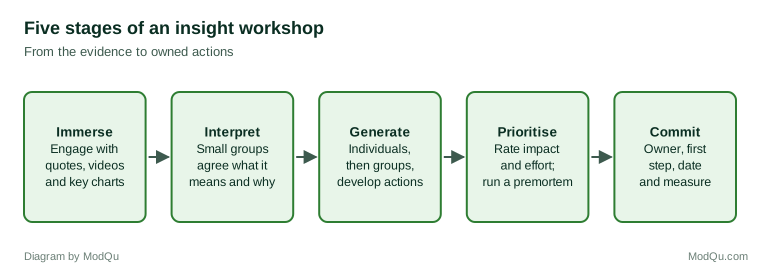
A workshop that turns findings into action typically moves through five stages.
1. Immerse
Begin with the evidence, not the conclusions. Participants should engage with the findings directly: listening to customer recordings, reading quotes, examining key charts, or walking through a customer journey. This builds shared understanding and lets participants form their own view before hearing the insight team's. Immersion also brings out the knowledge participants hold: salespeople and service staff often recognise patterns in the data from their own experience, or point out factors the research missed.
To counter the tendency to discuss only shared information, ask each participant to note what they found surprising or what they know that is not in the findings, before any group discussion.
2. Interpret
In small groups, participants agree what the findings mean. Useful questions include: What is the most important thing we have learned? What surprised us? What explains this? What would have to be true for this to be wrong? The insight team's role here is to answer questions about the evidence, correct misreadings and say when an interpretation goes beyond the data, not to dictate the conclusions.
3. Generate
Generate possible actions. Because group brainstorming loses ideas, start with individual work: each person writes down ideas silently before any discussion. Delbecq et al. (1975) described the "nominal group technique", in which individuals generate ideas silently, share them in turn without discussion, clarify them and then vote, which combines the benefits of individual thought and group discussion. Written methods in which ideas are passed around and built on can then extend the list.
4. Prioritise
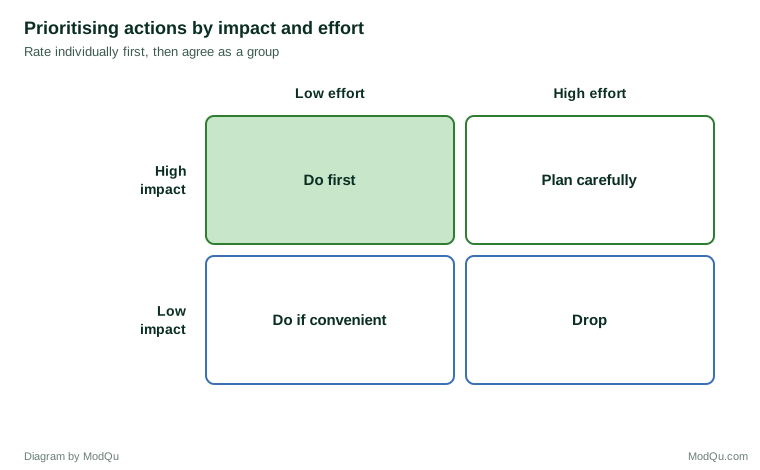
Not every idea can be pursued. Ask participants to rate actions on their likely impact and the effort or cost involved, individually first and then together. Individual rating before discussion reduces the influence of the first or most senior speaker.
Before finalising priorities, test the leading options. Klein (2007) proposed the "premortem": participants imagine that the chosen action has been implemented and has failed, and write down why. Mitchell et al. (1989) found that imagining that an event had already happened increased people's ability to generate reasons for its outcome, which is the basis of the technique's value. A premortem surfaces risks that participants might otherwise hesitate to raise. Nemeth et al. (2001) found that genuine dissent stimulated more and better thinking than a devil's advocate role-played on instruction, which suggests inviting people who actually disagree to say so.
5. Commit
End with commitments, not a list. Each chosen action should have an owner, a first step, a date and a measure of success. Gollwitzer (1999) reviewed research on "implementation intentions", specific plans of the form "when situation X arises, I will do Y", and found that they substantially increased the likelihood that people followed through on their goals. Locke and Latham (2002) reviewed decades of research showing that specific, challenging goals lead to higher performance than vague goals such as "do your best".
Who should attend
The participants should include those who hold relevant knowledge, those with authority to make decisions, and those who will carry out the actions. A workshop without decision makers produces recommendations that must then be sold to others; a workshop without those who will implement the actions produces plans that may not work in practice. Including people from several functions also increases the range of information available, which is the main advantage groups have over individuals. Between 8 and 20 participants is usually workable, with small groups of four to six for most activities. Mixing functions within each small group, rather than letting each department sit together, brings different knowledge into every discussion and reduces the risk that groups simply defend their own areas.
Facilitation
A skilled facilitator, ideally someone without a stake in the outcome, makes a large difference. Schwarz (2002) described the facilitator's role as helping a group improve how it works together, by making the process explicit, testing assumptions and ensuring that all relevant information is shared, while remaining neutral on the content. Kaner (2014) described how groups typically move from a divergent phase, in which ideas and views multiply, through a difficult middle phase of disagreement and confusion, to a convergent phase of agreement, and argued that facilitators should help groups through the difficult middle rather than cutting it short.
Practical facilitation techniques include:
- Silent individual work before discussion at each stage.
- Round-robin sharing so every participant contributes.
- Anonymous voting where hierarchy might inhibit honest views.
- Separating idea generation from evaluation, so that ideas are not dismissed before they are understood.
- A visible record of evidence, interpretations and decisions as the workshop progresses.
- Timekeeping that protects the later stages, which are often squeezed.
Gray et al. (2010) described many such techniques for structuring group work, and Brown (2008) described how design thinking workshops use rapid cycles of understanding, idea generation and prototyping. Liedtka (2015) argued that design thinking methods can reduce cognitive biases in innovation, for example by encouraging teams to consider multiple options and to test assumptions with customers before committing.
An example
Consider a hypothetical energy supplier whose research found that many new customers called the contact centre in their first month, mostly because they did not understand their first bill. The insight team ran a half-day workshop with 16 people from billing, customer service, digital, marketing and finance.
Participants began by listening to six short call recordings and reading a sample of first bills with the most common confusions marked. Each person then wrote down what surprised them. Several service agents noted that customers were often confused by an estimated reading, a point the research had recorded but not emphasised. In small groups, participants agreed that the main problem was not the bill's design but the lack of explanation before it arrived.
Individuals then wrote down possible actions, which were shared in turn and grouped. The group rated about 30 ideas on impact and effort. Three stood out: a short email explaining the first bill a few days before it arrived, a change to how estimated readings were shown, and a prompt in the app asking new customers for a meter reading. A premortem on the email raised the risk that it would be filtered as marketing, leading to a change in the sender and subject line.
Each action left the room with an owner, a first step and a date, and the agreed measure was the share of new customers calling about their first bill. A review three months later found that first-month billing calls had fallen by about a quarter in the group that received the email, and the remaining two actions were rolled out.
After the workshop
The workshop is not the end. Within a few days, circulate a short summary of the main insights, the actions agreed, their owners and dates. Schedule a review, typically after one to three months, to check progress and learn from the results. Actions that have stalled should be discussed openly: was the insight wrong, was the action poorly chosen, or did something else get in the way? This follow-through turns a single workshop into a cycle of learning.
Key takeaways
Insight workshops turn findings into action by involving the people who hold knowledge, authority and responsibility in interpreting the evidence and deciding what to do. Participation increases commitment, but groups also tend to discuss only shared information, lose ideas in open brainstorming, converge too quickly and silence quieter members. A five-stage workshop that moves from immersion in the evidence through interpretation, idea generation and prioritisation to specific commitments, using silent individual work, structured sharing, premortems and anonymous voting, reduces these problems. Each action should end with an owner, a first step, a date and a measure, followed by a summary and a scheduled review.
References
Brown, T. (2008). Design thinking. Harvard Business Review, 86(6), 84–92.
Coch, L., & French, J. R. P., Jr. (1948). Overcoming resistance to change. Human Relations, 1(4), 512–532. https://doi.org/10.1177/001872674800100408
Delbecq, A. L., Van de Ven, A. H., & Gustafson, D. H. (1975). Group techniques for program planning: A guide to nominal group and Delphi processes. Scott, Foresman.
Diehl, M., & Stroebe, W. (1987). Productivity loss in brainstorming groups: Toward the solution of a riddle. Journal of Personality and Social Psychology, 53(3), 497–509. https://doi.org/10.1037/0022-3514.53.3.497
Edmondson, A. (1999). Psychological safety and learning behavior in work teams. Administrative Science Quarterly, 44(2), 350–383. https://doi.org/10.2307/2666999
Gollwitzer, P. M. (1999). Implementation intentions: Strong effects of simple plans. American Psychologist, 54(7), 493–503. https://doi.org/10.1037/0003-066X.54.7.493
Gray, D., Brown, S., & Macanufo, J. (2010). Gamestorming: A playbook for innovators, rulebreakers, and changemakers. O'Reilly.
Janis, I. L. (1982). Groupthink: Psychological studies of policy decisions and fiascoes (2nd ed.). Houghton Mifflin.
Kaner, S. (2014). Facilitator's guide to participatory decision-making (3rd ed.). Jossey-Bass.
Klein, G. (2007). Performing a project premortem. Harvard Business Review, 85(9), 18–19.
Lewin, K. (1947). Group decision and social change. In T. M. Newcomb & E. L. Hartley (Eds.), Readings in social psychology (pp. 330–344). Henry Holt.
Liedtka, J. (2015). Perspective: Linking design thinking with innovation outcomes through cognitive bias reduction. Journal of Product Innovation Management, 32(6), 925–938. https://doi.org/10.1111/jpim.12163
Locke, E. A., & Latham, G. P. (2002). Building a practically useful theory of goal setting and task motivation: A 35-year odyssey. American Psychologist, 57(9), 705–717. https://doi.org/10.1037/0003-066X.57.9.705
Mitchell, D. J., Russo, J. E., & Pennington, N. (1989). Back to the future: Temporal perspective in the explanation of events. Journal of Behavioral Decision Making, 2(1), 25–38. https://doi.org/10.1002/bdm.3960020103
Mullen, B., Johnson, C., & Salas, E. (1991). Productivity loss in brainstorming groups: A meta-analytic integration. Basic and Applied Social Psychology, 12(1), 3–23. https://doi.org/10.1207/s15324834basp1201_1
Nemeth, C., Brown, K., & Rogers, J. (2001). Devil's advocate versus authentic dissent: Stimulating quantity and quality. European Journal of Social Psychology, 31(6), 707–720. https://doi.org/10.1002/ejsp.58
Norton, M. I., Mochon, D., & Ariely, D. (2012). The IKEA effect: When labor leads to love. Journal of Consumer Psychology, 22(3), 453–460. https://doi.org/10.1016/j.jcps.2011.08.002
Paulus, P. B., & Yang, H.-C. (2000). Idea generation in groups: A basis for creativity in organizations. Organizational Behavior and Human Decision Processes, 82(1), 76–87. https://doi.org/10.1006/obhd.2000.2888
Schwarz, R. M. (2002). The skilled facilitator: A comprehensive resource for consultants, facilitators, managers, trainers, and coaches (2nd ed.). Jossey-Bass.
Stasser, G., & Titus, W. (1985). Pooling of unshared information in group decision making: Biased information sampling during discussion. Journal of Personality and Social Psychology, 48(6), 1467–1478. https://doi.org/10.1037/0022-3514.48.6.1467
Sunstein, C. R., & Hastie, R. (2015). Wiser: Getting beyond groupthink to make groups smarter. Harvard Business Review Press.