
Insights · Communicating insight
Personas: Building Them From Evidence Rather Than Assumption
What personas are, why many are built on assumption and stereotype, how to build them from qualitative and quantitative evidence, how to check that they represent real customers, and how to keep them current.
A persona is a description of a fictional but representative customer, usually with a name, a photograph, a short biography and a summary of goals, behaviours and frustrations. Personas are popular because they turn research into something teams can picture and discuss. "Would Maria use this feature?" is easier to answer than "Would segment 3 use this feature?". But many personas are built from assumptions rather than evidence, and a persona that looks convincing but does not represent real customers can mislead a whole organisation. This article explains how to build personas from evidence.
Where personas come from
Cooper (1999) popularised personas in software design, arguing that designing for a specific, well-understood user produces better products than designing for an abstract "user" who can be stretched to justify any feature. Pruitt and Grudin (2003) described how personas were used in large product teams and found that they helped teams focus on users and communicate about them, but only when they were grounded in data and actively maintained.
The problem with assumed personas
Personas are easy to create without research. A team gathers in a workshop, imagines its customers and writes their stories. The result reflects the team's beliefs, which may be outdated, partial or stereotyped. Chapman and Milham (2006) argued that personas are often not verifiable: it is unclear how many real customers resemble a persona, and adding vivid details makes a persona seem more real while making it less representative, since fewer real people share every detail. Turner and Turner (2011) examined how personas can reproduce stereotypes, and argued that the detail which makes them engaging also invites designers to fill gaps with assumptions. Matthews et al. (2012) interviewed design professionals and found that many did not use personas in their own work, considering them too abstract or not credible, although they found them useful for communicating with others.
Building personas from evidence
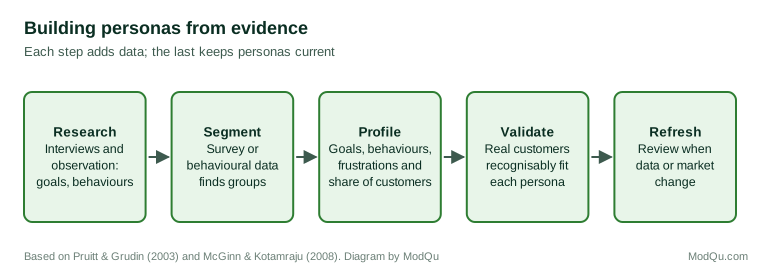
Start with qualitative research. Interviews and observation reveal goals, motivations and behaviours, and suggest the dimensions on which customers differ.
Find the groups in quantitative data. Use a survey or behavioural data to identify groups that differ on those dimensions. McGinn and Kotamraju (2008) described a method that used survey data and factor analysis to define personas, which allowed the size of each persona to be estimated. Wedel and Kamakura (2000) reviewed the statistical methods available for segmenting markets. Salminen et al. (2021) reviewed fifteen years of research on data-driven persona development and found growing use of methods that build personas from large behavioural datasets, which makes them easier to update.
Describe each group with evidence. Base each attribute of a persona on data, record its source, and state what share of customers the persona represents. Use details that matter for decisions, such as goals and behaviours, rather than details added only for colour.
Validate. Check that real customers can be matched to the personas and that the personas differ in ways that lead to different decisions.
Refresh. Review personas when new data arrive or the market changes. A persona built five years ago may describe customers who no longer exist.
An example
Consider a hypothetical meal-kit company whose marketing team created a persona called "Busy Ben", a young professional who orders meal kits to save time on weeknights. Ben appeared in every planning meeting, and new recipes and advertising were designed around this persona.
When the company built personas from evidence, the picture changed. Twenty interviews suggested that customers differed mainly in why they cooked and how confident they were in the kitchen. A survey of 3,000 customers, combined with order data, identified four groups. The largest, about 35% of customers, were families with children who used the kits to try new dishes without planning meals. The time-saving young professional existed, but represented about 15% of customers and had the highest rate of cancellation. A third group, about 30%, were older couples who enjoyed cooking and valued ingredient quality more than speed.
Each new persona carried its share of customers, its order patterns and a note of the data behind it. Recipe planning shifted towards family dishes, and the team began testing offers for the older couples, who had been almost invisible in the original persona.
Using personas well
Personas work best as a shared reference that keeps decisions focused on real customers. They should be accompanied by a short note of the evidence behind them and their share of customers, so that a minority persona is not treated as the main audience. Teams should also agree on which personas are primary, meaning the ones a product or campaign is designed for first, and which are secondary. They should be challenged when new evidence conflicts with them, and retired when they no longer fit.
Key takeaways
Personas help teams picture and discuss customers, but those built from assumptions can mislead. Evidence-based personas start with qualitative research, use quantitative data to find and size groups, base each attribute on data, are validated against real customers and are refreshed regularly. Each persona should state the share of customers it represents and the evidence behind it.
References
Chapman, C. N., & Milham, R. P. (2006). The personas' new clothes: Methodological and practical arguments against a popular method. Proceedings of the Human Factors and Ergonomics Society Annual Meeting, 50(5), 634–636. https://doi.org/10.1177/154193120605000503
Cooper, A. (1999). The inmates are running the asylum: Why high-tech products drive us crazy and how to restore the sanity. Sams.
Matthews, T., Judge, T., & Whittaker, S. (2012). How do designers and user experience professionals actually perceive and use personas? In Proceedings of the SIGCHI Conference on Human Factors in Computing Systems (pp. 1219–1228). ACM. https://doi.org/10.1145/2207676.2208573
McGinn, J., & Kotamraju, N. (2008). Data-driven persona development. In Proceedings of the SIGCHI Conference on Human Factors in Computing Systems (pp. 1521–1524). ACM. https://doi.org/10.1145/1357054.1357292
Pruitt, J., & Grudin, J. (2003). Personas: Practice and theory. In Proceedings of the 2003 Conference on Designing for User Experiences (pp. 1–15). ACM. https://doi.org/10.1145/997078.997089
Salminen, J., Guan, K., Jung, S.-G., & Jansen, B. J. (2021). A survey of 15 years of data-driven persona development. International Journal of Human–Computer Interaction, 37(18), 1685–1708. https://doi.org/10.1080/10447318.2021.1908670
Turner, P., & Turner, S. (2011). Is stereotyping inevitable when designing with personas? Design Studies, 32(1), 30–44. https://doi.org/10.1016/j.destud.2010.06.002
Wedel, M., & Kamakura, W. A. (2000). Market segmentation: Conceptual and methodological foundations (2nd ed.). Springer. https://doi.org/10.1007/978-1-4615-4651-1