
Insights · Communicating insight
Insight Presentations That Persuade
What research on persuasion, credibility and learning says about presenting insight so that decision makers understand, accept and act on it, including structure, slide design, handling counter-evidence and dealing with resistant audiences.
Insight teams often assume that good evidence speaks for itself. It rarely does. Decision makers are busy, have their own views and hear many competing claims. A sound analysis presented poorly may be ignored, while a weaker one presented well may carry the day. Presenting insight persuasively is therefore part of the job, not a distraction from it. This article draws on research about persuasion, credibility and learning to explain how to present insight so that it is understood, accepted and acted on, without crossing the line into manipulation.
How audiences process persuasive messages
Petty and Cacioppo (1986) proposed the elaboration likelihood model, which describes two routes to persuasion. On the "central" route, people think carefully about the arguments and evidence, and are persuaded by their quality. On the "peripheral" route, people rely on cues such as the speaker's status, the number of arguments or the confidence of the presentation. Which route people take depends on their motivation and ability to think about the message. Chaiken (1980) proposed a similar distinction between systematic and heuristic processing and found that people relied more on cues such as the likeability of the source when the issue mattered less to them.
For insight presentations, the implication is twofold. When the audience is motivated and able to examine the evidence, as decision makers facing an important choice usually are, the quality of the evidence matters most, and it must be presented so that they can follow it. Attitudes formed through careful thought also tend to last longer and to guide behaviour more reliably than those formed through cues. But peripheral cues still matter, especially for audiences who are distracted, short of time or not directly affected, and a presentation that seems disorganised or uncertain will be discounted whatever its content.
Credibility
The credibility of the presenter affects how a message is received. Hovland and Weiss (1951) found that the same message was more persuasive immediately when attributed to a highly credible source than to a less credible one. Pornpitakpan (2004) reviewed five decades of research and concluded that highly credible sources are generally more persuasive than less credible ones, with credibility made up mainly of expertise and trustworthiness.
Insight teams build credibility over time by being right, by being transparent about methods and limitations, and by being seen as independent rather than advocates for a particular outcome. Within a presentation, credibility comes from showing how the evidence was gathered, acknowledging what is uncertain and answering challenges openly.
Structure: lead with the answer
Decision makers want to know what the analysis means before they see how it was done. Minto (2009) recommended putting the main conclusion first and arranging supporting arguments beneath it. This contrasts with the structure of many research reports, which follow the order in which the work was done: background, method, results and only then conclusions. For a persuasive presentation, the order should be the order of the argument, not the order of the research.
A useful pattern is:
- The answer. The main insight and recommendation in one or two sentences.
- Why it matters. The size of the opportunity or problem.
- The evidence. Three or four key findings that support the answer, each with its strongest evidence.
- What else we considered. The main alternative explanations and why they were ruled out.
- What we recommend. Specific actions, owners and how success will be measured.
Slide design
Many presentations rely on slides with a short topic heading and a list of bullet points. Tufte (2003) criticised this style, arguing that it breaks reasoning into fragments, hides the relationships between points and encourages a low density of information. Alley et al. (2006) studied slides used in engineering lectures and found that audiences recalled more when slides had a sentence headline stating the main point than when they had a short phrase. Garner and Alley (2013) tested an "assertion–evidence" design, in which each slide has a sentence stating its claim supported by visual evidence rather than bullet points, and found that it improved audience comprehension compared with the conventional design.
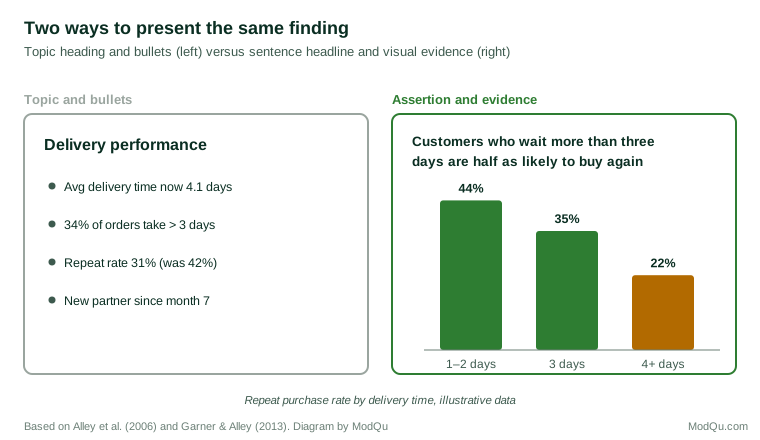
Research on learning supports these findings. Sweller (1988) described how the limited capacity of working memory constrains learning, and argued that instructional material should avoid imposing unnecessary cognitive load. Mayer (2009) summarised experiments showing that people learn better from words and pictures together than from words alone, and when extraneous material is removed. A slide crowded with text competes with the speaker for the audience's attention.
Clarity also affects how true a message seems. Reber and Schwarz (1999) found that statements presented in colours that were easier to read were more likely to be judged true than the same statements in colours that were harder to read. Presentation quality is not a substitute for evidence, but poor presentation can make good evidence seem less convincing.
Make the numbers meaningful
Numbers persuade when the audience can grasp what they mean. A finding expressed in the units the audience uses to make decisions, usually money, customers or time, is more persuasive than one expressed in the units of the analysis. "A two-point fall in the repeat purchase rate" means little to most executives; "about 4,000 fewer repeat customers a month, worth roughly the cost of the new delivery contract" connects directly to a decision.
Several practices help:
- Translate into business terms. Convert percentages and indices into revenue, cost, customers or time.
- Give a comparison. A number on its own is hard to judge. Compare it with last year, a target, a competitor or another segment.
- Use round numbers in speech. Precise figures belong in the appendix; "about a third" is easier to remember than 32.7%.
- Give absolute as well as relative figures. "Up 50%" should be accompanied by the starting and ending values.
- Show one key number per slide. If several numbers compete for attention, the audience may remember none.
Acknowledge the other side
It can seem that a persuasive presentation should present only the evidence in favour of its conclusion. Research suggests otherwise. Allen (1991) and O'Keefe (1999) reviewed studies comparing one-sided messages with two-sided messages that also discuss opposing arguments. O'Keefe found that two-sided messages that acknowledged and then refuted opposing arguments were more persuasive than one-sided messages, while two-sided messages that mentioned opposing arguments without refuting them were less persuasive. Addressing the strongest objections also increases credibility, because it shows that the presenter has considered them.
For insight presentations, this means anticipating the main objections and alternative explanations, and showing the evidence that addresses them. A slide headed "Could it be seasonality?" that shows the effect persists after seasonal adjustment answers a question that would otherwise be raised, or silently held, by the audience.
When the audience does not want to hear it
The hardest presentations are those whose conclusions challenge what the audience believes or has invested in. Kunda (1990) reviewed evidence of motivated reasoning: people evaluate evidence more critically when it threatens a conclusion they prefer. Lord et al. (1979) found that people with opposing views on an issue who read the same mixed evidence each rated the studies supporting their own view as more convincing, and became more confident in their original positions. Nickerson (1998) described the broader tendency to seek and interpret evidence in ways that confirm existing beliefs.
Several approaches help. Cohen et al. (2000) found that people who had first affirmed an important value unrelated to the issue were more open to evidence that challenged their views, apparently because the evidence felt less threatening to their sense of self. In organisational terms, this suggests acknowledging what the audience got right and framing new evidence as building on their experience rather than repudiating it. Conger (1998) argued that effective persuasion in organisations depends on establishing credibility, finding common ground with the audience, reinforcing positions with vivid evidence and connecting emotionally, and that it is a process of learning and negotiation rather than a one-off pitch. Involving sceptical stakeholders early, asking them what evidence would change their minds, and testing their alternative explanations can turn opponents into contributors.
Before and after the presentation
Much persuasion happens outside the meeting itself. Important decision makers rarely like to be surprised in front of colleagues, particularly by findings that reflect on their own areas. Sharing the main findings with key stakeholders individually beforehand gives them time to absorb the evidence, raise questions privately and, often, become supporters. It also lets the insight team learn which objections will be raised and prepare answers.
During the presentation, leave time for discussion. Questions are not interruptions but signs that the audience is engaging with the evidence on the central route. Answering them directly, including saying "we do not know" when that is true, builds credibility.
After the presentation, send a short written summary of the main insight, the evidence and the agreed actions. Decisions are often made, or unmade, in later conversations among people who were not all present, and a clear written record helps the insight survive those conversations intact.
Persuasion and integrity
There is a line between persuasion and manipulation. Cialdini (2009) described principles that make people more likely to comply with requests, including reciprocity, commitment, social proof, liking, authority and scarcity, and noted that each can be used to help people make good decisions or to exploit them. For insight teams, the test is whether the presentation helps the audience see the evidence more clearly or less clearly. Leading with the answer, using clear headlines and charts, anticipating objections and showing uncertainty all help people understand. Hiding counter-evidence, overstating confidence or relying on the presenter's status to avoid scrutiny do not, and they erode the credibility on which future persuasion depends.
A checklist for persuasive insight presentations
- Is the main insight stated in one or two sentences at the start?
- Does each slide have a sentence headline stating its point?
- Is each point supported by visual evidence rather than a list of bullets?
- Are the strongest objections and alternative explanations addressed?
- Is uncertainty stated, and is the recommendation proportionate to it?
- Are specific actions, owners and measures of success given?
- Has the presentation been tested on someone who will challenge it?
Key takeaways
Good evidence does not speak for itself. Audiences evaluate presentations both through careful thought about the evidence and through cues such as credibility and clarity, so both matter. Persuasive insight presentations lead with the answer, state each point in a sentence headline supported by visual evidence, avoid unnecessary load, and address opposing arguments with evidence. Audiences who are invested in a different conclusion will scrutinise challenging evidence more harshly, so it helps to acknowledge their experience, involve them early and test their alternatives. Persuasion should help the audience see the evidence more clearly; techniques that obscure it damage the credibility on which the insight function depends.
References
Allen, M. (1991). Meta-analysis comparing the persuasiveness of one-sided and two-sided messages. Western Journal of Speech Communication, 55(4), 390–404. https://doi.org/10.1080/10570319109374395
Alley, M., Schreiber, M., Ramsdell, K., & Muffo, J. (2006). How the design of headlines in presentation slides affects audience retention. Technical Communication, 53(2), 225–234.
Chaiken, S. (1980). Heuristic versus systematic information processing and the use of source versus message cues in persuasion. Journal of Personality and Social Psychology, 39(5), 752–766. https://doi.org/10.1037/0022-3514.39.5.752
Cialdini, R. B. (2009). Influence: Science and practice (5th ed.). Pearson Education.
Cohen, G. L., Aronson, J., & Steele, C. M. (2000). When beliefs yield to evidence: Reducing biased evaluation by affirming the self. Personality and Social Psychology Bulletin, 26(9), 1151–1164. https://doi.org/10.1177/01461672002611011
Conger, J. A. (1998). The necessary art of persuasion. Harvard Business Review, 76(3), 84–95.
Garner, J., & Alley, M. (2013). How the design of presentation slides affects audience comprehension: A case for the assertion–evidence approach. International Journal of Engineering Education, 29(6), 1564–1579.
Hovland, C. I., & Weiss, W. (1951). The influence of source credibility on communication effectiveness. Public Opinion Quarterly, 15(4), 635–650. https://doi.org/10.1086/266350
Kunda, Z. (1990). The case for motivated reasoning. Psychological Bulletin, 108(3), 480–498. https://doi.org/10.1037/0033-2909.108.3.480
Lord, C. G., Ross, L., & Lepper, M. R. (1979). Biased assimilation and attitude polarization: The effects of prior theories on subsequently considered evidence. Journal of Personality and Social Psychology, 37(11), 2098–2109. https://doi.org/10.1037/0022-3514.37.11.2098
Mayer, R. E. (2009). Multimedia learning (2nd ed.). Cambridge University Press. https://doi.org/10.1017/CBO9780511811678
Minto, B. (2009). The pyramid principle: Logic in writing and thinking (3rd ed.). Prentice Hall.
Nickerson, R. S. (1998). Confirmation bias: A ubiquitous phenomenon in many guises. Review of General Psychology, 2(2), 175–220. https://doi.org/10.1037/1089-2680.2.2.175
O'Keefe, D. J. (1999). How to handle opposing arguments in persuasive messages: A meta-analytic review of the effects of one-sided and two-sided messages. Annals of the International Communication Association, 22(1), 209–249. https://doi.org/10.1080/23808985.1999.11678963
Petty, R. E., & Cacioppo, J. T. (1986). The elaboration likelihood model of persuasion. Advances in Experimental Social Psychology, 19, 123–205. https://doi.org/10.1016/S0065-2601(08)60214-2
Pornpitakpan, C. (2004). The persuasiveness of source credibility: A critical review of five decades' evidence. Journal of Applied Social Psychology, 34(2), 243–281. https://doi.org/10.1111/j.1559-1816.2004.tb02547.x
Reber, R., & Schwarz, N. (1999). Effects of perceptual fluency on judgments of truth. Consciousness and Cognition, 8(3), 338–342. https://doi.org/10.1006/ccog.1999.0386
Sweller, J. (1988). Cognitive load during problem solving: Effects on learning. Cognitive Science, 12(2), 257–285. https://doi.org/10.1207/s15516709cog1202_4
Tufte, E. R. (2003). The cognitive style of PowerPoint. Graphics Press.