
Insights · Communicating insight
From Insight to Strategy: The Translation Process
How organisations turn insights about customers and markets into strategic choices, initiatives and measures, why the translation often fails, and a practical chain from insight to implication, choice, action and measurement.
Insight is not strategy. An insight tells an organisation something true and important about its customers or market. A strategy is a set of choices about where to compete and how to win. Between the two lies a process of translation that is often neglected. Many organisations collect good insight and write sound strategies, but the two are only loosely connected: the strategy cites the research in its introduction and then proceeds as it would have done anyway. This article describes how to make the translation deliberate.
Using insight is not automatic
Research on market orientation has long recognised that generating market intelligence is only the first step. Kohli and Jaworski (1990) defined market orientation as the generation of market intelligence, its dissemination across departments and the organisation's responsiveness to it. Day (1994) described the capabilities of market-driven organisations, including "market sensing", the ability to learn about customers and competitors, and argued that the value of this capability lies in how it shapes action. Menon and Varadarajan (1992) distinguished between using knowledge to take action, using it to enlighten managers' general understanding, and using it symbolically to justify decisions already made. Moorman (1995) found that organisations whose cultures supported the processing and use of market information achieved better new product outcomes.
The symbolic use of insight, citing research to support decisions already taken, is common and easy to miss. It often happens when research is commissioned late in the planning cycle, after the main choices have effectively been made, or when its findings are summarised by the people whose plans they affect. A strategy that would have been the same without the insight has not used it.
What strategy needs from insight
Rumelt (2011) argued that good strategy has three elements: a diagnosis that explains the nature of the challenge, a guiding policy for dealing with it, and coherent actions to carry out the policy. Insight contributes most directly to the diagnosis. A strategy built on a clear, evidence-based diagnosis of customers and markets is more likely to focus on what matters. Porter (1996) argued that strategy requires choosing what not to do, and insight helps make these choices by showing which customers, needs and positions are most attractive. Lafley and Martin (2013) described strategy as a set of linked choices: where to play and how to win, supported by capabilities and management systems.
A translation chain
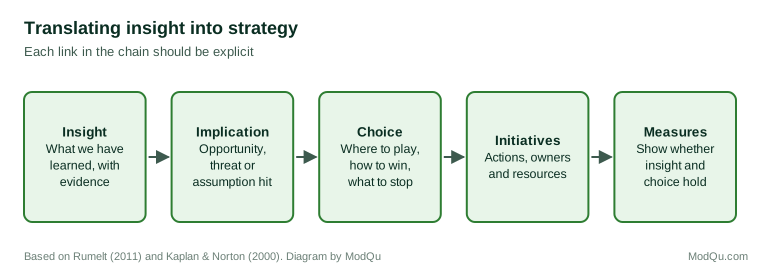
Insight. State what has been learned, with its evidence and the confidence attached to it.
Implication. State what the insight means for this organisation. Is it an opportunity, a threat, or a challenge to an existing assumption? Which current plans does it support and which does it undermine?
Choice. State the strategic choice the insight informs: which customers to prioritise, which needs to meet, how to position, and, importantly, what to stop or not to start.
Initiatives. Specify the actions that will implement the choice, with owners, resources and timing.
Measures. Define indicators that will show whether the choice is working and whether the insight remains true. Kaplan and Norton (2000) proposed "strategy maps" that link objectives across financial, customer, internal process and learning perspectives, making explicit how actions are expected to produce results. Including the original insight in such a map makes the assumption visible and testable.
An example
Consider a hypothetical regional bank whose research found that small business customers valued speed of lending decisions far more than interest rates, and that most switched banks after a slow decision on a loan. The insight was clear. Its implication was that the bank's strategy, which competed mainly on price, was aimed at the wrong attribute, and that its slow, branch-based lending process was a threat to its small business base.
The strategic choice that followed was to compete for small businesses on speed and simplicity rather than price, and to stop offering below-market rates that were eroding margins without retaining customers. The initiatives included a simplified application, automated decisions for loans below a set size and a target of a decision within two working days. The measures included decision time, the share of applicants who accepted offers, and switching rates among small business customers, together with a periodic survey to check that speed remained the most valued attribute.
Each step could be traced back to the original insight, and the measures would show both whether the strategy was working and whether the insight still held.
Why translation fails
Several common problems break the chain. Insights may be presented too generally to inform a choice, such as "customers value convenience". The people who own the insight and those who own the strategy may rarely meet. Strategies may be agreed before research is complete. And strategy execution often unravels: Sull et al. (2015) found in a large survey of managers that coordination across units and clear communication of priorities were weak in many organisations, so that even good strategies were poorly carried out.
Mintzberg and Waters (1985) distinguished deliberate strategies, which are planned, from emergent strategies, which form through patterns of action over time. Insight can inform both: deliberate strategy through planned translation, and emergent strategy through the steady flow of insight to managers making daily decisions.
Practical steps
- Write implications, not just findings. Each insight in a strategic review should state what it means for the organisation.
- Link each strategic choice to its evidence. Strategy documents should show which insights support each major choice.
- Name what will stop. An insight that changes nothing has not been translated.
- Track the assumptions. Monitor the key insights a strategy depends on, and revisit the strategy if they change.
- Use scenarios where insight is uncertain. Schoemaker (1995) described scenario planning as a way to develop strategies that are robust across several plausible futures, which suits insights whose implications are not yet clear.
Key takeaways
Insight and strategy are often only loosely connected, and research is frequently used symbolically to justify decisions already made. Translation can be made deliberate through a chain from insight to implication, choice, initiatives and measures. Strategy needs insight most for its diagnosis and for choosing what not to do. Linking choices to evidence, naming what will stop and tracking key assumptions keep strategy and insight connected over time.
References
Day, G. S. (1994). The capabilities of market-driven organizations. Journal of Marketing, 58(4), 37–52. https://doi.org/10.1177/002224299405800404
Kaplan, R. S., & Norton, D. P. (2000). Having trouble with your strategy? Then map it. Harvard Business Review, 78(5), 167–176.
Kohli, A. K., & Jaworski, B. J. (1990). Market orientation: The construct, research propositions, and managerial implications. Journal of Marketing, 54(2), 1–18. https://doi.org/10.1177/002224299005400201
Lafley, A. G., & Martin, R. L. (2013). Playing to win: How strategy really works. Harvard Business Review Press.
Menon, A., & Varadarajan, P. R. (1992). A model of marketing knowledge use within firms. Journal of Marketing, 56(4), 53–71. https://doi.org/10.1177/002224299205600405
Mintzberg, H., & Waters, J. A. (1985). Of strategies, deliberate and emergent. Strategic Management Journal, 6(3), 257–272. https://doi.org/10.1002/smj.4250060306
Moorman, C. (1995). Organizational market information processes: Cultural antecedents and new product outcomes. Journal of Marketing Research, 32(3), 318–335. https://doi.org/10.1177/002224379503200307
Porter, M. E. (1996). What is strategy? Harvard Business Review, 74(6), 61–78.
Rumelt, R. P. (2011). Good strategy/bad strategy: The difference and why it matters. Crown Business.
Schoemaker, P. J. H. (1995). Scenario planning: A tool for strategic thinking. Sloan Management Review, 36(2), 25–40.
Sull, D., Homkes, R., & Sull, C. (2015). Why strategy execution unravels—and what to do about it. Harvard Business Review, 93(3), 57–66.