
Insights · What an insight is
Insight Generation Under Cognitive Load and Time Pressure
Deadlines, distractions and information overload are normal in analytical work. This article reviews what research shows about how cognitive load, stress and time pressure affect insight and analysis, including some surprising findings, and how teams can protect the conditions that insight needs.
Insight work rarely happens in calm conditions. Analysts juggle several projects, deadlines arrive before the data are fully understood, dashboards and messages compete for attention, and senior stakeholders want answers by the end of the week. It is widely assumed that these pressures make insight harder. Research broadly supports that assumption, but the details are more interesting than a simple rule that pressure is bad. Some kinds of load harm analysis more than insight, some kinds of pressure can help, and the capacities that make people good analysts can occasionally get in the way of insight. This article reviews the evidence and draws out practical lessons.
Two kinds of strain
It helps to separate two kinds of strain on thinking.
Cognitive load is the demand placed on working memory, the limited mental workspace in which people hold and manipulate information. Baddeley (2003) describes working memory as a system with separate stores for verbal and visual information, coordinated by a central executive that directs attention. When many items must be held in mind at once, or when attention must be divided between tasks, the system becomes overloaded. Sweller (1988) showed that some problem-solving strategies, such as constantly comparing the current state of a problem with the goal, consume so much working memory that little capacity remains for learning the underlying structure of the problem.
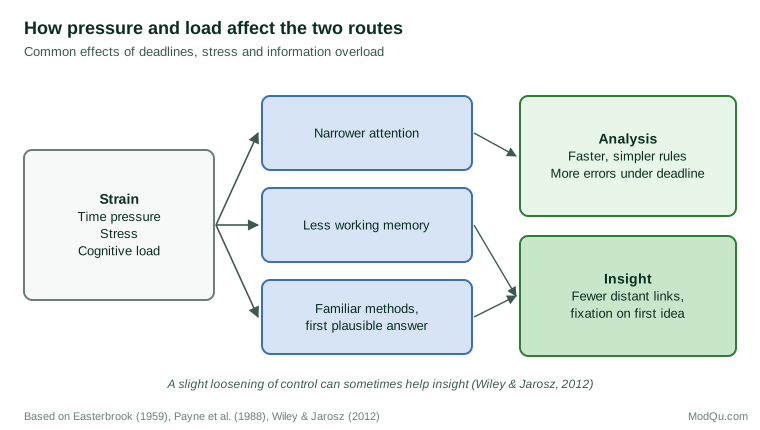
Time pressure and stress affect thinking in different ways. They raise arousal, narrow attention and push people toward faster, simpler strategies. Easterbrook (1959) proposed that as arousal increases, people attend to a narrower range of cues, first dropping irrelevant information, which can help, and then dropping relevant information, which harms performance. Neuroscience research has since shown that stress impairs the functioning of the prefrontal cortex, the brain region most involved in flexible, controlled thinking (Arnsten, 2009).
Both kinds of strain are common in research work. Information overload, the condition in which the amount of information exceeds a person's capacity to process it, has been studied across many fields. Eppler and Mengis (2004) reviewed this literature and found that overload reduces decision quality, makes people more selective in what they attend to and leads them to rely on simpler rules.
How pressure changes the way people decide
Research on decision-making shows that people adapt their strategies to time pressure. Payne, Bettman and Johnson (1988) asked participants to choose between options described by several attributes, with and without time limits. Under time pressure, people worked faster, focused on the most important attributes and switched to simpler, attribute-based strategies that ignore much of the available information. These adaptations were often sensible: when time was short, a simple strategy produced better results than an elaborate one left unfinished. Ordóñez and Benson (1997) found that time pressure also changed how people evaluated risky options, making them pay more attention to potential losses and to simpler features of the choice.
For insight work, the implication is that time pressure does not simply make people worse. It makes them different. They rely on the information that seems most important, on familiar methods and on the first plausible interpretation. Those habits can produce adequate decisions in routine situations. They are less well suited to finding something new, because insight often depends on information that does not seem important at first and on interpretations that are not the most obvious.
Working memory and insight: a complicated relationship
Since analytic thinking depends heavily on working memory, one might expect that greater working memory capacity always helps, and that load always hurts. For analysis, this is broadly true. Dual-process theories describe deliberate, analytic thought as dependent on working memory, in contrast to faster, intuitive processes that are not (Evans & Stanovich, 2013).
For insight, the relationship is more complicated. Chein and Weisberg (2014) found that people with greater working memory capacity solved more compound remote associates problems, including those they reported solving by insight. But other studies point the other way. DeCaro, Van Stockum and Wieth (2016) found that people with higher working memory capacity were sometimes less successful on insight problems, particularly those that required abandoning an initial approach. Their explanation was that people with high capacity tend to pursue a focused, rule-based strategy so effectively that they persist with it longer than they should.
Wiley and Jarosz (2012) reviewed this evidence and concluded that the narrow, focused attention that working memory supports helps when the solution lies along the obvious path, but can hinder creative problem-solving when the solution lies elsewhere. Ricks, Turley-Ames and Wiley (2007) found that high working memory capacity did not protect people from mental set created by domain knowledge: experts were misled by their expertise regardless of their capacity.
Two striking experiments illustrate the point. Jarosz, Colflesh and Wiley (2012) found that mildly intoxicated participants solved more remote associates problems, and solved them faster, than sober participants. Wieth and Zacks (2011) found that people solved more insight problems at their non-optimal time of day, such as morning people tested in the evening, while their performance on analytic problems did not change. In both cases, a reduction in attentional control seems to have allowed people to consider more distant possibilities. Neither study suggests that analysts should work drunk or tired. They show that the tight focus which makes analysis efficient can narrow the search for new ideas.
Choking under pressure
High stakes can damage performance even in skilled people. Beilock and Carr (2005) gave participants difficult arithmetic problems under low and high pressure. Under pressure, people with high working memory capacity lost their advantage, performing no better than people with low capacity. The researchers argued that worries about performance occupied working memory, taking away the very resource that gave high-capacity people their edge. Analysts preparing findings for a demanding audience may experience a similar effect: concern about how the results will be received competes for the mental resources needed to interpret them well.
Is any pressure good for creativity?
The popular belief that people do their best creative work under deadline has some support, but only under specific conditions. Byron, Khazanchi and Nazarian (2010) combined results from studies of stress and creativity in a meta-analysis. They found that stressors that people experienced as uncontrollable reduced creativity. Evaluative pressure, such as knowing that work would be judged, had a curvilinear relationship with creativity: low levels slightly increased creative performance, while high levels reduced it.
Field research tells a similar story. Amabile, Hadley and Kramer (2002) analysed thousands of daily diary entries from employees working on creative projects. On days with high time pressure, people were generally less likely to think creatively, and the negative effect could last for days after the pressure ended. The exception was when people under pressure could focus on a single important task without interruption and understood why the deadline mattered. Amabile's (1983) earlier work had already emphasised that intrinsic motivation, interest in the task itself, supports creativity, while pressure experienced as external control tends to undermine it.
Mood plays a related role. Positive mood broadens attention and has been linked to more insight solutions (Subramaniam et al., 2009), whereas stress and anxiety narrow it. Time pressure that feels like a challenge to be met is therefore less damaging than pressure that feels like a threat.
Why load hurts insight in particular
Putting these findings together suggests why heavy load and pressure are especially harmful to insight, even more than to routine analysis.
- Insight needs breadth of attention. It depends on noticing weak, distant associations (Kounios & Beeman, 2014). Pressure narrows attention to the most obvious cues.
- Insight needs time to escape fixation. It often follows an impasse and a period away from the problem, during which misleading ideas fade. Deadlines remove that period.
- Insight needs spare capacity. Mind wandering during undemanding activity supports creative incubation (Baird et al., 2012). Constant demands leave no room for it.
- Insight needs tolerance of uncertainty. Under pressure, people prefer the first plausible answer. New interpretations require holding several possibilities open.
Analysis suffers too, but it degrades more gracefully: an analyst under pressure can still run standard procedures and produce correct, if unremarkable, results. The cost of pressure is therefore often invisible. The report is delivered on time, the tables are accurate, and no one knows what insight was missed.
Interestingly, insight can be more accurate under deadline
One finding cuts the other way. Salvi, Bricolo, Kounios, Bowden and Beeman (2016) found that when people worked under a deadline, insight solutions remained largely accurate, while analytic solutions became more error-prone. Analytic thinkers under pressure tended to offer incomplete answers, whereas insight solutions, which appear all at once, were either complete or not produced at all. This does not mean that pressure produces more insights. It means that when an insight does arrive under pressure, it may deserve more trust than a hurried, half-finished analysis.
An illustration: two weeks in an analytics team
Consider a customer insight team asked to explain a fall in repeat purchases among new customers. The project has two weeks. In the first version of the project, the team spends ten days cleaning data, building tables and producing charts, and starts interpreting on day eleven while also preparing the final presentation and handling requests from two other projects. The explanation they reach is the one the marketing director suggested at the briefing: a competitor's promotion drew customers away. The tables are consistent with it, so it goes into the report.
In the second version, the same team protects time differently. Data processing is split between two analysts so that it finishes on day seven. The project lead blocks two mornings without meetings for interpretation, and the team sets aside a half-day session on day nine to review findings with a colleague from the operations department. Over a weekend between the first look at the data and the review session, the lead keeps returning to an odd detail: the fall in repeat purchases began two weeks before the competitor's promotion. At the session, the operations colleague mentions that a new delivery partner was introduced in that month. The team checks delivery times and finds that late deliveries to first-time customers had doubled. The competitor's promotion had made matters worse, but it was not the main cause.
Both versions finish on time and both produce accurate tables. Only the second produces the insight that changes the decision, from matching the competitor's discount to fixing the delivery problem. The difference lies almost entirely in how load and pressure were distributed across the project: the second version reduced load during interpretation, left room for incubation over the weekend and added a fresh perspective when fixation was most likely. The example is illustrative, but its pattern follows directly from the research reviewed above.
Practical lessons for insight teams
The research suggests several ways to protect the conditions that insight needs without ignoring the realities of deadlines.
- Separate production from interpretation. Data processing and table production can be done under time pressure with little loss of quality. Interpretation should be scheduled when people have time and attention to spare, not squeezed into the last hours before a deadline.
- Reduce load during interpretation. Close messaging tools, work from summaries rather than from hundreds of tables, and limit the number of projects people interpret at once. Overload drives people towards the simplest available account (Eppler & Mengis, 2004).
- Make deadlines meaningful and focused. Pressure is less damaging when people understand why it matters and can concentrate on one task (Amabile et al., 2002).
- Build in a pause. Even a short break between finishing analysis and drawing conclusions allows fixation to fade and distant associations to surface.
- Lower the stakes of early ideas. Treat first interpretations as hypotheses to be discussed, not as verdicts to be defended. This reduces evaluative pressure, which at high levels suppresses creativity (Byron et al., 2010).
- Check hurried analysis carefully. Under deadline, analytic errors increase. Peer review of key numbers before presentation is cheap insurance.
- Use different people for different tasks. An analyst deeply familiar with a dataset may be locked into its usual interpretation. A colleague with less involvement, and less load, may see what the analyst cannot.
Key takeaways
Cognitive load and time pressure narrow attention, reduce available working memory and push people toward familiar methods and the first plausible answer. These effects harm analysis somewhat and insight more, because insight depends on broad attention, distant associations, time to escape fixation and spare mental capacity. The relationship is not simple: high working memory capacity can sometimes hinder insight, mild loosening of attentional control can help, modest evaluative pressure can slightly increase creativity, and insight solutions reached under deadline remain largely accurate. For research teams, the practical lesson is to protect interpretation from the pressures that are unavoidable elsewhere in a project, so that the insight the work could produce is not silently lost.
References
Amabile, T. M. (1983). The social psychology of creativity: A componential conceptualization. Journal of Personality and Social Psychology, 45(2), 357–376. https://doi.org/10.1037/0022-3514.45.2.357
Amabile, T. M., Hadley, C. N., & Kramer, S. J. (2002). Creativity under the gun. Harvard Business Review, 80(8), 52–61.
Arnsten, A. F. T. (2009). Stress signalling pathways that impair prefrontal cortex structure and function. Nature Reviews Neuroscience, 10(6), 410–422. https://doi.org/10.1038/nrn2648
Baddeley, A. (2003). Working memory: Looking back and looking forward. Nature Reviews Neuroscience, 4(10), 829–839. https://doi.org/10.1038/nrn1201
Baird, B., Smallwood, J., Mrazek, M. D., Kam, J. W. Y., Franklin, M. S., & Schooler, J. W. (2012). Inspired by distraction: Mind wandering facilitates creative incubation. Psychological Science, 23(10), 1117–1122. https://doi.org/10.1177/0956797612446024
Beilock, S. L., & Carr, T. H. (2005). When high-powered people fail: Working memory and "choking under pressure" in math. Psychological Science, 16(2), 101–105. https://doi.org/10.1111/j.0956-7976.2005.00789.x
Byron, K., Khazanchi, S., & Nazarian, D. (2010). The relationship between stressors and creativity: A meta-analysis examining competing theoretical models. Journal of Applied Psychology, 95(1), 201–212. https://doi.org/10.1037/a0017868
Chein, J. M., & Weisberg, R. W. (2014). Working memory and insight in verbal problems: Analysis of compound remote associates. Memory & Cognition, 42(1), 67–83. https://doi.org/10.3758/s13421-013-0343-4
DeCaro, M. S., Van Stockum, C. A., & Wieth, M. B. (2016). When higher working memory capacity hinders insight. Journal of Experimental Psychology: Learning, Memory, and Cognition, 42(1), 39–49. https://doi.org/10.1037/xlm0000152
Easterbrook, J. A. (1959). The effect of emotion on cue utilization and the organization of behavior. Psychological Review, 66(3), 183–201. https://doi.org/10.1037/h0047707
Eppler, M. J., & Mengis, J. (2004). The concept of information overload: A review of literature from organization science, accounting, marketing, MIS, and related disciplines. The Information Society, 20(5), 325–344. https://doi.org/10.1080/01972240490507974
Evans, J. St. B. T., & Stanovich, K. E. (2013). Dual-process theories of higher cognition: Advancing the debate. Perspectives on Psychological Science, 8(3), 223–241. https://doi.org/10.1177/1745691612460685
Jarosz, A. F., Colflesh, G. J. H., & Wiley, J. (2012). Uncorking the muse: Alcohol intoxication facilitates creative problem solving. Consciousness and Cognition, 21(1), 487–493. https://doi.org/10.1016/j.concog.2012.01.002
Kounios, J., & Beeman, M. (2014). The cognitive neuroscience of insight. Annual Review of Psychology, 65, 71–93. https://doi.org/10.1146/annurev-psych-010213-115154
Ordóñez, L., & Benson, L., III. (1997). Decisions under time pressure: How time constraint affects risky decision making. Organizational Behavior and Human Decision Processes, 71(2), 121–140. https://doi.org/10.1006/obhd.1997.2717
Payne, J. W., Bettman, J. R., & Johnson, E. J. (1988). Adaptive strategy selection in decision making. Journal of Experimental Psychology: Learning, Memory, and Cognition, 14(3), 534–552. https://doi.org/10.1037/0278-7393.14.3.534
Ricks, T. R., Turley-Ames, K. J., & Wiley, J. (2007). Effects of working memory capacity on mental set due to domain knowledge. Memory & Cognition, 35(6), 1456–1462. https://doi.org/10.3758/BF03193615
Salvi, C., Bricolo, E., Kounios, J., Bowden, E., & Beeman, M. (2016). Insight solutions are correct more often than analytic solutions. Thinking & Reasoning, 22(4), 443–460. https://doi.org/10.1080/13546783.2016.1141798
Subramaniam, K., Kounios, J., Parrish, T. B., & Jung-Beeman, M. (2009). A brain mechanism for facilitation of insight by positive affect. Journal of Cognitive Neuroscience, 21(3), 415–432. https://doi.org/10.1162/jocn.2009.21057
Sweller, J. (1988). Cognitive load during problem solving: Effects on learning. Cognitive Science, 12(2), 257–285. https://doi.org/10.1207/s15516709cog1202_4
Wieth, M. B., & Zacks, R. T. (2011). Time of day effects on problem solving: When the non-optimal is optimal. Thinking & Reasoning, 17(4), 387–401. https://doi.org/10.1080/13546783.2011.625663
Wiley, J., & Jarosz, A. F. (2012). Working memory capacity, attentional focus, and problem solving. Current Directions in Psychological Science, 21(4), 258–262. https://doi.org/10.1177/0963721412447622