
Insights · Generating insight
Implicit Measurement and Unconscious Attitudes
What implicit measures such as the Implicit Association Test capture, why they interest consumer researchers, what the evidence says about how well they predict behaviour, and how to use them responsibly alongside conventional questions.
Most customer research asks people directly what they think and feel. Yet people cannot always report the influences on their own preferences, and sometimes they prefer not to. Implicit measures attempt to capture attitudes indirectly, from the speed or pattern of people's responses rather than from what they say. They have attracted considerable interest in consumer research as a possible window onto preferences that surveys miss. This article explains what they measure, how well they predict behaviour, and how to use them responsibly.
The limits of self-report
Nisbett and Wilson (1977) reviewed evidence that people often have little access to the mental processes behind their judgements. When asked why they chose one product over another, participants in several studies gave confident explanations that did not match the factors that had actually influenced them, such as the position of the product on a display. Self-reports can also be shaped by the wish to give a socially acceptable answer.
Greenwald and Banaji (1995) proposed that many evaluations operate implicitly, influencing judgement and behaviour without being consciously identified. Fazio et al. (1986) showed that attitudes towards objects can be activated automatically, within a fraction of a second of seeing the object, and that this automatic activation was stronger for attitudes that people held more firmly. These findings suggested that attitudes could be measured from the speed of people's responses.
How implicit measures work
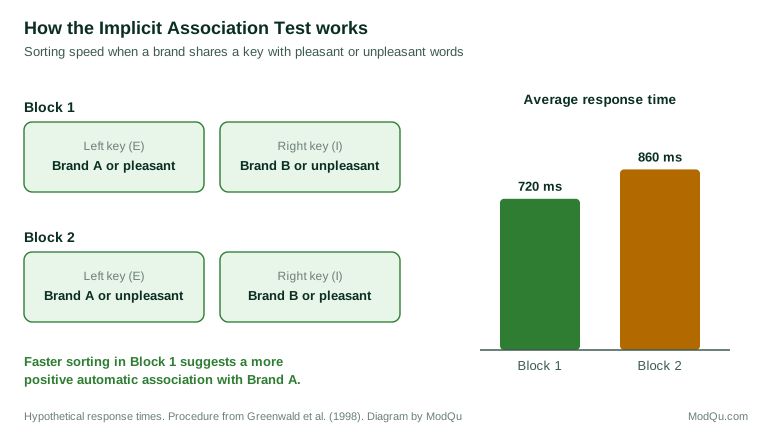
The best-known implicit measure is the Implicit Association Test (IAT), introduced by Greenwald et al. (1998). Participants sort words or images into categories as quickly as possible using two response keys. In one set of trials, a target category, such as a brand, shares a key with "good" words; in another, it shares a key with "bad" words. If a person responds faster when the brand is paired with "good" than when it is paired with "bad", this is taken as evidence of a more positive automatic association with the brand. Nosek et al. (2005) examined how methodological choices, such as the order of the blocks and the stimuli used, affect IAT results, and described procedures for reducing their influence.
Other implicit measures use different procedures. In the affect misattribution procedure developed by Payne et al. (2005), a brief image of an object is followed by an ambiguous symbol, and people rate the symbol as pleasant or unpleasant. Their ratings tend to be influenced by the image shown just before, which provides an indirect measure of their evaluation of it.
Why they interest consumer researchers
Implicit measures promise to capture evaluations that people cannot or will not report. Maison et al. (2004) found that IAT scores predicted brand preferences and distinguished between consumers of competing brands, and in some cases added to the prediction of behaviour beyond explicit measures. Friese et al. (2006) studied choices between well-known brands and generic products and found that when people's implicit and explicit preferences differed, their choices under time pressure followed their implicit preferences more often than when they had time to think.
Theory helps explain when this should happen. Strack and Deutsch (2004) proposed that behaviour is shaped by two systems: a reflective system that operates through deliberate reasoning and an impulsive system that operates through learned associations. Implicit measures are thought to tap the impulsive system. Friese et al. (2008) found that implicit measures predicted food choices better when people's capacity for self-control was reduced, while explicit measures predicted better when people had the capacity to deliberate. Implicit measures may therefore be most useful for understanding quick, low-involvement purchases made under distraction or time pressure.
How well do they predict behaviour?
The evidence on prediction is mixed. Greenwald et al. (2009) conducted a meta-analysis of studies relating IAT scores to behaviour and other outcomes. They found that the IAT predicted behaviour, that explicit measures generally predicted better in most domains, but that the IAT predicted better in socially sensitive domains where people may be reluctant to report their views. Oswald et al. (2013) re-analysed studies of discrimination and found that IAT scores predicted behaviour weakly and no better than explicit measures. Forscher et al. (2019) analysed hundreds of studies that tried to change implicit measures and found that, although the measures could be changed, these changes did not reliably lead to changes in behaviour.
For consumer researchers, the implications are clear. Implicit measures are not a window onto hidden "true" preferences that reliably predict what people will buy. Individual scores are noisy, and associations with behaviour at the individual level are modest. They are best treated as one additional source of evidence, most informative when compared across groups or conditions and when combined with explicit measures and behavioural data.
An example of use
Consider a hypothetical food company testing two packaging designs for a snack that many people say they eat only occasionally. In a survey, respondents rate both designs similarly, and many describe the snack as an indulgence they try to avoid. An implicit measure shows a clearly more positive automatic association with one design. The divergence between what people say and how they respond quickly is the finding of interest. Because snack purchases are often quick and made under distraction, the implicit result may be more relevant to behaviour at the shelf than the survey ratings, following the pattern reported by Friese et al. (2008). But the company should not rely on it alone. A test in a small number of stores, comparing sales of the two designs, would show whether the implicit preference translates into purchases.
Using implicit measures well
Several practices help. Use implicit measures alongside explicit questions, and pay most attention to cases where the two diverge, since the divergence itself is informative. Focus on comparisons between groups or between brands rather than conclusions about individuals. Choose implicit measures for questions where self-report is likely to be limited, such as socially sensitive topics or quick, habitual choices. Follow established procedures, because small methodological choices can change results (Nosek et al., 2005). And validate implicit findings against actual behaviour, such as sales or choices, wherever possible.
Key takeaways
People cannot always report the influences on their preferences, and implicit measures attempt to capture evaluations from response speed or patterns instead. The Implicit Association Test and similar procedures can detect automatic associations with brands and products, and these associations appear most relevant to quick, impulsive decisions. But meta-analyses show that implicit measures predict behaviour only modestly, often no better than explicit measures. They are most useful as a complement to conventional research, especially where self-report is likely to be incomplete.
References
Fazio, R. H., Sanbonmatsu, D. M., Powell, M. C., & Kardes, F. R. (1986). On the automatic activation of attitudes. Journal of Personality and Social Psychology, 50(2), 229–238. https://doi.org/10.1037/0022-3514.50.2.229
Forscher, P. S., Lai, C. K., Axt, J. R., Ebersole, C. R., Herman, M., Devine, P. G., & Nosek, B. A. (2019). A meta-analysis of procedures to change implicit measures. Journal of Personality and Social Psychology, 117(3), 522–559. https://doi.org/10.1037/pspa0000160
Friese, M., Hofmann, W., & Wänke, M. (2008). When impulses take over: Moderated predictive validity of explicit and implicit attitude measures in predicting food choice and consumption behaviour. British Journal of Social Psychology, 47(3), 397–419. https://doi.org/10.1348/014466607X241540
Friese, M., Wänke, M., & Plessner, H. (2006). Implicit consumer preferences and their influence on product choice. Psychology & Marketing, 23(9), 727–740. https://doi.org/10.1002/mar.20126
Greenwald, A. G., & Banaji, M. R. (1995). Implicit social cognition: Attitudes, self-esteem, and stereotypes. Psychological Review, 102(1), 4–27. https://doi.org/10.1037/0033-295X.102.1.4
Greenwald, A. G., McGhee, D. E., & Schwartz, J. L. K. (1998). Measuring individual differences in implicit cognition: The Implicit Association Test. Journal of Personality and Social Psychology, 74(6), 1464–1480. https://doi.org/10.1037/0022-3514.74.6.1464
Greenwald, A. G., Poehlman, T. A., Uhlmann, E. L., & Banaji, M. R. (2009). Understanding and using the Implicit Association Test: III. Meta-analysis of predictive validity. Journal of Personality and Social Psychology, 97(1), 17–41. https://doi.org/10.1037/a0015575
Maison, D., Greenwald, A. G., & Bruin, R. H. (2004). Predictive validity of the Implicit Association Test in studies of brands, consumer attitudes, and behavior. Journal of Consumer Psychology, 14(4), 405–415. https://doi.org/10.1207/s15327663jcp1404_9
Nisbett, R. E., & Wilson, T. D. (1977). Telling more than we can know: Verbal reports on mental processes. Psychological Review, 84(3), 231–259. https://doi.org/10.1037/0033-295X.84.3.231
Nosek, B. A., Greenwald, A. G., & Banaji, M. R. (2005). Understanding and using the Implicit Association Test: II. Method variables and construct validity. Personality and Social Psychology Bulletin, 31(2), 166–180. https://doi.org/10.1177/0146167204271418
Oswald, F. L., Mitchell, G., Blanton, H., Jaccard, J., & Tetlock, P. E. (2013). Predicting ethnic and racial discrimination: A meta-analysis of IAT criterion studies. Journal of Personality and Social Psychology, 105(2), 171–192. https://doi.org/10.1037/a0032734
Payne, B. K., Cheng, C. M., Govorun, O., & Stewart, B. D. (2005). An inkblot for attitudes: Affect misattribution as implicit measurement. Journal of Personality and Social Psychology, 89(3), 277–293. https://doi.org/10.1037/0022-3514.89.3.277
Strack, F., & Deutsch, R. (2004). Reflective and impulsive determinants of social behavior. Personality and Social Psychology Review, 8(3), 220–247. https://doi.org/10.1207/s15327957pspr0803_1