
Insights · Generating insight
Heuristics and Biases in Consumer Decisions
The mental shortcuts consumers use when judging and choosing, from availability and anchoring to context effects, sunk costs and present bias, what research says about when they help and when they mislead, and what they mean for customer research and insight.
Consumers make many decisions every day, usually with limited time, attention and information. They cannot compare every product on every attribute, so they rely on mental shortcuts: rules of thumb that make choices manageable. Psychologists call these shortcuts heuristics. Most of the time they work well. Under some conditions they lead to systematic errors, known as biases. Understanding both is a rich source of consumer insight, because heuristics explain choices that look puzzling from the outside, and because they affect how customers answer research questions as well as how they buy.
This article describes the main heuristics and biases relevant to consumer decisions, the debate about whether they are best seen as errors or as adaptive tools, and what they mean for insight work.
Bounded rationality and two views of heuristics
Simon (1955) argued that real decision makers have limited information and limited capacity to process it, and that they therefore seek options that are good enough rather than the best possible. Heuristics are one way of coping with these limits.
Two research traditions have developed this idea differently. The heuristics and biases programme, associated with Tversky and Kahneman (1974), identified heuristics mainly by the errors they produce: if people's judgements depart systematically from the answers given by probability theory, a heuristic is likely to be at work. Kahneman (2011) later described heuristic judgement as the work of a fast, intuitive mode of thinking, in contrast to slower, deliberate reasoning. Evans and Stanovich (2013) reviewed such dual-process theories and the evidence and debates surrounding them.
A second tradition, associated with Gigerenzer and colleagues, emphasises that heuristics can be highly effective. Gigerenzer and Goldstein (1996) showed that simple rules that use only part of the available information, such as choosing on the basis of the single most valid cue, can be as accurate as complex statistical models in some environments. Gigerenzer and Gaissmaier (2011) reviewed evidence that heuristics are "ecologically rational": they work well when they fit the structure of the environment in which they are used, and fail when they do not.
Both views are useful for insight work. The first explains why consumers make predictable mistakes; the second explains why they often choose sensibly with little effort, and why a shortcut that works in one setting can fail in another.
Judgement heuristics
Availability
Tversky and Kahneman (1973) proposed that people judge how frequent or likely something is by how easily examples come to mind. Events that are vivid, recent or widely reported are judged more common than they are. For consumers, availability helps explain why a single memorable product failure, or a widely shared bad review, can outweigh many unremarkable good experiences, and why heavily advertised brands may seem more popular and reliable than their market share justifies.
Representativeness
Kahneman and Tversky (1972) found that people judge the probability that something belongs to a category by how closely it resembles the typical member of that category, often neglecting base rates. Consumers use representativeness when they infer quality from packaging that resembles a premium brand, or assume that a product with a scientific-looking label is effective. Store brands that imitate the appearance of market leaders rely partly on this heuristic.
Anchoring
When people estimate a quantity, they are influenced by numbers they have recently seen, even when those numbers are irrelevant. Tversky and Kahneman (1974) demonstrated this with estimates that were influenced by a number produced by a wheel of fortune. Wilson et al. (1996) found that anchoring occurred even with arbitrary anchors and was difficult to eliminate by warning people about it. Strack and Mussweiler (1997) proposed that anchors work by making information consistent with the anchor more accessible in memory. Ariely et al. (2003) showed that arbitrary anchors could influence how much people were willing to pay for consumer products. Recommended retail prices, "was" prices and the first price a customer sees in a range all act as anchors.
The affect heuristic
Slovic et al. (2007) described how people's feelings about something, positive or negative, guide their judgements of its risks and benefits. If people like a technology or a product, they tend to judge its benefits high and its risks low; if they dislike it, the reverse. For brands, this means that overall affective impressions can shape judgements of specific attributes, a pattern that insight teams often see when customers who like a brand rate it highly on every attribute, including ones they have not experienced.
Choice heuristics and context effects
Standard economic theory assumes that adding an option to a choice set should not increase the share of an existing option. Research on context effects shows that it often does.
The attraction or decoy effect
Huber et al. (1982) found that adding an option that is clearly inferior to one existing option, but not to another, increases the share of the option it is inferior to. This "asymmetrically dominated" option acts as a decoy that makes the target look better by comparison.
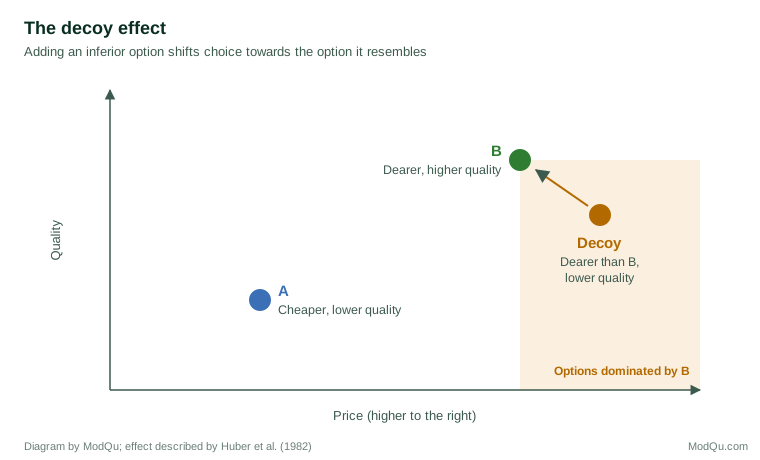
Simonson (1989) proposed that the attraction effect, and the related compromise effect, in which an option gains share when it becomes the middle option in a range, arise because people look for reasons that justify their choices. A target that clearly beats an alternative, or that sits in the middle of a range, is easy to justify. Many pricing structures, such as offering three sizes or three service tiers, use these effects.
The evidence calls for some caution. Frederick et al. (2014) tested the attraction effect across many studies and found that it was often weak or absent when options were presented in more realistic ways, for example with attributes shown as images rather than numbers. Context effects are real, but their size depends heavily on how the options are presented.
Status quo and default bias
Samuelson and Zeckhauser (1988) found that people disproportionately choose the option that is presented as the status quo. Customers tend to stay with their current supplier, keep default settings and renew existing contracts, even when better alternatives are available. Part of this reflects the effort of switching; part reflects loss aversion, the tendency to weigh what might be lost more heavily than what might be gained (Kahneman & Tversky, 1979).
Framing
Tversky and Kahneman (1981) showed that equivalent descriptions of the same choice lead to different decisions depending on whether outcomes are framed as gains or losses. "95% fat-free" and "contains 5% fat" describe the same product but invite different evaluations.
Biases over time
Sunk costs
People often continue with something because of what they have already invested, even when future costs outweigh future benefits. Arkes and Blumer (1985) randomly assigned theatre season ticket buyers to pay full price or receive one of two discounts, and found that those who paid full price attended more performances in the first half of the season. For consumers, sunk costs help explain why customers persist with products they have paid for, and why prepaid plans can increase usage.
Present bias
People tend to give much more weight to immediate costs and benefits than to those in the future, and to make plans they later fail to carry out. Laibson (1997) modelled this as hyperbolic discounting, in which the immediate present is treated as special. DellaVigna and Malmendier (2006) studied gym members and found that those who chose flat-rate monthly contracts paid more per visit, on average, than they would have paid with a pay-per-visit option, because they overestimated how often they would attend. Present bias helps explain the popularity of subscriptions, free trials and "buy now, pay later" offers, as well as the gap between customers' intentions and their actual behaviour.
When heuristics matter most
Reliance on heuristics varies with the situation and the person. Dual-process accounts suggest that intuitive, heuristic processing dominates when people are short of time, distracted, tired or not very interested in the decision, and that deliberate reasoning plays a larger part when stakes are high and people have the time and motivation to think (Evans & Stanovich, 2013; Kahneman, 2011). For consumers, this means heuristics are likely to matter most in routine, low-involvement purchases, such as groceries, and in moments of distraction, such as browsing on a phone. In large, infrequent purchases, such as a car or a mortgage, people deliberate more, although heuristics such as anchoring and status quo bias still influence them.
Experience also changes how heuristics work. A shortcut that is unreliable for a novice may be well tuned for an experienced buyer who has learned which cues predict quality in a particular category. Gigerenzer and Gaissmaier (2011) argued that whether a heuristic helps or harms depends on how well it fits the environment. For insight work, this suggests asking not only which heuristics customers use, but whether those heuristics serve them well in the market as it is, and where the organisation's own design choices make them work better or worse.
Heuristics in customer research
Heuristics affect how customers answer questions, not only how they buy. Schwarz (1999) reviewed evidence that survey answers are shaped by question wording, response scales and the order of questions, because respondents use features of the questionnaire as cues to what is being asked. A numerical scale running from 0 to 10 invites different answers from one running from -5 to +5; a question that follows one about recent problems may be answered in that light. Anchoring, availability and framing all operate within surveys.
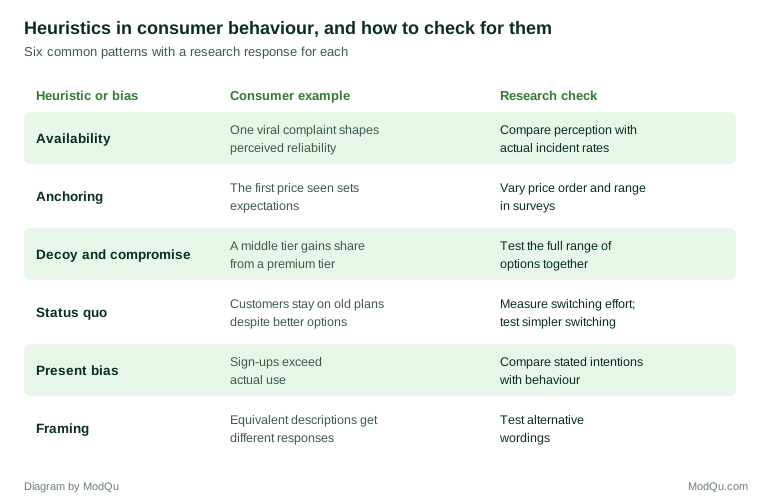
This has several implications for research design. Price questions are vulnerable to anchoring, so the order and range of prices shown should be varied or carefully controlled. Questions about frequency and likelihood are vulnerable to availability, so they should ask about specific recent periods rather than general habits. Wording should be tested for framing effects, and important questions can be asked in more than one form. Stated intentions should be treated with caution, because present bias and status quo bias mean that customers often do not do what they plan. Where possible, survey findings should be checked against behavioural data.
Heuristics as a source of insight
Heuristics are also a source of insight in their own right. When customers behave in ways that seem irrational, a heuristic often provides the explanation, and the explanation suggests what to change. A product that customers rate highly but rarely buy may be suffering from status quo bias, in which case reducing switching effort matters more than improving the product. A premium tier that almost no one chooses may still raise sales of the middle tier through a compromise effect. A sudden fall in perceived reliability may reflect a single widely shared incident, an availability effect, rather than a change in actual performance.
An illustration
Consider a hypothetical broadband provider whose research shows that most customers rate its service as good, yet few of them take up a new, faster package that a survey suggested many would want. Several heuristics offer possible explanations, each of which can be checked.
Status quo bias suggests that customers stay with their current package because switching requires effort and feels risky, whatever its benefits. If so, simplifying the upgrade, for example to a single confirmation in the app, should increase take-up more than further advertising of the package's benefits.
Anchoring suggests that customers judge the new price against what they pay now, so even a modest increase feels large. If so, presenting the upgrade as a small monthly addition, or comparing it with the cost of the competing offers customers might consider, may change the reaction.
Present bias suggests that the benefits of faster speeds feel distant and uncertain while the higher bill is immediate. If so, a trial period in which customers experience the benefit before paying for it may help.
Finally, the survey itself may have overstated interest. Stated intentions are vulnerable to the gap between what people plan and what they do, and the survey question may have framed the package attractively. Comparing survey responses with actual behaviour among customers who were offered the package would show how far stated interest translates into purchases.
Each explanation implies a different response, and the insight team can test them against each other through small experiments, rather than choosing the most plausible story. This is the main practical value of the heuristics literature for insight work: it supplies a set of well-studied explanations that can be turned into testable hypotheses.
Reducing harmful biases
Organisations sometimes want to help customers avoid biases that harm them, for example in financial or health decisions, and insight teams want to avoid biases in their own judgements. Fischhoff (1982) reviewed attempts to reduce bias and concluded that simply warning people about a bias rarely works; changing the task, for example by presenting information in a different format, is usually more effective. Milkman et al. (2009) reviewed strategies for improving decisions and highlighted approaches such as considering the opposite, taking an outside view based on similar past cases, and changing the decision environment. For customer-facing decisions, this suggests that better presentation, such as clear comparisons and sensible defaults, does more than education alone.
Key takeaways
Consumers rely on heuristics to cope with limited time and attention. Availability, representativeness, anchoring and affect shape their judgements; context effects, status quo bias and framing shape their choices; sunk costs and present bias shape their decisions over time. Heuristics are often effective, but they produce predictable errors when they do not fit the situation. They also affect how customers answer survey questions, which has direct implications for research design. For insight teams, heuristics are both a source of explanations for puzzling behaviour and a reason to check what customers say against what they do. Some effects, such as context effects, vary greatly with presentation, so their relevance should be tested rather than assumed.
References
Ariely, D., Loewenstein, G., & Prelec, D. (2003). "Coherent arbitrariness": Stable demand curves without stable preferences. The Quarterly Journal of Economics, 118(1), 73–106. https://doi.org/10.1162/00335530360535153
Arkes, H. R., & Blumer, C. (1985). The psychology of sunk cost. Organizational Behavior and Human Decision Processes, 35(1), 124–140. https://doi.org/10.1016/0749-5978(85)90049-4
DellaVigna, S., & Malmendier, U. (2006). Paying not to go to the gym. American Economic Review, 96(3), 694–719. https://doi.org/10.1257/aer.96.3.694
Evans, J. St. B. T., & Stanovich, K. E. (2013). Dual-process theories of higher cognition: Advancing the debate. Perspectives on Psychological Science, 8(3), 223–241. https://doi.org/10.1177/1745691612460685
Fischhoff, B. (1982). Debiasing. In D. Kahneman, P. Slovic, & A. Tversky (Eds.), Judgment under uncertainty: Heuristics and biases (pp. 422–444). Cambridge University Press.
Frederick, S., Lee, L., & Baskin, E. (2014). The limits of attraction. Journal of Marketing Research, 51(4), 487–507. https://doi.org/10.1509/jmr.12.0061
Gigerenzer, G., & Gaissmaier, W. (2011). Heuristic decision making. Annual Review of Psychology, 62, 451–482. https://doi.org/10.1146/annurev-psych-120709-145346
Gigerenzer, G., & Goldstein, D. G. (1996). Reasoning the fast and frugal way: Models of bounded rationality. Psychological Review, 103(4), 650–669. https://doi.org/10.1037/0033-295X.103.4.650
Huber, J., Payne, J. W., & Puto, C. (1982). Adding asymmetrically dominated alternatives: Violations of regularity and the similarity hypothesis. Journal of Consumer Research, 9(1), 90–98. https://doi.org/10.1086/208899
Kahneman, D. (2011). Thinking, fast and slow. Farrar, Straus and Giroux.
Kahneman, D., & Tversky, A. (1972). Subjective probability: A judgment of representativeness. Cognitive Psychology, 3(3), 430–454. https://doi.org/10.1016/0010-0285(72)90016-3
Kahneman, D., & Tversky, A. (1979). Prospect theory: An analysis of decision under risk. Econometrica, 47(2), 263–291. https://doi.org/10.2307/1914185
Laibson, D. (1997). Golden eggs and hyperbolic discounting. The Quarterly Journal of Economics, 112(2), 443–477. https://doi.org/10.1162/003355397555253
Milkman, K. L., Chugh, D., & Bazerman, M. H. (2009). How can decision making be improved? Perspectives on Psychological Science, 4(4), 379–383. https://doi.org/10.1111/j.1745-6924.2009.01142.x
Samuelson, W., & Zeckhauser, R. (1988). Status quo bias in decision making. Journal of Risk and Uncertainty, 1(1), 7–59. https://doi.org/10.1007/BF00055564
Schwarz, N. (1999). Self-reports: How the questions shape the answers. American Psychologist, 54(2), 93–105. https://doi.org/10.1037/0003-066X.54.2.93
Simon, H. A. (1955). A behavioral model of rational choice. The Quarterly Journal of Economics, 69(1), 99–118. https://doi.org/10.2307/1884852
Simonson, I. (1989). Choice based on reasons: The case of attraction and compromise effects. Journal of Consumer Research, 16(2), 158–174. https://doi.org/10.1086/209205
Slovic, P., Finucane, M. L., Peters, E., & MacGregor, D. G. (2007). The affect heuristic. European Journal of Operational Research, 177(3), 1333–1352. https://doi.org/10.1016/j.ejor.2005.04.006
Strack, F., & Mussweiler, T. (1997). Explaining the enigmatic anchoring effect: Mechanisms of selective accessibility. Journal of Personality and Social Psychology, 73(3), 437–446. https://doi.org/10.1037/0022-3514.73.3.437
Tversky, A., & Kahneman, D. (1973). Availability: A heuristic for judging frequency and probability. Cognitive Psychology, 5(2), 207–232. https://doi.org/10.1016/0010-0285(73)90033-9
Tversky, A., & Kahneman, D. (1974). Judgment under uncertainty: Heuristics and biases. Science, 185(4157), 1124–1131. https://doi.org/10.1126/science.185.4157.1124
Tversky, A., & Kahneman, D. (1981). The framing of decisions and the psychology of choice. Science, 211(4481), 453–458. https://doi.org/10.1126/science.7455683
Wilson, T. D., Houston, C. E., Etling, K. M., & Brekke, N. (1996). A new look at anchoring effects: Basic anchoring and its antecedents. Journal of Experimental Psychology: General, 125(4), 387–402. https://doi.org/10.1037/0096-3445.125.4.387