
Insights · Generating insight
Behavioural Economics as a Source of Consumer Insight
How findings from behavioural economics, including loss aversion, reference points, mental accounting, framing and choice overload, help explain consumer behaviour, and how to use them carefully in insight work.
Traditional economic models assume that consumers weigh costs and benefits consistently and choose the option that serves them best. Behavioural economics studies the systematic ways in which real people depart from this model. Its findings offer insight teams a set of tested explanations for behaviour that otherwise looks puzzling: why customers keep a service they rarely use, why a small fee causes outrage while a larger price rise goes unnoticed, or why adding options can reduce sales.
Bounded rationality
The starting point is Simon's (1955) argument that people have limited information, time and computational capacity, and therefore aim for choices that are good enough rather than optimal. Tversky and Kahneman (1974) showed that people rely on mental shortcuts, or heuristics, to make judgements under uncertainty, and that these shortcuts, while often useful, lead to predictable errors. Later work applied these ideas to consumer choice. Thaler (1980) argued that economic theory could not explain several common consumer behaviours, and proposed psychological explanations for them.
Key findings for consumer insight
Losses loom larger than gains
Kahneman and Tversky's (1979) prospect theory proposed that people evaluate outcomes as gains or losses relative to a reference point, rather than in terms of final wealth, and that losses have a greater psychological impact than gains of the same size. Tversky and Kahneman (1992) estimated that, in their experiments, losses were weighted roughly twice as heavily as equivalent gains.
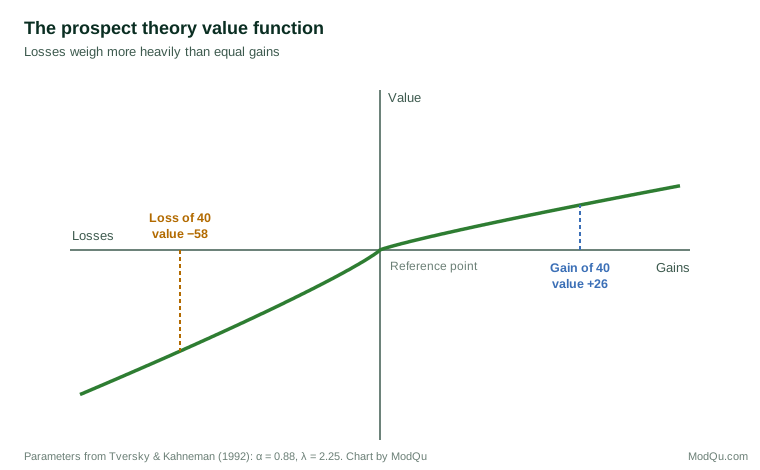
Loss aversion helps explain why customers react more strongly to the removal of a feature than to the addition of a new one, why surcharges provoke more resistance than equivalent discounts withdrawn, and why free trials that customers must actively cancel retain many of them. It also helps explain the endowment effect: Kahneman et al. (1990) found that people who had been given an object, such as a coffee mug, demanded substantially more to give it up than others were willing to pay to acquire it.
Reference points and anchors
Because people judge outcomes relative to reference points, the reference point itself shapes behaviour. A price seems high or low in relation to a previous price, a competitor's price or a recommended retail price. Ariely et al. (2003) found that arbitrary numbers could act as anchors for how much people were willing to pay for products, even though their relative valuations of different products remained consistent.
Framing
Tversky and Kahneman (1981) showed that logically equivalent descriptions of a choice can lead to different decisions. Options described in terms of gains encourage caution, while the same options described in terms of losses encourage risk taking. For insight work, framing matters twice: it affects how customers respond to offers, and it affects how they answer survey questions.
Mental accounting
Thaler (1985) proposed that people keep separate mental accounts for different kinds of spending and income, and evaluate transactions within those accounts rather than in terms of total wealth. Mental accounting helps explain why customers may spend a tax refund or a bonus more freely than regular income, and why bundled prices can feel less painful than a series of separate charges.
Choice overload
More choice is usually assumed to be better. Iyengar and Lepper (2000) found that shoppers offered a tasting display of 24 jams were more likely to stop but less likely to buy than those offered 6. Later research qualified this finding. Scheibehenne et al. (2010) conducted a meta-analysis of choice overload studies and found that the average effect was close to zero, with considerable variation between studies. Choice overload appears to occur under some conditions, such as when options are hard to compare or preferences are unclear, but not as a general rule.
Evidence from the field
Many behavioural findings were first established in laboratory experiments with students. DellaVigna (2009) reviewed field evidence and found that many behavioural patterns, including reference dependence, limited attention and present bias, also appear in real markets, among consumers, investors and workers. At the same time, the replication of psychological findings has proved less reliable than once assumed. A large collaborative project that repeated 100 published psychology studies found that a substantially smaller share produced statistically significant results the second time, and that effect sizes were on average about half as large (Open Science Collaboration, 2015). The choice overload literature is one example of an influential finding that proved weaker and more conditional than first reported.
Using behavioural economics in insight work
Behavioural economics is most useful to insight teams as a source of hypotheses. When customers behave in ways that surveys do not explain, the established findings suggest possible reasons: a reference point, a framing effect, a loss that looms larger than a gain. These hypotheses should then be tested in the organisation's own context, ideally through field experiments, rather than assumed to apply. Effects that are well replicated, such as loss aversion and framing, are safer starting points than effects that rest on a few studies.
A practical approach is to keep a short list of the behavioural explanations most relevant to the organisation's market, and to check each unexplained pattern against it. A subscription business, for example, might ask whether low cancellation rates reflect satisfaction or simply the effort and loss aversion involved in cancelling, a question that a survey alone cannot answer but a comparison of usage and cancellation data can.
Behavioural insights also improve research design. Knowing that framing affects answers encourages careful, neutral question wording. Knowing that stated intentions often diverge from behaviour encourages the use of behavioural data alongside survey responses.
Key takeaways
Behavioural economics describes systematic ways in which consumers depart from the model of consistent, optimal choice. Loss aversion, reference dependence, framing, mental accounting and, under some conditions, choice overload all help explain consumer behaviour. Many findings have been confirmed in the field, but some have proved weaker than first reported. Insight teams should use behavioural economics as a source of hypotheses to test in their own markets, not as a set of universal rules.
References
Ariely, D., Loewenstein, G., & Prelec, D. (2003). "Coherent arbitrariness": Stable demand curves without stable preferences. The Quarterly Journal of Economics, 118(1), 73–106. https://doi.org/10.1162/00335530360535153
DellaVigna, S. (2009). Psychology and economics: Evidence from the field. Journal of Economic Literature, 47(2), 315–372. https://doi.org/10.1257/jel.47.2.315
Iyengar, S. S., & Lepper, M. R. (2000). When choice is demotivating: Can one desire too much of a good thing? Journal of Personality and Social Psychology, 79(6), 995–1006. https://doi.org/10.1037/0022-3514.79.6.995
Kahneman, D., & Tversky, A. (1979). Prospect theory: An analysis of decision under risk. Econometrica, 47(2), 263–291. https://doi.org/10.2307/1914185
Kahneman, D., Knetsch, J. L., & Thaler, R. H. (1990). Experimental tests of the endowment effect and the Coase theorem. Journal of Political Economy, 98(6), 1325–1348. https://doi.org/10.1086/261737
Open Science Collaboration. (2015). Estimating the reproducibility of psychological science. Science, 349(6251), Article aac4716. https://doi.org/10.1126/science.aac4716
Scheibehenne, B., Greifeneder, R., & Todd, P. M. (2010). Can there ever be too many options? A meta-analytic review of choice overload. Journal of Consumer Research, 37(3), 409–425. https://doi.org/10.1086/651235
Simon, H. A. (1955). A behavioral model of rational choice. The Quarterly Journal of Economics, 69(1), 99–118. https://doi.org/10.2307/1884852
Thaler, R. (1980). Toward a positive theory of consumer choice. Journal of Economic Behavior & Organization, 1(1), 39–60. https://doi.org/10.1016/0167-2681(80)90051-7
Thaler, R. (1985). Mental accounting and consumer choice. Marketing Science, 4(3), 199–214. https://doi.org/10.1287/mksc.4.3.199
Tversky, A., & Kahneman, D. (1974). Judgment under uncertainty: Heuristics and biases. Science, 185(4157), 1124–1131. https://doi.org/10.1126/science.185.4157.1124
Tversky, A., & Kahneman, D. (1981). The framing of decisions and the psychology of choice. Science, 211(4481), 453–458. https://doi.org/10.1126/science.7455683
Tversky, A., & Kahneman, D. (1992). Advances in prospect theory: Cumulative representation of uncertainty. Journal of Risk and Uncertainty, 5(4), 297–323. https://doi.org/10.1007/BF00122574