
Inquiry · The art of the question
Types of Questions: Closed, Open, Probing and Reflective
Closed, open, probing and reflective questions each do a different job. This article explains what each type is for, what the research says about their strengths and weaknesses, and how to combine them in interviews, surveys and conversations.
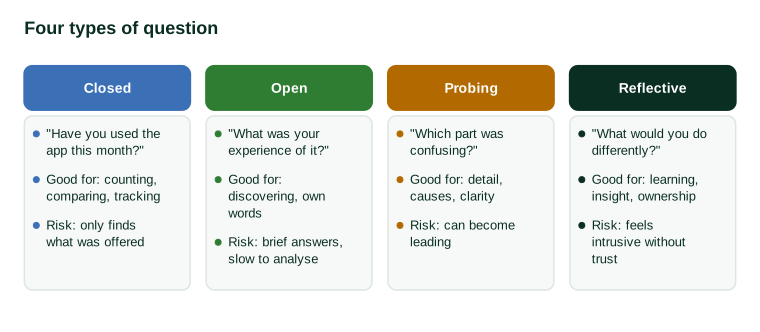
Questions come in many forms, but four types cover most of what researchers, interviewers and managers need: closed questions, open questions, probing questions and reflective questions. Each draws out a different kind of answer. Closed questions produce precise, comparable responses; open questions produce rich accounts in the respondent's own words; probing questions take an answer further; and reflective questions invite people to think about their own thinking. Knowing when to use each, and how to move between them, is one of the basic skills of inquiry.
Closed questions
A closed question offers a fixed set of answers: yes or no, a choice from a list, or a point on a scale. "Have you used our app in the past month?" and "How satisfied are you, on a scale from 1 to 5?" are closed questions. Their strength is precision. Every respondent answers the same question in the same terms, so answers can be counted, compared across groups and tracked over time. Closed questions are quick to answer and quick to analyse, which is why they dominate large surveys.
Their weakness is that they can only find what the researcher thought to offer. Stanley Payne (1951), in one of the first books on question wording, warned that a list of answers puts words into respondents' mouths. Howard Schuman and Stanley Presser (1979) demonstrated this experimentally. When they asked national samples what they considered the most important thing for children to learn, the answers to an open version and a closed version of the same question differed markedly: options that appeared on the closed list were chosen far more often than they were mentioned spontaneously, and answers that were not on the list largely disappeared. Closed questions also invite answers from people who have no real view, because choosing an option is easy (Krosnick, 1999).
Open questions
An open question lets the respondent answer in their own words: "What, if anything, would make you more likely to recommend us?" Open questions reveal what matters to people, including things the researcher did not anticipate, and they capture the language people actually use. Schuman and Presser (1979) found that open questions were particularly valuable at the early stages of research, for discovering the range of possible answers that a later closed question should include.
Open questions have costs. They take longer to answer, so some respondents give brief or empty replies, and they take longer to analyse, since answers must be read and coded. Answers also depend on what comes to mind at the moment, so an issue that a respondent cares about may go unmentioned simply because it was not salient. The usual solution is to use open questions to explore and closed questions to measure, often in that order.
Within an interview, open questions do the main work. Kvale and Brinkmann (2009) recommend that interviews begin with broad, open questions that invite description, such as "Can you tell me about a time when…?", because concrete accounts of specific experiences are more reliable than general opinions. Michael Patton (2015) adds that truly open questions do not presuppose an answer. "How satisfied were you with the training?" assumes some satisfaction; "What was your experience of the training?" does not.
Probing questions
A probing question follows up an answer to obtain more detail, clarification or explanation. Probes can be as simple as "Can you say more about that?" or "What happened next?", or more specific: "You said the process was confusing. Which part?" Probing is what turns a superficial answer into a useful one. Kvale and Brinkmann (2009) describe several kinds of follow-up, including probing for detail, asking for examples, and checking the interviewer's interpretation ("So you are saying that…?").
Probing also has a social effect. Huang et al. (2017) found that people who asked more follow-up questions in conversation were better liked by their partners, because follow-ups show that the asker has listened. In research interviews, this sense of being heard encourages respondents to say more. The risk with probing is that it can become leading. "Was it the price that put you off?" is a probe, but it suggests an answer; "What put you off?" does not. J. T. Dillon (1988), in a detailed study of classroom questioning, also warned that a rapid sequence of probes can feel like interrogation and shut down thought.
Probes can also deepen the level of thinking. Graesser and Person (1994) found that the questions most associated with learning were deep ones about causes, consequences and comparisons, such as "Why?" and "What if?", rather than shallow requests for facts. A good probe often moves the conversation from what happened to why it happened.
Reflective questions
Reflective questions ask people to examine their own experience, assumptions or reasoning. "What did you learn from that?", "What assumptions were you making?" and "How would you approach it differently now?" are reflective questions. Donald Schön (1983) showed that professionals improve by reflecting on their practice, and reflective questions are the tool that prompts this.
The term also has a specific meaning in counselling. Carl Rogers (1951) developed the technique of reflection, in which the listener restates what the speaker has said, often as a tentative question, so that the speaker can confirm, correct or extend it. In motivational interviewing, Miller and Rollnick (2013) recommend combining open questions with frequent reflections, on the grounds that reflections help people hear and develop their own reasoning. The family therapist Karl Tomm (1988) distinguished reflexive questions, which aim to help people see their situation from new perspectives, from questions that merely gather information. "If your colleague were describing this problem, what would they say?" is an example.
Reflective questions are powerful in debriefs, coaching and team reviews, because they lead people to draw their own conclusions, which they are more likely to act on. Their risk is that they can feel intrusive or contrived if asked before trust is established.
Moving between types
In practice, good questioning combines all four types. A common sequence, sometimes called a funnel, starts with open questions to explore, uses probes to deepen, moves to closed questions to confirm specifics and ends with a reflective question. A hypothetical customer interview might run like this:
- Open: "Tell me about the last time you contacted our support team."
- Probe: "What happened after you were transferred?"
- Closed: "Was the problem resolved on that call?"
- Reflective: "Looking back, what would have made the biggest difference?"
Surveys follow the same logic at a larger scale. Exploratory interviews or open survey questions identify what matters and how people describe it; closed questions then measure how common each view is. A final open question, such as "Is there anything else you would like to tell us?", catches what the closed questions missed.
Conclusion
No type of question is best in every situation. Closed questions measure, open questions discover, probing questions deepen and reflective questions help people learn from their own experience. The skill lies in choosing the type that fits the purpose, and in recognising when an answer calls for a different kind of question next.
References
Dillon, J. T. (1988). Questioning and teaching: A manual of practice. Teachers College Press.
Graesser, A. C., & Person, N. K. (1994). Question asking during tutoring. American Educational Research Journal, 31(1), 104–137. https://doi.org/10.3102/00028312031001104
Huang, K., Yeomans, M., Brooks, A. W., Minson, J., & Gino, F. (2017). It doesn't hurt to ask: Question-asking increases liking. Journal of Personality and Social Psychology, 113(3), 430–452. https://doi.org/10.1037/pspi0000097
Krosnick, J. A. (1999). Survey research. Annual Review of Psychology, 50, 537–567. https://doi.org/10.1146/annurev.psych.50.1.537
Kvale, S., & Brinkmann, S. (2009). InterViews: Learning the craft of qualitative research interviewing (2nd ed.). Sage.
Miller, W. R., & Rollnick, S. (2013). Motivational interviewing: Helping people change (3rd ed.). Guilford Press.
Patton, M. Q. (2015). Qualitative research and evaluation methods (4th ed.). Sage.
Payne, S. L. (1951). The art of asking questions. Princeton University Press.
Rogers, C. R. (1951). Client-centered therapy: Its current practice, implications, and theory. Houghton Mifflin.
Schuman, H., & Presser, S. (1979). The open and closed question. American Sociological Review, 44(5), 692–712. https://doi.org/10.2307/2094521
Schön, D. A. (1983). The reflective practitioner: How professionals think in action. Basic Books.
Tomm, K. (1988). Interventive interviewing: Part III. Intending to ask lineal, circular, strategic, or reflexive questions? Family Process, 27(1), 1–15. https://doi.org/10.1111/j.1545-5300.1988.00001.x