
Inquiry · The art of the question
The Five Whys and Root-Cause Questioning
The Five Whys is one of the simplest tools for finding the root cause of a problem: keep asking why until you reach something you can fix. This article explains where it came from, how to use it well, and why critics warn that a single chain of whys can miss what matters.
When something goes wrong, the obvious explanation is rarely the whole story. A machine stops because a fuse blew; but why did the fuse blow? The Five Whys is a technique for answering that second question, and the questions behind it, by asking "why?" repeatedly until the questioner reaches a cause that, if fixed, would stop the problem recurring. It is one of the simplest tools in the repertoire of inquiry, and one of the most widely used, from car factories to hospitals to software teams. It is also one of the most criticised. Understanding both its value and its limits makes it far more useful.
Origins
The technique is associated with Toyota and with Taiichi Ohno, the engineer who developed the Toyota Production System. Ohno (1988) described the practice of asking "why" five times whenever a problem occurred, so that "the root cause of the problem, hidden behind more obvious symptoms" could be found. His own example concerned a machine that had stopped:
- Why did the machine stop? Because the fuse blew due to an overload.
- Why was there an overload? Because the bearing was not sufficiently lubricated.
- Why was it not lubricated? Because the lubrication pump was not pumping sufficiently.
- Why was it not pumping sufficiently? Because the shaft of the pump was worn and rattling.
- Why was the shaft worn? Because there was no strainer attached, and metal scraps got in.
Replacing the fuse would have restarted the machine, but it would have stopped again. Fitting a strainer addressed the cause. Jeffrey Liker (2004) describes the Five Whys as central to Toyota's culture of problem solving, in which workers are expected to "go and see" the problem for themselves and to keep asking until they understand it. The number five is a rule of thumb, not a requirement: the point is to keep going past the first, most visible cause.
Why it works
The Five Whys works because people tend to stop explaining too early. Leonid Rozenblit and Frank Keil (2002) found that people believe they understand how everyday objects work, such as zips and flush toilets, far better than they actually do. When asked to explain the mechanism step by step, their confidence dropped sharply. They called this the illusion of explanatory depth. A chain of "why" questions has the same effect on explanations of problems: it exposes the gaps between a symptom and its causes, and forces the team to fill them with evidence.
The technique also redirects attention from people to systems. Social psychologists have long documented a tendency to explain behaviour in terms of individuals' characteristics rather than their circumstances, which Lee Ross (1977) called the fundamental attribution error. In investigations of failure, this shows up as a rush to blame the person closest to the event. James Reason (2000) argued that most errors are better understood as the product of system conditions, such as poor design, time pressure or inadequate training, which he called latent conditions. Asking why a person made an error, and then why those conditions existed, moves the inquiry from blame towards prevention. Sidney Dekker (2014) puts it more sharply: "human error" is where an investigation should start, not where it should end.
How to use it well
The technique is simple, but doing it well takes discipline. Experience in quality management and patient safety suggests some practical guidelines (Serrat, 2017; Card, 2017):
- Define the problem precisely. Start with a specific, observable problem ("Twelve orders shipped late last week") rather than a vague one ("Delivery is poor").
- Base each answer on evidence. Each "because" should be checked against data, records or direct observation, not supplied from assumption. Ohno's emphasis on going to see the problem is essential.
- Involve the people who know the process. Those who do the work usually understand the causes better than managers or analysts.
- Look for causes, not culprits. If an answer names a person, ask why the system allowed the error to happen.
- Stop at a cause you can act on. The chain ends when it reaches a cause that can be changed and that, if changed, would prevent recurrence.
- Check the logic in reverse. Read the chain backwards using "therefore": no strainer, therefore metal scraps, therefore a worn shaft, and so on. If a link does not follow, the chain is wrong.
Figure 1 shows a hypothetical example from a research setting.
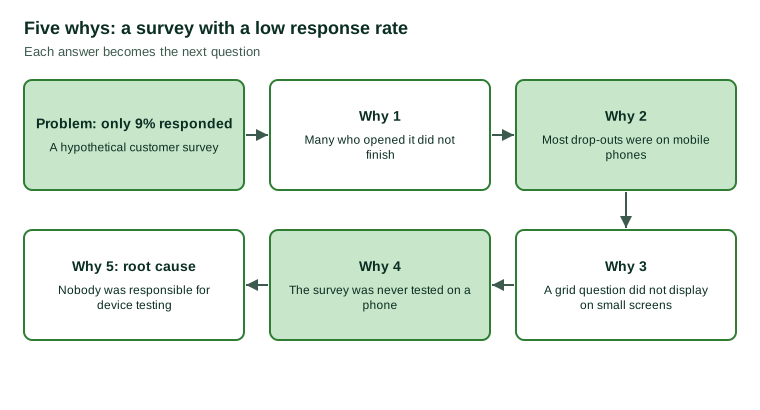
In this example, the first answer (the survey email was sent at a bad time) might have led the team simply to change the sending time. The chain reveals a deeper problem: many respondents abandoned the survey on mobile phones because a grid question did not display properly, and the survey had not been tested on phones because no one was responsible for that check. Fixing the grid helps this survey; assigning responsibility for device testing helps every future survey.
The critics' case
The Five Whys has strong critics, especially in healthcare, where root-cause analysis is widely used after patient harm. Alan Card (2017) argued that the technique is too simple for complex systems. Its main weaknesses, he suggested, are that it follows a single chain when most failures have several contributing causes; that different investigators asking why about the same event often produce different chains; and that it encourages teams to stop at a single "root cause" when prevention requires action on several factors. In Ohno's machine example, one could equally ask why the missing strainer was not noticed during maintenance, which leads to a different chain and a different fix.
Others have raised similar concerns about root-cause analysis more broadly. Wu et al. (2008) observed that root-cause analyses in hospitals consumed considerable time but often produced weak recommendations, such as retraining or new policies, rather than stronger changes to systems. Charles Vincent (2003) had earlier argued that investigations should look beyond the immediate event to the task, team, working conditions and organisation that shaped it. Peerally et al. (2017) argued that the very term "root cause" is misleading, because serious incidents usually arise from the interaction of many factors, and that investigations focused on a single cause risk missing the conditions that will produce the next incident. Nancy Leveson (2012), writing from systems engineering, argued that accidents in complex systems are better understood as failures of control across a whole system than as chains of events, and Jens Rasmussen (1997) showed how many small, locally reasonable decisions can together drift a system towards an accident.
Using the Five Whys as part of a wider inquiry
These criticisms do not mean the technique should be abandoned. They mean it should be used for what it does well and combined with other tools where problems are complex. Some practical adaptations address the main weaknesses:
- Branch the chain. When a "why" has more than one answer, follow each. The result is a tree rather than a chain, which better reflects how most problems arise.
- Combine it with a cause-and-effect diagram. Kaoru Ishikawa's (1976) fishbone diagram prompts a team to consider causes in several categories, such as methods, materials, equipment, people, measurement and environment, before choosing which chains to follow.
- Use several investigators. Comparing chains produced independently by different people reveals where interpretations differ and where more evidence is needed.
- Judge the fix, not the chain. The quality of a root-cause analysis is shown by whether its actions prevent recurrence. Following up after a set period to check whether the problem has returned closes the loop.
Mahto and Kumar (2008) describe how manufacturers have combined these tools in practice, using diagrams to map possible causes and repeated questioning to trace the most likely ones to their source.
Conclusion
The Five Whys succeeds because it asks people to go one step further than feels necessary, and then another. It moves attention from symptoms to causes and from individuals to systems. Its weakness is the same simplicity that makes it attractive: real problems rarely have a single root, and a single chain of questions can give false confidence. Used with evidence, with branching where the answers multiply, and with follow-up to check that the fix worked, it remains one of the most practical ways to turn a question about failure into lasting improvement.
References
Card, A. J. (2017). The problem with '5 whys'. BMJ Quality & Safety, 26(8), 671–677. https://doi.org/10.1136/bmjqs-2016-005849
Dekker, S. (2014). The field guide to understanding 'human error' (3rd ed.). Ashgate.
Ishikawa, K. (1976). Guide to quality control. Asian Productivity Organization.
Leveson, N. G. (2012). Engineering a safer world: Systems thinking applied to safety. MIT Press. https://doi.org/10.7551/mitpress/8179.001.0001
Liker, J. K. (2004). The Toyota way: 14 management principles from the world's greatest manufacturer. McGraw-Hill.
Mahto, D., & Kumar, A. (2008). Application of root cause analysis in improvement of product quality and productivity. Journal of Industrial Engineering and Management, 1(2), 16–53. https://doi.org/10.3926/jiem.2008.v1n2.p16-53
Ohno, T. (1988). Toyota production system: Beyond large-scale production. Productivity Press.
Peerally, M. F., Carr, S., Waring, J., & Dixon-Woods, M. (2017). The problem with root cause analysis. BMJ Quality & Safety, 26(5), 417–422. https://doi.org/10.1136/bmjqs-2016-005511
Rasmussen, J. (1997). Risk management in a dynamic society: A modelling problem. Safety Science, 27(2–3), 183–213. https://doi.org/10.1016/S0925-7535(97)00052-0
Reason, J. (2000). Human error: Models and management. BMJ, 320(7237), 768–770. https://doi.org/10.1136/bmj.320.7237.768
Ross, L. (1977). The intuitive psychologist and his shortcomings: Distortions in the attribution process. Advances in Experimental Social Psychology, 10, 173–220. https://doi.org/10.1016/S0065-2601(08)60357-3
Rozenblit, L., & Keil, F. (2002). The misunderstood limits of folk science: An illusion of explanatory depth. Cognitive Science, 26(5), 521–562. https://doi.org/10.1207/s15516709cog2605_1
Serrat, O. (2017). The five whys technique. In Knowledge solutions: Tools, methods, and approaches to drive organizational performance (pp. 307–310). Springer. https://doi.org/10.1007/978-981-10-0983-9_32
Vincent, C. (2003). Understanding and responding to adverse events. New England Journal of Medicine, 348(11), 1051–1056. https://doi.org/10.1056/NEJMhpr020760
Wu, A. W., Lipshutz, A. K. M., & Pronovost, P. J. (2008). Effectiveness and efficiency of root cause analysis in medicine. JAMA, 299(6), 685–687. https://doi.org/10.1001/jama.299.6.685