
Inquiry · The art of the question
The Power of Questions: How Asking Shapes Knowing
Questions do more than collect answers. They direct attention, shape memory, frame decisions and can even change behaviour. This article reviews the evidence on how asking shapes knowing, and what it means for anyone who asks questions for a living.
In 1974 two psychologists showed students a film of a car accident and then asked them how fast the cars had been going. The only difference between groups was a single verb. Some were asked how fast the cars were going when they "hit" each other; others, when they "smashed into" each other. The "smashed" group estimated a speed about nine miles per hour higher. A week later, they were also more than twice as likely to remember seeing broken glass, although there was none in the film (Loftus & Palmer, 1974). The experiment is a vivid demonstration of a general truth: questions do not simply retrieve what people know. They shape it.
This article draws together evidence from philosophy, psychology and survey research on the power of questions. It shows how questions direct inquiry, change memory and judgement, influence behaviour and drive learning, and it draws out practical lessons for researchers, managers and anyone who wants better answers.
Questions give inquiry its direction
Philosophers have long argued that knowledge is organised around questions. R. G. Collingwood (1939) held that every statement is an answer to a question and cannot be understood without knowing what question it answers. Hans-Georg Gadamer (2004) spoke of the "priority of the question" in all understanding: before we can learn anything, we must be open to a question that the subject matter puts to us. Jaakko Hintikka (2007) built a whole theory of knowledge-seeking on this idea, modelling inquiry as a sequence of questions put to sources of information, with the quality of the inquiry depending on the strategic choice of what to ask next.
The practical implication is that the question defines the space of possible answers. Ask "Which of our three products should we promote?" and the answer will be one of three products. Ask "What do our customers most need that we are not providing?" and the space opens up. Jane Friedman (2013) argues that inquiring into something is a distinctive state of mind directed at a question, and that having the right question in mind is what makes evidence relevant or irrelevant.
Not all questions are equal
Researchers who study questioning distinguish between kinds of questions by the thinking they demand. A question that asks for a fact ("When did the product launch?") calls for recall. A question that asks for an explanation ("Why did sales fall after launch?") calls for reasoning about causes. A question that asks for a judgement ("Which explanation fits the evidence best?") calls for weighing alternatives. Arthur Graesser and Natalie Person (1994) recorded the questions asked in tutoring sessions and classified them by type. They found that students asked very few questions, and that most of those were shallow requests for facts or for repetition. Deep questions, such as why, how, what if and what is the difference between, were rare. Yet the frequency of deep questions was related to how well students performed on examinations, while the frequency of shallow questions was not.
The same pattern appears in organisations. Meetings and research briefs are full of questions about what happened and how much, and much shorter on questions about why and what would happen if. Both kinds are needed. Descriptive questions establish the facts; explanatory and counterfactual questions turn facts into understanding. A useful discipline for any research plan is to check that it contains at least one question of each kind.
Questions can demand more effort than people give
Every question asks the person answering it to do some work: understand what is meant, search memory, form a judgement and express it in the format offered. Jon Krosnick (1991) argued that respondents often do not do all of this work. Instead, they satisfice, giving an answer that seems acceptable rather than one that reflects careful thought. Satisficing is more likely when questions are difficult, when respondents are tired or unmotivated, and when the question offers an easy way out, such as agreeing with a statement, choosing the first reasonable option in a list or selecting "don't know". The result is answers that reflect the shape of the question more than the views of the person.
This gives question designers a further responsibility. A question that is long, abstract or placed at the end of a lengthy questionnaire invites a less considered answer than the same question asked clearly and early. Short, concrete questions about specific experiences, rather than general attitudes, reduce the effort required and produce more accurate answers.
Questions shape memory
The Loftus and Palmer experiment was one of many that established the misinformation effect: information embedded in questions can alter what people remember. Figure 1 shows the speed estimates from the original study.
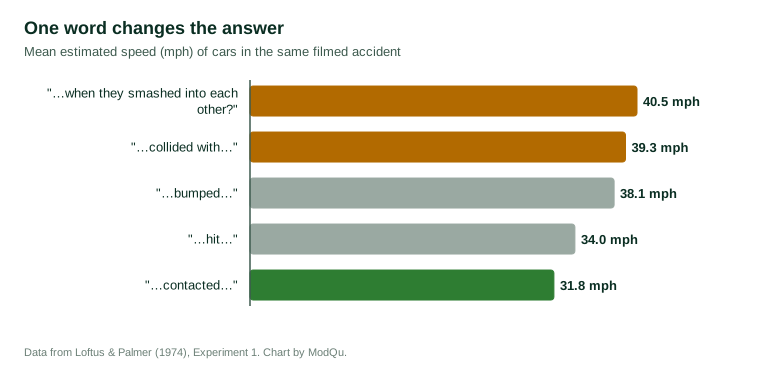
Elizabeth Loftus (2005) later reviewed thirty years of research showing that leading questions and suggestive information can change memories of events, sometimes creating memories of things that never happened. The implications for legal interviewing were profound and led to the development of interview methods that avoid leading questions. For researchers, the lesson is the same: the wording of a question is part of the measurement, not a neutral container for it.
Better questions, better memories: the cognitive interview
The research on leading questions did more than expose a problem. It led to a solution. Ronald Fisher and Edward Geiselman (1992) developed the cognitive interview, a method of questioning witnesses based on what psychologists had learned about memory. Instead of a rapid series of specific, closed questions, the interviewer asks the witness to mentally reinstate the context of the event, to report everything that comes to mind without filtering, and to recall the events in different orders and from different perspectives. The interviewer avoids suggestive questions and lets the witness do most of the talking.
The method has been tested many times. A meta-analysis by Köhnken et al. (1999) found that the cognitive interview elicited substantially more correct information than standard police interviews, with only a small increase in errors. A later meta-analysis by Memon et al. (2010), covering a further decade of studies, reached the same conclusion. The finding is a clear demonstration that the same person, with the same memory, can give a much fuller and more accurate account when asked in a better way.
The lesson extends well beyond policing. Customer interviews, usability studies and staff exit interviews all depend on people recalling what happened and why. Asking them to describe a specific recent occasion in detail, and resisting the temptation to suggest answers, yields richer and more reliable information than asking them to generalise.
Questions shape judgement
Survey researchers have documented how much answers depend on how questions are asked. Howard Schuman and Stanley Presser (1981) ran dozens of split-ballot experiments in national surveys, giving randomly selected halves of a sample different versions of the same question. Changes in wording, the order of questions and whether a "don't know" option was offered all produced substantial differences in reported opinion. Norbert Schwarz (1999) explained many of these effects by showing that respondents treat every feature of a question, including the response scale, as information about what the researcher wants to know. When asked how many hours a day they watched television, people given a scale with high categories reported more viewing than people given a scale with low categories, because the scale suggested what was typical.
Amos Tversky and Daniel Kahneman (1981) showed that framing a choice in terms of gains or losses reverses preferences. When a public health programme was described in terms of lives saved, most people chose the certain option; when the same programme was described in terms of deaths, most chose the risky option. The question, not the facts, determined the answer.
Questions change behaviour
Perhaps the most surprising finding is that being asked a question can change what people do. Steven Sherman (1980) found that people asked to predict whether they would volunteer for a charity were more likely to volunteer when the request came. Morwitz et al. (1993) found that simply asking consumers whether they intended to buy a car or a computer increased their subsequent purchase rates. This question–behaviour effect, sometimes called the mere-measurement effect, has been found for voting, exercise, health screening and many other behaviours. A meta-analysis by Spangenberg et al. (2016) confirmed a small but reliable effect across more than a hundred studies.
The effect has a double edge. It can be used deliberately to encourage beneficial behaviour, but it also means that research itself can alter the behaviour it measures. A customer survey that asks about intention to switch providers may slightly increase switching. Researchers who are aware of this can design studies with control groups that are not asked, to measure the effect.
Questions drive learning
Asking questions is one of the most powerful ways to learn, and being asked them is one of the most powerful ways to remember. Roediger and Karpicke (2006) showed that students who were tested on material, answering questions about it, retained far more a week later than students who spent the same time re-reading it. This testing effect is one of the most robust findings in educational psychology.
Generating questions is also effective. Alison King (1992) taught students to ask one another guided questions such as "How does … relate to …?" and "What is a new example of …?" and found that their comprehension improved compared with students who simply discussed the material. Rosenshine et al. (1996) reviewed 26 studies in which students were taught to generate questions about texts and found substantial improvements in comprehension. Children are natural questioners: Michelle Chouinard (2007) recorded young children's everyday conversations and found that they asked questions frequently and persistently, and that most of their questions sought information rather than attention, consistent with the view that questioning is a central mechanism of early learning.
Questions build relationships
Questions also affect how people feel about each other. Huang et al. (2017) analysed thousands of conversations, including speed-dating encounters, and found that people who asked more questions, particularly follow-up questions that built on what the other person had said, were better liked. Follow-up questions signal listening and interest. This matters for researchers too: interviewers who ask good follow-up questions elicit richer answers because respondents feel heard.
Why the power of questions is easy to overlook
If questions are so influential, why are they so often treated as neutral? One reason is that their effects are usually invisible to the person answering. Respondents in the Loftus and Palmer study did not notice that the verb had influenced them. Survey respondents do not realise that the scale has shaped their answer. Another reason is that people asking questions usually know what they want to find out and assume their questions are transparent. Warren Berger (2014) argues that organisations reward answers more than questions, so that the skill of framing a good question receives less attention than it deserves.
An example: two versions of the same study
Consider a hypothetical retailer that wants to know why customers abandon online shopping baskets. In the first version of the study, the research team sends a short survey to customers who left items in their basket. It asks: "Did you leave because of high delivery costs?" with the options yes and no. Most respondents answer yes, and the company cuts its delivery charge. Abandonment barely changes.
In the second version, the team begins by asking a small group of customers to describe, in their own words, the last time they left a basket without buying. The open accounts reveal several reasons: some customers were comparing prices across sites, some were using the basket as a wish list, some were deterred by a forced account registration, and some did mention delivery costs. Only then does the team write a closed question listing these reasons in random order, with an "other" option. The answers show that forced registration is the most common deterrent among customers who intended to buy. Removing it has a much larger effect than cutting delivery charges.
The difference between the two studies is not in the sample, the analysis or the budget. It is in the questions. The first version asked a leading, closed question that confirmed what the company already suspected. The second opened the space of possible answers before narrowing it, in the way the research on questioning recommends.
Practical lessons
The evidence suggests several principles for anyone who designs research or asks questions professionally:
- Treat the question as part of the method. Every word, response option and preceding question can influence answers. Pre-test questions and, where possible, compare versions experimentally.
- Avoid leading language. Neutral wording such as "What happened next?" yields more accurate accounts than suggestive wording.
- Open the space before closing it. Start with broad, open questions to find out what matters, before narrowing to specific options that might exclude the real answer.
- Be aware that asking can change behaviour. When measuring intentions or attitudes, consider whether the measurement itself might affect the outcome, and use control groups where it matters.
- Use questions to learn. Answering and generating questions consolidates understanding. Teams that quiz themselves on findings, or ask "what is a new example of this?", learn more from their research.
- Ask follow-up questions. They yield richer information and better relationships.
Conclusion
Questions are not neutral instruments for extracting knowledge that already exists. They direct attention, frame judgements, shape memories, change behaviour and build understanding. This makes them one of the most powerful tools of inquiry and one of the most easily misused. The difference between research that informs and research that misleads often lies less in the analysis than in the questions asked at the start.
References
Berger, W. (2014). A more beautiful question: The power of inquiry to spark breakthrough ideas. Bloomsbury.
Chouinard, M. M. (2007). Children's questions: A mechanism for cognitive development. Monographs of the Society for Research in Child Development, 72(1), 1–129.
Collingwood, R. G. (1939). An autobiography. Oxford University Press.
Fisher, R. P., & Geiselman, R. E. (1992). Memory-enhancing techniques for investigative interviewing: The cognitive interview. Charles C Thomas.
Friedman, J. (2013). Question-directed attitudes. Philosophical Perspectives, 27(1), 145–174. https://doi.org/10.1111/phpe.12026
Gadamer, H.-G. (2004). Truth and method (2nd rev. ed.; J. Weinsheimer & D. G. Marshall, Trans.). Continuum. (Original work published 1960)
Graesser, A. C., & Person, N. K. (1994). Question asking during tutoring. American Educational Research Journal, 31(1), 104–137. https://doi.org/10.3102/00028312031001104
Hintikka, J. (2007). Socratic epistemology: Explorations of knowledge-seeking by questioning. Cambridge University Press. https://doi.org/10.1017/CBO9780511619298
Huang, K., Yeomans, M., Brooks, A. W., Minson, J., & Gino, F. (2017). It doesn't hurt to ask: Question-asking increases liking. Journal of Personality and Social Psychology, 113(3), 430–452. https://doi.org/10.1037/pspi0000097
King, A. (1992). Facilitating elaborative learning through guided student-generated questioning. Educational Psychologist, 27(1), 111–126. https://doi.org/10.1207/s15326985ep2701_8
Krosnick, J. A. (1991). Response strategies for coping with the cognitive demands of attitude measures in surveys. Applied Cognitive Psychology, 5(3), 213–236. https://doi.org/10.1002/acp.2350050305
Köhnken, G., Milne, R., Memon, A., & Bull, R. (1999). The cognitive interview: A meta-analysis. Psychology, Crime & Law, 5(1–2), 3–27. https://doi.org/10.1080/10683169908414991
Loftus, E. F. (2005). Planting misinformation in the human mind: A 30-year investigation of the malleability of memory. Learning & Memory, 12(4), 361–366. https://doi.org/10.1101/lm.94705
Loftus, E. F., & Palmer, J. C. (1974). Reconstruction of automobile destruction: An example of the interaction between language and memory. Journal of Verbal Learning and Verbal Behavior, 13(5), 585–589. https://doi.org/10.1016/S0022-5371(74)80011-3
Memon, A., Meissner, C. A., & Fraser, J. (2010). The cognitive interview: A meta-analytic review and study space analysis of the past 25 years. Psychology, Public Policy, and Law, 16(4), 340–372. https://doi.org/10.1037/a0020518
Morwitz, V. G., Johnson, E., & Schmittlein, D. (1993). Does measuring intent change behavior? Journal of Consumer Research, 20(1), 46–61. https://doi.org/10.1086/209332
Roediger, H. L., III, & Karpicke, J. D. (2006). Test-enhanced learning: Taking memory tests improves long-term retention. Psychological Science, 17(3), 249–255. https://doi.org/10.1111/j.1467-9280.2006.01693.x
Rosenshine, B., Meister, C., & Chapman, S. (1996). Teaching students to generate questions: A review of the intervention studies. Review of Educational Research, 66(2), 181–221. https://doi.org/10.3102/00346543066002181
Schuman, H., & Presser, S. (1981). Questions and answers in attitude surveys: Experiments on question form, wording, and context. Academic Press.
Schwarz, N. (1999). Self-reports: How the questions shape the answers. American Psychologist, 54(2), 93–105. https://doi.org/10.1037/0003-066X.54.2.93
Sherman, S. J. (1980). On the self-erasing nature of errors of prediction. Journal of Personality and Social Psychology, 39(2), 211–221. https://doi.org/10.1037/0022-3514.39.2.211
Spangenberg, E. R., Kareklas, I., Devezer, B., & Sprott, D. E. (2016). A meta-analytic synthesis of the question–behavior effect. Journal of Consumer Psychology, 26(3), 441–458. https://doi.org/10.1016/j.jcps.2015.12.004
Tversky, A., & Kahneman, D. (1981). The framing of decisions and the psychology of choice. Science, 211(4481), 453–458. https://doi.org/10.1126/science.7455683