
Inquiry · The art of the question
Question Formulation Technique
The Question Formulation Technique is a structured way for any group to produce, improve and prioritise its own questions. This article describes its steps, the research behind it and how it can be used beyond the classroom.
Most of the questions in a classroom, a meeting or a research brief are asked by the person in charge. The Question Formulation Technique (QFT) reverses this. It gives a group a short, structured process for producing its own questions, improving them and choosing which to pursue. It was developed by Dan Rothstein and Luz Santana at the Right Question Institute, originally to help parents in low-income communities ask better questions of schools and services, and later adapted for classrooms (Rothstein & Santana, 2011). It is now used in schools, universities, health services and organisations.
The steps
Figure 1 summarises the process.
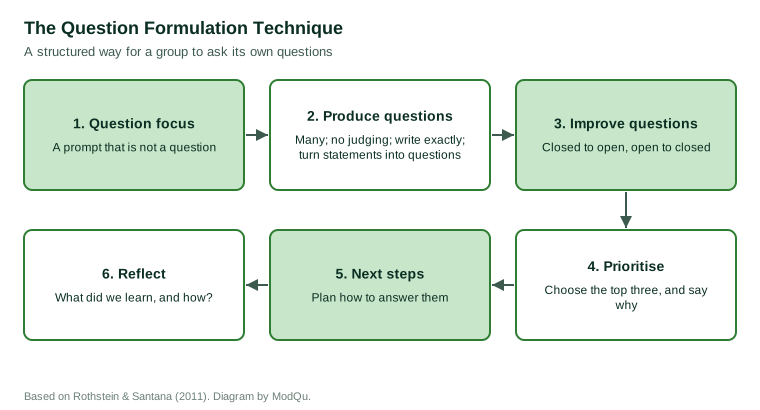
- The question focus. The facilitator presents a prompt, which is not itself a question: a statement, image, data chart or short phrase, such as "Customers who stop using the app in the first week".
- Producing questions. Working in small groups, participants write down as many questions as they can about the focus, following four rules: ask as many questions as you can; do not stop to discuss, judge or answer any question; write every question down exactly as it is stated; and change any statement into a question.
- Improving questions. Participants classify their questions as closed (answerable with yes, no or a single word) or open, discuss the advantages and disadvantages of each, and practise changing questions from one type to the other.
- Prioritising. The group chooses its three most important questions, according to criteria the facilitator sets, and explains its choice.
- Next steps. The group decides how to use its priority questions, for example by planning research to answer them.
- Reflecting. Participants discuss what they learned and how they learned it.
Why the rules matter
The four rules for producing questions are the heart of the method. They draw on the same insight as Alex Osborn's (1953) rules for brainstorming: judging ideas while generating them suppresses both the number and the variety of ideas produced. Separating generation from evaluation allows more unusual questions to surface. Research has shown that brainstorming in groups can be less productive than individuals working alone, partly because people wait their turn and fear judgement (Diehl & Stroebe, 1987). The QFT's emphasis on writing every question down without discussion, and its later step of improving and choosing, is designed to reduce these losses.
The step of changing closed questions into open ones, and the reverse, makes participants aware that the form of a question shapes the answer it can receive. This is a lesson that survey researchers learn through long experience, and the QFT teaches it directly.
The evidence for student questioning
The QFT itself has mostly been studied through case studies and practitioner reports, but it builds on a substantial body of research on student-generated questions. Rosenshine et al. (1996) reviewed 26 experimental studies in which students were taught to generate questions about what they read, and found consistent improvements in comprehension. Alison King (1992) showed that students who learned to ask each other guided questions understood lectures better than students who simply discussed them. Christine Chin and Jonathan Osborne (2008) reviewed research in science education and concluded that students' own questions can guide their learning and reveal their thinking to teachers, but that students rarely ask questions unless classrooms are deliberately organised to encourage them. Graesser and Person (1994) found that deep questions about causes and consequences are rare but closely linked to understanding, and Scardamalia and Bereiter (1992) found that children's questions based on what they wanted to know, rather than on the text in front of them, were more likely to lead to deeper understanding.
There is also a motivational argument. Self-determination theory holds that people are more engaged when they have a sense of autonomy and ownership over their activities (Ryan & Deci, 2000). When the questions belong to the learners, the inquiry does too.
Using the QFT beyond the classroom
The technique adapts easily to adult settings. A research team at the start of a project can use a question focus such as a key statistic, a customer quotation or a business goal, and produce questions before deciding what to study. A management team can use it to open a strategic discussion without anchoring on the first question raised. Because the prioritising step makes criteria explicit, the group's final questions are easier to explain to others.
In a hypothetical example, a retailer's insights team uses the focus "Repeat purchases fell 8% last quarter". In ten minutes the group produces thirty questions, including several no one would have raised in an ordinary meeting, such as whether the measure itself had changed. The group prioritises three questions and turns them into the brief for its next study.
Conclusion
The Question Formulation Technique turns question asking from an individual talent into a shared, teachable skill. Its rules are simple, but they address real obstacles to good questioning, and the research on student-generated questions suggests that the practice it builds pays off in understanding and engagement.
References
Chin, C., & Osborne, J. (2008). Students' questions: A potential resource for teaching and learning science. Studies in Science Education, 44(1), 1–39. https://doi.org/10.1080/03057260701828101
Diehl, M., & Stroebe, W. (1987). Productivity loss in brainstorming groups: Toward the solution of a riddle. Journal of Personality and Social Psychology, 53(3), 497–509. https://doi.org/10.1037/0022-3514.53.3.497
Graesser, A. C., & Person, N. K. (1994). Question asking during tutoring. American Educational Research Journal, 31(1), 104–137. https://doi.org/10.3102/00028312031001104
King, A. (1992). Facilitating elaborative learning through guided student-generated questioning. Educational Psychologist, 27(1), 111–126. https://doi.org/10.1207/s15326985ep2701_8
Osborn, A. F. (1953). Applied imagination: Principles and procedures of creative thinking. Scribner.
Rosenshine, B., Meister, C., & Chapman, S. (1996). Teaching students to generate questions: A review of the intervention studies. Review of Educational Research, 66(2), 181–221. https://doi.org/10.3102/00346543066002181
Rothstein, D., & Santana, L. (2011). Make just one change: Teach students to ask their own questions. Harvard Education Press.
Ryan, R. M., & Deci, E. L. (2000). Self-determination theory and the facilitation of intrinsic motivation, social development, and well-being. American Psychologist, 55(1), 68–78. https://doi.org/10.1037/0003-066X.55.1.68
Scardamalia, M., & Bereiter, C. (1992). Text-based and knowledge-based questioning by children. Cognition and Instruction, 9(3), 177–199. https://doi.org/10.1207/s1532690xci0903_1