
Inquiry · The art of the question
Curiosity: The Psychology of Wanting to Know
Curiosity is the desire to know, and it drives much of human learning and discovery. This article explains what psychologists have learned about curiosity, from its different forms to its effects on memory, learning and work, and how it can be encouraged.
Curiosity is the motive behind inquiry. Before anyone asks a question, they must want to know the answer. Psychologists have studied curiosity for more than seventy years, and the research has moved from philosophical description to brain imaging and large studies of learning and work. It shows that curiosity takes several forms, that it is triggered by identifiable conditions, that it improves memory and performance, and that it can be encouraged or suppressed by the way information and questions are presented.
What curiosity is
The psychologist Daniel Berlyne (1954) proposed one of the first scientific accounts of curiosity. He distinguished two dimensions. The first separates perceptual curiosity, the urge to look at or listen to something novel or surprising, from epistemic curiosity, the desire for knowledge. The second separates specific curiosity, the desire for a particular piece of information, such as the answer to a puzzle, from diversive curiosity, a general seeking of stimulation, as when someone browses aimlessly to relieve boredom. Figure 1 shows the four combinations.
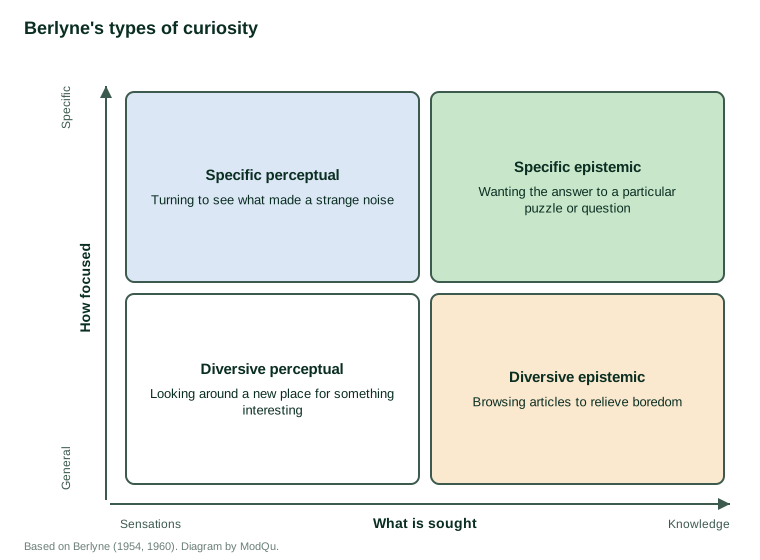
Berlyne (1960) argued that curiosity is aroused by what he called collative variables: novelty, surprise, complexity, uncertainty and conflict between ideas. A stimulus that is completely familiar arouses no curiosity; one that is completely incomprehensible arouses confusion rather than interest. Curiosity is strongest in between.
More recent research treats curiosity both as a passing state and as a stable trait on which people differ. Jordan Litman (2005) distinguished curiosity driven by the pleasure of learning something new, which he called interest-type curiosity, from curiosity driven by the discomfort of not knowing, which he called deprivation-type curiosity. Todd Kashdan and colleagues (2018) developed a measure of five dimensions of curiosity: joyous exploration, deprivation sensitivity, stress tolerance, social curiosity and thrill seeking. Their work suggests that the ability to tolerate the uncertainty of not knowing is an important and often overlooked part of being curious.
Why we become curious
George Loewenstein (1994), reviewing the research, proposed that specific curiosity arises when people become aware of a gap between what they know and what they want to know. This information-gap account explains several features of curiosity: it is triggered by questions, puzzles and incomplete stories; it increases as people get closer to an answer; and it requires some existing knowledge, because people must know enough to notice what they do not know.
Kang et al. (2009) tested this idea. They asked people trivia questions and measured both their confidence that they knew the answer and their curiosity to find it out. Curiosity was highest when people were moderately confident, and lower when they were either sure of the answer or had no idea at all. This inverted-U pattern is consistent with both Berlyne's and Loewenstein's accounts.
Curiosity is also a powerful motive, sometimes more powerful than good sense. Hsee and Ruan (2016) found that people were willing to experience unpleasant outcomes, such as mild electric shocks, simply to resolve uncertainty about what would happen, which they called the Pandora effect.
Curiosity and learning
Children show curiosity from the start. Michelle Chouinard (2007) recorded young children's everyday conversations and found that they asked large numbers of questions, most of them seeking information, and persisted when they did not receive a satisfactory answer. Susan Engel (2011), however, observed classrooms and found that children asked far fewer questions at school than at home, and that teachers often responded to curiosity as an interruption to the planned lesson.
Curiosity has measurable effects on learning. In the study by Kang et al. (2009), participants remembered the answers to questions they had been curious about better than answers to other questions, and brain imaging showed that curiosity was associated with activity in regions linked to reward. Gruber et al. (2014) found that when people were curious about the answer to a question, they also remembered better unrelated faces shown to them while they waited for the answer. Curiosity appears to put the brain into a state that is better at learning in general.
Over longer periods, curiosity predicts achievement. Sophie von Stumm et al. (2011) analysed many studies of academic performance and found that intellectual curiosity predicted performance about as strongly as conscientiousness, and that curiosity and effort together predicted it nearly as well as intelligence. They called curiosity the "third pillar" of academic performance.
Celeste Kidd and Benjamin Hayden (2015) reviewed the psychological and neuroscientific research and suggested that curiosity is best understood as a drive to seek information that helps people learn, which is why it is aimed at things that are neither too familiar nor too complex. Gottlieb et al. (2013) similarly argue that the brain treats information as a kind of reward, valued for its ability to reduce uncertainty.
Curiosity at work
Curiosity also matters in organisations. Harrison et al. (2011) followed new employees at call centres and found that those with higher trait curiosity sought more information and tried out more ways of interpreting their new roles, which helped them adapt and perform better. Francesca Gino (2018) reported studies suggesting that curiosity at work is associated with fewer decision-making errors, more creative solutions and less conflict in teams, because curious people are more inclined to consider others' perspectives. She also found that curiosity tends to decline as people settle into a job, unless organisations deliberately encourage it.
The limits of curiosity
Curiosity is not always a guide to what is worth knowing. Because it responds to gaps in knowledge rather than to the importance of what fills them, it can be captured by trivia, gossip and headlines written to tease. Loewenstein (1994) noted that the information-gap mechanism explains why people keep reading a mediocre mystery novel to the end, and why they often feel let down once the answer arrives. The Pandora effect (Hsee & Ruan, 2016) shows that the urge to resolve uncertainty can lead people to choose outcomes they know will be unpleasant. Curiosity also fades quickly once a gap is closed, so a question answered too soon may leave no lasting interest behind.
For inquiry, the practical lesson is that curiosity needs direction. A research team can be curious about many things that have no bearing on the decision it is meant to inform. The discipline of linking each question to a purpose does not suppress curiosity; it points it at the gaps that matter. At the same time, some of the most valuable discoveries begin with curiosity about something that seemed irrelevant, which is why many organisations leave room for open exploration alongside directed research.
Encouraging curiosity
The research suggests several practical ways to encourage curiosity, in a classroom, a team or a piece of communication:
- Open a gap. Start with a question, puzzle or surprising fact that makes people aware of what they do not know.
- Pitch it right. Curiosity is highest when people know something, but not everything. Provide enough background for the gap to be visible.
- Welcome questions. Treat questions as contributions, not interruptions, and give time to explore them.
- Tolerate uncertainty. Allow people to stay with an open question for a while rather than rushing to the answer.
- Model it. Leaders and teachers who ask genuine questions and admit what they do not know make curiosity normal.
Conclusion
Curiosity is not a luxury or a distraction from serious work. It is the motive that turns attention into learning, and it predicts achievement at school and adaptation at work. It arises from noticing gaps in knowledge, and it can be encouraged by presenting information as questions to be answered rather than facts to be received. For anyone whose work involves generating knowledge, cultivating curiosity, in oneself and in others, is part of the job.
References
Berlyne, D. E. (1954). A theory of human curiosity. British Journal of Psychology, 45(3), 180–191. https://doi.org/10.1111/j.2044-8295.1954.tb01243.x
Berlyne, D. E. (1960). Conflict, arousal, and curiosity. McGraw-Hill. https://doi.org/10.1037/11164-000
Chouinard, M. M. (2007). Children's questions: A mechanism for cognitive development. Monographs of the Society for Research in Child Development, 72(1), 1–129.
Engel, S. (2011). Children's need to know: Curiosity in schools. Harvard Educational Review, 81(4), 625–645. https://doi.org/10.17763/haer.81.4.h054131316473115
Gino, F. (2018). The business case for curiosity. Harvard Business Review, 96(5), 48–57.
Gottlieb, J., Oudeyer, P.-Y., Lopes, M., & Baranes, A. (2013). Information-seeking, curiosity, and attention: Computational and neural mechanisms. Trends in Cognitive Sciences, 17(11), 585–593. https://doi.org/10.1016/j.tics.2013.09.001
Gruber, M. J., Gelman, B. D., & Ranganath, C. (2014). States of curiosity modulate hippocampus-dependent learning via the dopaminergic circuit. Neuron, 84(2), 486–496. https://doi.org/10.1016/j.neuron.2014.08.060
Harrison, S. H., Sluss, D. M., & Ashforth, B. E. (2011). Curiosity adapted the cat: The role of trait curiosity in newcomer adaptation. Journal of Applied Psychology, 96(1), 211–220. https://doi.org/10.1037/a0021647
Hsee, C. K., & Ruan, B. (2016). The Pandora effect: The power and peril of curiosity. Psychological Science, 27(5), 659–666. https://doi.org/10.1177/0956797616631733
Kang, M. J., Hsu, M., Krajbich, I. M., Loewenstein, G., McClure, S. M., Wang, J. T., & Camerer, C. F. (2009). The wick in the candle of learning: Epistemic curiosity activates reward circuitry and enhances memory. Psychological Science, 20(8), 963–973. https://doi.org/10.1111/j.1467-9280.2009.02402.x
Kashdan, T. B., Stiksma, M. C., Disabato, D. J., McKnight, P. E., Bekier, J., Kaji, J., & Lazarus, R. (2018). The five-dimensional curiosity scale: Capturing the bandwidth of curiosity and identifying four unique subgroups of curious people. Journal of Research in Personality, 73, 130–149. https://doi.org/10.1016/j.jrp.2017.11.011
Kidd, C., & Hayden, B. Y. (2015). The psychology and neuroscience of curiosity. Neuron, 88(3), 449–460. https://doi.org/10.1016/j.neuron.2015.09.010
Litman, J. A. (2005). Curiosity and the pleasures of learning: Wanting and liking new information. Cognition and Emotion, 19(6), 793–814. https://doi.org/10.1080/02699930541000101
Loewenstein, G. (1994). The psychology of curiosity: A review and reinterpretation. Psychological Bulletin, 116(1), 75–98. https://doi.org/10.1037/0033-2909.116.1.75
von Stumm, S., Hell, B., & Chamorro-Premuzic, T. (2011). The hungry mind: Intellectual curiosity is the third pillar of academic performance. Perspectives on Psychological Science, 6(6), 574–588. https://doi.org/10.1177/1745691611421204