
Inquiry · The art of the question
Intellectual Humility and Open-Minded Inquiry
Intellectual humility means recognising the limits of what you know and being willing to revise your views. This article explains what it is, what the research says about its effects on reasoning and learning, and how it supports open-minded inquiry.
Inquiry begins with the admission that one does not yet know. Intellectual humility is the disposition that makes this admission easy rather than painful. Philosophers and psychologists have studied it intensively over the past decade, and the research suggests that it is linked to better reasoning, more accurate judgement and more productive disagreement.
What intellectual humility is
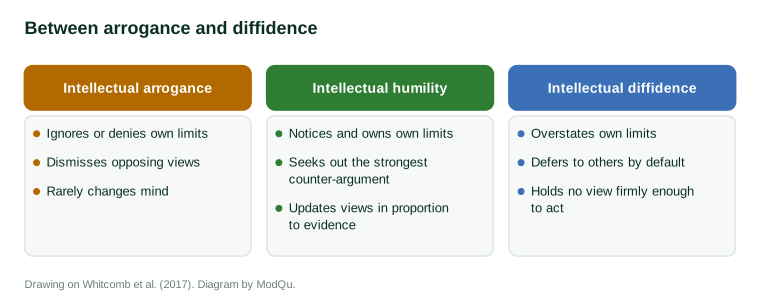
Whitcomb et al. (2017) define intellectual humility as "proper attentiveness to, and owning of, one's intellectual limitations". Owning a limitation means acknowledging it, caring about it and responding to it appropriately, for example by seeking evidence or deferring to someone who knows more. On this view, intellectual humility sits between two failings, as Figure 1 shows.
Psychologists measure intellectual humility with questionnaires that ask, for example, whether people recognise that their views might be wrong and whether they are willing to change them in light of evidence. Leary et al. (2017) developed one such scale, and Krumrei-Mancuso and Rouse (2016) developed another that distinguishes several aspects, including independence of intellect and ego, openness to revising one's viewpoint and respect for others' viewpoints.
What the research shows
People higher in intellectual humility process evidence differently. Leary et al. (2017) found that they were better at distinguishing strong arguments from weak ones, and were less likely to judge people who changed their minds as weak or inconsistent. Porter and Schumann (2018) found that intellectually humble people were more willing to learn about opposing political views and less likely to see their opponents as unintelligent or immoral. They also showed that intellectual humility can be increased temporarily: people who read an article explaining that the brain is capable of growth showed more intellectual humility and more openness to opposing views than people who read an article saying that intelligence is fixed.
A related trait, actively open-minded thinking, measures willingness to search for evidence against one's own beliefs and to weigh it fairly. Stanovich and West (1997) found that people high in this trait were better at evaluating arguments independently of whether they agreed with the conclusions. In forecasting tournaments, open-mindedness was one of the characteristics that distinguished the most accurate forecasters (Mellers et al., 2015).
Overconfidence, the opposite failing, is common. Kruger and Dunning (1999) found that people who performed worst on tests of logic, grammar and humour were the most likely to overestimate their performance, partly because the skills needed to perform well are the same skills needed to recognise good performance. Intellectual humility is not a cure for this, but it makes people more likely to check.
Porter et al. (2022), reviewing the growing body of research, concluded that intellectual humility is associated with greater openness to learning, more careful evaluation of information and better ability to navigate disagreement, while noting that most studies are correlational and that more experimental work is needed.
Humility and inquiry
Intellectual humility matters for anyone who generates knowledge. A researcher who cannot imagine being wrong will design studies that can only confirm what they expect, and will explain away awkward results. An organisation whose leaders project certainty will hear less bad news. Intellectual humility does not mean having no views or deferring to everyone. Whitcomb et al. (2017) are clear that underestimating one's own knowledge is also a failing. It means holding views in proportion to the evidence and being ready to update them.
Some practical habits help:
- State confidence explicitly. Saying "I am about 70% sure" invites correction more readily than a flat assertion.
- Ask what would change your mind. If nothing could, the view is not based on evidence.
- Seek out disagreement. Ask people who are likely to see the issue differently, and listen for their strongest argument.
- Treat a change of mind as a success. In a research team, revising a conclusion in light of new evidence is the system working as it should.
Conclusion
Intellectual humility is the readiness to recognise the limits of one's knowledge and to act on that recognition. The research links it to fairer evaluation of evidence, openness to opposing views and better judgement. For inquiry, it is less a personality trait than a working condition: questions only lead somewhere if the person asking them is willing to be surprised by the answer.
References
Kruger, J., & Dunning, D. (1999). Unskilled and unaware of it: How difficulties in recognizing one's own incompetence lead to inflated self-assessments. Journal of Personality and Social Psychology, 77(6), 1121–1134. https://doi.org/10.1037/0022-3514.77.6.1121
Krumrei-Mancuso, E. J., & Rouse, S. V. (2016). The development and validation of the comprehensive intellectual humility scale. Journal of Personality Assessment, 98(2), 209–221. https://doi.org/10.1080/00223891.2015.1068174
Leary, M. R., Diebels, K. J., Davisson, E. K., Jongman-Sereno, K. P., Isherwood, J. C., Raimi, K. T., Deffler, S. A., & Hoyle, R. H. (2017). Cognitive and interpersonal features of intellectual humility. Personality and Social Psychology Bulletin, 43(6), 793–813. https://doi.org/10.1177/0146167217697695
Mellers, B., Stone, E., Atanasov, P., Rohrbaugh, N., Metz, S. E., Ungar, L., Bishop, M. M., Horowitz, M., Merkle, E., & Tetlock, P. (2015). The psychology of intelligence analysis: Drivers of prediction accuracy in world politics. Journal of Experimental Psychology: Applied, 21(1), 1–14. https://doi.org/10.1037/xap0000040
Porter, T., Elnakouri, A., Meyers, E. A., Shibayama, T., Jayawickreme, E., & Grossmann, I. (2022). Predictors and consequences of intellectual humility. Nature Reviews Psychology, 1(9), 524–536. https://doi.org/10.1038/s44159-022-00081-9
Porter, T., & Schumann, K. (2018). Intellectual humility and openness to the opposing view. Self and Identity, 17(2), 139–162. https://doi.org/10.1080/15298868.2017.1361861
Stanovich, K. E., & West, R. F. (1997). Reasoning independently of prior belief and individual differences in actively open-minded thinking. Journal of Educational Psychology, 89(2), 342–357. https://doi.org/10.1037/0022-0663.89.2.342
Whitcomb, D., Battaly, H., Baehr, J., & Howard-Snyder, D. (2017). Intellectual humility: Owning our limitations. Philosophy and Phenomenological Research, 94(3), 509–539. https://doi.org/10.1111/phpr.12228