
Inquiry · The art of the question
The Information-Gap Theory of Curiosity
George Loewenstein's information-gap theory explains curiosity as a response to noticing a gap between what we know and what we want to know. This article explains the theory, the evidence for it, its extensions and limits, and how it can be used to design better questions, research and communication.
Why do people keep reading a story to find out how it ends, click on a headline that withholds the key fact, or lie awake trying to remember the name of an actor? In 1994 the economist and psychologist George Loewenstein offered an answer that has shaped research on curiosity ever since. In a review of a century of writing on the subject, he proposed that curiosity arises when attention is drawn to a gap in one's knowledge (Loewenstein, 1994). The gap produces a feeling of deprivation, and curiosity is the desire to close it. This information-gap theory is simple, but it explains a wide range of findings and offers practical guidance to anyone who wants to stimulate, or responsibly use, the desire to know.
The theory
Loewenstein built on earlier work by Daniel Berlyne (1954), who had distinguished specific curiosity, the desire for a particular piece of information, from diversive curiosity, a general seeking of stimulation. The information-gap theory is a theory of specific curiosity. Its central claims are:
- Curiosity arises when a person becomes aware of a gap between what they know and what they want to know.
- The gap produces an aversive feeling, similar to a mild form of deprivation, which motivates the person to obtain the missing information.
- The intensity of curiosity depends on the size of the gap relative to what the person already knows. A person must already know something about a subject to notice what they do not know.
- Curiosity increases as a person gets closer to closing the gap, and is satisfied, often quickly, once the gap is closed.
Loewenstein compared the experience to an itch that needs scratching. He noted that people often find the resolution of curiosity less satisfying than they expected, which suggests that curiosity is driven more by the discomfort of not knowing than by the pleasure of the answer.
What triggers a gap
Loewenstein (1994) identified several situations that reliably open an information gap. A question or riddle poses a gap directly. A sequence of events with an unknown outcome, as in a mystery story, creates anticipation of a resolution. A violation of expectations, such as a surprising fact, signals that one's understanding is incomplete. Knowing that someone else has information one lacks creates a sense of deficit. And partial information, such as the first letters of a word, makes the remaining gap vivid. Each of these is a way of drawing attention to what is not known.
The theory also explains why curiosity requires knowledge. A person who knows nothing about chess is unlikely to be curious about a particular endgame, because they cannot see that there is a question. As knowledge grows, more gaps become visible. This is consistent with the observation that experts are often more curious about their fields than novices.
The evidence
Several lines of research support the theory. Figure 1 shows the pattern found by Kang et al. (2009), who asked people trivia questions and measured both their confidence that they knew the answer and their curiosity to find it out.
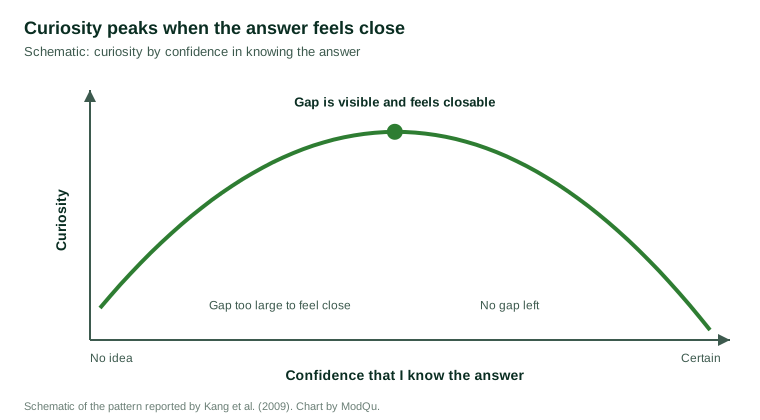
Curiosity was highest when people were moderately confident. When they were sure they knew the answer, there was no gap; when they had no idea, the gap was too large to feel close. This inverted-U pattern is what the theory predicts. Kang et al. also found that curiosity was associated with activity in brain regions involved in anticipating rewards, that people were willing to spend scarce tokens or wait longer to learn answers they were curious about, and that they remembered these answers better a week or two later.
Gruber et al. (2014) extended these findings. When people were curious about the answer to a trivia question, they also remembered unrelated faces shown during the wait for the answer better than faces shown when they were not curious. Curiosity appeared to create a general state of readiness to learn. Marvin and Shohamy (2016) found that people's memory for answers was enhanced most when the answer was more interesting than they had expected, suggesting that curiosity works partly through the brain's system for learning from surprise.
Wade and Kidd (2019) examined the role of prior knowledge directly. Participants were most curious about questions for which they thought they were close to knowing the answer, and this curiosity predicted how well they learned the answers. Metcalfe et al. (2020) linked this to the idea of a "region of proximal learning", in which people are most motivated to learn material that is just beyond what they currently know.
The theory also explains a well-known phenomenon in memory. Bluma Zeigarnik (1927) found that people remembered interrupted tasks better than completed ones. An unfinished task, like an unanswered question, leaves a gap that keeps it active in the mind.
Two kinds of curiosity
Later research has refined the theory. Jordan Litman (2005) argued that curiosity has two sources. Deprivation-type curiosity, which corresponds closely to Loewenstein's account, is driven by the unpleasant feeling of a specific gap and is strongest when people feel they almost know the answer. Interest-type curiosity is driven by the anticipated pleasure of learning something new and is more open-ended. Litman and Jimerson (2004) developed a scale to measure curiosity as a feeling of deprivation and found that it was distinct from more general interest. Both kinds motivate inquiry, but deprivation-type curiosity is more urgent and more focused, while interest-type curiosity is more likely to lead to broad exploration.
Wanting and avoiding information
Russell Golman and George Loewenstein (2018) later developed the information-gap idea into a broader theory of how people value information. They proposed that people attend to particular questions, and that their feelings about information depend not only on its usefulness but on how it affects their beliefs about those questions. Closing a gap is pleasant, but learning bad news is not. This explains why people sometimes avoid information they could easily obtain, such as medical test results or the performance of their investments. Golman et al. (2017) reviewed extensive evidence of such information avoidance, and Sweeny et al. (2010) found that people are most likely to avoid information when they expect it to be unpleasant and feel unable to do anything about it.
The same theory also explains the Pandora effect identified by Hsee and Ruan (2016): people who were uncertain about what would happen were willing to experience mildly unpleasant outcomes, such as electric shocks, simply to resolve the uncertainty. The pull of a gap can be strong enough to override other preferences.
Criticisms and limits
The information-gap theory explains specific curiosity well but says less about diversive curiosity or the broad, open-ended interest that drives much exploration. Kidd and Hayden (2015) argued that curiosity is best understood more generally, as a drive to acquire information that is useful for learning, of which closing specific gaps is one part. Dubey and Griffiths (2020) proposed a rational account in which curiosity is directed at information that is likely to be useful in the future, which can explain both the pull of novelty and the pull of gaps in familiar subjects. FitzGibbon et al. (2020) reviewed evidence that information acts as a reward in its own right, and noted that this makes curiosity vulnerable to exploitation, as when content is designed to provoke clicks rather than to inform.
Using information gaps responsibly
The theory offers clear guidance for teachers, researchers and communicators.
- Start with a question, not an answer. A presentation that opens with a puzzle or a surprising fact creates a gap that the rest of the presentation can close.
- Make sure the audience knows enough to see the gap. A question that is too far beyond what people know produces confusion rather than curiosity. Provide enough context first.
- Reveal information in stages. Withholding part of an answer, as a good mystery does, sustains attention.
- Close the gap. A gap that is opened and never closed leaves frustration and distrust. Menon and Soman (2002) found that advertisements that aroused curiosity were effective only when the curiosity was then satisfied with useful information.
- Do not exploit the gap. Headlines and messages that promise more than they deliver use the information gap against the reader. Over time they erode trust.
In research, the same principles apply. Respondents are more engaged by a survey or interview that poses genuine questions they find interesting, and a research report that frames its findings around the questions the reader has will be read more attentively than one that simply lists results.
Conclusion
The information-gap theory explains curiosity as a response to noticing what we do not know. It accounts for why curiosity requires some knowledge, why it peaks when an answer feels close and why it can be so compelling. The evidence from behavioural, memory and brain imaging studies largely supports it, while later work has broadened the picture to include interest-driven curiosity and the avoidance of unwelcome information. For anyone who asks questions for a living, the theory carries a practical message: the way to make people want to know is to show them, clearly and honestly, what they do not yet know.
References
Berlyne, D. E. (1954). A theory of human curiosity. British Journal of Psychology, 45(3), 180–191. https://doi.org/10.1111/j.2044-8295.1954.tb01243.x
Dubey, R., & Griffiths, T. L. (2020). Reconciling novelty and complexity through a rational analysis of curiosity. Psychological Review, 127(3), 455–476. https://doi.org/10.1037/rev0000175
FitzGibbon, L., Lau, J. K. L., & Murayama, K. (2020). The seductive lure of curiosity: Information as a motivationally salient reward. Current Opinion in Behavioral Sciences, 35, 21–27. https://doi.org/10.1016/j.cobeha.2020.05.014
Golman, R., Hagmann, D., & Loewenstein, G. (2017). Information avoidance. Journal of Economic Literature, 55(1), 96–135. https://doi.org/10.1257/jel.20151245
Golman, R., & Loewenstein, G. (2018). Information gaps: A theory of preferences regarding the presence and absence of information. Decision, 5(3), 143–164. https://doi.org/10.1037/dec0000068
Gruber, M. J., Gelman, B. D., & Ranganath, C. (2014). States of curiosity modulate hippocampus-dependent learning via the dopaminergic circuit. Neuron, 84(2), 486–496. https://doi.org/10.1016/j.neuron.2014.08.060
Hsee, C. K., & Ruan, B. (2016). The Pandora effect: The power and peril of curiosity. Psychological Science, 27(5), 659–666. https://doi.org/10.1177/0956797616631733
Kang, M. J., Hsu, M., Krajbich, I. M., Loewenstein, G., McClure, S. M., Wang, J. T., & Camerer, C. F. (2009). The wick in the candle of learning: Epistemic curiosity activates reward circuitry and enhances memory. Psychological Science, 20(8), 963–973. https://doi.org/10.1111/j.1467-9280.2009.02402.x
Kidd, C., & Hayden, B. Y. (2015). The psychology and neuroscience of curiosity. Neuron, 88(3), 449–460. https://doi.org/10.1016/j.neuron.2015.09.010
Litman, J. A. (2005). Curiosity and the pleasures of learning: Wanting and liking new information. Cognition and Emotion, 19(6), 793–814. https://doi.org/10.1080/02699930541000101
Litman, J. A., & Jimerson, T. L. (2004). The measurement of curiosity as a feeling of deprivation. Journal of Personality Assessment, 82(2), 147–157. https://doi.org/10.1207/s15327752jpa8202_3
Loewenstein, G. (1994). The psychology of curiosity: A review and reinterpretation. Psychological Bulletin, 116(1), 75–98. https://doi.org/10.1037/0033-2909.116.1.75
Marvin, C. B., & Shohamy, D. (2016). Curiosity and reward: Valence predicts choice and information prediction errors enhance learning. Journal of Experimental Psychology: General, 145(3), 266–272. https://doi.org/10.1037/xge0000140
Menon, S., & Soman, D. (2002). Managing the power of curiosity for effective web advertising strategies. Journal of Advertising, 31(3), 1–14. https://doi.org/10.1080/00913367.2002.10673672
Metcalfe, J., Schwartz, B. L., & Eich, T. S. (2020). Epistemic curiosity and the region of proximal learning. Current Opinion in Behavioral Sciences, 35, 40–47. https://doi.org/10.1016/j.cobeha.2020.06.007
Sweeny, K., Melnyk, D., Miller, W., & Shepperd, J. A. (2010). Information avoidance: Who, what, when, and why. Review of General Psychology, 14(4), 340–353. https://doi.org/10.1037/a0021288
Wade, S., & Kidd, C. (2019). The role of prior knowledge and curiosity in learning. Psychonomic Bulletin & Review, 26(4), 1377–1387. https://doi.org/10.3758/s13423-019-01598-6
Zeigarnik, B. (1927). Das Behalten erledigter und unerledigter Handlungen [The retention of completed and uncompleted actions]. Psychologische Forschung, 9, 1–85. https://doi.org/10.1007/BF02409755