
Inquiry · Inquiry in education and learning
The Distinction Between Open and Guided Inquiry Designs
Inquiry-based learning ranges from open designs, in which learners pose their own questions and methods, to guided designs with substantial structure and support. This article explains the difference, reviews the evidence on how much guidance works best, and offers practical guidance for designers.
When people talk about inquiry-based learning, they can mean very different things. At one extreme, learners choose their own questions, design their own investigations and reach their own conclusions with little help. At the other, a teacher poses the question, provides the method and guides learners step by step towards an answer that is known in advance. Between these lie many intermediate forms. The difference matters, because the research shows that how much guidance learners receive is one of the most important influences on whether inquiry helps them learn.
Levels of inquiry
A common way of describing the range is by asking who supplies three things: the question, the method of investigation and the answer. Banchi and Bell (2008) describe four levels, shown in Figure 1.
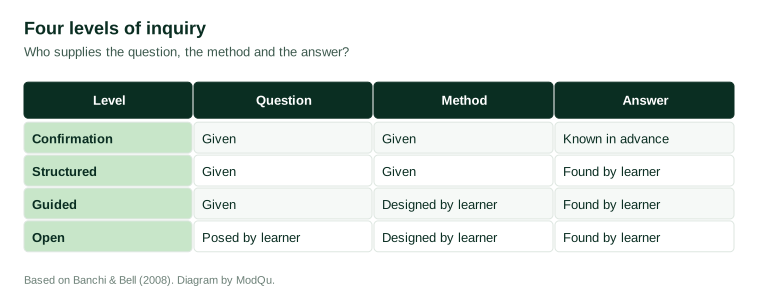
In confirmation inquiry, learners verify a known result by following a set procedure. In structured inquiry, they are given the question and the procedure but must work out the answer. In guided inquiry, they are given the question but design their own method. In open inquiry, they formulate the question as well. The levels are not a ranking of quality. Each suits different purposes and different learners.
The case for open inquiry
The argument for open designs goes back to Jerome Bruner (1961), who argued that knowledge discovered by learners themselves is better understood, more easily remembered and more likely to be applied, and that discovery develops the habits of inquiry. Open inquiry also mirrors real research, in which the hardest part is often deciding what question to ask and how to investigate it. Learners who only ever answer questions set by others may not learn how to pose their own.
The case for guidance
Critics argue that open inquiry overloads novices. Kirschner et al. (2006) drew on research on human cognitive architecture, especially cognitive load theory (Sweller, 1988), to argue that novices lack the knowledge needed to search a problem space efficiently. Unguided search uses up working memory without building lasting knowledge. Richard Mayer (2004) reviewed decades of research comparing pure discovery with guided discovery, in fields from problem solving to computer programming, and concluded that pure discovery consistently produced worse learning. Klahr and Nigam (2004) found that children taught a scientific principle through direct instruction learned it better than children left to discover it, and were just as good at applying it to new problems.
What the meta-analyses show
Larger reviews have clarified the picture. Alfieri et al. (2011) analysed 164 studies and found that unassisted discovery was less effective than explicit instruction, but that enhanced discovery, with guidance, feedback or worked examples, was more effective than other forms of instruction. Furtak et al. (2012), focusing on science teaching, found that inquiry approaches had a positive effect overall, and that the effect was larger when teachers guided the activities than when students led them. Lazonder and Harmsen (2016), in a meta-analysis of 72 studies, found that guidance improved both the activities learners carried out during inquiry and what they learned from it, and that more specific guidance helped younger and less experienced learners most.
The conclusion is not that inquiry fails, but that inquiry needs support. The question is how much, and what kind.
Matching guidance to the learner
The right level of guidance depends on what learners already know. Slava Kalyuga (2007) described the expertise reversal effect: instructional supports that help novices can hinder more experienced learners, who find them redundant. Novices benefit from worked examples, clear procedures and frequent feedback. As learners gain knowledge, guidance can be faded and more of the inquiry handed over to them.
Wood et al. (1976) introduced the term scaffolding for this kind of temporary support, adjusted to the learner's needs and removed as competence grows. A review of discovery learning with computer simulations by de Jong and van Joolingen (1998) reached a similar conclusion. They examined research in which learners explored simulated systems and found that they had difficulty generating hypotheses, designing experiments and interpreting data, and that tools supporting each of these processes improved learning.
There is one important qualification. Manu Kapur (2008) found that students who first struggled with complex problems on their own, and then received instruction, sometimes learned more deeply than students who received instruction first. He called this productive failure. The initial struggle appears to help learners notice what they do not know and prepare them to understand the instruction that follows. So open exploration can be valuable when it is followed by guidance, rather than replacing it.
Kinds of guidance
Guidance can take many forms, and they are not equally useful at every stage. Lazonder and Harmsen (2016) distinguished several types, ranging from the least to the most specific. Process constraints limit the complexity of the task, for example by reducing the number of variables learners can change. Status overviews show learners what they have done so far, helping them keep track. Prompts remind learners to carry out particular activities, such as stating a hypothesis before running an experiment. Heuristics suggest how to carry out an activity, for example by changing one variable at a time. Scaffolds take over part of the activity, such as providing a table to record results. Explanations tell learners directly what to do or what something means. Their analysis found that all these types helped learners carry out inquiry activities, and that the more specific types, such as scaffolds and explanations, were particularly effective in improving learning outcomes.
The practical implication is that guidance does not have to mean giving away the answer. A learner who is prompted to state a hypothesis, given a heuristic for designing a fair test and provided with a template for recording data is still doing the inquiry, but with support at the points where novices typically go wrong.
A hypothetical example
A training programme for new market researchers wants participants to learn how to investigate why a product's sales have changed. In an open design, participants would be handed a data set and asked to find out what is going on. Most novices would produce a list of observations without a clear question. In a guided design, the first exercise gives them a specific question ("Did the price change in March affect sales in the north?"), a suggested method and a template. The second exercise gives them the question but asks them to design the method. The third gives them only the data and a business problem, and asks them to formulate their own questions. Each step hands over more of the inquiry, and by the end participants are doing open inquiry with the skills to do it well.
Practical guidance
For anyone designing learning, training or research development, the evidence suggests:
- Start more guided for novices, with clear questions, procedures and feedback, and open up as competence grows.
- Guide the hard parts. Support question formulation, method design and interpretation of results, where novices struggle most.
- Use exploration before instruction when the goal is deep understanding, but make sure instruction follows.
- Make open inquiry the goal, not the starting point. The ability to pose one's own questions and design one's own investigations is a valuable outcome, best reached in stages.
Conclusion
Open and guided inquiry are not rivals but points on a range. The evidence shows that guidance makes inquiry more effective, especially for novices, and that the best designs adjust the level of guidance to the learner and fade it over time. Open inquiry remains an important goal, because generating knowledge ultimately depends on people who can ask their own questions. The route there runs through guided practice.
References
Alfieri, L., Brooks, P. J., Aldrich, N. J., & Tenenbaum, H. R. (2011). Does discovery-based instruction enhance learning? Journal of Educational Psychology, 103(1), 1–18. https://doi.org/10.1037/a0021017
Banchi, H., & Bell, R. (2008). The many levels of inquiry. Science and Children, 46(2), 26–29.
Bruner, J. S. (1961). The act of discovery. Harvard Educational Review, 31(1), 21–32.
de Jong, T., & van Joolingen, W. R. (1998). Scientific discovery learning with computer simulations of conceptual domains. Review of Educational Research, 68(2), 179–201. https://doi.org/10.3102/00346543068002179
Furtak, E. M., Seidel, T., Iverson, H., & Briggs, D. C. (2012). Experimental and quasi-experimental studies of inquiry-based science teaching: A meta-analysis. Review of Educational Research, 82(3), 300–329. https://doi.org/10.3102/0034654312457206
Kalyuga, S. (2007). Expertise reversal effect and its implications for learner-tailored instruction. Educational Psychology Review, 19(4), 509–539. https://doi.org/10.1007/s10648-007-9054-3
Kapur, M. (2008). Productive failure. Cognition and Instruction, 26(3), 379–424. https://doi.org/10.1080/07370000802212669
Kirschner, P. A., Sweller, J., & Clark, R. E. (2006). Why minimal guidance during instruction does not work: An analysis of the failure of constructivist, discovery, problem-based, experiential, and inquiry-based teaching. Educational Psychologist, 41(2), 75–86. https://doi.org/10.1207/s15326985ep4102_1
Klahr, D., & Nigam, M. (2004). The equivalence of learning paths in early science instruction: Effects of direct instruction and discovery learning. Psychological Science, 15(10), 661–667. https://doi.org/10.1111/j.0956-7976.2004.00737.x
Lazonder, A. W., & Harmsen, R. (2016). Meta-analysis of inquiry-based learning: Effects of guidance. Review of Educational Research, 86(3), 681–718. https://doi.org/10.3102/0034654315627366
Mayer, R. E. (2004). Should there be a three-strikes rule against pure discovery learning? The case for guided methods of instruction. American Psychologist, 59(1), 14–19. https://doi.org/10.1037/0003-066X.59.1.14
Sweller, J. (1988). Cognitive load during problem solving: Effects on learning. Cognitive Science, 12(2), 257–285. https://doi.org/10.1207/s15516709cog1202_4
Wood, D., Bruner, J. S., & Ross, G. (1976). The role of tutoring in problem solving. Journal of Child Psychology and Psychiatry, 17(2), 89–100. https://doi.org/10.1111/j.1469-7610.1976.tb00381.x