
Inquiry · Inquiry in education and learning
Teaching Critical Thinking: What Works
Can critical thinking be taught, and if so, how? This article reviews the evidence from meta-analyses and experiments on teaching reasoning, from explicit instruction and argument mapping to dialogue and debiasing, and sets out what works for schools, universities and organisations.
Almost every educational institution claims to teach critical thinking, and many employers say they want it. But it is reasonable to ask whether critical thinking can be taught at all, and if so, which approaches work. For a long time the answer rested mostly on opinion. Over the past few decades, however, a substantial body of evidence has accumulated, including several large meta-analyses. The findings are encouraging in some respects and sobering in others. Critical thinking can be improved, but not automatically, not quickly and not by every method that claims to improve it. This article reviews what the research shows.
Does education improve critical thinking?
A natural starting point is whether ordinary education develops critical thinking. Christopher Huber and Nathan Kuncel (2016) conducted a meta-analysis of studies measuring changes in critical thinking during university. They found that students' critical thinking skills and dispositions did improve substantially over the course of a degree. However, the improvement was not clearly greater than would be expected from maturation and general life experience, and specific instruction in critical thinking added relatively modest gains beyond the general effect of college. Richard Arum and Josipa Roksa (2011), in a widely discussed study of American undergraduates, found that many students showed little improvement on a performance-based test of critical thinking, analytical reasoning and writing over their first two years, especially in courses that required little reading and writing.
These findings suggest that critical thinking does not develop reliably as a by-product of studying a subject. Explicit attention to it seems to be needed.
Four approaches
Robert Ennis (1989) distinguished four ways of teaching critical thinking, which have since been used to organise the research. Figure 1 summarises them.
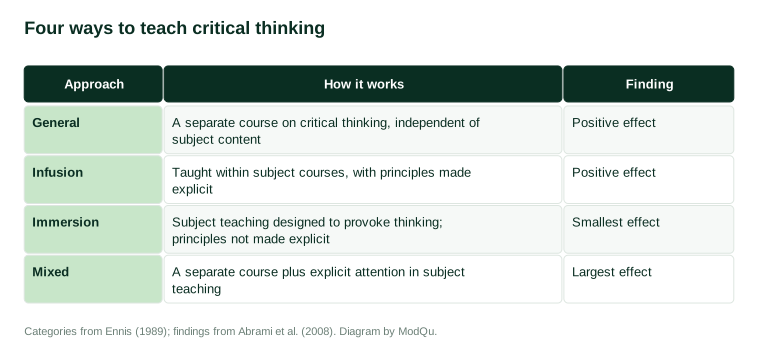
In the general approach, critical thinking is taught as a separate subject, with its own course, independent of other content. In the infusion approach, it is taught within subject courses, with its principles made explicit. In the immersion approach, students are immersed in subject teaching that is designed to provoke deep thinking, but critical thinking principles are not made explicit. The mixed approach combines a separate course in critical thinking with explicit attention to it in subject teaching.
What the meta-analyses show
Philip Abrami and colleagues (2008) analysed 117 studies of interventions aimed at improving critical thinking. The overall effect was positive but modest, with very large variation between studies. Two factors stood out. First, the approach mattered: the mixed approach produced the largest effects, and the immersion approach, in which critical thinking was expected to develop implicitly, the smallest. Second, interventions in which teachers had received special training in teaching critical thinking produced larger gains than those in which they had not.
A follow-up meta-analysis by Abrami et al. (2015), covering 341 effect sizes, examined specific teaching strategies. Three stood out as effective: dialogue, in which students discuss problems, whether in whole-class discussion, small groups or debate; authentic or anchored instruction, in which students work on realistic problems; and mentoring, in which students receive one-to-one guidance. Combinations of these, particularly dialogue with authentic problems, were most effective.
Niu et al. (2013) conducted a meta-analysis focused on university students and found a small to moderate positive effect of instructional interventions. Longer interventions tended to produce larger effects, suggesting that critical thinking develops slowly.
Explicit instruction
A consistent finding is that critical thinking principles are better learned when they are taught explicitly. Marin and Halpern (2011) compared two groups of secondary school students: one received explicit instruction in critical thinking skills, the other received instruction in which the skills were embedded in subject content without being named. The explicit instruction group made substantially larger gains. Bensley et al. (2010) similarly found that psychology students who received explicit instruction in argument analysis, embedded in their psychology course, improved more than students who studied the same content without explicit instruction.
Diane Halpern (1998) argued that explicit teaching is needed because critical thinking skills do not transfer automatically. Students must learn not only how to use a skill, but how to recognise situations that call for it. Halpern recommended teaching the structure of problems, so that students can see that a medical, a financial and a political argument may share the same logical form, and practising skills across varied contexts.
Transfer and the role of knowledge
The challenge of transfer is central. Barnett and Ceci (2002) reviewed research on whether learning transfers from one context to another and found that transfer is more likely between similar contexts and less likely when the knowledge domain, physical setting or purpose differ. Daniel Willingham (2007) argued that critical thinking depends heavily on domain knowledge, so that a person who thinks critically about chemistry may not do so about history. He concluded that teaching general critical thinking strategies has value, but only when students also have the knowledge needed to apply them and practise them repeatedly in different contexts.
There is, however, evidence that some kinds of reasoning can be taught in ways that transfer. Richard Nisbett and colleagues found that training in statistical principles, such as the law of large numbers and regression to the mean, improved people's reasoning about everyday problems that were not explicitly statistical (Fong et al., 1986; Nisbett et al., 1987). Lehman et al. (1988) found that graduate training in psychology and medicine, which involve probabilistic and methodological reasoning, improved students' reasoning about everyday problems involving statistics and methodology, while training in law and chemistry did not have the same effect. The kind of reasoning practised in a discipline shapes the kind of thinking that transfers.
Argument mapping
One technique with promising evidence is argument mapping, in which students create diagrams showing the structure of an argument: the main claim, the reasons for and against it, and the evidence for each reason. Tim van Gelder (2005) argued that argument mapping helps because it makes the structure of reasoning visible, reducing the load on working memory and allowing students to see where an argument is weak. Charles Twardy (2004) reported that students in a philosophy course taught with argument mapping software showed substantially larger gains on a standard critical thinking test than students in courses taught without it.
Dialogue and argumentation
The finding of Abrami et al. (2015) that dialogue is effective is supported by experimental studies. Deanna Kuhn and Amanda Crowell (2011) compared a group of young adolescents who took part in an extended programme of dialogic argument, debating issues with peers over three years, with a group who studied the same issues through a more conventional approach of class discussion and writing. The dialogue group produced better arguments in their individual essays, considering opposing views more often. Kuhn's interpretation is that arguing with others, who press for reasons and raise objections, builds the habit of anticipating such challenges when reasoning alone.
Debiasing
Another line of research asks whether people can be trained to avoid specific reasoning biases. Richard Larrick (2004) reviewed this literature and found that some strategies help, especially those that change how people approach a problem rather than simply warning them about bias. One of the most effective is to consider the opposite: Lord et al. (1984) found that asking people to imagine how they would have evaluated evidence that pointed the other way reduced biased assimilation of evidence more than simply asking them to be unbiased. Morewedge et al. (2015) found that a single training session, using either a video or an interactive game that explained biases, gave feedback and taught strategies, reduced several biases, with effects lasting at least two months.
Philosophy for Children
Programmes that teach philosophy to children through structured discussion have also been evaluated. Trickey and Topping (2004) reviewed controlled studies of Philosophy for Children and found moderate positive effects on measures of reasoning and cognitive ability. A large trial in English primary schools funded by the Education Endowment Foundation (Gorard et al., 2015) found positive effects on reading and mathematics, although the authors noted limitations in the evidence, and a later, larger trial did not find effects on attainment. The approach illustrates both the promise of dialogue-based teaching and the difficulty of establishing its effects at scale.
What does not work
The research also points to approaches that tend to disappoint. The first is assuming that critical thinking will develop on its own in content-heavy courses. The immersion approach had the smallest effects in Abrami et al.'s (2008) analysis, and the studies of university students suggest that general education alone produces limited gains beyond maturation (Huber & Kuncel, 2016). The second is teaching lists of fallacies or biases without practice. Knowing the name of a fallacy does not mean recognising it in a real argument, still less avoiding it in one's own reasoning. Larrick (2004) found that simply warning people about a bias rarely reduces it. The third is very short training. Single lectures or workshops can raise awareness, but the meta-analyses show larger effects from longer, sustained interventions (Niu et al., 2013). The fourth is assessing critical thinking only through recall. If students are tested on definitions of critical thinking terms, they will learn definitions; if they are tested on their ability to evaluate a new argument, they will practise evaluation.
What works: a summary
Taken together, the evidence suggests several principles:
- Teach critical thinking explicitly. Name the skills, explain them and show examples. Do not rely on them developing implicitly.
- Combine general principles with subject content. The mixed approach, teaching principles and applying them in subjects, is the most effective.
- Use dialogue. Discussion, debate and argument with peers develop reasoning, especially when sustained over time.
- Use realistic problems. Authentic tasks give students reasons to think carefully and practice in applying skills to the kinds of problems they will meet.
- Teach for transfer. Practise skills in varied contexts, and teach students to recognise the structure of problems.
- Address dispositions. Encourage students to value evidence, consider alternatives and examine their own views, not only to master techniques.
- Train teachers. Teachers who understand critical thinking and how to teach it produce larger gains.
- Allow time. Critical thinking develops slowly; short interventions have small effects.
In organisations
These principles apply to organisations as well as schools. A research team or analytics function can build critical thinking by holding regular reviews in which members present findings and colleagues challenge the reasoning, using simple tools such as argument maps or structured templates for evaluating evidence, practising "consider the opposite" before major decisions, and providing mentoring for less experienced staff. The research suggests that one-off training courses will have limited effect unless the skills they teach are practised regularly in real work.
Consider a hypothetical insights team that wants to strengthen its analysts' critical thinking. Instead of sending them on a one-day course, it introduces three changes. Every major finding is presented at a weekly session with a short written argument: the claim, the evidence and the main alternative explanation. A rotating "challenger" is asked to make the strongest case against the conclusion. And once a quarter, the team looks back at its past conclusions to see which held up and which did not. These practices combine explicit principles, dialogue, authentic problems and feedback, the elements the research associates with the largest gains.
Conclusion
Critical thinking can be taught, but not by hoping it will emerge from ordinary instruction. The most effective approaches teach its principles explicitly, apply them in real subjects and problems, use dialogue and argument to develop them and give learners repeated practice over time. Transfer remains the hardest challenge: skills learned in one context do not automatically carry over to another. But the evidence shows that well-designed teaching, sustained over time and supported by skilled teachers, can make people measurably better at the careful evaluation of claims and evidence on which inquiry depends.
References
Abrami, P. C., Bernard, R. M., Borokhovski, E., Waddington, D. I., Wade, C. A., & Persson, T. (2015). Strategies for teaching students to think critically: A meta-analysis. Review of Educational Research, 85(2), 275–314. https://doi.org/10.3102/0034654314551063
Abrami, P. C., Bernard, R. M., Borokhovski, E., Wade, A., Surkes, M. A., Tamim, R., & Zhang, D. (2008). Instructional interventions affecting critical thinking skills and dispositions: A stage 1 meta-analysis. Review of Educational Research, 78(4), 1102–1134. https://doi.org/10.3102/0034654308326084
Arum, R., & Roksa, J. (2011). Academically adrift: Limited learning on college campuses. University of Chicago Press.
Barnett, S. M., & Ceci, S. J. (2002). When and where do we apply what we learn? A taxonomy for far transfer. Psychological Bulletin, 128(4), 612–637. https://doi.org/10.1037/0033-2909.128.4.612
Bensley, D. A., Crowe, D. S., Bernhardt, P., Buckner, C., & Allman, A. L. (2010). Teaching and assessing critical thinking skills for argument analysis in psychology. Teaching of Psychology, 37(2), 91–96. https://doi.org/10.1080/00986281003626656
Ennis, R. H. (1989). Critical thinking and subject specificity: Clarification and needed research. Educational Researcher, 18(3), 4–10. https://doi.org/10.3102/0013189X018003004
Fong, G. T., Krantz, D. H., & Nisbett, R. E. (1986). The effects of statistical training on thinking about everyday problems. Cognitive Psychology, 18(3), 253–292. https://doi.org/10.1016/0010-0285(86)90001-0
Gorard, S., Siddiqui, N., & See, B. H. (2015). Philosophy for Children: SAPERE evaluation report and executive summary. Education Endowment Foundation.
Halpern, D. F. (1998). Teaching critical thinking for transfer across domains: Disposition, skills, structure training, and metacognitive monitoring. American Psychologist, 53(4), 449–455. https://doi.org/10.1037/0003-066X.53.4.449
Huber, C. R., & Kuncel, N. R. (2016). Does college teach critical thinking? A meta-analysis. Review of Educational Research, 86(2), 431–468. https://doi.org/10.3102/0034654315605917
Kuhn, D., & Crowell, A. (2011). Dialogic argumentation as a vehicle for developing young adolescents' thinking. Psychological Science, 22(4), 545–552. https://doi.org/10.1177/0956797611402512
Larrick, R. P. (2004). Debiasing. In D. J. Koehler & N. Harvey (Eds.), Blackwell handbook of judgment and decision making (pp. 316–338). Blackwell. https://doi.org/10.1002/9780470752937.ch16
Lehman, D. R., Lempert, R. O., & Nisbett, R. E. (1988). The effects of graduate training on reasoning: Formal discipline and thinking about everyday-life events. American Psychologist, 43(6), 431–442. https://doi.org/10.1037/0003-066X.43.6.431
Lord, C. G., Lepper, M. R., & Preston, E. (1984). Considering the opposite: A corrective strategy for social judgment. Journal of Personality and Social Psychology, 47(6), 1231–1243. https://doi.org/10.1037/0022-3514.47.6.1231
Marin, L. M., & Halpern, D. F. (2011). Pedagogy for developing critical thinking in adolescents: Explicit instruction produces greatest gains. Thinking Skills and Creativity, 6(1), 1–13. https://doi.org/10.1016/j.tsc.2010.08.002
Morewedge, C. K., Yoon, H., Scopelliti, I., Symborski, C. W., Korris, J. H., & Kassam, K. S. (2015). Debiasing decisions: Improved decision making with a single training intervention. Policy Insights from the Behavioral and Brain Sciences, 2(1), 129–140. https://doi.org/10.1177/2372732215600886
Nisbett, R. E., Fong, G. T., Lehman, D. R., & Cheng, P. W. (1987). Teaching reasoning. Science, 238(4827), 625–631. https://doi.org/10.1126/science.3672116
Niu, L., Behar-Horenstein, L. S., & Garvan, C. W. (2013). Do instructional interventions influence college students' critical thinking skills? A meta-analysis. Educational Research Review, 9, 114–128. https://doi.org/10.1016/j.edurev.2012.12.002
Trickey, S., & Topping, K. J. (2004). 'Philosophy for children': A systematic review. Research Papers in Education, 19(3), 365–380. https://doi.org/10.1080/0267152042000248016
Twardy, C. R. (2004). Argument maps improve critical thinking. Teaching Philosophy, 27(2), 95–116. https://doi.org/10.5840/teachphil200427213
van Gelder, T. (2005). Teaching critical thinking: Some lessons from cognitive science. College Teaching, 53(1), 41–48. https://doi.org/10.3200/CTCH.53.1.41-48
Willingham, D. T. (2007). Critical thinking: Why is it so hard to teach? American Educator, 31(2), 8–19.