
Inquiry · Logic and reasoning
Systems Thinking Tools for Complex Inquiry Problems
Some problems resist inquiry because their causes loop back on themselves, act with delays or look different to different people. This article explains the main tools of systems thinking, from causal loop diagrams and stock-and-flow models to soft systems methodology, and how they help inquiry into complex problems.
Many of the problems that organisations investigate do not have a single cause that can be found and fixed. Sales fall, and the response, a discount, raises sales briefly but trains customers to wait for the next discount. Staff leave, workloads on those who remain increase, and more staff leave. A new policy works well in its first year and then produces effects no one intended. In each case, the problem arises not from any one part of the system but from how the parts interact over time. Systems thinking is a family of ideas and tools for inquiring into such problems. This article explains its main concepts, describes the tools most useful in practice and sets out how they can be combined with other methods of inquiry.
What systems thinking adds
The biologist Ludwig von Bertalanffy (1968) argued that many fields, from biology to sociology, study systems: sets of interacting parts whose behaviour as a whole cannot be understood by studying the parts separately. Donella Meadows (2008) defined a system as a set of elements interconnected in a way that produces its own pattern of behaviour over time. Her point was that the structure of a system, the way its parts are connected, largely determines how it behaves. Changing the people in a system often changes little if the structure stays the same.
Ross Arnold and Jon Wade (2015) reviewed definitions of systems thinking and identified a set of core skills: recognising interconnections, identifying feedback loops, understanding how the system's behaviour arises from its structure, distinguishing types of flows and variables, modelling, and understanding behaviour over time. Barry Richmond (1993) described systems thinking as a set of thinking skills that complement, rather than replace, more familiar analytical methods.
For inquiry, the main contribution is a change in the kind of question asked. Instead of asking "what caused this?", systems thinking asks "what structure keeps producing this pattern?" The difference matters because a problem produced by structure will return after its immediate cause is removed.
Core concepts
Feedback. A feedback loop exists when a change in one element eventually leads, through a chain of causes, back to a further change in the same element. In a reinforcing loop, the change is amplified: growth produces more growth, or decline produces more decline. In a balancing loop, the change is counteracted, pushing the system towards a limit or a goal. Most real systems contain both kinds, and their relative strength shifts over time.
Stocks and flows. A stock is anything that accumulates: customers, inventory, cash, staff, trust. Flows are the rates at which stocks increase or decrease. Stocks change only through their flows, and they change gradually, which gives systems their inertia. A company's reputation, for example, is a stock that builds slowly through positive experiences and can drain away more quickly.
Delays. Effects often take time to appear. A training programme may improve performance only after months; a price change may affect demand at once but affect brand perception much later. Delays make it difficult to connect actions with their results and are a common source of overreaction.
Unintended consequences. Robert Merton (1936) analysed the unanticipated consequences of purposive social action, attributing them to ignorance, error, a focus on immediate interests and the effect of predictions on behaviour. Jay Forrester (1971) argued that social systems often behave "counterintuitively": policies chosen because they seem obviously right can make problems worse, because the intuition behind them ignores feedback and delay.
People find systems hard to understand
A substantial body of research shows that people, including highly educated ones, struggle to reason about feedback, accumulation and delay. John Sterman (1989) studied players of the "beer game", a simulation of a simple supply chain in which each player manages the inventory at one stage. Players consistently created large swings in orders and inventory, even though consumer demand changed only once. They failed to account for orders already placed but not yet delivered, and blamed the swings on factors outside their control. Lee et al. (1997) documented the same amplification of order swings up real supply chains and named it the bullwhip effect.
Linda Booth Sweeney and John Sterman (2000) tested graduate students at a leading business school on simple problems involving stocks and flows, such as how the amount of water in a bathtub changes given its inflow and outflow. Many students could not answer correctly. Cronin et al. (2009) found that the difficulty persisted even when the problems were presented clearly and the students were motivated, suggesting that it reflects a general difficulty in understanding accumulation rather than a lack of effort or information. These findings suggest that systems tools are useful precisely because unaided intuition is unreliable in this area.
Tools for systems inquiry
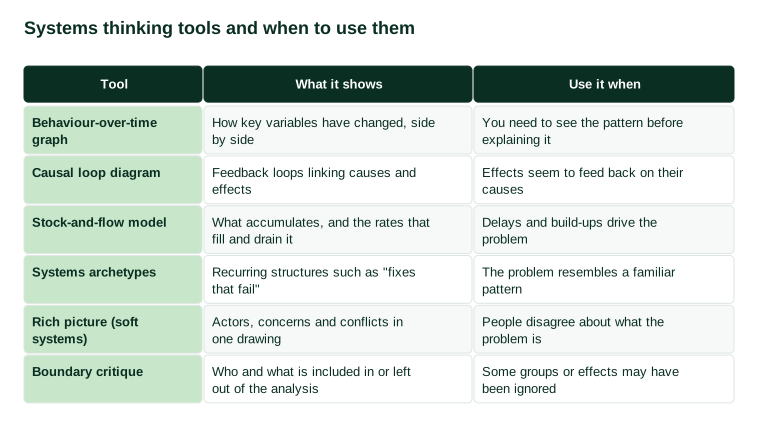
Figure 1 summarises the tools most often used in practice and the situations in which each is helpful.
Behaviour-over-time graphs
The simplest tool is a graph of how key variables have changed over time, drawn side by side. Sterman (2000) recommends starting systems inquiry with such graphs, because they turn a vague concern into a description of a pattern: growth that levelled off, a cycle, a decline that accelerated. The pattern then becomes the thing to be explained. Different patterns suggest different structures: exponential growth suggests a dominant reinforcing loop, while oscillation suggests a balancing loop with a delay.
Causal loop diagrams
A causal loop diagram shows the variables in a system and the causal links between them, with each link marked as positive (the variables move in the same direction) or negative (they move in opposite directions). Loops are labelled as reinforcing or balancing. Figure 2 shows a simple hypothetical example.
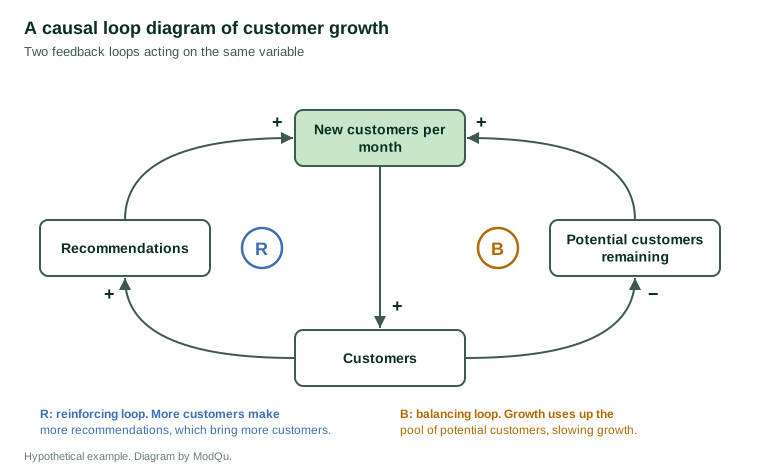
In the example, more customers produce more recommendations, which bring in more new customers: a reinforcing loop. But as the customer base grows, the pool of people who might still become customers shrinks, and growth slows: a balancing loop. Together they produce the familiar S-shaped growth curve. The diagram explains why early rapid growth does not continue, and it points inquiry towards the question that matters, which is how large the pool of potential customers really is.
Causal loop diagrams are quick to draw and useful for discussion, but they have limits. They do not distinguish stocks from flows, and they cannot show how strong each loop is. Two people can draw the same diagram and draw opposite conclusions about what the system will do.
Stock-and-flow models
Where the precise behaviour matters, the structure can be formalised as a stock-and-flow model and simulated. This approach, called system dynamics, was developed by Forrester (1961) to study industrial firms. Sterman (2000) provides a comprehensive account of how such models are built and tested. A simulation model makes every assumption explicit and allows the inquirer to test what would happen under different policies before trying them. Homer and Hirsch (2006) describe applications in public health, such as modelling how chronic diseases develop in a population and how prevention programmes might change their course.
The cost of formal models is time and the need for data to estimate the relationships. Their value lies less in precise forecasts than in revealing which assumptions the conclusions depend on.
Systems archetypes
Peter Senge (1990) popularised a set of systems archetypes: common structures that recur across very different settings. Examples include "fixes that fail", where a quick fix relieves a symptom but produces side effects that make the problem worse over time; "shifting the burden", where a symptomatic solution weakens the capacity to apply a fundamental one; and "limits to growth", where a reinforcing process runs into a balancing constraint, as in Figure 2. Garrett Hardin (1968) described another archetype, the "tragedy of the commons", in which individuals acting in their own interest overuse a shared resource.
Archetypes are useful as hypotheses. If a problem resembles "fixes that fail", the inquirer knows what to look for: a fix, a delayed side effect, and a link back to the original problem. Repenning and Sterman (2001) used this kind of reasoning to explain why process improvement programmes often fail: under pressure to meet targets, managers push people to work harder rather than improve processes, which brings quick gains but erodes the capability that improvement requires.
Soft systems methodology
Not all complex problems are about feedback in a well-defined system. Some are complex because people disagree about what the system is and what it is for. Russell Ackoff (1974) called such situations "messes": tangled sets of interacting problems that cannot be separated and solved one at a time. Peter Checkland (1981) developed soft systems methodology for these situations. Instead of modelling the real world as a system, it models different views of it. Participants draw a rich picture of the situation, showing its actors, concerns and conflicts. They then build simple models of purposeful activity from different points of view and compare them with the real situation to find changes that are both desirable and feasible (Checkland & Poulter, 2006). The aim is not a single correct model but an accommodation that allows action.
Boundary critique
Every systems analysis draws a boundary around what it includes. Werner Ulrich (1983) argued that these boundary judgements are not merely technical: they determine whose interests count and which effects are considered. He proposed a set of questions to make them explicit, such as who benefits from the system as designed, who is affected but not involved, and whose knowledge is treated as relevant. Gerald Midgley (2000) developed boundary critique into a general approach for systemic intervention. For inquiry, the lesson is that defining the scope of a problem is already a choice with consequences, and should be made openly.
Building models with the people involved
Systems models are often most useful when they are built with the people who know the system. Jac Vennix (1996) developed group model building, in which a facilitator helps a team build a model of its own problem. The process brings out the different mental models people hold and makes disagreements explicit, which often contributes more to shared understanding than the finished model. Peter Hovmand (2014) extended the approach to communities, involving residents in modelling problems that affect them. Michael Jackson (2003) argued that different systems approaches suit different kinds of problems and that practitioners should choose and combine them according to the situation, rather than applying one approach to everything.
Systems thinking and research design
Systems thinking also has implications for how evidence is collected. Much applied research relies on cross-sectional data: a survey or analysis at a single point in time. Such data describe the level of each stock, such as how satisfied customers are or how many staff intend to leave, but they cannot show the loops that connect them or the delays between cause and effect. Two variables measured at the same moment may be linked in both directions, each driving the other, and a single snapshot cannot tell which effect dominates.
Several design choices help. Repeated measurement of the same variables over time, ideally from the same people or units, makes it possible to see how changes in one variable precede changes in another. Asking about timing directly, such as when a customer first noticed a problem and when they decided to leave, can reveal delays that would otherwise be missed. Qualitative interviews are well suited to uncovering the causal links that people perceive, which can then be drawn as a causal loop diagram and tested with quantitative data. Sterman (2000) emphasises that the most important data for a systems model are often not the numbers but the descriptions, held by people who work in the system, of how decisions are actually made.
Systems thinking also changes how results should be interpreted. A correlation between two variables measured once is not evidence of a simple one-way cause, and an intervention that works in the short term may fail once feedback and delays play out. Reports of research into complex problems should therefore say what time horizon the findings cover and what feedback the analysis did not capture.
A hypothetical example
A company's customer service department is under pressure. Waiting times have risen, and complaints have increased. The first explanation offered is that the team is understaffed, and the proposed solution is to hire more agents.
A systems inquiry begins by drawing behaviour-over-time graphs. They show that call volumes rose sharply about six months after a new billing system was introduced, and that repeat calls, customers calling a second or third time about the same issue, account for much of the increase. The team then draws a causal loop diagram. Long waiting times lead agents to rush calls to clear the queue. Rushed calls resolve fewer problems first time. Unresolved problems produce repeat calls, which lengthen the queue further. This is a reinforcing loop, and it matches the "fixes that fail" archetype: the quick fix of rushing calls makes the underlying problem worse.
The analysis changes the recommendation. Hiring more agents would help, but only temporarily if the loop remains. The more effective intervention is to reduce the inflow of problems by fixing the billing errors that cause many calls, and to measure agents on first-contact resolution rather than call length. The inquiry also prompts a boundary question: the billing team, whose system created many of the calls, had not been part of the discussion.
Using systems tools well
- Start with the pattern over time. Describe what has happened before explaining why.
- Draw the loops. Ask how effects feed back to their causes, and look for delays.
- Check archetypes as hypotheses. If a structure looks familiar, test whether it really applies.
- Make the boundary explicit. Ask who and what has been left out.
- Combine with evidence. Systems diagrams are hypotheses about structure. Test the links with data where possible.
- Look for leverage. Meadows (1999) argued that the most effective places to intervene are often the rules, goals and information flows of a system, not the numbers people usually adjust.
Conclusion
Complex problems resist inquiry when their causes form loops, act with delays or look different from different positions. Systems thinking offers tools that address each of these difficulties: causal loop diagrams and stock-and-flow models for feedback and accumulation, archetypes for recognising recurring structures, soft systems methodology for situations of disagreement, and boundary critique for the choices hidden in any analysis. Research shows that unaided intuition is unreliable in such situations, which is why explicit tools matter. Used alongside data and other methods, they help inquiry move from asking what caused a problem to understanding the structure that keeps producing it.
References
Ackoff, R. L. (1974). Redesigning the future: A systems approach to societal problems. Wiley.
Arnold, R. D., & Wade, J. P. (2015). A definition of systems thinking: A systems approach. Procedia Computer Science, 44, 669–678. https://doi.org/10.1016/j.procs.2015.03.050
Bertalanffy, L. von. (1968). General system theory: Foundations, development, applications. George Braziller.
Booth Sweeney, L., & Sterman, J. D. (2000). Bathtub dynamics: Initial results of a systems thinking inventory. System Dynamics Review, 16(4), 249–286. https://doi.org/10.1002/sdr.198
Checkland, P. (1981). Systems thinking, systems practice. Wiley.
Checkland, P., & Poulter, J. (2006). Learning for action: A short definitive account of soft systems methodology and its use for practitioners, teachers and students. Wiley.
Cronin, M. A., Gonzalez, C., & Sterman, J. D. (2009). Why don't well-educated adults understand accumulation? A challenge to researchers, educators, and citizens. Organizational Behavior and Human Decision Processes, 108(1), 116–130. https://doi.org/10.1016/j.obhdp.2008.03.003
Forrester, J. W. (1961). Industrial dynamics. MIT Press.
Forrester, J. W. (1971). Counterintuitive behavior of social systems. Theory and Decision, 2(2), 109–140. https://doi.org/10.1007/BF00148991
Hardin, G. (1968). The tragedy of the commons. Science, 162(3859), 1243–1248. https://doi.org/10.1126/science.162.3859.1243
Homer, J. B., & Hirsch, G. B. (2006). System dynamics modeling for public health: Background and opportunities. American Journal of Public Health, 96(3), 452–458. https://doi.org/10.2105/AJPH.2005.062059
Hovmand, P. S. (2014). Community based system dynamics. Springer. https://doi.org/10.1007/978-1-4614-8763-0
Jackson, M. C. (2003). Systems thinking: Creative holism for managers. Wiley.
Lee, H. L., Padmanabhan, V., & Whang, S. (1997). The bullwhip effect in supply chains. Sloan Management Review, 38(3), 93–102.
Meadows, D. (1999). Leverage points: Places to intervene in a system. Sustainability Institute.
Meadows, D. H. (2008). Thinking in systems: A primer (D. Wright, Ed.). Chelsea Green.
Merton, R. K. (1936). The unanticipated consequences of purposive social action. American Sociological Review, 1(6), 894–904. https://doi.org/10.2307/2084615
Midgley, G. (2000). Systemic intervention: Philosophy, methodology, and practice. Kluwer Academic/Plenum. https://doi.org/10.1007/978-1-4615-4201-8
Repenning, N. P., & Sterman, J. D. (2001). Nobody ever gets credit for fixing problems that never happened: Creating and sustaining process improvement. California Management Review, 43(4), 64–88. https://doi.org/10.2307/41166101
Richmond, B. (1993). Systems thinking: Critical thinking skills for the 1990s and beyond. System Dynamics Review, 9(2), 113–133. https://doi.org/10.1002/sdr.4260090203
Senge, P. M. (1990). The fifth discipline: The art and practice of the learning organization. Doubleday.
Sterman, J. D. (1989). Modeling managerial behavior: Misperceptions of feedback in a dynamic decision making experiment. Management Science, 35(3), 321–339. https://doi.org/10.1287/mnsc.35.3.321
Sterman, J. D. (2000). Business dynamics: Systems thinking and modeling for a complex world. Irwin/McGraw-Hill.
Ulrich, W. (1983). Critical heuristics of social planning: A new approach to practical philosophy. Paul Haupt.
Vennix, J. A. M. (1996). Group model building: Facilitating team learning using system dynamics. Wiley.