
Inquiry · Logic and reasoning
Inquiry Processes for Wicked Problems and Ill-Structured Domains
Wicked problems have no definitive formulation, no stopping rule and no right answer, and the people affected disagree about what they are. This article explains what makes problems wicked or ill structured, and the inquiry processes that have been developed to make progress on them.
Some problems can be solved. Others can only be worked on. Scheduling deliveries to minimise cost is difficult, but it has a clear goal and a test of success. Reducing homelessness in a city, improving the quality of a health system or deciding how a company should respond to a changing market are different. People disagree about what the problem is, every proposed solution changes the situation, and there is no point at which the work is clearly finished. In 1973 the planners Horst Rittel and Melvin Webber called such problems wicked. This article explains what makes problems wicked or ill structured, why ordinary methods of inquiry struggle with them and what processes have been developed to make progress.
What makes a problem wicked
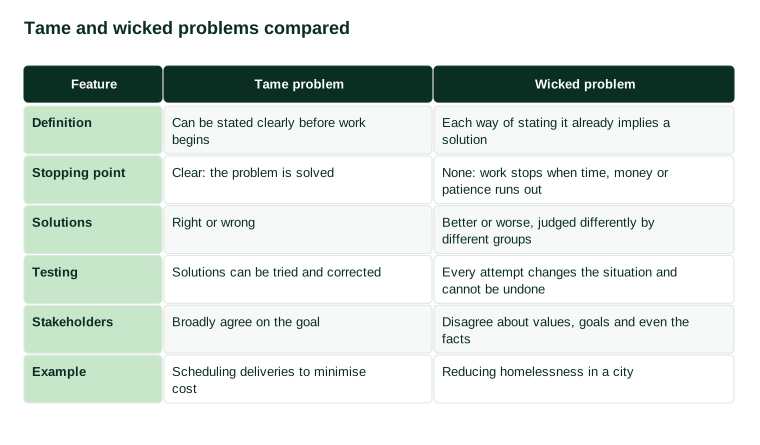
The term first appeared in print in a short editorial by C. West Churchman (1967), reporting a seminar in which Rittel had described a class of social problems that are ill formulated, where the information is confusing, where clients and decision makers hold conflicting values and where the ramifications of the whole system are thoroughly confusing. Rittel and Webber (1973) then listed ten characteristics. Among them: there is no definitive formulation of a wicked problem; there is no stopping rule; solutions are not true or false but good or bad; every solution is a "one-shot operation", because there is no opportunity to learn by trial and error without consequences; and every wicked problem is essentially unique. They also noted that the problem can be explained in many ways, and the choice of explanation determines the nature of the solution. Figure 1 contrasts wicked problems with tame ones.
The design theorist Richard Buchanan (1992) argued that most design problems are wicked in this sense, because the designer must decide what the problem is as part of solving it. Russell Ackoff (1974) made a similar point about management, describing real problems as "messes": systems of interacting problems that cannot be understood or solved separately.
Not every difficult problem is wicked. Keith Grint (2005) distinguished tame problems, which may be complicated but have known solutions; critical problems, crises that require immediate command; and wicked problems, which require leaders to ask questions and engage others rather than supply answers. Head and Alford (2015) argued that wickedness is a matter of degree, depending on how complex the problem is, how uncertain the knowledge about it is and how much the people involved disagree. Levin et al. (2012) described super wicked problems, such as climate change, which add further features: time is running out, those seeking to solve the problem also cause it, and there is no central authority to act.
Ill-structured domains
A related idea comes from research on learning and problem solving. Herbert Simon (1973) distinguished well-structured problems, in which the goal, the possible moves and the test of success are clearly defined, from ill-structured ones, in which they are not. David Jonassen (1997) argued that most problems people meet at work and in everyday life are ill structured: they have multiple possible solutions, multiple criteria for judging them and no agreed method for reaching them.
Rand Spiro and colleagues developed cognitive flexibility theory to describe how people learn in ill-structured domains such as medicine (Spiro et al., 1988). In such domains, each case involves many concepts interacting in different ways, and the same concept applies differently from case to case. They found that learners who were taught simplified general rules struggled to apply their knowledge to new cases. Learning improved when material was revisited from several perspectives and through multiple cases, so that learners built flexible knowledge rather than a single schema.
Patricia King and Karen Kitchener (1994) studied how people reason about ill-structured problems over the course of their education. In their reflective judgement model, people at early stages assume that every question has a right answer known to authorities. At later stages, they recognise that knowledge about ill-structured problems is uncertain but that some judgements are better supported than others, and they can construct and defend reasoned conclusions while remaining open to revision. This mature stage is the one wicked problems require.
Why ordinary methods struggle
Standard approaches to inquiry assume a sequence: define the problem, gather evidence, analyse it, choose a solution and implement it. Rittel and Webber (1973) argued that this sequence breaks down for wicked problems, because the problem cannot be defined until a solution has been considered, and information gathering depends on the definition. Jeff Conklin (2006) called the result "fragmentation": stakeholders see the problem in different ways, specialists break it into pieces that do not fit back together, and projects stall amid conflicting views.
Inquiry into a wicked problem therefore cannot rely on a single correct analysis. It must be designed to build shared understanding among people with different perspectives, to generate and compare framings of the problem, and to learn from interventions that cannot be reversed.
This has consequences for the research methods used. Surveys, interviews and data analysis remain valuable, but their role changes. Instead of being designed to answer a single, fixed question, they are used to map how different groups see the problem, to test the factual assumptions that each framing depends on and to monitor the effects of interventions over time. A survey that asks several stakeholder groups the same questions about causes and priorities can show where views converge and where they diverge, which is itself useful evidence. Qualitative research can reveal the reasoning behind each position, so that disagreements about values are not mistaken for disagreements about facts. Head and Alford (2015) argue that because knowledge about wicked problems is incomplete and contested, research should be seen as one input to a continuing process of deliberation, not as a source of final answers.
Inquiry processes for wicked problems
Argument-based approaches
Werner Kunz and Horst Rittel (1970) proposed the issue-based information system (IBIS) as a way of structuring discussion of wicked problems. In IBIS, the discussion is recorded as a network of issues (questions), positions (possible answers) and arguments for and against each position. Conklin (2006) developed this into dialogue mapping, in which a facilitator records a group's conversation in IBIS form in real time, so that participants can see how their contributions relate. The map makes disagreements explicit and helps the group move from fragmentation towards shared understanding.
Surfacing assumptions
Richard Mason and Ian Mitroff (1981) developed strategic assumption surfacing and testing. Groups with different proposed strategies identify the stakeholders and assumptions on which their strategy depends, rate each assumption for importance and certainty, and debate the assumptions with other groups. The process brings hidden disagreements about facts and values to the surface, so that inquiry can focus on the assumptions that matter most and are least certain.
Soft systems methodology
Peter Checkland (1981) developed soft systems methodology for problem situations in which people hold different views of what the system is and what it is for. Participants build models of purposeful activity from several points of view and compare them with the real situation, seeking changes that are both desirable and feasible. The approach treats the multiple framings of a wicked problem as material for inquiry rather than as an obstacle.
Collaboration and adaptive management
Nancy Roberts (2000) identified three broad strategies for dealing with wicked problems. Authoritative strategies give the problem to an expert or a single decision maker, which reduces conflict but excludes knowledge and may lack legitimacy. Competitive strategies let interests contend for power, which can encourage innovation but may lead to stalemate. Collaborative strategies bring stakeholders together to work on the problem jointly, which is slower but can build the shared understanding and commitment that durable progress requires. The Australian Public Service Commission (2007) recommended collaborative, adaptive approaches for wicked policy problems, together with a willingness to treat policies as experiments to be monitored and adjusted.
Elinor Ostrom (1990) showed that communities can manage shared resources without either central control or privatisation, through institutions they design and adjust themselves. Her work demonstrates that collaborative inquiry and governance can succeed where problems involve conflicting interests, provided that certain conditions are in place, such as clear boundaries, participation in rule-making and effective monitoring.
Incremental and probing approaches
Charles Lindblom (1959) argued that policymakers facing complex problems sensibly proceed by small steps, comparing a limited range of options and adjusting in light of experience. Snowden and Boone (2007) proposed a similar approach for complex situations: probe with small, safe-to-fail experiments, sense the response and amplify what works. Because wicked problems allow no clean trial and error, the safest probes are those that are small, reversible where possible and closely monitored.
A hypothetical example
A regional bank wants to understand why small businesses in some towns are struggling. Early discussion shows that people define the problem differently. Lenders see a problem of credit risk; local councils see one of declining town centres; business owners see high rents and online competition; community groups see the loss of young people to cities. Each definition suggests different research and different solutions.
Rather than choose one framing, the research team runs workshops in which representatives of each group map the issues and their connections, using a dialogue-mapping approach. The map shows that several framings share assumptions about footfall and local spending, which can be tested with data. It also shows disagreements about values, such as how much a bank should support struggling businesses, that data cannot settle. The team designs a programme of small pilot initiatives in three towns, with agreed measures and regular reviews, and treats the results as evidence for the next round of discussion. The problem is not solved, but it is now being worked on in a way that all parties understand and can learn from.
Principles for inquiry into wicked problems
- Recognise the type of problem. Treating a wicked problem as tame leads to confident solutions to the wrong problem.
- Collect several framings. Each stakeholder's definition captures part of the problem.
- Separate factual from value disagreements. Use evidence where it can settle questions, and deliberation where it cannot.
- Make the reasoning visible. Maps of issues, positions and arguments help groups see where they agree and differ.
- Act in small, monitored steps. Treat interventions as experiments and learn from each.
- Expect no final answer. Measure progress by improvement, not by solution.
Conclusion
Wicked and ill-structured problems resist the standard sequence of define, analyse and solve. Their definitions are contested, their solutions are judgements rather than answers and every intervention changes the situation. Research on such problems points to inquiry processes that build shared understanding across perspectives, surface and test assumptions, combine evidence with deliberation and proceed through small, monitored steps. These processes do not make wicked problems tame, but they allow organisations and communities to make reasoned, defensible progress on the problems that matter most.
References
Ackoff, R. L. (1974). Redesigning the future: A systems approach to societal problems. Wiley.
Australian Public Service Commission. (2007). Tackling wicked problems: A public policy perspective. Commonwealth of Australia.
Buchanan, R. (1992). Wicked problems in design thinking. Design Issues, 8(2), 5–21. https://doi.org/10.2307/1511637
Checkland, P. (1981). Systems thinking, systems practice. Wiley.
Churchman, C. W. (1967). Wicked problems. Management Science, 14(4), B141–B142.
Conklin, J. (2006). Dialogue mapping: Building shared understanding of wicked problems. Wiley.
Grint, K. (2005). Problems, problems, problems: The social construction of 'leadership'. Human Relations, 58(11), 1467–1494. https://doi.org/10.1177/0018726705061314
Head, B. W., & Alford, J. (2015). Wicked problems: Implications for public policy and management. Administration & Society, 47(6), 711–739. https://doi.org/10.1177/0095399713481601
Jonassen, D. H. (1997). Instructional design models for well-structured and ill-structured problem-solving learning outcomes. Educational Technology Research and Development, 45(1), 65–94. https://doi.org/10.1007/BF02299613
King, P. M., & Kitchener, K. S. (1994). Developing reflective judgment: Understanding and promoting intellectual growth and critical thinking in adolescents and adults. Jossey-Bass.
Kunz, W., & Rittel, H. W. J. (1970). Issues as elements of information systems (Working Paper No. 131). Institute of Urban and Regional Development, University of California, Berkeley.
Levin, K., Cashore, B., Bernstein, S., & Auld, G. (2012). Overcoming the tragedy of super wicked problems: Constraining our future selves to ameliorate global climate change. Policy Sciences, 45(2), 123–152. https://doi.org/10.1007/s11077-012-9151-0
Lindblom, C. E. (1959). The science of "muddling through". Public Administration Review, 19(2), 79–88. https://doi.org/10.2307/973677
Mason, R. O., & Mitroff, I. I. (1981). Challenging strategic planning assumptions: Theory, cases, and techniques. Wiley.
Ostrom, E. (1990). Governing the commons: The evolution of institutions for collective action. Cambridge University Press. https://doi.org/10.1017/CBO9780511807763
Rittel, H. W. J., & Webber, M. M. (1973). Dilemmas in a general theory of planning. Policy Sciences, 4(2), 155–169. https://doi.org/10.1007/BF01405730
Roberts, N. (2000). Wicked problems and network approaches to resolution. International Public Management Review, 1(1), 1–19.
Simon, H. A. (1973). The structure of ill structured problems. Artificial Intelligence, 4(3–4), 181–201. https://doi.org/10.1016/0004-3702(73)90011-8
Snowden, D. J., & Boone, M. E. (2007). A leader's framework for decision making. Harvard Business Review, 85(11), 68–76.
Spiro, R. J., Coulson, R. L., Feltovich, P. J., & Anderson, D. K. (1988). Cognitive flexibility theory: Advanced knowledge acquisition in ill-structured domains. In Proceedings of the Tenth Annual Conference of the Cognitive Science Society (pp. 375–383). Lawrence Erlbaum.