
Inquiry · Logic and reasoning
Thought Experiments as Tools of Inquiry
A thought experiment investigates a question by reasoning through an imagined scenario rather than running a real one. This article explains how thought experiments work in science, philosophy and business, why they can produce new knowledge, and where they mislead.
Some of the most important experiments in history were never performed. Galileo did not need to drop stones from a tower to show that a long-held belief about falling bodies was incoherent. Einstein did not need to ride on a beam of light to see that the physics of his day had a problem. A thought experiment investigates a question by setting up an imagined scenario and reasoning carefully about what would happen in it. It costs nothing to run, can explore situations that could never be built, and, at its best, reveals contradictions or consequences hidden in what we already believe. It can also mislead, because the imagined world is only as reliable as the assumptions put into it.
What a thought experiment is
The philosopher Roy Sorensen (1992) defines a thought experiment as an experiment that aims to answer its question by reasoning about the scenario rather than by carrying it out. Like a real experiment, it isolates a question, controls the conditions and asks what follows. Unlike a real experiment, it relies on the inquirer's existing knowledge, logic and judgement to supply the outcome.
Ernst Mach (1976), who popularised the term in the late nineteenth and early twentieth centuries, saw thought experiments as a natural extension of ordinary planning. Before acting, people imagine what will happen if they do one thing or another. Scientists do the same in a more disciplined way, varying conditions in imagination to see which features of a situation matter. Mach argued that thought experiments draw on a store of experience that people possess without having articulated it, and bring it to bear on a precise question.
Classic examples
Figure 1 summarises five well-known thought experiments from physics, ethics and political philosophy.
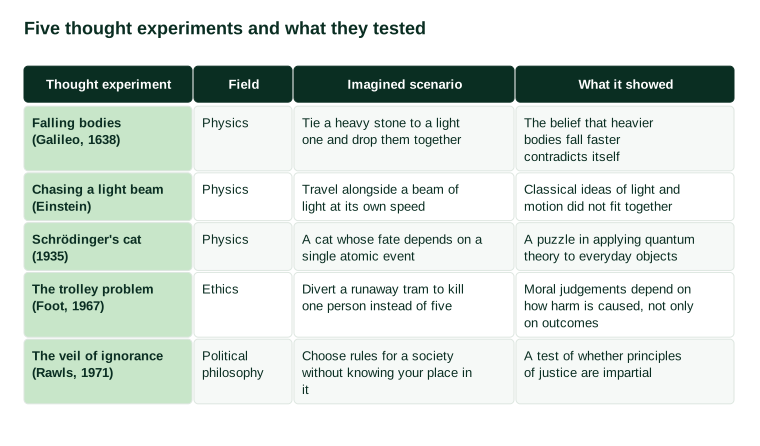
Galileo's argument is the standard example. Aristotle's physics held that heavier bodies fall faster than lighter ones. Galileo Galilei (1914) asked what would happen if a heavy stone and a light stone were tied together. On the Aristotelian view, the light stone should slow the heavy one, so the pair should fall more slowly than the heavy stone alone. But the pair is heavier than the heavy stone, so it should fall faster. The theory predicts both, and so cannot be right. Tamar Gendler (1998) argues that this thought experiment does more than expose a contradiction: it leads the reader to see that weight is the wrong property to look at, and so prepares the ground for a new conception of falling.
Albert Einstein (1949) recalled that as a young man he had wondered what he would see if he could travel alongside a beam of light at the same speed. The light would appear as a frozen wave, something that neither experience nor the theory of electromagnetism allowed. The puzzle stayed with him and contributed to the reasoning behind special relativity. Erwin Schrödinger (1935) imagined a cat in a sealed box whose survival depends on whether a single atom decays. His purpose was to show how strange the standard interpretation of quantum theory became when it was applied to everyday objects.
Philosophy uses thought experiments even more heavily. Philippa Foot (1967) imagined the driver of a runaway tram who can steer onto a track where one person will be killed instead of five. Judith Jarvis Thomson (1985) developed many variants, including one in which the five can be saved only by pushing a person into the tram's path. Most people judge the first action acceptable and the second wrong, although the numbers are the same, and the puzzle is to say why. John Rawls (1971) asked what principles of justice people would choose behind a "veil of ignorance", not knowing their own position in society. John Searle (1980) imagined a person in a room following rules to manipulate Chinese symbols without understanding them, to argue that running a program is not the same as understanding. Frank Jackson (1982) imagined a scientist who knows every physical fact about colour vision but has never seen colour, and asked whether she learns something new when she first sees red.
How can imagining produce knowledge?
If a thought experiment uses no new data, how can it teach anything? Philosophers have given different answers.
John Norton (1996) argues that thought experiments are arguments in disguise. Every conclusion reached through a thought experiment could, in principle, be reconstructed as an explicit argument from stated premises, and its reliability depends entirely on the reliability of those premises and of the reasoning. The vivid scenario is a way of presenting the argument, not an independent source of evidence.
James Robert Brown (2011) takes a stronger view. He argues that some thought experiments, Galileo's among them, give direct insight into the laws of nature in a way that is not reducible to argument. Thomas Kuhn (1977) offered a middle position. Thought experiments, he argued, help scientists recognise that their existing concepts do not fit together, forcing them to revise those concepts. They teach not by providing new facts but by revealing problems in the way familiar facts have been organised.
Whatever the correct theory, there is broad agreement on one point. A thought experiment can only draw out what is already present, often implicitly, in the inquirer's knowledge and assumptions. Its power lies in making that implicit content explicit and testing it for coherence.
Thought experiments in practice
Thought experiments are not only for physicists and philosophers. Several practical techniques used in organisations are disciplined thought experiments.
The pre-mortem. Gary Klein (2007) proposed that before a project begins, the team should imagine that it has already failed and write down the reasons why. Research by Mitchell et al. (1989) found that imagining an event as having already happened increased the number of reasons people generated to explain it by about 30%. The pre-mortem uses this effect to bring hidden risks to the surface.
Scenario planning. Paul Schoemaker (1995) described how organisations can construct several plausible futures, each internally consistent, and reason through how their strategies would perform in each. The scenarios are not forecasts but structured thought experiments about uncertainty.
Counterfactual analysis. Historians and policy analysts ask what would have happened if a key event had gone differently. Tetlock and Belkin (1996) set out criteria for disciplined counterfactual reasoning, including that the imagined change should be minimal and the reasoning consistent with established theory and evidence.
The extreme case. An analyst can test an argument or a model by imagining extreme conditions: what if the price doubled, or demand fell to zero? A model that gives absurd answers at the extremes is likely to rest on faulty assumptions within the normal range as well.
A hypothetical example shows the method in an everyday research setting. A subscription company believes that its churn is driven by price. An analyst asks: imagine the price were cut to zero tomorrow. Which customers would still leave? The answer, from what the team already knows, is that customers who have stopped using the product would leave anyway, and they make up a large share of those who cancel. The thought experiment costs nothing, but it shows that the price explanation cannot be the whole story, and it points the next piece of research towards product use rather than price sensitivity.
Where thought experiments mislead
The weaknesses of thought experiments follow from their strengths. Because they rely on imagination and intuition, they inherit the limits of both.
Hidden assumptions. The imagined scenario may contain assumptions that are not stated and may be false. Daniel Dennett (2013) called many philosophical thought experiments "intuition pumps": devices that guide the reader to a conclusion, sometimes by drawing attention away from the details that matter. He recommended "turning the knobs", varying each feature of the scenario to see whether the intuition changes.
Unreliable intuitions. The conclusions of many thought experiments rest on what people judge would happen, or what would be right. Weinberg et al. (2001) found that responses to some well-known philosophical thought experiments varied across cultural groups, which raises the question of whose intuitions should count. Greene et al. (2001) found that versions of the trolley problem that involved direct personal harm engaged brain areas associated with emotion more strongly, suggesting that different versions engage different kinds of response, not only different reasoning.
Imagination is not the world. A thought experiment cannot reveal facts about the world that the inquirer does not already, in some sense, know. Where the scenario depends on empirical details, such as how customers or materials would actually behave, the thought experiment can generate a hypothesis but cannot test it. Galileo's argument worked because it exposed a contradiction; arguments that depend on guessing outcomes are much weaker.
Using thought experiments well
- State the question first. Be clear what the thought experiment is meant to show.
- Write down the assumptions. Make explicit what the scenario takes for granted, so that others can challenge it.
- Turn the knobs. Vary the details and see whether the conclusion holds.
- Separate logic from guesswork. Conclusions that follow from consistency are strong; conclusions that depend on predicting behaviour need real data.
- Follow up with evidence. Treat the result as a hypothesis or a sharpened question, and test it where the world can be observed.
Conclusion
Thought experiments are among the oldest and cheapest tools of inquiry. They let inquirers explore situations that cannot be built, expose contradictions in established beliefs and test plans before resources are committed. Their limits are equally clear. They can reveal only what is already implicit in the inquirer's knowledge, and they are vulnerable to hidden assumptions and unreliable intuitions. Used with care, and followed where possible by real evidence, they remain one of the most effective ways of finding out what our own beliefs really commit us to.
References
Brown, J. R. (2011). The laboratory of the mind: Thought experiments in the natural sciences (2nd ed.). Routledge.
Dennett, D. C. (2013). Intuition pumps and other tools for thinking. W. W. Norton.
Einstein, A. (1949). Autobiographical notes. In P. A. Schilpp (Ed.), Albert Einstein: Philosopher-scientist (pp. 1–95). Library of Living Philosophers.
Foot, P. (1967). The problem of abortion and the doctrine of the double effect. Oxford Review, 5, 5–15.
Galilei, G. (1914). Dialogues concerning two new sciences (H. Crew & A. de Salvio, Trans.). Macmillan. (Original work published 1638)
Gendler, T. S. (1998). Galileo and the indispensability of scientific thought experiment. The British Journal for the Philosophy of Science, 49(3), 397–424. https://doi.org/10.1093/bjps/49.3.397
Greene, J. D., Sommerville, R. B., Nystrom, L. E., Darley, J. M., & Cohen, J. D. (2001). An fMRI investigation of emotional engagement in moral judgment. Science, 293(5537), 2105–2108. https://doi.org/10.1126/science.1062872
Jackson, F. (1982). Epiphenomenal qualia. The Philosophical Quarterly, 32(127), 127–136. https://doi.org/10.2307/2960077
Klein, G. (2007). Performing a project premortem. Harvard Business Review, 85(9), 18–19.
Kuhn, T. S. (1977). A function for thought experiments. In The essential tension: Selected studies in scientific tradition and change (pp. 240–265). University of Chicago Press.
Mach, E. (1976). On thought experiments. In Knowledge and error: Sketches on the psychology of enquiry (T. J. McCormack & P. Foulkes, Trans., pp. 134–147). D. Reidel. (Original work published 1905)
Mitchell, D. J., Russo, J. E., & Pennington, N. (1989). Back to the future: Temporal perspective in the explanation of events. Journal of Behavioral Decision Making, 2(1), 25–38. https://doi.org/10.1002/bdm.3960020103
Norton, J. D. (1996). Are thought experiments just what you thought? Canadian Journal of Philosophy, 26(3), 333–366. https://doi.org/10.1080/00455091.1996.10717457
Rawls, J. (1971). A theory of justice. Harvard University Press.
Schoemaker, P. J. H. (1995). Scenario planning: A tool for strategic thinking. Sloan Management Review, 36(2), 25–40.
Schrödinger, E. (1935). Die gegenwärtige Situation in der Quantenmechanik [The present situation in quantum mechanics]. Naturwissenschaften, 23(48), 807–812. https://doi.org/10.1007/BF01491891
Searle, J. R. (1980). Minds, brains, and programs. Behavioral and Brain Sciences, 3(3), 417–424. https://doi.org/10.1017/S0140525X00005756
Sorensen, R. A. (1992). Thought experiments. Oxford University Press.
Tetlock, P. E., & Belkin, A. (Eds.). (1996). Counterfactual thought experiments in world politics: Logical, methodological, and psychological perspectives. Princeton University Press.
Thomson, J. J. (1985). The trolley problem. The Yale Law Journal, 94(6), 1395–1415. https://doi.org/10.2307/796133
Weinberg, J. M., Nichols, S., & Stich, S. (2001). Normativity and epistemic intuitions. Philosophical Topics, 29(1–2), 429–460. https://doi.org/10.5840/philtopics2001291/217