
Inquiry · Logic and reasoning
The Place of Intuition and Tacit Knowing Within Systematic Inquiry
Systematic inquiry is often contrasted with intuition, yet experienced researchers rely on tacit knowledge at every stage. This article explains what intuition and tacit knowing are, when expert intuition can be trusted, and how to give it a proper place within a disciplined process.
Systematic inquiry is usually presented as the opposite of intuition. Methods, protocols and statistics exist, it is said, precisely to protect conclusions from hunches. Yet experienced researchers know that intuition is at work throughout their projects: in sensing which question is worth asking, noticing that a result looks wrong, choosing which interviews to follow up or recognising a pattern in messy data before it can be stated. The philosopher Michael Polanyi argued that all knowledge rests on a foundation of knowing that cannot be fully put into words. This article explains what intuition and tacit knowledge are, what research says about when they can be trusted and how they can be combined with systematic methods rather than set against them.
Tacit knowing
Polanyi (1966) summed up his view in a phrase: "we can know more than we can tell". People recognise a familiar face among thousands without being able to say how. A skilled cyclist keeps balance without knowing the physics involved. Polanyi argued that scientific knowledge depends on the same kind of knowing. Scientists judge which problems are promising, which data are reliable and which explanations are plausible using skills acquired through long practice and largely inexpressible in rules (Polanyi, 1958). Even reading a scientific instrument requires a trained perception that cannot be fully written down.
Harry Collins (2010) distinguished several kinds of tacit knowledge. Some could be made explicit with enough effort but has not been, because no one has needed to. Some is embodied in skills, like riding a bicycle. And some is collective, held by communities in their shared practices and judgements, and cannot be possessed by any individual alone. Arthur Reber (1989) showed in laboratory studies that people can learn complex patterns without being aware of what they have learned, and then use that knowledge to make accurate judgements they cannot explain.
Ikujiro Nonaka and Hirotaka Takeuchi (1995) applied these ideas to organisations. They argued that new organisational knowledge is often created when the tacit knowledge of experienced individuals is shared and gradually made explicit, through conversation, metaphors, models and documents, and then absorbed again as tacit skill by others.
What intuition is
Herbert Simon (1992) offered a direct definition: intuition is "nothing more and nothing less than recognition". An expert who has encountered many similar situations has stored patterns in memory; a new situation triggers a pattern, and with it a judgement about what is happening and what to do. William Chase and Herbert Simon (1973) showed that chess masters could reproduce realistic chess positions after a brief glance far better than novices, but had no advantage for randomly arranged pieces. Their skill lay in recognising meaningful patterns built up through years of play.
Gary Klein (1998) studied experienced fire commanders and other professionals making decisions under pressure. He found that they rarely compared options. Instead, they recognised the situation as a familiar type, which suggested a course of action, and then imagined how that action would play out to check it. Klein called this recognition-primed decision making. Hubert and Stuart Dreyfus (1986) described a similar progression in skill acquisition: novices follow explicit rules, while experts respond fluidly to situations without consciously applying rules at all.
Erik Dane and Michael Pratt (2007) defined intuitions as judgements that arise through rapid, non-conscious and holistic associations, and that are often accompanied by feelings. Bechara et al. (1997) found evidence for such feelings in a gambling task: participants began to choose advantageously, and showed physiological signs of anticipating losses, before they could say which options were better.
When intuition can be trusted
The central question is not whether intuition is good or bad, but when it is reliable. Daniel Kahneman, known for research on the errors of intuitive judgement, and Gary Klein, known for research on its successes, set out to find where they agreed. Kahneman and Klein (2009) concluded that expert intuition is likely to be reliable when two conditions are met: the environment is regular enough to be predictable, and the person has had extensive practice in it with timely, clear feedback. Figure 1 summarises the conditions.
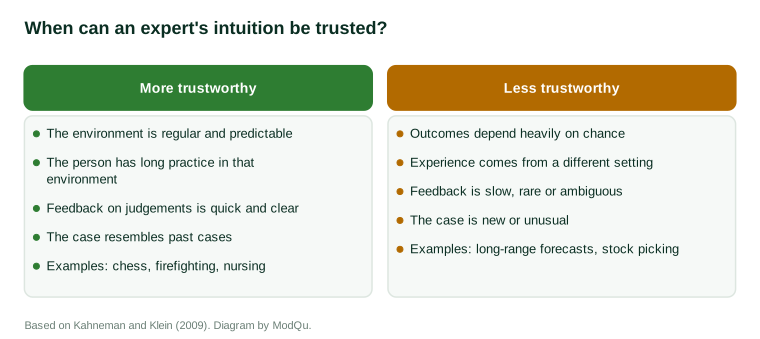
Chess players, firefighters and experienced nurses work in environments with these features, and their intuitions are often accurate. Long-range political forecasters and stock pickers do not: their environments are dominated by chance, and feedback is slow and noisy. In such settings, people can develop strong confidence in intuitions that are no better than chance. Kahneman (2011) stressed that subjective confidence is not a reliable guide, because the feeling of certainty arises from the coherence of the story the mind constructs, not from its accuracy.
Robin Hogarth (2001) made a related distinction between "kind" learning environments, in which feedback is accurate and intuition learns the right lessons, and "wicked" ones, in which feedback is missing or misleading and intuition learns the wrong ones. Paul Meehl (1954) showed that in many prediction tasks, simple statistical formulas outperformed the judgements of clinicians. A later meta-analysis by Grove et al. (2000) confirmed that mechanical prediction was, on average, about as accurate as or more accurate than clinical judgement across a wide range of tasks. These findings do not show that intuition is worthless, but that it should not be trusted in domains where it has had no reliable feedback to learn from.
Intuition within systematic inquiry
Intuition and method play different roles at different stages of inquiry.
Generating questions and hypotheses. Intuition is valuable at the start, when an experienced researcher senses that something is interesting or wrong. The mathematician Jacques Hadamard (1945) collected accounts from scientists and mathematicians describing how ideas often arrived suddenly, after a period of conscious work followed by rest. Such ideas still needed to be checked, but they would not have arisen from method alone.
Noticing anomalies. Experienced analysts often sense that a result "looks wrong" before they can say why. This intuition, based on familiarity with what such data normally look like, is a valuable check on errors in data and analysis. It should prompt investigation, not dismissal of the result.
Interpreting qualitative data. Recognising themes in interviews or open-ended survey responses relies heavily on tacit skill. Systematic procedures such as coding frames and second coders make that interpretation more transparent and checkable without removing the need for judgement.
Testing and deciding. Intuition is least reliable at the stage of judging whether a hypothesis is true, particularly in uncertain domains. Here, systematic evidence should take priority. Gerd Gigerenzer (2007) argues that simple rules of thumb can work well when they fit the structure of the environment, but this fit must itself be checked.
Donald Schön (1983) described skilled professionals as engaged in "reflection-in-action": acting intuitively, noticing surprises and then reflecting consciously on what their intuitions had missed. This is perhaps the best model of how the two can work together. Intuition proposes; reflection and evidence dispose.
A hypothetical example
An experienced market researcher reviews the results of a customer survey and feels uneasy about a sharp rise in satisfaction among one group of customers. She cannot immediately say why, but the figure does not match what she has heard in recent conversations with clients. Rather than ignore the feeling or report the figure, she investigates. She finds that the survey link for that group had been sent only to customers who had recently received a service upgrade, so the sample was not representative. Her intuition did not provide the answer, but it identified where to look, and systematic checking supplied the explanation.
The example also shows the limits of the feeling on its own. Had she trusted her intuition without checking, she might have dismissed a genuine improvement. Had the figure been accurate, her unease would have been a false alarm, and the right response would have been to update her sense of what clients think. In both cases the intuition earned its value by prompting a check, not by settling the question. Over time, recording such hunches and noting which ones proved right is one way for a research team to learn where its experienced members' intuitions are reliable.
Giving intuition its proper place
- Record intuitions explicitly. Writing down a hunch, with the reasons for it if known, turns it into a hypothesis that can be tested.
- Ask whether the conditions for expertise are met. Is the domain regular, and has the person had good feedback in it?
- Use intuition to direct attention, and evidence to reach conclusions.
- Make tacit knowledge shareable. Ask experienced staff to explain cases, work alongside newer colleagues and document their reasoning where possible.
- Check confidence against track records. Where intuitive judgements can be scored, score them.
Conclusion
Systematic inquiry does not eliminate intuition; it depends on it. Tacit knowledge guides the choice of questions, the recognition of patterns and the detection of errors, and much of it cannot be written down as rules. But intuition is reliable only where it has been trained by regular environments and clear feedback. The task for inquirers is not to choose between intuition and method, but to use each where it is strong: intuition to propose and notice, systematic evidence to test and decide.
References
Bechara, A., Damasio, H., Tranel, D., & Damasio, A. R. (1997). Deciding advantageously before knowing the advantageous strategy. Science, 275(5304), 1293–1295. https://doi.org/10.1126/science.275.5304.1293
Chase, W. G., & Simon, H. A. (1973). Perception in chess. Cognitive Psychology, 4(1), 55–81. https://doi.org/10.1016/0010-0285(73)90004-2
Collins, H. (2010). Tacit and explicit knowledge. University of Chicago Press.
Dane, E., & Pratt, M. G. (2007). Exploring intuition and its role in managerial decision making. Academy of Management Review, 32(1), 33–54. https://doi.org/10.5465/amr.2007.23463682
Dreyfus, H. L., & Dreyfus, S. E. (1986). Mind over machine: The power of human intuition and expertise in the era of the computer. Free Press.
Gigerenzer, G. (2007). Gut feelings: The intelligence of the unconscious. Viking.
Grove, W. M., Zald, D. H., Lebow, B. S., Snitz, B. E., & Nelson, C. (2000). Clinical versus mechanical prediction: A meta-analysis. Psychological Assessment, 12(1), 19–30. https://doi.org/10.1037/1040-3590.12.1.19
Hadamard, J. (1945). The psychology of invention in the mathematical field. Princeton University Press.
Hogarth, R. M. (2001). Educating intuition. University of Chicago Press.
Kahneman, D. (2011). Thinking, fast and slow. Farrar, Straus and Giroux.
Kahneman, D., & Klein, G. (2009). Conditions for intuitive expertise: A failure to disagree. American Psychologist, 64(6), 515–526. https://doi.org/10.1037/a0016755
Klein, G. (1998). Sources of power: How people make decisions. MIT Press.
Meehl, P. E. (1954). Clinical versus statistical prediction: A theoretical analysis and a review of the evidence. University of Minnesota Press.
Nonaka, I., & Takeuchi, H. (1995). The knowledge-creating company: How Japanese companies create the dynamics of innovation. Oxford University Press.
Polanyi, M. (1958). Personal knowledge: Towards a post-critical philosophy. University of Chicago Press.
Polanyi, M. (1966). The tacit dimension. Doubleday.
Reber, A. S. (1989). Implicit learning and tacit knowledge. Journal of Experimental Psychology: General, 118(3), 219–235. https://doi.org/10.1037/0096-3445.118.3.219
Schön, D. A. (1983). The reflective practitioner: How professionals think in action. Basic Books.
Simon, H. A. (1992). What is an "explanation" of behavior? Psychological Science, 3(3), 150–161. https://doi.org/10.1111/j.1467-9280.1992.tb00017.x