
Inquiry · Inquiry in education and learning
Problem-Based Learning and Its Outcomes
Problem-based learning asks students to learn by working on realistic problems before they are taught the answers. This article explains how it works, where it came from and what decades of research say about its outcomes.
In most courses, students learn a body of knowledge first and apply it to problems afterwards. Problem-based learning (PBL) reverses this order. Students begin with a realistic, complex problem, such as a patient's symptoms, a failing engineering system or a business in difficulty, and work in small groups to figure out what they need to know to understand and resolve it. The knowledge is acquired in the course of the inquiry, rather than before it. PBL is one of the most widely adopted and most studied forms of inquiry-based education, and its research record offers clear lessons about what it does well and where it falls short.
Origins
PBL was developed in the late 1960s at the medical school of McMaster University in Canada. Howard Barrows and Robyn Tamblyn (1980) described its rationale: medical students taught through lectures could recall facts but struggled to apply them to real patients, whose problems did not come labelled by subject. Barrows argued that students would learn more usefully if they acquired knowledge in the way they would need to use it, by reasoning through clinical problems. The approach spread to medical schools around the world, including Maastricht in the Netherlands, and then to nursing, engineering, law, business and school education (Barrows, 1996; Neville, 2009).
How it works
In a typical PBL course, a group of six to ten students meets with a tutor, who facilitates rather than lectures. Cindy Hmelo-Silver (2004) describes the cycle summarised in Figure 1.
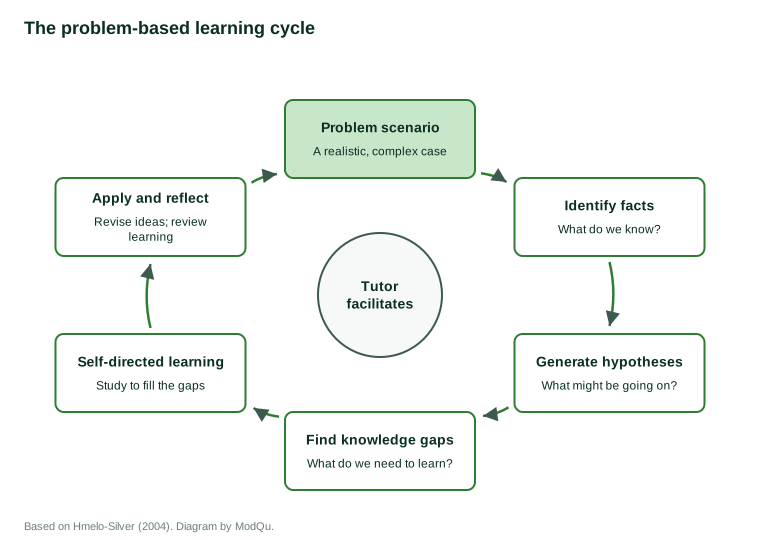
The group reads the problem, identifies the relevant facts, generates hypotheses about what is going on and identifies what it does not know. Members then study independently to fill these gaps, using books, articles and other resources. At the next meeting, they apply what they have learned to the problem, revise their hypotheses and, at the end, reflect on what they have learned and how. The process is a structured form of inquiry: the problem poses the question, and the students investigate it.
What makes a good problem
The problem is the engine of PBL, and its design matters. Research and practice suggest that good PBL problems share several features (Hmelo-Silver, 2004; Schmidt et al., 2011). They are realistic, resembling situations that students will meet in practice. They are ill-structured, meaning that they have more than one reasonable approach and do not come with all the information needed, so that students must decide what to find out. They are complex enough to require several kinds of knowledge, but not so complex that students cannot make progress. And they connect to what students already know, so that discussion can activate prior knowledge and reveal gaps.
A poorly designed problem undermines the whole process. If it is too simple, students solve it without learning anything new. If it is too far beyond them, they flounder. If it points obviously to a single topic, it becomes a disguised lecture. Good problems take time to write and are usually refined over several years of use.
What the research shows
Because PBL replaced conventional teaching in whole medical schools, it has been evaluated more extensively than most educational methods. The findings are consistent but nuanced.
Early reviews by Albanese and Mitchell (1993) and Vernon and Blake (1993) found that medical students in PBL programmes performed similarly to, or slightly worse than, conventionally taught students on tests of basic science knowledge, but performed better on clinical reasoning and clinical performance, and enjoyed their studies more. Dochy et al. (2003), in a meta-analysis across disciplines, found a robust positive effect of PBL on students' skills in applying knowledge, but no clear advantage, and possibly a small disadvantage, for the acquisition of knowledge itself. Students in PBL, however, appeared to retain what they learned for longer.
Gijbels et al. (2005) refined this picture by examining what kind of assessment was used. PBL had the largest advantage when tests assessed students' understanding of the principles that link concepts, as opposed to recall of isolated facts. Strobel and van Barneveld (2009), synthesising several meta-analyses, concluded that PBL is superior for long-term retention, skill development and student and teacher satisfaction, while conventional teaching is more effective for short-term knowledge as measured by standard examinations. Walker and Leary (2009) found that the benefits of PBL varied by discipline and by the type of problem, and were largest for assessments that required application.
Long-term outcomes are encouraging. Koh et al. (2008) systematically reviewed studies of doctors who had graduated from PBL and conventional programmes, and found that PBL graduates rated themselves, and were sometimes rated by others, as stronger in social and cognitive aspects of professional competence, such as coping with uncertainty, communication skills and self-directed learning.
Debates and limits
PBL has critics. Kirschner et al. (2006) argued that minimally guided forms of instruction, including some forms of PBL, are less effective than explicit instruction for novices, because novices lack the knowledge needed to reason through complex problems and become overloaded. Hmelo-Silver et al. (2007) replied that well-designed PBL is not minimally guided: tutors, structured processes and carefully chosen problems provide substantial scaffolding. Schmidt et al. (2011), reviewing research on how PBL works, concluded that its effects depend on the quality of the problems, the skill of the tutors and the functioning of the groups, and that activating students' prior knowledge through discussion of the problem is one of its most important mechanisms.
Lessons for inquiry
PBL shows that starting with a problem can produce knowledge that is better connected, better retained and more readily applied, at some cost to the speed with which facts are covered. Its success depends on guidance: good problems, skilled facilitation and structured processes. The same lessons apply outside education. Teams that learn by working on real problems, with support and reflection, build the kind of knowledge they can use.
The approach also translates to workplaces. A hypothetical analytics team onboarding new analysts might replace a week of training sessions with a real, anonymised case: a past client question with its messy data. New staff work in pairs to decide what they need to know, consult colleagues and documentation, and present their analysis at the end of the week. They learn the tools and data sources in the order they need them, and they learn where to look when they meet the next unfamiliar problem.
References
Albanese, M. A., & Mitchell, S. (1993). Problem-based learning: A review of literature on its outcomes and implementation issues. Academic Medicine, 68(1), 52–81. https://doi.org/10.1097/00001888-199301000-00012
Barrows, H. S. (1996). Problem-based learning in medicine and beyond: A brief overview. New Directions for Teaching and Learning, 1996(68), 3–12. https://doi.org/10.1002/tl.37219966804
Barrows, H. S., & Tamblyn, R. M. (1980). Problem-based learning: An approach to medical education. Springer.
Dochy, F., Segers, M., Van den Bossche, P., & Gijbels, D. (2003). Effects of problem-based learning: A meta-analysis. Learning and Instruction, 13(5), 533–568. https://doi.org/10.1016/S0959-4752(02)00025-7
Gijbels, D., Dochy, F., Van den Bossche, P., & Segers, M. (2005). Effects of problem-based learning: A meta-analysis from the angle of assessment. Review of Educational Research, 75(1), 27–61. https://doi.org/10.3102/00346543075001027
Hmelo-Silver, C. E. (2004). Problem-based learning: What and how do students learn? Educational Psychology Review, 16(3), 235–266. https://doi.org/10.1023/B:EDPR.0000034022.16470.f3
Hmelo-Silver, C. E., Duncan, R. G., & Chinn, C. A. (2007). Scaffolding and achievement in problem-based and inquiry learning: A response to Kirschner, Sweller, and Clark (2006). Educational Psychologist, 42(2), 99–107. https://doi.org/10.1080/00461520701263368
Kirschner, P. A., Sweller, J., & Clark, R. E. (2006). Why minimal guidance during instruction does not work: An analysis of the failure of constructivist, discovery, problem-based, experiential, and inquiry-based teaching. Educational Psychologist, 41(2), 75–86. https://doi.org/10.1207/s15326985ep4102_1
Koh, G. C.-H., Khoo, H. E., Wong, M. L., & Koh, D. (2008). The effects of problem-based learning during medical school on physician competency: A systematic review. CMAJ, 178(1), 34–41. https://doi.org/10.1503/cmaj.070565
Neville, A. J. (2009). Problem-based learning and medical education forty years on. Medical Principles and Practice, 18(1), 1–9. https://doi.org/10.1159/000163038
Schmidt, H. G., Rotgans, J. I., & Yew, E. H. J. (2011). The process of problem-based learning: What works and why. Medical Education, 45(8), 792–806. https://doi.org/10.1111/j.1365-2923.2011.04035.x
Strobel, J., & van Barneveld, A. (2009). When is PBL more effective? A meta-synthesis of meta-analyses comparing PBL to conventional classrooms. Interdisciplinary Journal of Problem-Based Learning, 3(1), 44–58. https://doi.org/10.7771/1541-5015.1046
Vernon, D. T., & Blake, R. L. (1993). Does problem-based learning work? A meta-analysis of evaluative research. Academic Medicine, 68(7), 550–563. https://doi.org/10.1097/00001888-199307000-00015
Walker, A., & Leary, H. (2009). A problem based learning meta analysis: Differences across problem types, implementation types, disciplines, and assessment levels. Interdisciplinary Journal of Problem-Based Learning, 3(1), 12–43. https://doi.org/10.7771/1541-5015.1061