
Inquiry · The art of the question
Powerful Questions in Leadership and Management
Leaders who ask good questions learn more, make better decisions and build teams that speak up. This article reviews the research on questioning in leadership, from psychological safety and employee voice to coaching and decision making, and offers practical guidance on what to ask and how.
Leaders are usually promoted for having answers. Yet much of the research on leadership suggests that their most valuable contribution is often a well-chosen question. Questions draw out information that would otherwise stay hidden, test plans before they fail, help people solve their own problems and signal that challenge is welcome. They also carry risks: a question from someone with power can be heard as an accusation, a test or an instruction in disguise. This article draws on research in organisational behaviour, decision making and coaching to explain what makes a question powerful in a management setting and how leaders can ask better ones.
Why leaders need questions
Organisations know far more than their leaders do. Front-line staff see problems with customers, products and processes long before those problems appear in reports. The difficulty is that this knowledge often does not travel upwards. Elizabeth Morrison and Frances Milliken (2000) described organisational silence, a collective pattern in which employees withhold concerns and ideas because they believe speaking up is futile or risky. In interviews with employees, Milliken et al. (2003) found that most could recall occasions when they had stayed silent about an issue at work, most often because they feared being seen negatively or damaging relationships with their managers.
Questions are one of the main ways leaders can break this silence. James Detert and Ethan Burris (2007) found that employees were more likely to speak up when their managers were open, meaning that they listened, showed interest in ideas and acted on them. Asking is the visible sign of that openness. But asking is not enough on its own. Ethan Burris (2012) found that managers sometimes reacted to challenging suggestions by rating the employees who made them less favourably, which teaches the whole team that the invitation to speak was not sincere.
Humble inquiry and psychological safety
Edgar Schein (2013) argued that managers in many organisations are trained to tell rather than to ask, and that this habit damages both relationships and performance. He proposed humble inquiry: "the fine art of drawing someone out, of asking questions to which you do not already know the answer, of building a relationship based on curiosity and interest in the other person". The key is that the question is genuine. A question that is really a statement ("Don't you think we should…?") or a test ("Do you know what the deadline is?") does not produce new information and may reduce trust.
Amy Edmondson (1999) showed that teams learn and perform better when members share a belief that the team is safe for interpersonal risk-taking, such as admitting a mistake, asking for help or questioning a decision. She called this psychological safety. Leaders create it partly through how they ask and how they respond. A leader who opens a meeting with "What are we missing?" and thanks the person who raises an awkward point is building safety. A leader who asks "Any questions?" at the end of a presentation and moves on after a few seconds of silence is not.
Questions in decision making
Groups that make decisions without challenge are prone to error. Irving Janis (1972) studied policy disasters and described groupthink, a mode of thinking in which the desire for agreement overrides realistic appraisal of alternatives. Among his remedies were that leaders should hold back their own preferences at the start, so that others are not anchored by them, and invite each member to act as a critical evaluator. Charlan Nemeth (1986) found that exposure to a dissenting minority view leads groups to think more divergently and consider more options, even when the minority is wrong.
Leaders can build this kind of challenge into their questioning. Some questions that research and practice suggest are particularly useful before a decision include:
- "What would have to be true for this to be the right choice?"
- "What evidence would change our minds?"
- "What alternatives have we not considered?"
- "Imagine it is a year from now and this has failed. What went wrong?"
The last of these is the premortem, developed by Gary Klein (2007). By asking people to assume failure and explain it, the premortem makes it acceptable to voice doubts that would otherwise seem disloyal. Kahneman et al. (2011) recommend that leaders reviewing a team's proposal ask a series of questions to detect bias, such as whether the team fell in love with its recommendation, whether credible alternatives were considered and whether the base rates of similar projects were taken into account.
Questions for problems leaders cannot solve alone
Ronald Heifetz (1994) distinguished technical problems, which can be solved with existing expertise, from adaptive challenges, which require people to learn and change their own values, habits or relationships. For technical problems, a leader with the answer may simply provide it. For adaptive challenges, providing the answer does not work, because the people who must change have to work through the problem themselves. Here the leader's role is to frame the question, hold attention on it and resist the pressure to supply a quick fix. Michael Marquardt (2014) makes a similar argument, describing how leaders who ask questions develop the capability of their teams rather than their dependence.
Coaching questions
Coaching relies heavily on questions, and there is growing evidence about which kinds work. A meta-analysis by Theeboom et al. (2014) found that coaching in organisations had positive effects on performance, well-being, coping, attitudes to work and goal-directed self-regulation. Within coaching, the type of question matters. Anthony Grant and Sean O'Connor (2010) compared problem-focused questions, which ask people to analyse what is wrong and why, with solution-focused questions, which ask what a good outcome would look like and what steps could move towards it. Both helped participants make progress, but solution-focused questions produced greater increases in positive feelings and in participants' sense that they could reach their goals, and problem-focused questions reduced negative feelings less.
The practical lesson is not that analysing problems is wrong, but that a conversation that only asks "Why did this go wrong?" can leave people discouraged. Following it with "What would good look like?" and "What is the smallest step you could take?" turns analysis into action. Hackman and Wageman (2005) note that the timing of coaching matters too: questions about goals and strategy are most useful at the start of a piece of work, questions about process at the midpoint, and reflective questions about learning at the end.
Appreciative inquiry takes this further. Cooperrider and Whitney (2005) argue that organisations move in the direction of the questions they ask, so that asking about successes and strengths ("When was this team at its best, and what made that possible?") generates more energy for change than asking about failures.
Asking well: how, not only what
Figure 1 sets out some common management questions and alternatives that are more likely to produce useful information.
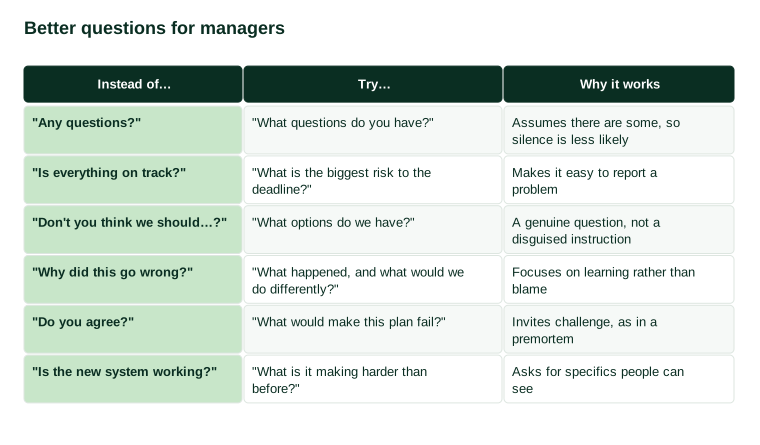
Research on conversation also points to how questions are asked. Huang et al. (2017) found that people who asked more follow-up questions were better liked, because follow-ups signal that the asker has listened. Leaders who ask a question and then genuinely follow up on the answer get more information and build more trust than leaders who ask and move on. Chris Argyris and Donald Schön (1978) observed that managers often advocate their own views strongly while asking few genuine questions about others' reasoning, and recommended balancing advocacy with inquiry: stating one's view and the reasons for it, and then asking how others see it differently.
When questions backfire
Questions from a leader are not neutral, because they come from someone with power over the person answering. Several patterns turn a question into a problem. A rapid series of questions can feel like cross-examination, especially if the leader already knows the answers. A question asked in public about a mistake ("Who signed this off?") will be heard as a search for someone to blame, and the main lesson people draw is to avoid being the one who is named. A question that is never followed by any visible action teaches people that answering is a waste of effort, which is one of the main reasons for organisational silence identified by Morrison and Milliken (2000).
Leaders can reduce these risks with a few habits. Signal the purpose of a question ("I'm asking because I want to understand what made this hard, not to find fault"). Ask difficult questions in private before raising them in a group. Close the loop by telling people what was done with their answers, even when the answer was to do nothing. Karl Weick and Kathleen Sutcliffe (2007) found that organisations that operate reliably in hazardous conditions, such as aircraft carriers and nuclear plants, share a "preoccupation with failure": leaders constantly ask what might be going wrong and treat small surprises as information rather than as reasons for blame. The questions themselves are simple; what makes them powerful is the response that follows.
A hypothetical example
A regional manager is told that a new scheduling system is "working well". In one version of the conversation, the manager asks "Is the new system working?" and hears yes. In another, the manager asks "What is the system making harder than it used to be?" and then "Can you show me an example?" The second conversation reveals that staff are keeping a paper schedule alongside the new system because it cannot handle shift swaps. The problem was known to everyone on the floor, but only the second question made it easy to say.
Conclusion
Powerful questions in leadership are not clever phrases. They are genuine questions, asked by someone who wants to know the answer, at a moment when the answer can make a difference, and followed by a response that shows the answer was valued. The research shows that such questions bring hidden knowledge to the surface, improve decisions, help people solve their own problems and build teams in which speaking up is normal. The skill can be learned, and few skills offer a leader a larger return.
References
Argyris, C., & Schön, D. A. (1978). Organizational learning: A theory of action perspective. Addison-Wesley.
Burris, E. R. (2012). The risks and rewards of speaking up: Managerial responses to employee voice. Academy of Management Journal, 55(4), 851–875. https://doi.org/10.5465/amj.2010.0562
Cooperrider, D. L., & Whitney, D. (2005). Appreciative inquiry: A positive revolution in change. Berrett-Koehler.
Detert, J. R., & Burris, E. R. (2007). Leadership behavior and employee voice: Is the door really open? Academy of Management Journal, 50(4), 869–884. https://doi.org/10.5465/amj.2007.26279183
Edmondson, A. (1999). Psychological safety and learning behavior in work teams. Administrative Science Quarterly, 44(2), 350–383. https://doi.org/10.2307/2666999
Grant, A. M., & O'Connor, S. A. (2010). The differential effects of solution-focused and problem-focused coaching questions: A pilot study with implications for practice. Industrial and Commercial Training, 42(2), 102–111. https://doi.org/10.1108/00197851011026090
Hackman, J. R., & Wageman, R. (2005). A theory of team coaching. Academy of Management Review, 30(2), 269–287. https://doi.org/10.5465/amr.2005.16387885
Heifetz, R. A. (1994). Leadership without easy answers. Harvard University Press.
Huang, K., Yeomans, M., Brooks, A. W., Minson, J., & Gino, F. (2017). It doesn't hurt to ask: Question-asking increases liking. Journal of Personality and Social Psychology, 113(3), 430–452. https://doi.org/10.1037/pspi0000097
Janis, I. L. (1972). Victims of groupthink: A psychological study of foreign-policy decisions and fiascoes. Houghton Mifflin.
Kahneman, D., Lovallo, D., & Sibony, O. (2011). Before you make that big decision. Harvard Business Review, 89(6), 50–60.
Klein, G. (2007). Performing a project premortem. Harvard Business Review, 85(9), 18–19.
Marquardt, M. J. (2014). Leading with questions: How leaders find the right solutions by knowing what to ask (Rev. ed.). Jossey-Bass.
Milliken, F. J., Morrison, E. W., & Hewlin, P. F. (2003). An exploratory study of employee silence: Issues that employees don't communicate upward and why. Journal of Management Studies, 40(6), 1453–1476. https://doi.org/10.1111/1467-6486.00387
Morrison, E. W., & Milliken, F. J. (2000). Organizational silence: A barrier to change and development in a pluralistic world. Academy of Management Review, 25(4), 706–725. https://doi.org/10.5465/amr.2000.3707697
Nemeth, C. J. (1986). Differential contributions of majority and minority influence. Psychological Review, 93(1), 23–32. https://doi.org/10.1037/0033-295X.93.1.23
Schein, E. H. (2013). Humble inquiry: The gentle art of asking instead of telling. Berrett-Koehler.
Theeboom, T., Beersma, B., & van Vianen, A. E. M. (2014). Does coaching work? A meta-analysis on the effects of coaching on individual level outcomes in an organizational context. The Journal of Positive Psychology, 9(1), 1–18. https://doi.org/10.1080/17439760.2013.837499
Weick, K. E., & Sutcliffe, K. M. (2007). Managing the unexpected: Resilient performance in an age of uncertainty (2nd ed.). Jossey-Bass.