
Inquiry · Public and formal inquiry
Participatory Research and Citizen Science
Participatory research and citizen science involve non-professionals in producing knowledge, from counting birds to designing health studies with their own communities. This article explains the main traditions, what participation adds, what the evidence shows about data quality and impact, and how to design participatory projects well.
For most of the twentieth century, research was something done by trained professionals to or about other people. Participants answered questions, provided samples or were observed, but had no say in what was studied, how or why. Two movements have challenged this model. Participatory research holds that the people affected by a problem should take part in investigating it, as partners rather than subjects. Citizen science enlists members of the public in collecting and analysing data, often on a scale no professional team could match. The two traditions have different origins and aims, but both rest on the idea that knowledge can be produced more effectively, and more fairly, when inquiry is shared. This article explains both traditions, what participation adds, what the evidence shows and how participatory projects can be designed well.
Participatory research
The roots of participatory research lie in the action research of the psychologist Kurt Lewin (1946), who argued that research on social problems should be carried out with the people involved, in cycles of planning, action and reflection, with the aim of producing change as well as knowledge. A second root is the work of the Brazilian educator Paulo Freire (1970), who argued that people learn most deeply when they investigate the problems of their own lives, and that this inquiry can help them change their circumstances. In the 1970s and 1980s, researchers in Latin America, Africa and Asia developed participatory action research, in which communities studied their own situations to challenge the monopoly of knowledge held by experts and elites (Fals-Borda & Rahman, 1991).
In public health, these ideas developed into community-based participatory research. Barbara Israel and colleagues (1998) set out its principles: it treats the community as a unit of identity, builds on its strengths, involves partners equitably in all phases of research, combines knowledge and action, and involves long-term commitment. Minkler and Wallerstein (2008) collected many examples, from studies of environmental hazards in poor neighbourhoods to programmes addressing diabetes in Indigenous communities.
Andrea Cornwall and Rachel Jewkes (1995) argued that what distinguishes participatory research is not a particular method but the question of who controls the research: who defines the problem, who decides how to study it, who interprets the findings and who owns and uses the results. Participation can range from token consultation to full partnership, echoing Sherry Arnstein's (1969) ladder of citizen participation.
Linda Tuhiwai Smith (2012) argued that research has often been experienced by Indigenous peoples as something imposed from outside, extracting knowledge for others' benefit. She called for research that is defined, conducted and owned by Indigenous communities themselves, according to their own priorities and values. Her work has influenced research ethics and practice in many countries, including Canada, Australia and New Zealand.
Citizen science
Citizen science has a different history. Amateur naturalists, astronomers and weather observers have contributed to science for centuries, but the term gained wide use in the 1990s. The sociologist Alan Irwin (1995) used it to describe a science that responds to the concerns of citizens and draws on their knowledge; at about the same time, ornithologists at Cornell University used it for projects in which volunteers collected data for research (Bonney et al., 2009). The second meaning has become dominant.
Jonathan Silvertown (2009) attributed the rapid growth of citizen science to the internet and mobile technology, which made it easy for large numbers of people to contribute observations, and to a growing recognition among scientists that volunteers could provide data at scales otherwise impossible. Examples include eBird, which has collected many millions of bird observations from volunteers worldwide (Sullivan et al., 2009); Galaxy Zoo, in which volunteers classified the shapes of galaxies in astronomical images (Lintott et al., 2008); and Foldit, an online game in which players solved protein-folding puzzles, in some cases outperforming computer algorithms (Cooper et al., 2010).
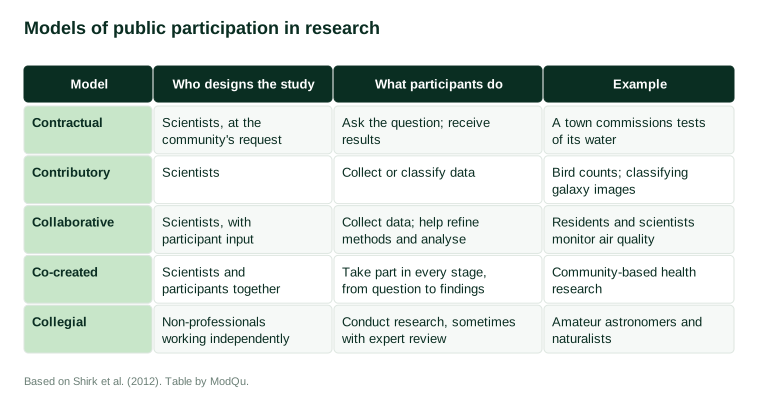
Shirk et al. (2012) proposed a framework that brings participatory research and citizen science together by describing the degree of public involvement. Figure 1 summarises their models, from contractual projects, in which a community asks scientists to investigate a question, through contributory projects, in which volunteers mainly collect data, to co-created projects, in which the public takes part in every stage, and collegial projects, in which non-professionals conduct research independently. Muki Haklay (2013) proposed a similar typology, ranging from crowdsourcing, in which participants act mainly as sensors, to extreme citizen science, in which they define problems and collect and analyse data themselves.
Lay knowledge and expert knowledge
Participatory approaches rest partly on the claim that non-experts possess knowledge that experts lack. Brian Wynne (1996) studied sheep farmers in Cumbria after the Chernobyl nuclear accident. Government scientists predicted that radioactive contamination of upland grazing would soon decline, but their predictions proved wrong, partly because they did not understand local soils and farming practices that the farmers knew well. The scientists' dismissal of farmers' knowledge damaged trust and led to poorer decisions.
Phil Brown (1992) described popular epidemiology, in which residents who suspected that toxic waste was causing illness in their community gathered their own evidence, often before officials took their concerns seriously. In the case Brown studied, in Woburn, Massachusetts, residents' investigation of a cluster of childhood leukaemia led eventually to scientific studies and legal action. Steven Epstein (1996) showed how AIDS activists in the United States learned enough about clinical research to influence the design of drug trials, making them more acceptable to patients without compromising their scientific validity.
More recently, residents of Flint, Michigan, working with independent scientists, collected water samples that revealed high lead levels in their drinking water after officials had dismissed their concerns. A paediatrician's analysis of children's blood tests, published by Hanna-Attisha et al. (2016), showed that the proportion of children with elevated blood lead levels had increased after the city changed its water source. The case shows how community-initiated inquiry can bring a hidden problem to light.
Participatory methods in practice
Participatory projects use many of the same methods as conventional research, such as surveys, interviews and measurement, but they also use methods designed to let participants contribute their own perspectives directly.
Photovoice. Caroline Wang and Mary Ann Burris (1997) developed photovoice, in which community members are given cameras and asked to photograph aspects of their lives related to a research question, such as the strengths and problems of their neighbourhood. The photographs are then discussed in groups, and participants explain what they show and why it matters. The method allows people to set the agenda for discussion, captures conditions that outsiders might not notice and produces material that can be shared with decision makers.
Community mapping. Participants mark on maps the places they consider safe or unsafe, the resources they use and the problems they experience. Maps make local knowledge visible and can be compared with official data, often revealing gaps or errors in the latter.
Peer research. Members of a community are trained to conduct interviews or surveys with their peers. Peer researchers may gain access to people who would not speak to outsiders and may understand the meaning of what they hear more fully. Training and support are needed to maintain quality and to protect peer researchers, who may face pressure from people they know.
Joint analysis. Rather than analysing data alone and presenting conclusions, researchers hold workshops in which community partners help interpret the findings. Partners often notice patterns that researchers miss and can judge which findings are surprising and which merely confirm what everyone already knew.
Citizen science as learning
Citizen science also changes the participants. Bonney et al. (2009) found that volunteers in well-designed projects gained knowledge of the subject and an understanding of how scientific research works, including the importance of careful observation and standard methods. Some went on to further study or to take part in conservation and community action. Shirk et al. (2012) argued that projects should be designed with these outcomes in mind, deciding deliberately what participants should learn and what role they should play, rather than treating volunteers simply as unpaid data collectors.
For research organisations, this is a reminder that participation is a two-way exchange. People who contribute their time and knowledge expect to learn something, to see the results and to know that their contribution mattered. Projects that meet these expectations retain volunteers and build lasting relationships; projects that do not tend to lose participants quickly.
Ethical questions
Participatory research raises ethical questions that conventional research ethics procedures were not designed for. Participants may be both researchers and subjects, which blurs the usual distinction between those who conduct and those who are studied. Confidentiality can be hard to maintain when community members collect information about their neighbours. Findings that reflect badly on a community, or on particular groups within it, may cause harm if published without care. Tuhiwai Smith (2012) emphasised that communities should have a say in how knowledge about them is used and shared. Many participatory projects therefore develop written agreements covering consent, data ownership, publication and the handling of sensitive findings, and revisit these agreements as the project develops.
What the evidence shows
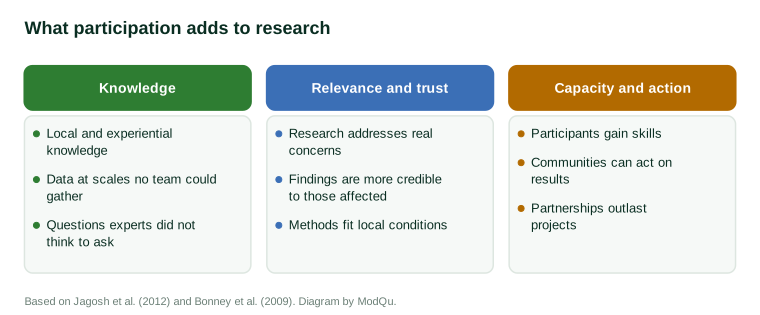
Benefits of participatory research. Jagosh et al. (2012) conducted a realist review of community-based participatory research in health and identified a range of benefits, summarised in Figure 2. Partnerships helped ensure that research addressed questions communities cared about, improved recruitment and the cultural fit of interventions, built skills and capacity in communities and produced outcomes that lasted beyond individual projects. These benefits depended on building trust, which took time. Cargo and Mercer (2008) reviewed the value and challenges of participatory research and found it could improve the relevance and use of research, but noted that it required more time and resources than conventional studies and raised difficult questions about how to share power. Wallerstein and Duran (2010) argued that participatory approaches can help close the gap between research and practice, because interventions developed with communities are more likely to be adopted and sustained.
Data quality in citizen science. A common concern is whether data collected by volunteers are reliable. Kosmala et al. (2016) reviewed the evidence and concluded that citizen science data can be as accurate as professional data, provided projects are well designed. Accuracy depends on clear protocols, training, tasks matched to volunteers' skills, built-in checks such as having several volunteers classify the same item, and statistical methods that account for differences between observers. Galaxy Zoo, for example, combined the classifications of many volunteers for each image and found that the combined results agreed closely with those of professional astronomers (Lintott et al., 2008).
Influence on decisions. Gwen Ottinger (2010) studied community groups that used simple air-sampling devices to document pollution near oil refineries. She found that their data were often dismissed by regulators because they did not follow official sampling standards, even when they revealed real problems. Citizen data had more influence when it was designed to meet recognised standards or was used to prompt official monitoring. The lesson is that the credibility of participatory evidence depends partly on how it is collected and partly on whether decision makers are willing to engage with it.
Judging participatory projects
Because participatory projects aim at several goals at once, they need to be judged on several dimensions. The first is the quality of the knowledge produced: are the data accurate, the analysis sound and the conclusions supported by evidence? The standards here are the same as for any research, although the methods for meeting them may differ. The second is the quality of the participation itself: did participants have real influence over the questions, methods and interpretation, or were they consulted only after the important decisions had been made? The third is the effect on the people and communities involved: did they gain skills, confidence or resources, and were they able to act on the findings? The fourth is the use of the results: did the research inform decisions, change practice or lead to further inquiry?
Projects can succeed on some dimensions and fail on others. A citizen science project may produce excellent data while giving volunteers little understanding of the purpose of their work. A community partnership may build strong relationships and capacity while producing findings too limited to influence policy. Being clear at the outset about which goals matter most, and how each will be assessed, helps projects make sensible trade-offs and report honestly on what they achieved. Jagosh et al. (2012) found that the benefits of participatory research often appeared over long periods, as partnerships produced further projects and communities applied what they had learned to new problems. Evaluations that stop when a single project ends may therefore understate what participation achieves.
Challenges
Participatory research and citizen science face several challenges.
Time and resources. Building genuine partnerships takes time, often longer than conventional funding cycles allow. Cargo and Mercer (2008) noted that participatory projects frequently require years of relationship-building before research can begin.
Power and ownership. Partners may have very different resources, status and goals. Researchers may need publications; communities may need action. Agreements about who owns data, who decides what is published and how findings will be used are essential.
Representativeness. Volunteers are not a random sample. They tend to be more educated and more interested in the topic than the general population, and they collect data where and when it suits them. Citizen science data on wildlife, for example, are concentrated near roads and towns. Statistical adjustment can correct for some of these biases, but not all.
Quality and credibility. As Ottinger (2010) found, data collected outside professional standards may be dismissed even when accurate. Projects must decide how far to follow established protocols, which aids credibility, or to develop methods suited to local conditions, which may capture what standard methods miss.
Tokenism. Participation can be superficial, with community members consulted but given no real influence. Arnstein's (1969) warning about tokenism remains relevant.
Designing participatory projects
Research on participatory approaches suggests several principles:
- Be clear about the model. Decide at the start which kind of participation the project involves and what influence participants will have.
- Involve partners early. The most important decisions, such as the choice of question, are made at the start.
- Agree on ownership and use of data and findings before data collection begins.
- Design for quality. Use clear protocols, training, redundancy and appropriate statistical methods.
- Value local knowledge. Treat participants' experience as evidence, not merely as context.
- Share results. Report back to participants in forms they can use.
- Plan for the long term. Trust built in one project can support future inquiry.
Lessons for organisations
The principles of participatory research apply beyond academic and community settings. Organisations that involve customers, employees or communities in designing and conducting research often gain knowledge they would otherwise miss, and findings that participants trust and act on.
A hypothetical example illustrates the point. A housing association wants to understand why tenants in several of its buildings report persistent damp. Rather than commissioning a survey designed by its own staff, it forms a working group of tenants and building surveyors. Tenants help design the questions and map where damp occurs, drawing on their knowledge of when it appears and what they have tried. Some tenants keep simple diaries of humidity readings using inexpensive devices. The combined evidence reveals that damp is concentrated in flats where extractor fans were removed during an earlier renovation, a detail the association's records did not show. Because tenants helped produce the findings, they trust the resulting repair programme and help prioritise which flats to fix first.
Conclusion
Participatory research and citizen science extend inquiry beyond professional researchers. Participatory research brings the people affected by a problem into its investigation, drawing on their knowledge and supporting their capacity to act. Citizen science enlists the public in gathering and analysing data at scales otherwise impossible. The evidence shows that both can produce knowledge that is accurate, relevant and used, provided projects are designed with care: clear about the role of participants, rigorous about quality, honest about power and committed to sharing results. As Wynne's sheep farmers and Flint's residents showed, people outside the professions often know things that experts need to learn.
References
Arnstein, S. R. (1969). A ladder of citizen participation. Journal of the American Institute of Planners, 35(4), 216–224. https://doi.org/10.1080/01944366908977225
Bonney, R., Cooper, C. B., Dickinson, J., Kelling, S., Phillips, T., Rosenberg, K. V., & Shirk, J. (2009). Citizen science: A developing tool for expanding science knowledge and scientific literacy. BioScience, 59(11), 977–984. https://doi.org/10.1525/bio.2009.59.11.9
Brown, P. (1992). Popular epidemiology and toxic waste contamination: Lay and professional ways of knowing. Journal of Health and Social Behavior, 33(3), 267–281. https://doi.org/10.2307/2137356
Cargo, M., & Mercer, S. L. (2008). The value and challenges of participatory research: Strengthening its practice. Annual Review of Public Health, 29, 325–350. https://doi.org/10.1146/annurev.publhealth.29.091307.083824
Cooper, S., Khatib, F., Treuille, A., Barbero, J., Lee, J., Beenen, M., Leaver-Fay, A., Baker, D., Popović, Z., & Foldit players. (2010). Predicting protein structures with a multiplayer online game. Nature, 466(7307), 756–760. https://doi.org/10.1038/nature09304
Cornwall, A., & Jewkes, R. (1995). What is participatory research? Social Science & Medicine, 41(12), 1667–1676. https://doi.org/10.1016/0277-9536(95)00127-S
Epstein, S. (1996). Impure science: AIDS, activism, and the politics of knowledge. University of California Press.
Fals-Borda, O., & Rahman, M. A. (Eds.). (1991). Action and knowledge: Breaking the monopoly with participatory action-research. Apex Press.
Freire, P. (1970). Pedagogy of the oppressed (M. B. Ramos, Trans.). Herder and Herder.
Haklay, M. (2013). Citizen science and volunteered geographic information: Overview and typology of participation. In D. Sui, S. Elwood, & M. Goodchild (Eds.), Crowdsourcing geographic knowledge (pp. 105–122). Springer. https://doi.org/10.1007/978-94-007-4587-2_7
Hanna-Attisha, M., LaChance, J., Sadler, R. C., & Champney Schnepp, A. (2016). Elevated blood lead levels in children associated with the Flint drinking water crisis: A spatial analysis of risk and public health response. American Journal of Public Health, 106(2), 283–290. https://doi.org/10.2105/AJPH.2015.303003
Irwin, A. (1995). Citizen science: A study of people, expertise and sustainable development. Routledge.
Israel, B. A., Schulz, A. J., Parker, E. A., & Becker, A. B. (1998). Review of community-based research: Assessing partnership approaches to improve public health. Annual Review of Public Health, 19, 173–202. https://doi.org/10.1146/annurev.publhealth.19.1.173
Jagosh, J., Macaulay, A. C., Pluye, P., Salsberg, J., Bush, P. L., Henderson, J., Sirett, E., Wong, G., Cargo, M., Herbert, C. P., Seifer, S. D., Green, L. W., & Greenhalgh, T. (2012). Uncovering the benefits of participatory research: Implications of a realist review for health research and practice. The Milbank Quarterly, 90(2), 311–346. https://doi.org/10.1111/j.1468-0009.2012.00665.x
Kosmala, M., Wiggins, A., Swanson, A., & Simmons, B. (2016). Assessing data quality in citizen science. Frontiers in Ecology and the Environment, 14(10), 551–560. https://doi.org/10.1002/fee.1436
Lewin, K. (1946). Action research and minority problems. Journal of Social Issues, 2(4), 34–46. https://doi.org/10.1111/j.1540-4560.1946.tb02295.x
Lintott, C. J., Schawinski, K., Slosar, A., Land, K., Bamford, S., Thomas, D., Raddick, M. J., Nichol, R. C., Szalay, A., Andreescu, D., Murray, P., & Vandenberg, J. (2008). Galaxy Zoo: Morphologies derived from visual inspection of galaxies from the Sloan Digital Sky Survey. Monthly Notices of the Royal Astronomical Society, 389(3), 1179–1189. https://doi.org/10.1111/j.1365-2966.2008.13689.x
Minkler, M., & Wallerstein, N. (Eds.). (2008). Community-based participatory research for health: From process to outcomes (2nd ed.). Jossey-Bass.
Ottinger, G. (2010). Buckets of resistance: Standards and the effectiveness of citizen science. Science, Technology, & Human Values, 35(2), 244–270. https://doi.org/10.1177/0162243909337121
Shirk, J. L., Ballard, H. L., Wilderman, C. C., Phillips, T., Wiggins, A., Jordan, R., McCallie, E., Minarchek, M., Lewenstein, B. V., Krasny, M. E., & Bonney, R. (2012). Public participation in scientific research: A framework for deliberate design. Ecology and Society, 17(2), Article 29. https://doi.org/10.5751/ES-04705-170229
Silvertown, J. (2009). A new dawn for citizen science. Trends in Ecology & Evolution, 24(9), 467–471. https://doi.org/10.1016/j.tree.2009.03.017
Sullivan, B. L., Wood, C. L., Iliff, M. J., Bonney, R. E., Fink, D., & Kelling, S. (2009). eBird: A citizen-based bird observation network in the biological sciences. Biological Conservation, 142(10), 2282–2292. https://doi.org/10.1016/j.biocon.2009.05.006
Tuhiwai Smith, L. (2012). Decolonizing methodologies: Research and Indigenous peoples (2nd ed.). Zed Books.
Wallerstein, N., & Duran, B. (2010). Community-based participatory research contributions to intervention research: The intersection of science and practice to improve health equity. American Journal of Public Health, 100(S1), S40–S46. https://doi.org/10.2105/AJPH.2009.184036
Wang, C., & Burris, M. A. (1997). Photovoice: Concept, methodology, and use for participatory needs assessment. Health Education & Behavior, 24(3), 369–387. https://doi.org/10.1177/109019819702400309
Wynne, B. (1996). May the sheep safely graze? A reflexive view of the expert–lay knowledge divide. In S. Lash, B. Szerszynski, & B. Wynne (Eds.), Risk, environment and modernity: Towards a new ecology (pp. 44–83). Sage.