
Inquiry · The art of the question
Listening as a Method of Inquiry
Listening is usually treated as the passive half of asking, but research shows it actively shapes what people say and what an inquirer learns. This article explains listening as a method of inquiry, the evidence for its effects, and practical techniques for listening well in interviews, research and management.
Every question is only half of an exchange. The other half is what happens while the answer is given. A questioner who is half-listening, waiting for a pause to ask the next question or already deciding what the answer means, will hear less and learn less than one who is fully attending. More surprisingly, research shows that the quality of listening changes not only what the listener takes in but what the speaker says. Good listening draws out fuller, more honest and more thoughtful answers. Listening is therefore not a passive receiving of information. It is an active method of inquiry, with its own techniques, evidence base and pitfalls.
Listening shapes what is said
The idea that a listener influences the speaker is central to the work of the psychologist Carl Rogers. Rogers (1951) found that clients in therapy explored their experiences more deeply when the therapist listened with full attention, without judgement, and reflected back what they had heard. Rogers and Farson (1957) later described this practice as active listening and argued that it was valuable far beyond therapy, including in management. They suggested that people who feel genuinely heard become less defensive, more open to examining their own views and more willing to say what they really think.
Experimental research has since confirmed these claims. Janet Bavelas and colleagues (2000) asked people to tell stories of close calls to listeners, some of whom were distracted by a separate task. Distracted listeners made fewer specific responses, such as appropriate facial expressions at key moments, and the stories told to them were worse: speakers told them less well, particularly at the dramatic endings. Bavelas et al. concluded that listeners act as "co-narrators", shaping the story as it is told. Pasupathi and Billitteri (2015) reviewed similar studies and found that attentive listeners elicit longer, more detailed and more meaningful accounts.
Guy Itzchakov and Avraham Kluger have studied the effects of high-quality listening in a series of experiments. Itzchakov et al. (2017) found that people who spoke to a good listener about their attitudes became more aware of the complexity of their own views, recognising both sides of an issue, and less defensive about the inconsistencies. They also became less extreme. Kluger and Itzchakov (2022), reviewing the research on listening at work, concluded that being listened to well increases speakers' psychological safety, reduces their defensiveness and makes them more willing to share information and ideas. Castro et al. (2018) found that people who were listened to well while describing ideas went on to produce more creative ideas, an effect explained partly by increased psychological safety.
For inquiry, these findings matter enormously. The information a researcher, manager or interviewer obtains depends on what people are willing and able to say, and that depends in part on how they are listened to.
What good listening involves
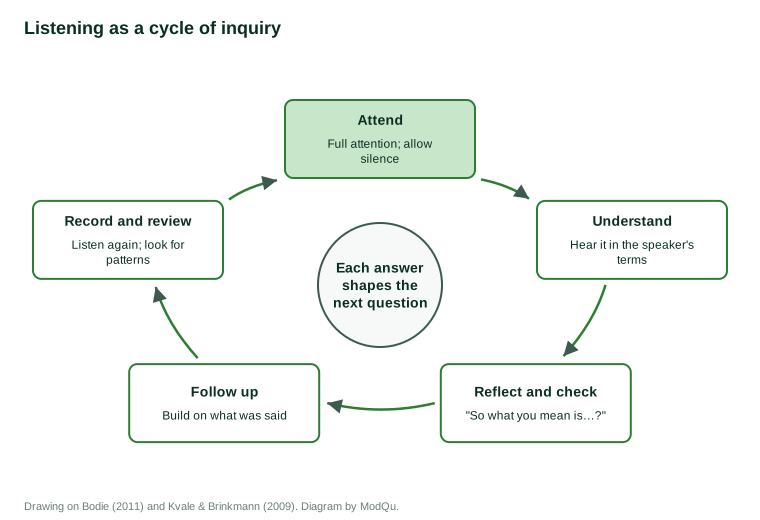
Researchers have identified several components of high-quality listening. Graham Bodie (2011) developed a measure of active-empathic listening with three parts: sensing (paying attention to what is said and not said), processing (making sense of the message, remembering it and connecting its parts) and responding (showing the speaker that they have been heard and understood). Each of these can be done well or badly. Figure 1 shows how listening fits into a cycle of inquiry.
Attending
Attending means giving the speaker full attention: not checking a phone, not planning the next question and not interrupting. It includes non-verbal signals such as eye contact and nodding, and brief verbal signals such as "mm" or "I see", which conversation researchers call backchannels. Clark and Schaefer (1989) showed that such signals are part of how speakers and listeners establish that they understand each other. Silence is also part of attending. Mary Budd Rowe (1986) found that when teachers waited three seconds or more after asking a question, and after a student's answer, students gave longer and more thoughtful responses, more students participated and more of them asked questions of their own. The same applies in interviews: a short pause after an answer often draws out more.
Understanding
Understanding means trying to grasp what the speaker means, from their point of view, rather than fitting what they say into the listener's own categories. This is harder than it sounds. Listeners tend to hear what they expect, and to stop listening once they think they have understood. Kvale and Brinkmann (2009) recommend that research interviewers practise "deliberate naïveté", setting aside their assumptions and attending to what is actually said. James Spradley (1979) advised ethnographers to listen for the speaker's own terms and categories, which often reveal how they see their world, and to avoid translating them too quickly into the researcher's language.
Reflecting and checking
Reflecting means restating what the speaker has said, in different words, so that they can confirm or correct it. "So the problem was less the cost than the time it took?" is a reflection. Rogers (1951) regarded reflection as the core of active listening. Weger et al. (2010) found that interviewees rated interviewers who paraphrased their messages as better listeners and felt more understood, although paraphrasing did not change how much they liked the interviewer. In research, reflection also checks the listener's interpretation in real time, which reduces the risk of misunderstanding.
Following up
Listening well produces better follow-up questions, because the questions build on what was actually said rather than on what was planned. Huang et al. (2017) found that follow-up questions, more than any other kind, made people feel listened to and increased how much they liked the questioner. In interviews, the most valuable information often comes from following an unexpected remark rather than moving to the next question on the guide.
Listening in research interviews
In qualitative research, listening is the main instrument. Elliot Mishler (1986) argued that research interviews should be understood as joint constructions of meaning by interviewer and respondent, in which the respondent's stories are shaped by how the interviewer listens and responds. Holstein and Gubrium (1995) similarly described the "active interview", in which both parties contribute to the account that is produced. On this view, there is no neutral way to listen; the question is whether the listening helps the respondent to give a full and authentic account.
Michael Patton (2015) emphasises that interviewers should listen for what is not said as well as what is, and for the emotions and hesitations that accompany words. Recording interviews allows the researcher to listen again later, which often reveals details missed the first time. Careful analysis, such as the thematic analysis described by Braun and Clarke (2006), is in part a disciplined form of re-listening, in which the researcher returns repeatedly to what was said to identify patterns.
The same principles apply to investigative interviewing. The cognitive interview developed by Fisher and Geiselman (1992) depends on the interviewer listening without interrupting, letting the witness control the flow of information and following up on the witness's own account rather than imposing a structure. Witnesses questioned this way recall more accurate detail.
Listening in organisations
Organisations are full of information that never reaches the people who need it. Morrison and Milliken (2000) described organisational silence, in which employees withhold concerns because they believe speaking up is futile or dangerous. Listening, more than asking, determines whether this silence persists. An employee who raises a concern and is interrupted, dismissed or met with defensiveness learns not to raise the next one. Van Quaquebeke and Felps (2018) proposed that leaders who engage in respectful inquiry, asking open questions and then listening attentively to the answers, satisfy employees' needs for autonomy, competence and relatedness, and so increase their motivation and willingness to contribute. Amy Edmondson (1999) found that psychological safety, the belief that the team is safe for interpersonal risk-taking, is essential for team learning, and listening is one of the main ways it is built.
Listening at scale
Not all listening happens face to face. Organisations also listen through open-ended survey comments, customer complaints, support calls, reviews and online discussion. The same principles apply. The comments that follow a closed survey question often contain the most useful information in the whole survey, because they show what respondents wanted to say in their own words, yet they are frequently skimmed, counted or ignored. Listening well at scale means reading a sample of comments in full before coding them, paying attention to the language people use, and looking for issues the closed questions did not cover.
It also means noticing who is not speaking. Complaints come disproportionately from people who are confident, articulate and motivated enough to complain; customers who quietly leave say nothing. Online discussion is dominated by a small number of active participants. An organisation that listens only to the loudest voices will hear a distorted version of what its customers, employees or citizens think. Deliberately seeking out quieter groups, through targeted interviews or carefully designed samples, is part of listening well.
Listening across difference
Listening is hardest, and most valuable, when the speaker's experience is very different from the listener's. A researcher interviewing people of a different age, culture, class or profession may not recognise what is significant in their accounts, and may unconsciously signal which answers are expected. Respondents, for their part, may simplify or adapt what they say for a listener they assume will not understand. Back (2007) argued that good listening requires the listener to accept that they may not understand at first, and to stay with that uncertainty rather than filling it with their own assumptions.
Power differences have a similar effect. When a manager interviews an employee, or a company interviews a customer who depends on its service, the speaker may tell the listener what they think the listener wants to hear. Making it clear that critical views are welcome, listening without visible judgement and, where possible, using an independent interviewer all help to reduce this distortion.
Common barriers to listening
Several habits get in the way of good listening:
- Preparing the next question. Interviewers who are thinking about their next question miss what is being said now.
- Listening to respond rather than to understand. In discussions, people often listen for points to rebut rather than trying to understand the other view.
- Premature interpretation. Deciding what an answer means before it is finished closes off what the speaker might say next.
- Filling silences. Interrupting a pause with another question can cut off the most thoughtful part of an answer.
- Signalling judgement. Facial expressions, sighs or quick disagreement tell the speaker which answers are welcome.
Les Back (2007), a sociologist, argued that listening is an art that requires active cultivation, not least because so much of social life rewards speaking over attending.
Practising listening
Listening improves with deliberate practice. Some simple exercises help:
- Record and review. Listening back to one's own interviews reveals interruptions, missed cues and moments where a follow-up was needed.
- Summarise before responding. In meetings, try restating the previous speaker's point to their satisfaction before making one's own.
- Count the questions you did not plan. In an interview, a high proportion of unplanned follow-up questions is usually a sign of good listening.
- Notice the urge to interrupt, and wait a few seconds longer.
A hypothetical example
A researcher interviews a small business owner about accounting software. The interview guide asks about features, price and support. Early on, the owner mentions in passing that she "only really looks at it on Sunday nights". A researcher focused on the guide would move on. A researcher who is listening asks, "Tell me about Sunday nights." The answer reveals that the owner does all her bookkeeping in one weekly session at home, on a tablet, after her children are asleep, and that what she wants above all is to finish in under an hour. The features the company planned to promote are irrelevant to her; speed on a tablet is everything. The most important finding of the interview came not from any planned question but from listening to an aside.
The same researcher, listening back to the recording that evening, notices something else: twice the owner began to say something about her accountant and then changed the subject. In the next interview with her, the researcher asks about it gently. It emerges that the accountant, not the owner, chooses the software, and that the accountant's preferences are the real barrier to switching. Neither finding appeared in the interview guide, and neither would have been heard by a researcher listening only for answers to planned questions.
Conclusion
Listening is not the passive counterpart to asking. It is an active method of inquiry that shapes what people say, how fully they say it and how accurately the listener understands it. The research shows that attentive, non-judgemental listening, with reflection and follow-up, draws out richer and more honest information, reduces defensiveness and builds the trust on which future inquiry depends. For anyone who asks questions for a living, learning to listen well is as important as learning what to ask.
References
Back, L. (2007). The art of listening. Berg.
Bavelas, J. B., Coates, L., & Johnson, T. (2000). Listeners as co-narrators. Journal of Personality and Social Psychology, 79(6), 941–952. https://doi.org/10.1037/0022-3514.79.6.941
Bodie, G. D. (2011). The Active-Empathic Listening Scale (AELS): Conceptualization and evidence of validity within the interpersonal domain. Communication Quarterly, 59(3), 277–295. https://doi.org/10.1080/01463373.2011.583495
Braun, V., & Clarke, V. (2006). Using thematic analysis in psychology. Qualitative Research in Psychology, 3(2), 77–101. https://doi.org/10.1191/1478088706qp063oa
Castro, D. R., Anseel, F., Kluger, A. N., Lloyd, K. J., & Turjeman-Levi, Y. (2018). Mere listening effect on creativity and the mediating role of psychological safety. Psychology of Aesthetics, Creativity, and the Arts, 12(4), 489–502. https://doi.org/10.1037/aca0000177
Clark, H. H., & Schaefer, E. F. (1989). Contributing to discourse. Cognitive Science, 13(2), 259–294. https://doi.org/10.1207/s15516709cog1302_7
Edmondson, A. (1999). Psychological safety and learning behavior in work teams. Administrative Science Quarterly, 44(2), 350–383. https://doi.org/10.2307/2666999
Fisher, R. P., & Geiselman, R. E. (1992). Memory-enhancing techniques for investigative interviewing: The cognitive interview. Charles C Thomas.
Holstein, J. A., & Gubrium, J. F. (1995). The active interview. Sage. https://doi.org/10.4135/9781412986120
Huang, K., Yeomans, M., Brooks, A. W., Minson, J., & Gino, F. (2017). It doesn't hurt to ask: Question-asking increases liking. Journal of Personality and Social Psychology, 113(3), 430–452. https://doi.org/10.1037/pspi0000097
Itzchakov, G., Kluger, A. N., & Castro, D. R. (2017). I am aware of my inconsistencies but can tolerate them: The effect of high quality listening on speakers' attitude ambivalence. Personality and Social Psychology Bulletin, 43(1), 105–120. https://doi.org/10.1177/0146167216675339
Kluger, A. N., & Itzchakov, G. (2022). The power of listening at work. Annual Review of Organizational Psychology and Organizational Behavior, 9, 121–146. https://doi.org/10.1146/annurev-orgpsych-012420-091013
Kvale, S., & Brinkmann, S. (2009). InterViews: Learning the craft of qualitative research interviewing (2nd ed.). Sage.
Mishler, E. G. (1986). Research interviewing: Context and narrative. Harvard University Press.
Morrison, E. W., & Milliken, F. J. (2000). Organizational silence: A barrier to change and development in a pluralistic world. Academy of Management Review, 25(4), 706–725. https://doi.org/10.5465/amr.2000.3707697
Pasupathi, M., & Billitteri, J. (2015). Being and becoming through being heard: Listener effects on stories and selves. International Journal of Listening, 29(2), 67–84. https://doi.org/10.1080/10904018.2015.1029363
Patton, M. Q. (2015). Qualitative research and evaluation methods (4th ed.). Sage.
Rogers, C. R. (1951). Client-centered therapy: Its current practice, implications, and theory. Houghton Mifflin.
Rogers, C. R., & Farson, R. E. (1957). Active listening. Industrial Relations Center, University of Chicago.
Rowe, M. B. (1986). Wait time: Slowing down may be a way of speeding up! Journal of Teacher Education, 37(1), 43–50. https://doi.org/10.1177/002248718603700110
Spradley, J. P. (1979). The ethnographic interview. Holt, Rinehart and Winston.
Van Quaquebeke, N., & Felps, W. (2018). Respectful inquiry: A motivational account of leading through asking questions and listening. Academy of Management Review, 43(1), 5–27. https://doi.org/10.5465/amr.2014.0537
Weger, H., Jr., Castle, G. R., & Emmett, M. C. (2010). Active listening in peer interviews: The influence of message paraphrasing on perceptions of listening skill. International Journal of Listening, 24(1), 34–49. https://doi.org/10.1080/10904010903466311