
Inquiry · The art of the question
The Relationship Between Inquiry and Creativity in Knowledge Generation
Inquiry and creativity are often treated as opposites, one disciplined and the other free. This article shows how closely they are linked, from finding problems to generating and testing ideas, and what the research suggests about combining them to generate new knowledge.
Inquiry is often pictured as careful and methodical, creativity as spontaneous and free. The research tells a different story. Creative work depends on inquiry: on finding good problems, gathering knowledge, asking questions and testing ideas. And inquiry depends on creativity: on imagining hypotheses, seeing connections and devising new ways to find things out. This article examines the relationship between the two, drawing on psychological research on creativity, studies of scientists at work and research on how new knowledge is generated.
What creativity is
Psychologists generally define creativity as the production of ideas or products that are both original and effective, meaning novel and also useful or appropriate to the task (Runco & Jaeger, 2012). Both parts matter. An idea that is new but useless is not creative, and neither is one that is useful but entirely familiar. J. P. Guilford (1950), in an address that launched modern creativity research, distinguished divergent thinking, generating many possible answers to an open problem, from convergent thinking, finding the single best answer. Creative work requires both.
Kaufman and Beghetto (2009) distinguished levels of creativity, from the personal insights that occur in everyday learning to the professional creativity of experts and the rare, field-changing creativity of figures such as Darwin. All levels involve generating something new, and all depend on inquiry.
Creativity begins with finding the problem
The clearest link between inquiry and creativity is problem finding. Jacob Getzels and Mihaly Csikszentmihalyi (1976) studied art students as they created a still-life drawing from a set of objects. Some students quickly chose objects and began drawing. Others spent longer handling and exploring the objects, rearranged them and changed their approach as they worked. Experts rated the work of the second group as more original, and these "problem-finding" behaviours predicted the students' artistic success years later. The creative act began not with a solution but with the way the problem was found and framed.
Later research has confirmed the importance of what is now often called problem construction. Reiter-Palmon and Robinson (2009) reviewed studies showing that people who spend more effort defining and redefining a problem produce more creative solutions, and that problem construction can be improved through training. Okuda et al. (1991) found that children's ability to find problems in real-world situations predicted their creative accomplishments better than standard tests of divergent thinking. In other words, the inquiring part of creativity, asking what the problem really is, may be at least as important as the generating part.
The creative process as inquiry
Graham Wallas (1926) proposed a four-stage model of the creative process that has proved durable: preparation, in which the problem is investigated thoroughly; incubation, in which conscious attention is withdrawn; illumination, the moment of insight; and verification, in which the idea is tested and developed. Figure 1 places these stages alongside problem finding.
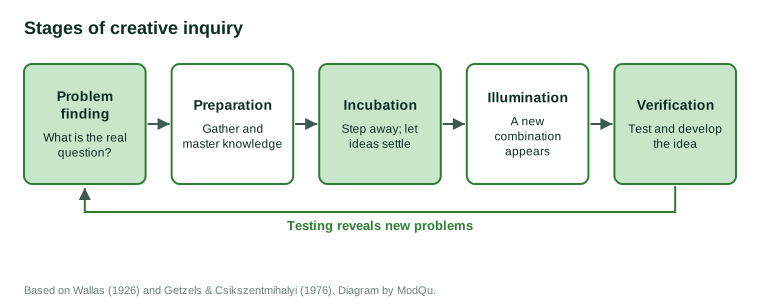
Two of the five stages, preparation and verification, are straightforward inquiry: gathering knowledge and testing ideas against evidence. Incubation has been studied experimentally. Sio and Ormerod (2009), in a meta-analysis of more than a hundred studies, found that taking a break from a problem does help people solve it, especially for problems requiring creative solutions, and that the benefit is larger when the preparation period was longer. Incubation works on what preparation has gathered.
Illumination itself often depends on prior knowledge, recombined in a new way. Gick and Holyoak (1980) showed that people could solve a difficult problem by applying an analogy from a story they had read earlier, but often only when prompted to see the connection. Thomas Ward (1994) found that even when people try to imagine something completely new, such as creatures from another planet, they draw heavily on the structure of things they already know. Creativity is less the creation of something from nothing than the recombination of what is known.
The creative step inside inquiry
Accounts of scientific method often describe how hypotheses are tested but say little about where they come from. The philosopher Norwood Russell Hanson (1958) argued that this leaves out the most important part of discovery. Before a hypothesis can be tested, someone must see the data in a way that suggests it, and this act of seeing is neither deduction nor simple generalisation. Following the American philosopher Charles Sanders Peirce, Hanson called the reasoning involved abduction: inferring, from a surprising observation, a hypothesis that would explain it if it were true. Abduction is the point at which inquiry is most creative. It requires imagination to propose an explanation that nobody has yet considered, and knowledge to judge whether it is plausible enough to be worth testing.
Every field of research depends on this step. A market researcher who notices that sales of two unrelated products rise and fall together, and suggests that both are bought by the same group of customers for a reason nobody has identified, is reasoning abductively. So is a doctor who considers an unusual diagnosis to explain an unexpected combination of symptoms. In each case, the creative idea is only the beginning: it must then be tested by the disciplined methods of inquiry. But without it, there would be nothing to test.
How scientists create
Kevin Dunbar (1997) studied leading molecular biology laboratories by attending their meetings and recording how scientists reasoned. He found that new ideas often arose from unexpected findings, which were common, and from the way laboratory groups discussed them. Scientists who took unexpected results seriously, rather than dismissing them as errors, and who reasoned about them using analogies to related problems, were the ones who made conceptual advances. Groups with members from diverse backgrounds were better at generating such analogies. Inquiry, in Dunbar's account, is the engine of scientific creativity.
Large-scale studies support the importance of recombination. Uzzi et al. (2013) analysed nearly 18 million scientific papers and found that the papers most likely to be highly cited combined mostly conventional knowledge with an unusual combination of ideas from different areas. Novelty grounded in established knowledge had the greatest impact.
Dean Keith Simonton (1999) argued that creative achievement follows a process of variation and selection: creators generate many ideas, most of which fail, and a few survive testing. On this view, the volume of ideas and the rigour of testing are both essential, which is to say that both creativity and inquiry are needed.
Thomas Kuhn (1962) described how revolutionary changes in science begin with anomalies that existing theories cannot explain. Recognising an anomaly is an act of inquiry; imagining a new framework that could explain it is an act of creativity.
Curiosity as a bridge
Curiosity links inquiry and creativity. Hagtvedt et al. (2019) found that employees with greater specific curiosity, the desire to resolve particular gaps in knowledge, were rated as more creative by their supervisors, and that the relationship was explained partly by their tendency to seek information and consider problems from new angles. Mihaly Csikszentmihalyi (1996), in interviews with exceptionally creative people, found that curiosity and a sense of wonder were among their most consistent characteristics.
The social side
Creativity in organisations is shaped by the environment. Teresa Amabile (1996) found that people are most creative when they are motivated by interest in the work itself rather than by external rewards or pressure, and when their environment provides autonomy, resources and encouragement to explore. Charlan Nemeth (1986) found that exposure to dissenting views led groups to consider more alternatives and find more original solutions. Brainstorming in groups, however, can produce fewer ideas than individuals working alone, partly because people wait their turn and fear judgement (Diehl & Stroebe, 1987). Structured approaches that separate the generation of ideas from their evaluation help. Constraints can help too. A clearly defined problem, a limited budget or a fixed deadline can focus creative effort, provided that people still have room to question how the problem has been framed. Open-ended freedom without a question to pursue tends to produce activity rather than discovery.
A hypothetical example
A research team at a hypothetical food company is asked why a new range of ready meals is selling poorly. The obvious approach would be to survey customers about taste, price and packaging. Instead, the team begins with problem finding. It reframes the question from "Why don't people like the meals?" to "When do people eat ready meals, and what job are they doing for them?" Preparation follows: the team reads its own past research, visits shops at different times of day and talks to shoppers.
An anomaly appears. Sales are much better in shops near hospitals than anywhere else. After a weekend away from the problem, one member of the team makes a connection with an earlier project on shift workers, who often eat at unusual times and value meals they can eat cold or reheat quickly at work. The idea is tested with a targeted survey and with sales data by time of day. It holds up. The company changes the range's packaging and placement to target night workers, and sales improve. Problem finding, preparation, incubation, illumination and verification can all be seen in the sequence, as can the interplay between creative leaps and disciplined checking.
Bringing inquiry and creativity together
The research suggests several practical principles for teams that want to generate new knowledge:
- Invest in problem finding. Spend time defining the question before seeking answers, and revisit the definition as the work proceeds.
- Prepare thoroughly. Creative insights draw on knowledge. Broad and deep preparation provides more material to recombine.
- Allow incubation. Build time into projects for ideas to develop, rather than demanding answers immediately.
- Take anomalies seriously. Unexpected results are a common source of new ideas.
- Seek diverse perspectives. People from different backgrounds bring different analogies and see different connections.
- Separate generating from evaluating, then evaluate rigorously.
Conclusion
Inquiry and creativity are not opposites but partners. Creative work begins with inquiry into what the problem is, draws on knowledge gathered through inquiry and must be tested through inquiry. Inquiry, in turn, needs creativity to imagine new hypotheses and connections. The generation of knowledge depends on both: the imagination to see what might be true and the discipline to find out whether it is.
References
Amabile, T. M. (1996). Creativity in context. Westview Press.
Csikszentmihalyi, M. (1996). Creativity: Flow and the psychology of discovery and invention. HarperCollins.
Diehl, M., & Stroebe, W. (1987). Productivity loss in brainstorming groups: Toward the solution of a riddle. Journal of Personality and Social Psychology, 53(3), 497–509. https://doi.org/10.1037/0022-3514.53.3.497
Dunbar, K. (1997). How scientists think: On-line creativity and conceptual change in science. In T. B. Ward, S. M. Smith, & J. Vaid (Eds.), Creative thought: An investigation of conceptual structures and processes (pp. 461–493). American Psychological Association. https://doi.org/10.1037/10227-017
Getzels, J. W., & Csikszentmihalyi, M. (1976). The creative vision: A longitudinal study of problem finding in art. Wiley.
Gick, M. L., & Holyoak, K. J. (1980). Analogical problem solving. Cognitive Psychology, 12(3), 306–355. https://doi.org/10.1016/0010-0285(80)90013-4
Guilford, J. P. (1950). Creativity. American Psychologist, 5(9), 444–454. https://doi.org/10.1037/h0063487
Hagtvedt, L. P., Dossinger, K., Harrison, S. H., & Huang, L. (2019). Curiosity made the cat more creative: Specific curiosity as a driver of creativity. Organizational Behavior and Human Decision Processes, 150, 1–13. https://doi.org/10.1016/j.obhdp.2018.10.007
Hanson, N. R. (1958). Patterns of discovery: An inquiry into the conceptual foundations of science. Cambridge University Press.
Kaufman, J. C., & Beghetto, R. A. (2009). Beyond big and little: The four C model of creativity. Review of General Psychology, 13(1), 1–12. https://doi.org/10.1037/a0013688
Kuhn, T. S. (1962). The structure of scientific revolutions. University of Chicago Press.
Nemeth, C. J. (1986). Differential contributions of majority and minority influence. Psychological Review, 93(1), 23–32. https://doi.org/10.1037/0033-295X.93.1.23
Okuda, S. M., Runco, M. A., & Berger, D. E. (1991). Creativity and the finding and solving of real-world problems. Journal of Psychoeducational Assessment, 9(1), 45–53. https://doi.org/10.1177/073428299100900104
Reiter-Palmon, R., & Robinson, E. J. (2009). Problem identification and construction: What do we know, what is the future? Psychology of Aesthetics, Creativity, and the Arts, 3(1), 43–47. https://doi.org/10.1037/a0014629
Runco, M. A., & Jaeger, G. J. (2012). The standard definition of creativity. Creativity Research Journal, 24(1), 92–96. https://doi.org/10.1080/10400419.2012.650092
Simonton, D. K. (1999). Origins of genius: Darwinian perspectives on creativity. Oxford University Press.
Sio, U. N., & Ormerod, T. C. (2009). Does incubation enhance problem solving? A meta-analytic review. Psychological Bulletin, 135(1), 94–120. https://doi.org/10.1037/a0014212
Uzzi, B., Mukherjee, S., Stringer, M., & Jones, B. (2013). Atypical combinations and scientific impact. Science, 342(6157), 468–472. https://doi.org/10.1126/science.1240474
Wallas, G. (1926). The art of thought. Harcourt, Brace.
Ward, T. B. (1994). Structured imagination: The role of category structure in exemplar generation. Cognitive Psychology, 27(1), 1–40. https://doi.org/10.1006/cogp.1994.1010