
Inquiry · The art of the question
The Relationship Between Wonder, Curiosity, and Sustained Inquiry
Wonder opens inquiry, curiosity directs it and interest sustains it. This article traces the relationship between these three states, from ancient philosophy to modern research on awe, interest development and long-term creative work, and explains how each can be cultivated.
In Plato's Theaetetus, Socrates says that wonder is where philosophy begins (Plato, 1987), and in the Metaphysics Aristotle agrees that it was wonder that first led people to philosophise, as it still does (Aristotle, 1998). Both were describing a familiar experience: something strikes us as strange, remarkable or inexplicable, and we want to understand it. But wonder alone does not produce knowledge. It must turn into specific questions, and those questions must be pursued, often for years, before they yield understanding. Psychology now has a good deal to say about each of these stages. This article examines the relationship between wonder, curiosity and the sustained interest that keeps inquiry going, and draws out what the research implies for anyone who wants to start and keep inquiry alive, in themselves, a classroom or an organisation.
Three related states
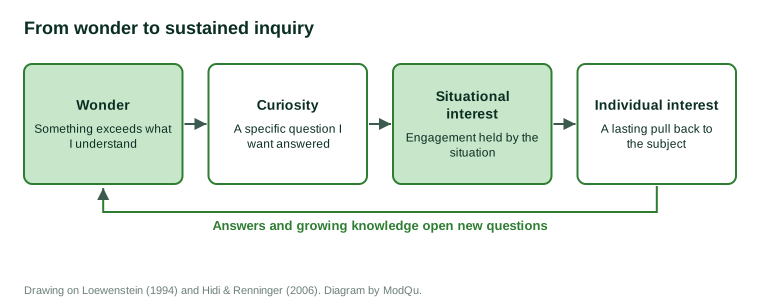
The three terms are often used interchangeably, but they describe different things.
Wonder is a response to something that exceeds our current understanding: the night sky, a surprising result, the complexity of a living cell. It is partly emotional and partly cognitive, and it often has an element of admiration or awe. Wonder does not necessarily ask a specific question. It registers that there is something here to be understood.
Curiosity is the desire to know something in particular. In George Loewenstein's (1994) influential account, curiosity arises when attention is drawn to a specific gap in one's knowledge, and it motivates the search for the information that would fill it. Curiosity is more focused than wonder and more readily satisfied.
Interest is a more lasting relationship with a subject. Suzanne Hidi and K. Ann Renninger (2006) distinguish situational interest, which is triggered by features of the environment and may be fleeting, from individual interest, a relatively enduring disposition to re-engage with a particular subject over time. Sustained inquiry depends on interest of the second kind.
Figure 1 shows one way of thinking about how these states connect.
Wonder and awe
The philosopher Plato (1987) presents wonder as the feeling characteristic of a philosopher. It arises when we notice that something we took for granted is puzzling. Robert Fuller (2006) traces how wonder has been understood across Western thought, and argues that it combines a sense of the strangeness of things with a desire to understand and a feeling of being connected to something larger than oneself.
Psychologists have studied a closely related emotion, awe. Dacher Keltner and Jonathan Haidt (2003) proposed that awe has two central features: a perception of vastness, of something much larger than the self in size, complexity or significance, and a need for accommodation, meaning that the experience cannot be absorbed into existing mental structures and so prompts them to change. Shiota et al. (2007) found that experiences of awe made people feel smaller and part of something larger, and that people who frequently experienced awe were more open to new experiences.
The need for accommodation is what links awe and wonder to inquiry. Something that does not fit our existing understanding demands explanation. Valdesolo et al. (2017) argue that awe is an emotional starting point for scientific thinking, because it makes people aware of gaps in their knowledge and motivates them to fill them. Gottlieb et al. (2018) found that people who were more prone to awe were more likely to understand that scientific knowledge is provisional and revisable, and less likely to rely on simple purpose-based explanations, suggesting that awe is associated with a more scientific stance towards the world.
The marine biologist Rachel Carson (1965) wrote that the most valuable gift for a child would be "a sense of wonder so indestructible that it would last throughout life", and argued that adults could help preserve it by sharing children's delight in the natural world rather than rushing to supply names and facts.
From wonder to curiosity
Wonder becomes productive when it gives rise to specific questions. A child who wonders at the stars eventually asks why they twinkle, or why some are brighter than others. A researcher who is struck by a surprising pattern in data asks what could explain it. This is the transition from a diffuse sense that something needs understanding to a focused desire for particular knowledge.
Daniel Berlyne (1960) argued that curiosity is aroused by novelty, surprise, complexity and conflict between ideas, which are the same features that tend to produce wonder. Loewenstein's information-gap theory adds that curiosity requires enough prior knowledge to see what is missing. A sense of wonder without any knowledge remains vague; knowledge allows wonder to be turned into questions.
The philosopher Paul Martin Opdal (2001) makes a related distinction for education. Curiosity, he argues, operates within an existing framework of understanding, seeking to fill gaps in it, whereas wonder can call the framework itself into question. Both are needed: wonder to open new perspectives, curiosity to work within them. A research team that only feels curiosity will answer its questions efficiently but may never question the framework that produced them; a team that only feels wonder may never settle on a question it can actually answer. The most productive inquiry moves back and forth between the two.
Curiosity has well-documented benefits for learning. Kidd and Hayden (2015) review evidence that curiosity enhances memory and that it is directed towards information that is neither too familiar nor too complex. People who are high in intellectual curiosity also tend to perform better academically, independently of their intelligence (von Stumm et al., 2011).
From curiosity to sustained interest
Curiosity is usually satisfied quickly. Once the answer is found, the motivation dissipates. Sustained inquiry, the kind that produces scientific discoveries, scholarly works and deep expertise, requires something more lasting. Hidi and Renninger's (2006) four-phase model describes how this develops. Interest begins as triggered situational interest, a short-lived response to something novel or surprising. If it is supported, it becomes maintained situational interest, in which the person engages with the subject over a period because it is meaningful. With further engagement and growing knowledge, it can develop into emerging individual interest, in which the person begins to seek out the subject independently, and eventually into well-developed individual interest, a stable and lasting commitment.
Two features of this model are important. First, interest depends on knowledge: people become more interested in subjects they know more about, because knowledge allows them to see more questions. Second, interest needs support at the early stages. Situational interest that receives no encouragement, resources or opportunities for further engagement tends to fade. Renninger and Hidi (2016) review evidence that interest at each phase predicts attention, persistence and learning, and Harackiewicz et al. (2016) found that interventions designed to help students see the relevance of what they were learning increased their interest and performance, particularly for students who started with low expectations of success.
Paul Silvia (2008) describes interest as an emotion that arises from appraising something as new and complex but comprehensible. When people feel they can make sense of something challenging, interest follows. This explains why interest grows with competence: as knowledge increases, more complex material becomes comprehensible and therefore interesting.
Sustained inquiry in practice
Studies of creative people illustrate how wonder, curiosity and interest combine over long periods. Mihaly Csikszentmihalyi (1996) interviewed nearly a hundred exceptionally creative people in the sciences, arts and public life. Almost all described a strong curiosity that began early in life and an absorption in their work that persisted for decades. Many described a sense of wonder that had not faded with expertise. Csikszentmihalyi's earlier research on flow (1990) showed that people experience deep engagement when the challenge of an activity matches their skills, which helps explain why sustained inquiry can be intrinsically rewarding: as skill grows, so does the complexity of the questions a person can enjoyably pursue.
The psychologist Howard Gruber (1981) studied Charles Darwin's notebooks in detail and described how Darwin's theory developed through a "network of enterprise", a set of related projects pursued over decades, each feeding the others. The theory of natural selection did not arrive in a single moment of insight. It emerged from sustained engagement with many questions, driven by a lasting interest in how living things came to be as they are.
Persistence matters too. Angela Duckworth and colleagues (2007) found that grit, defined as perseverance and passion for long-term goals, predicted achievement in several demanding settings over and above talent. Notably, the passion component of grit is closely related to sustained interest. Ericsson et al. (1993) showed that expert performance depends on years of deliberate practice, which is usually sustained by deep interest in the field.
The ability to tolerate not knowing is another component. Kashdan et al. (2018) identified stress tolerance, the willingness to accept the anxiety that comes with uncertainty and novelty, as one dimension of curiosity. Sustained inquiry involves long periods without answers, and those who can tolerate this discomfort are more likely to persist.
Wonder in research: the role of anomalies
In research, wonder often takes the form of surprise at an anomaly: a result that should not have happened, a pattern that does not fit, a case that breaks the rule. The historian of science Thomas Kuhn (1962) argued that scientific discovery commonly begins with "the awareness of anomaly", the recognition that nature has violated the expectations of established theory. Many anomalies are ignored or explained away, because they are inconvenient or because the researcher is focused on answering a different question. Those that are taken seriously can lead to new understanding.
The same is true in applied research. A customer segment that behaves differently from all the others, a survey result that contradicts the sales data or a comment that does not fit any of the coding categories may be noise. It may also be the first sign of something important. Treating such anomalies with wonder rather than irritation, asking "Why would that be?" rather than "How do we get rid of this?", is one of the habits that distinguishes researchers who discover things from those who only confirm what they expected.
A hypothetical example
Consider an analyst at a hypothetical transport company who is asked to report on monthly ticket sales. Routine analysis shows the expected seasonal pattern, but the analyst notices that one small station has seen steadily rising weekday sales for two years, against the trend everywhere else. Nothing in the brief requires an explanation. The analyst is simply struck by it, which is the moment of wonder.
The wonder turns into curiosity when the analyst frames specific questions: who are the new passengers, when do they travel and why here? Some quick checks show that most of the growth comes at a single time each morning and that a large employer opened nearby two years earlier. The curiosity is satisfied, but it has opened a broader question that holds the analyst's interest: are there other places where changes in local employment are reshaping demand, and could the company anticipate them? With the support of a manager, the analyst develops this into a longer project, building a data set that links employment changes to travel patterns across the network. Over the following year, the project identifies several growth areas early enough for the company to adjust its timetables. Wonder, curiosity and sustained interest each played a part, and the organisation's willingness to support the later stages made the difference between a passing observation and a useful body of knowledge.
How wonder and curiosity are lost
If wonder and curiosity come naturally to children, why do so many adults seem to lose them? Susan Engel (2011) observed elementary school classrooms and found that children asked very few questions, and that teachers often discouraged curiosity in favour of covering the curriculum. Children who are rewarded for correct answers rather than good questions learn to value answers over questions.
Similar pressures operate in organisations. Deadlines, targets and an emphasis on efficiency leave little time for questions that do not have an immediate payoff. Self-determination theory suggests that external pressures and controlling rewards can undermine intrinsic motivation, including the motivation to explore (Ryan & Deci, 2000). People who are told exactly what to investigate and how, and judged only on their outputs, have little room to follow their curiosity.
Cultivating wonder, curiosity and interest
The research suggests several ways to cultivate each stage of inquiry.
To cultivate wonder: - Expose people to phenomena that are surprising, complex or vast, and give them time to take them in before explaining them. - Model wonder. Teachers, leaders and researchers who express genuine amazement give others permission to do the same. - Treat the familiar as strange. Asking why something ordinary is the way it is can reveal how much remains unexplained.
To turn wonder into curiosity: - Help people put their wonder into words as specific questions. - Provide enough knowledge to make the gaps visible. - Value questions as much as answers.
To sustain interest: - Provide opportunities for repeated engagement with a subject over time. - Help people build knowledge, so that they can see more complex questions. - Connect the subject to what people care about, so that it feels relevant. - Allow autonomy in choosing questions to pursue. - Accept periods of uncertainty as a normal part of inquiry.
In an organisation, this might mean giving researchers time to explore anomalies in data rather than only answering the questions they were assigned, inviting customers or front-line staff to describe what puzzles them, and building long-term research programmes that allow questions to deepen over time rather than a series of disconnected projects.
Conclusion
Wonder, curiosity and sustained interest are distinct but connected. Wonder is the response to something that exceeds our understanding. Curiosity turns wonder into specific questions. Interest, built through repeated engagement and growing knowledge, sustains inquiry over the long periods that deep understanding requires. Each stage can be supported or undermined by the people and environments around us. John Dewey (1910) argued that children's natural curiosity is the most vital resource for thinking, and that the task of education is to keep it alive and turn it into a disciplined habit of inquiry. That task applies equally to any organisation that depends on generating knowledge.
References
Aristotle. (1998). The metaphysics (H. Lawson-Tancred, Trans.). Penguin.
Berlyne, D. E. (1960). Conflict, arousal, and curiosity. McGraw-Hill. https://doi.org/10.1037/11164-000
Carson, R. (1965). The sense of wonder. Harper & Row.
Csikszentmihalyi, M. (1990). Flow: The psychology of optimal experience. Harper & Row.
Csikszentmihalyi, M. (1996). Creativity: Flow and the psychology of discovery and invention. HarperCollins.
Dewey, J. (1910). How we think. D. C. Heath.
Duckworth, A. L., Peterson, C., Matthews, M. D., & Kelly, D. R. (2007). Grit: Perseverance and passion for long-term goals. Journal of Personality and Social Psychology, 92(6), 1087–1101. https://doi.org/10.1037/0022-3514.92.6.1087
Engel, S. (2011). Children's need to know: Curiosity in schools. Harvard Educational Review, 81(4), 625–645. https://doi.org/10.17763/haer.81.4.h054131316473115
Ericsson, K. A., Krampe, R. T., & Tesch-Römer, C. (1993). The role of deliberate practice in the acquisition of expert performance. Psychological Review, 100(3), 363–406. https://doi.org/10.1037/0033-295X.100.3.363
Fuller, R. C. (2006). Wonder: From emotion to spirituality. University of North Carolina Press.
Gottlieb, S., Keltner, D., & Lombrozo, T. (2018). Awe as a scientific emotion. Cognitive Science, 42(6), 2081–2094. https://doi.org/10.1111/cogs.12648
Gruber, H. E. (1981). Darwin on man: A psychological study of scientific creativity (2nd ed.). University of Chicago Press.
Harackiewicz, J. M., Smith, J. L., & Priniski, S. J. (2016). Interest matters: The importance of promoting interest in education. Policy Insights from the Behavioral and Brain Sciences, 3(2), 220–227. https://doi.org/10.1177/2372732216655542
Hidi, S., & Renninger, K. A. (2006). The four-phase model of interest development. Educational Psychologist, 41(2), 111–127. https://doi.org/10.1207/s15326985ep4102_4
Kashdan, T. B., Stiksma, M. C., Disabato, D. J., McKnight, P. E., Bekier, J., Kaji, J., & Lazarus, R. (2018). The five-dimensional curiosity scale: Capturing the bandwidth of curiosity and identifying four unique subgroups of curious people. Journal of Research in Personality, 73, 130–149. https://doi.org/10.1016/j.jrp.2017.11.011
Keltner, D., & Haidt, J. (2003). Approaching awe, a moral, spiritual, and aesthetic emotion. Cognition and Emotion, 17(2), 297–314. https://doi.org/10.1080/02699930302297
Kidd, C., & Hayden, B. Y. (2015). The psychology and neuroscience of curiosity. Neuron, 88(3), 449–460. https://doi.org/10.1016/j.neuron.2015.09.010
Kuhn, T. S. (1962). The structure of scientific revolutions. University of Chicago Press.
Loewenstein, G. (1994). The psychology of curiosity: A review and reinterpretation. Psychological Bulletin, 116(1), 75–98. https://doi.org/10.1037/0033-2909.116.1.75
Opdal, P. M. (2001). Curiosity, wonder and education seen as perspective development. Studies in Philosophy and Education, 20(4), 331–344. https://doi.org/10.1023/A:1011851211125
Plato. (1987). Theaetetus (R. A. H. Waterfield, Trans.). Penguin.
Renninger, K. A., & Hidi, S. E. (2016). The power of interest for motivation and engagement. Routledge.
Ryan, R. M., & Deci, E. L. (2000). Self-determination theory and the facilitation of intrinsic motivation, social development, and well-being. American Psychologist, 55(1), 68–78. https://doi.org/10.1037/0003-066X.55.1.68
Shiota, M. N., Keltner, D., & Mossman, A. (2007). The nature of awe: Elicitors, appraisals, and effects on self-concept. Cognition and Emotion, 21(5), 944–963. https://doi.org/10.1080/02699930600923668
Silvia, P. J. (2008). Interest—The curious emotion. Current Directions in Psychological Science, 17(1), 57–60. https://doi.org/10.1111/j.1467-8721.2008.00548.x
Valdesolo, P., Shtulman, A., & Baron, A. S. (2017). Science is awe-some: The emotional antecedents of science learning. Emotion Review, 9(3), 215–221. https://doi.org/10.1177/1754073916673212
von Stumm, S., Hell, B., & Chamorro-Premuzic, T. (2011). The hungry mind: Intellectual curiosity is the third pillar of academic performance. Perspectives on Psychological Science, 6(6), 574–588. https://doi.org/10.1177/1745691611421204