
Inquiry · Inquiry in education and learning
Inquiry-Oriented Assessment Practices That Value Process as well as Product
If assessment rewards only correct final answers, learners learn to hide uncertainty and avoid risky questions. This article explains how assessment can value the process of inquiry as well as its products, and what the research says about formative assessment, feedback and authentic tasks.
What gets assessed gets learned. Terry Crooks (1988), reviewing research on classroom evaluation, concluded that assessment practices strongly shape what students study, how they study and how they see themselves as learners. This poses a particular problem for inquiry. Inquiry involves asking questions, forming hypotheses, designing investigations, interpreting messy evidence and revising ideas. Much of its value lies in the process, and much of that process involves mistakes and dead ends. If assessment rewards only correct final answers, learners have every reason to avoid open questions, conceal uncertainty and choose safe topics. Inquiry-oriented assessment aims to value the process as well as the product, without abandoning standards.
Assessment for learning
The most important shift in assessment research in recent decades has been the recognition that assessment can serve learning, not only measure it. Paul Black and Dylan Wiliam (1998) reviewed some 250 studies and concluded that formative assessment, assessment used during learning to adjust teaching and guide students, produced substantial gains in achievement, with particularly large benefits for lower-attaining students. Wiliam (2011) later described formative assessment as a set of practices: clarifying what success looks like, gathering evidence of where learners are, giving feedback that moves them forward and activating learners as resources for each other and as owners of their own learning.
Royce Sadler (1989) argued that for feedback to help, learners must understand the goal, be able to compare their current work with it and know how to close the gap. Inquiry-oriented assessment applies these principles to the process of investigation itself: what does a good research question look like, how does one recognise a fair test, what makes an interpretation well supported?
Feedback, not just grades
Feedback is central, but not all feedback helps. Kluger and DeNisi (1996), in a meta-analysis of feedback interventions, found that feedback improved performance on average, but that in about a third of cases it made performance worse, especially when it drew attention to the person rather than the task. Ruth Butler (1988) found that students who received comments on their work showed more interest and better subsequent performance than those who received grades, and that giving grades alongside comments eliminated the benefit of the comments. Hattie and Timperley (2007) concluded that the most useful feedback addresses three questions: where am I going, how am I going and where to next?
For inquiry, this means feedback on the process: on the quality of questions, the design of investigations and the reasoning from evidence to conclusions, not just on whether the final answer was right.
Assessing process and product
Figure 1 contrasts assessment that focuses only on products with assessment that values process as well.
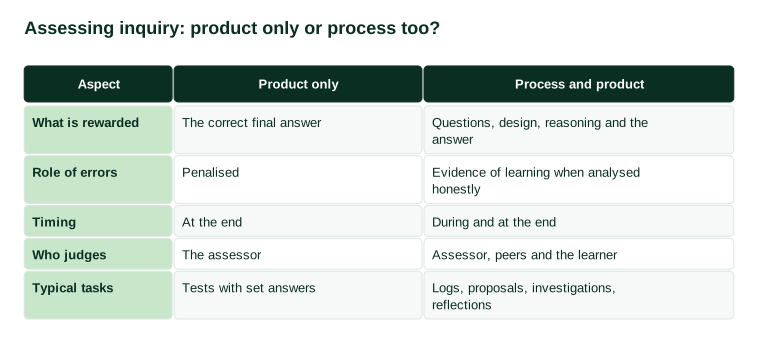
Several methods make the process visible:
- Research logs and lab notebooks record questions, decisions, results and revisions as they happen. Assessing them shows how a learner reasoned, not just where they ended up.
- Proposals and plans can be assessed before the investigation begins, so that feedback improves the design while it can still be changed.
- Reflective commentaries ask learners to explain what went wrong, what they would do differently and what they learned.
- Oral defences and conversations allow assessors to probe reasoning directly.
- Rubrics that describe levels of quality for each part of inquiry, from questioning to communicating, make expectations explicit. Panadero and Jonsson (2013) reviewed research on rubrics used formatively and found that they can improve performance and self-regulation, particularly when students understand and use them.
Authentic tasks and alignment
Grant Wiggins (1990) argued for authentic assessment: tasks that resemble the real work of a field, such as conducting an investigation, rather than answering isolated test items. Authentic tasks assess inquiry directly. John Biggs (1996) argued for constructive alignment, in which intended learning outcomes, teaching activities and assessment tasks all point in the same direction. If the outcome is the ability to investigate a question, the assessment must require investigation.
Boud and Falchikov (2006) added that assessment should prepare learners to judge their own work after formal education ends, which requires practice in self-assessment. Andrade and Valtcheva (2009) found that students who used criteria to assess their own drafts produced better final work.
Valuing failure without lowering standards
A common concern is that valuing process means rewarding effort regardless of quality. It need not. Process can be assessed against demanding standards: is the question researchable, is the design capable of answering it, are conclusions proportionate to evidence, are limitations acknowledged? An investigation whose hypothesis was refuted can score highly if it was well designed and honestly reported. An investigation that reached the expected answer through flawed reasoning can score poorly.
The same principle applies to research in organisations. Teams that are judged only on whether their findings support a desired decision learn to produce such findings. Teams judged on the quality of their questions, methods and reasoning learn to produce reliable knowledge.
A hypothetical example
A university course in market research replaces its final examination with a staged project. In week three, students submit a research question and a one-page plan, which the tutor returns with comments on whether the question is answerable and the method suitable. In week six, they submit a short progress log showing what they have found so far and what they have changed. In week ten, they submit a final report with a reflective section explaining the decisions they made, the limitations of their evidence and what they would do differently. The grade is based on a rubric that gives weight to the quality of the question, the design, the analysis, the honesty of the conclusions and the reflection.
One student's survey produces results that contradict her hypothesis. Under a product-only system, she might have been tempted to reframe the question so that the results fit. Under this system, she reports the contradiction, explores possible explanations and proposes a follow-up study. Her mark reflects the quality of that reasoning. Students in the course learn that a well-designed inquiry that produces an unexpected answer is a success, not a failure, which is exactly the lesson that research practice requires.
Practical principles
- Assess early as well as late, so that feedback can still improve the work.
- Make criteria for good inquiry explicit, and let learners use them on their own and others' work.
- Give comments before grades, and focus them on the task and the next step.
- Reward honest reporting of limitations, errors and unexpected results.
- Match the task to the goal: if the aim is to develop investigators, assessment should require investigation.
Conclusion
Assessment shapes inquiry. When it rewards only final answers, it discourages the questioning, risk-taking and revision that inquiry requires. When it values process as well as product, through formative feedback, visible reasoning, authentic tasks and criteria for good inquiry, it encourages learners to develop the skills that generate knowledge.
References
Andrade, H., & Valtcheva, A. (2009). Promoting learning and achievement through self-assessment. Theory Into Practice, 48(1), 12–19. https://doi.org/10.1080/00405840802577544
Biggs, J. (1996). Enhancing teaching through constructive alignment. Higher Education, 32(3), 347–364. https://doi.org/10.1007/BF00138871
Black, P., & Wiliam, D. (1998). Assessment and classroom learning. Assessment in Education: Principles, Policy & Practice, 5(1), 7–74. https://doi.org/10.1080/0969595980050102
Boud, D., & Falchikov, N. (2006). Aligning assessment with long-term learning. Assessment & Evaluation in Higher Education, 31(4), 399–413. https://doi.org/10.1080/02602930600679050
Butler, R. (1988). Enhancing and undermining intrinsic motivation: The effects of task-involving and ego-involving evaluation on interest and performance. British Journal of Educational Psychology, 58(1), 1–14. https://doi.org/10.1111/j.2044-8279.1988.tb00874.x
Crooks, T. J. (1988). The impact of classroom evaluation practices on students. Review of Educational Research, 58(4), 438–481. https://doi.org/10.3102/00346543058004438
Hattie, J., & Timperley, H. (2007). The power of feedback. Review of Educational Research, 77(1), 81–112. https://doi.org/10.3102/003465430298487
Kluger, A. N., & DeNisi, A. (1996). The effects of feedback interventions on performance: A historical review, a meta-analysis, and a preliminary feedback intervention theory. Psychological Bulletin, 119(2), 254–284. https://doi.org/10.1037/0033-2909.119.2.254
Panadero, E., & Jonsson, A. (2013). The use of scoring rubrics for formative assessment purposes revisited: A review. Educational Research Review, 9, 129–144. https://doi.org/10.1016/j.edurev.2013.01.002
Sadler, D. R. (1989). Formative assessment and the design of instructional systems. Instructional Science, 18(2), 119–144. https://doi.org/10.1007/BF00117714
Wiggins, G. (1990). The case for authentic assessment. Practical Assessment, Research, and Evaluation, 2, Article 2. https://doi.org/10.7275/ffb1-mm19
Wiliam, D. (2011). What is assessment for learning? Studies in Educational Evaluation, 37(1), 3–14. https://doi.org/10.1016/j.stueduc.2011.03.001