
Inquiry · Inquiry in education and learning
Inquiry Across the Lifespan: Developmental Aspects of Questioning and Knowledge Seeking
People inquire from infancy to old age, but the way they ask questions and seek knowledge changes as they develop. This article traces inquiry across the lifespan, from infants' exploration and preschoolers' questions to adult reflective judgement and curiosity in later life, and what each stage implies for learning and research.
Inquiry is not a skill that appears suddenly in school or university. Infants explore their surroundings in ways that look remarkably like experimentation; preschoolers ask a seemingly endless stream of questions; adolescents begin to question authority; adults develop more sophisticated ways of weighing evidence; and older adults continue to seek knowledge, though often with different priorities. Developmental psychology has studied each of these stages, and together the findings show both continuity, a lifelong drive to understand, and important changes in how that drive is expressed. This article traces inquiry across the lifespan and draws out what each stage suggests for people who teach, research or design for learners of different ages.
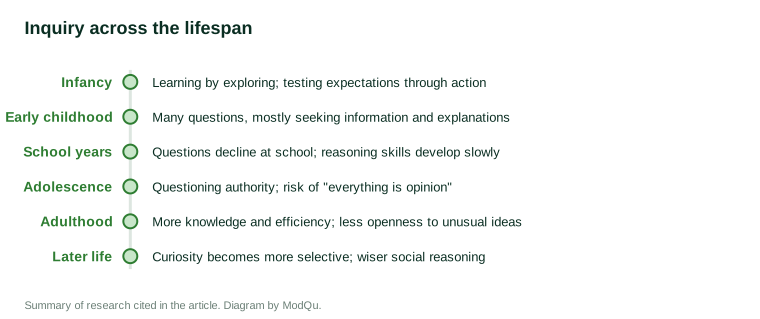
Figure 1 summarises the main changes.
Infancy: learning by exploring
Jean Piaget (1954) described how infants construct their understanding of the world through action, discovering that objects continue to exist when hidden, that actions have consequences and that things can be combined in new ways. Much later research has found that infants are more capable than Piaget supposed, but it has confirmed his central insight that young children are active learners.
Alison Gopnik and her colleagues argued that infants and young children learn in ways that resemble scientific inquiry: they form expectations about how the world works, notice when those expectations are violated and revise their understanding accordingly (Gopnik et al., 1999). Gopnik (2012) reviewed evidence that young children can learn causal relationships from patterns of evidence, can design informative interventions and can reason about probabilities. Exploration is not random play; it is directed at learning.
Laura Schulz and Elizabeth Bonawitz (2007) demonstrated this directly. They showed preschool children a toy with two levers and two effects. When the demonstration made it clear which lever caused which effect, children preferred to play with a new toy. When the evidence was confounded, so that the causal structure was unclear, children preferred to keep exploring the familiar toy. Children's play was sensitive to the information it could provide, which is exactly what effective inquiry requires.
Early childhood: the age of questions
Around the age of two, children begin to ask questions in earnest, and the "why" phase that follows is familiar to every parent. Michelle Chouinard (2007) analysed recordings of young children's everyday conversations with adults and found that children asked questions at a high rate. Most questions sought information, rather than attention or permission, and the proportion of questions seeking explanations increased with age. When children did not get the information they wanted, they persisted, repeating or reformulating their questions.
Frazier et al. (2009) found that preschoolers were genuinely seeking explanations, not just engaging in conversation. When an adult answered a "why" or "how" question with an explanation, children were more likely to agree or ask a follow-up question; when the adult gave a non-explanation, children were more likely to repeat the question or offer their own explanation. Children could tell the difference between an answer and an evasion.
Young children also learn to evaluate their sources. Koenig and Harris (2005) found that preschoolers preferred to learn new words from a speaker who had previously labelled familiar objects correctly over one who had labelled them wrongly. Paul Harris (2012) reviewed extensive evidence that children rely heavily on testimony from others, but do so selectively, taking into account the speaker's past accuracy and expertise. Inquiry, from early on, involves judging whom to trust.
The school years: questions decline, reasoning grows
A striking finding is that children's questioning declines when they enter school. Barbara Tizard and Martin Hughes (1984) recorded four-year-old girls at home and at nursery school and found that they asked many more questions at home, in conversation with their mothers, than they did at school with their teachers. Susan Engel (2011) observed elementary school classrooms and found that children rarely asked questions, and that teachers often responded to curiosity as a distraction from the planned lesson. The setting, not the child, appeared to suppress inquiry.
At the same time, more formal reasoning skills develop. Corinne Zimmerman (2007) reviewed research on the development of scientific thinking in elementary and middle school. Children become increasingly able to design experiments, evaluate evidence and coordinate theories with data, but these skills develop slowly and unevenly. Many children, and indeed many adults, have difficulty with the control of variables strategy, the principle that a fair test changes only one variable at a time. Chen and Klahr (1999) showed that this strategy can be taught to children of seven to ten years old through explicit instruction and practice, and that it transfers to new problems.
Deanna Kuhn (1989) found that children, and many adults, often fail to distinguish between theory and evidence. Asked to evaluate evidence about which foods cause colds, they tended to interpret the evidence in the light of their prior beliefs, accepting evidence that fitted and explaining away evidence that did not. Recognising that a belief is something that evidence can test, rather than simply a description of how things are, is a developmental achievement.
Adolescence: questioning authority and knowledge
Adolescence brings new capacities for abstract thinking and a growing tendency to question received views. Kuhn (1999) described how understanding of knowledge develops through levels. Young children are realists, treating knowledge as a direct copy of reality. Many older children and adolescents become absolutists, believing that claims are right or wrong and that authorities can settle them. With exposure to disagreement, many move to a multiplist position, concluding that because experts disagree, all opinions are equally valid. Some go on to an evaluativist position, recognising that knowledge is uncertain but that claims can be judged by the quality of their evidence and reasoning.
The multiplist stage is common in adolescence and can look like scepticism, but it undermines inquiry: if all views are equally valid, there is no point in examining evidence. Helping young people move beyond it, by showing them how evidence can be weighed, is one of the main tasks of secondary and higher education.
Early adulthood: reflective judgement
William Perry (1970) studied university students over their years of study and described a similar progression, from dualism, in which knowledge is right or wrong and authorities know the answers, through multiplicity, in which all views are seen as equally valid, to relativism and eventually commitment within relativism, in which students recognise that knowledge is contextual but still make reasoned commitments.
Patricia King and Karen Kitchener (1994) developed the reflective judgement model, based on extensive interviews in which people were asked to reason about ill-structured problems, such as how the pyramids were built or whether certain food additives are safe. They found that the ability to reason well about such problems, recognising uncertainty while still justifying a reasoned judgement, develops gradually through adolescence and adulthood, and is strongly associated with education. Many adults never reach the highest stages.
Adulthood: different kinds of openness
There is evidence that some aspects of open-ended inquiry decline from childhood to adulthood. Lucas et al. (2014) found that young children were better than adults at learning an unusual causal rule, apparently because adults' prior assumptions led them to favour more common rules. Gopnik et al. (2017) compared children, adolescents and adults on similar tasks and found that younger participants were more flexible in considering unusual hypotheses, while adults were more efficient at applying familiar ones. Gopnik and her colleagues suggest that childhood is a period specialised for broad exploration, and adulthood for exploiting what has been learned. Adults' expertise makes them efficient but can also narrow the range of possibilities they consider.
Adulthood also brings gains. Adults have far more knowledge with which to frame questions and interpret answers. Grossmann et al. (2010) found that older adults reasoned more wisely about social conflicts than younger and middle-aged adults, showing more recognition of multiple perspectives, of the limits of their own knowledge and of the need for compromise.
Later life: selective curiosity
Some cognitive abilities, such as processing speed and certain kinds of memory, decline with age. Timothy Salthouse (2009) found evidence that some of these declines begin in early adulthood. But curiosity and inquiry do not simply fade. Robinson et al. (2017) found that curiosity varied across adult life stages, and Sakaki et al. (2018) reviewed evidence that, while some forms of curiosity decline with age, specific curiosity about topics of personal interest may be maintained, and that curiosity in older age is associated with better well-being and cognitive health.
Laura Carstensen and colleagues (1999) proposed socioemotional selectivity theory, which holds that as people perceive their time as more limited, they prioritise emotionally meaningful goals over the acquisition of new information for its own sake. Older adults may therefore be more selective about what they inquire into, focusing on questions that matter to them personally. Hertzog et al. (2008) reviewed evidence that intellectually engaging activities in adulthood are associated with maintained cognitive function in later life, although the direction of causation is not fully established.
Why questioning declines at school
The fall in children's questions when they start school deserves closer attention, because it shapes how people inquire for the rest of their lives. Several features of classrooms contribute. Teachers ask most of the questions, usually ones to which they already know the answer, so children learn that questions are a test of knowledge rather than a way of finding out. Classes are large, so each child has few opportunities to ask. The curriculum sets the topics, so children's own questions often seem off-topic. And answering correctly is rewarded, while asking a question can reveal that one does not know, which children quickly learn may be embarrassing.
None of these features is inevitable. Teachers who set aside time for children's questions, treat questions as contributions and show genuine interest in them can keep questioning alive. Engel (2011) argued that teachers who model curiosity themselves, for example by wondering aloud about something unexpected, make it easier for children to do the same. The decline in questioning is a product of the environment, and the environment can be changed.
A hypothetical example across generations
Consider a hypothetical museum designing an exhibition on how bridges work. A team that understands inquiry across the lifespan designs different entry points for different visitors. For young children, there are hands-on models they can load until they collapse, so that they can explore cause and effect directly. For school-age children, there is a station where they change one feature of a bridge at a time and record the result, practising the control of variables. For teenagers, there is a display presenting two engineers' competing explanations for a historic collapse, with the evidence each relied on, inviting visitors to weigh them. For adults, there are case studies that connect bridge design to decisions about cost and risk. For older visitors, there is a collection of local bridges with personal stories from people who built and used them. Each entry point invites inquiry in the form that fits a stage of development.
Implications
The developmental picture suggests several lessons for anyone who teaches, designs learning or conducts research with people of different ages.
- Protect early questioning. Young children's questions are a powerful engine of learning. Settings that respond to them, rather than suppressing them, support later inquiry.
- Teach reasoning explicitly. Skills such as controlling variables and distinguishing theory from evidence do not develop automatically. They can be taught at relatively young ages.
- Help learners move beyond "everything is opinion". Showing how evidence can be weighed, and why some views are better supported than others, supports the development of reflective judgement.
- Value both exploration and expertise. Children's openness and adults' knowledge are complementary. Teams that mix fresh perspectives with experience may inquire better than either alone.
- Engage older adults on what matters to them. Curiosity in later life is often selective. Inquiry is most engaging when it connects with personal concerns.
For researchers, the findings also matter when designing studies. Children's answers to questions depend on whether they trust the questioner and understand what is being asked; adolescents may resist questions they see as coming from authority; adults bring assumptions that can limit what they report; and older adults may engage most fully with topics they see as personally meaningful.
Conclusion
Inquiry is lifelong, but it changes shape. Infants explore to learn; preschoolers ask questions persistently and judge their sources; school-age children develop reasoning skills while often asking fewer questions; adolescents and young adults learn, sometimes painfully, how to weigh competing claims; adults bring knowledge and efficiency at some cost to openness; and older adults remain curious, particularly about what matters to them. Understanding these changes helps teachers, researchers and organisations to support inquiry at every stage, and to combine the strengths of different ages.
References
Carstensen, L. L., Isaacowitz, D. M., & Charles, S. T. (1999). Taking time seriously: A theory of socioemotional selectivity. American Psychologist, 54(3), 165–181. https://doi.org/10.1037/0003-066X.54.3.165
Chen, Z., & Klahr, D. (1999). All other things being equal: Acquisition and transfer of the control of variables strategy. Child Development, 70(5), 1098–1120. https://doi.org/10.1111/1467-8624.00081
Chouinard, M. M. (2007). Children's questions: A mechanism for cognitive development. Monographs of the Society for Research in Child Development, 72(1), 1–129.
Engel, S. (2011). Children's need to know: Curiosity in schools. Harvard Educational Review, 81(4), 625–645. https://doi.org/10.17763/haer.81.4.h054131316473115
Frazier, B. N., Gelman, S. A., & Wellman, H. M. (2009). Preschoolers' search for explanatory information within adult–child conversation. Child Development, 80(6), 1592–1611. https://doi.org/10.1111/j.1467-8624.2009.01356.x
Gopnik, A. (2012). Scientific thinking in young children: Theoretical advances, empirical research, and policy implications. Science, 337(6102), 1623–1627. https://doi.org/10.1126/science.1223416
Gopnik, A., Meltzoff, A. N., & Kuhl, P. K. (1999). The scientist in the crib: Minds, brains, and how children learn. William Morrow.
Gopnik, A., O'Grady, S., Lucas, C. G., Griffiths, T. L., Wente, A., Bridgers, S., Aboody, R., Fung, H., & Dahl, R. E. (2017). Changes in cognitive flexibility and hypothesis search across human life history from childhood to adolescence to adulthood. Proceedings of the National Academy of Sciences, 114(30), 7892–7899. https://doi.org/10.1073/pnas.1700811114
Grossmann, I., Na, J., Varnum, M. E. W., Park, D. C., Kitayama, S., & Nisbett, R. E. (2010). Reasoning about social conflicts improves into old age. Proceedings of the National Academy of Sciences, 107(16), 7246–7250. https://doi.org/10.1073/pnas.1001715107
Harris, P. L. (2012). Trusting what you're told: How children learn from others. Harvard University Press.
Hertzog, C., Kramer, A. F., Wilson, R. S., & Lindenberger, U. (2008). Enrichment effects on adult cognitive development: Can the functional capacity of older adults be preserved and enhanced? Psychological Science in the Public Interest, 9(1), 1–65. https://doi.org/10.1111/j.1539-6053.2009.01034.x
King, P. M., & Kitchener, K. S. (1994). Developing reflective judgment: Understanding and promoting intellectual growth and critical thinking in adolescents and adults. Jossey-Bass.
Koenig, M. A., & Harris, P. L. (2005). Preschoolers mistrust ignorant and inaccurate speakers. Child Development, 76(6), 1261–1277. https://doi.org/10.1111/j.1467-8624.2005.00849.x
Kuhn, D. (1989). Children and adults as intuitive scientists. Psychological Review, 96(4), 674–689. https://doi.org/10.1037/0033-295X.96.4.674
Kuhn, D. (1999). A developmental model of critical thinking. Educational Researcher, 28(2), 16–46. https://doi.org/10.3102/0013189X028002016
Lucas, C. G., Bridgers, S., Griffiths, T. L., & Gopnik, A. (2014). When children are better (or at least more open-minded) learners than adults: Developmental differences in learning the forms of causal relationships. Cognition, 131(2), 284–299. https://doi.org/10.1016/j.cognition.2013.12.010
Perry, W. G., Jr. (1970). Forms of intellectual and ethical development in the college years: A scheme. Holt, Rinehart and Winston.
Piaget, J. (1954). The construction of reality in the child (M. Cook, Trans.). Basic Books. https://doi.org/10.1037/11168-000
Robinson, O. C., Demetre, J. D., & Litman, J. A. (2017). Adult life stage and crisis as predictors of curiosity and authenticity: Testing inferences from Erikson's lifespan theory. International Journal of Behavioral Development, 41(3), 426–431. https://doi.org/10.1177/0165025416645201
Sakaki, M., Yagi, A., & Murayama, K. (2018). Curiosity in old age: A possible key to achieving adaptive aging. Neuroscience & Biobehavioral Reviews, 88, 106–116. https://doi.org/10.1016/j.neubiorev.2018.03.007
Salthouse, T. A. (2009). When does age-related cognitive decline begin? Neurobiology of Aging, 30(4), 507–514. https://doi.org/10.1016/j.neurobiolaging.2008.09.023
Schulz, L. E., & Bonawitz, E. B. (2007). Serious fun: Preschoolers engage in more exploratory play when evidence is confounded. Developmental Psychology, 43(4), 1045–1050. https://doi.org/10.1037/0012-1649.43.4.1045
Tizard, B., & Hughes, M. (1984). Young children learning. Fontana.
Zimmerman, C. (2007). The development of scientific thinking skills in elementary and middle school. Developmental Review, 27(2), 172–223. https://doi.org/10.1016/j.dr.2006.12.001