
Inquiry · Philosophy of inquiry
Heuristic Inquiry: Internal Search and the Personal Generation of Knowledge
Heuristic inquiry treats the researcher's own experience as a source of knowledge, followed through six phases from immersion to creative synthesis. This article explains the method, its roots in tacit knowing, the psychology of incubation and insight, and how to judge its quality.
Most research methods try to keep the researcher out of the data. Questionnaires are standardised so that the person asking does not influence the answers; experiments are blinded so that expectations do not bias results. Heuristic inquiry takes the opposite approach. It begins with a question that the researcher has lived with personally, and it treats the researcher's own experience, intuition and reflection as primary sources of knowledge. Developed by the American psychologist Clark Moustakas in the 1960s and set out in detail in the 1980s, it is one of the most personal approaches to inquiry ever formalised. It is also one of the most demanding, because it asks the researcher to be both the subject of the study and its most careful critic.
Origins: a study of loneliness
Moustakas traced the method to his own experience. When his young daughter needed heart surgery, he faced an agonising decision and spent long, sleepless nights in hospital corridors. He found himself overwhelmed by loneliness and began to ask what loneliness actually is. He kept notes on his own experience, then listened to hospitalised children, read widely and talked with many other people about their experiences of being alone. The result was a book, Loneliness (Moustakas, 1961), which drew on his own immersion in the experience as well as on the experiences of others.
In later work, Moustakas and Bruce Douglass described the method that had emerged (Douglass & Moustakas, 1985), and Moustakas (1990) set out its concepts and phases in a full methodological text. The Greek word heuriskein, from which "heuristic" comes, means to discover or find; it is the root of Archimedes' cry of "Eureka". Heuristic inquiry is, in Moustakas's words, a process of internal search through which one discovers the nature and meaning of experience.
Key concepts
Heuristic inquiry rests on several ideas drawn from humanistic psychology and philosophy.
Tacit knowing. The philosopher and chemist Michael Polanyi argued that "we can know more than we can tell" (Polanyi, 1966, p. 4). We recognise a face among thousands without being able to say how; a skilled practitioner senses that something is wrong before being able to explain it. Polanyi (1958) held that all knowledge, including scientific knowledge, rests on this personal, tacit dimension. Moustakas made tacit knowing the foundation of heuristic inquiry: the aim is to bring into awareness what the researcher already knows but cannot yet articulate.
Indwelling. To understand an experience, the researcher must turn inward and stay with it, examining a quality or theme from many angles until its meaning becomes clearer. Indwelling is deliberate and patient; it resists premature conclusions.
Focusing. Borrowed from the psychotherapist Eugene Gendlin (1978), focusing is a technique for attending to the vague, bodily "felt sense" of a situation until words emerge that capture it.
Self-dialogue. The researcher holds an internal conversation with the phenomenon, asking questions of their own experience and listening to the responses.
The internal frame of reference. Following Carl Rogers (1961), heuristic inquiry insists that experience can only be understood from the point of view of the person who has it. The researcher's task is not to classify experience from outside but to understand it from inside.
The six phases
Moustakas (1990) described heuristic inquiry as moving through six phases (Figure 1). They are not strictly sequential; researchers move back and forth, and some phases last months.
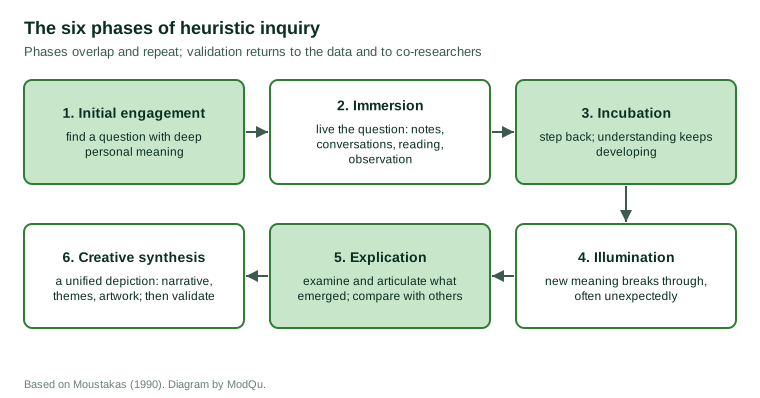
- Initial engagement. The researcher discovers a question that has strong personal meaning and social significance. This often takes considerable time: the question must be one the researcher cares about deeply enough to live with for a long period.
- Immersion. The researcher lives the question, attending to it in everyday life, conversations, dreams, reading and observation. Anything connected with the question becomes material for inquiry.
- Incubation. The researcher deliberately withdraws from intense focus on the question. Knowledge continues to develop outside conscious awareness, much as a seed grows underground.
- Illumination. New understanding breaks through, often unexpectedly: a theme becomes clear, a hidden connection is recognised, or a misunderstanding is corrected.
- Explication. The researcher examines what has emerged in detail, using focusing, indwelling and self-dialogue to articulate its components and meanings. Other people's accounts are studied to see how the themes appear in their experience.
- Creative synthesis. The researcher brings the material together into a unified expression, which may take the form of a narrative, a poem, an artwork or a set of themes, conveying the essential nature of the experience.
Moustakas (1990) also described how heuristic studies typically include other participants, often called co-researchers, whose experiences are gathered through long, open conversations. The researcher constructs individual portraits of these participants' experiences, then a composite depiction of the experience as a whole, and finally the creative synthesis.
Designing a heuristic study
A heuristic study is usually organised around a single question, phrased so that it points to experience rather than to causes. "What is the experience of returning to work after a long illness?" is a heuristic question; "Why do some employees return to work faster than others?" is not. Moustakas (1990) advised that the question should be stated clearly, with its key terms defined, but that it should remain open enough for unexpected meanings to emerge.
Co-researchers are chosen because they have had intense experience of the phenomenon and are willing to explore it in depth. Studies typically involve between about eight and fifteen people, a small number by survey standards, because each person's experience is explored at length. Data are gathered in long, informal conversations rather than structured interviews, and participants are often invited to contribute journals, letters, poems or artwork that express their experience. The researcher keeps a detailed record of their own experience throughout, including dreams, emotions and moments of insight.
Time is a distinctive requirement. Because immersion and incubation cannot be rushed, heuristic studies often take many months. A study that compresses the phases into a few weeks is unlikely to reach the depth of understanding the method aims for, which is one reason Sela-Smith (2002) found that many published studies fell short of Moustakas's model.
Incubation and illumination: what psychology says
The phases of incubation and illumination echo one of the oldest models of creative thinking. Graham Wallas (1926) proposed that creative work moves through preparation, incubation, illumination and verification, drawing on the accounts of scientists such as Henri Poincaré, who described solutions arriving suddenly after he had set a problem aside. Moustakas's sequence follows a similar arc.
Experimental psychology has tested whether incubation really helps. Sio and Ormerod (2009) combined 117 studies in a meta-analysis and found a reliable incubation effect: setting a problem aside for a time improves the chance of solving it, especially for creative problems with many possible solutions, and especially when the problem has been studied in depth beforehand. Research on insight has also found that the sudden "aha" experience is associated with distinctive patterns of brain activity, and that insight solutions are more often correct than people expect (Kounios & Beeman, 2014). These findings support two of heuristic inquiry's practical claims: that deep immersion should come before a period of retreat, and that the understanding that emerges unexpectedly afterwards deserves to be taken seriously and then tested.
The phases in practice: an illustration
Imagine a researcher who has spent several years caring for a parent with dementia and wants to understand the experience of anticipatory grief, the grief felt for someone who is still alive. In the initial engagement, the question takes shape through a growing sense that existing descriptions of grief do not fit what she feels. During immersion, she keeps a daily journal, reads accounts by other carers, notices how often the theme appears in conversations and films, and holds long conversations with ten other carers. After months of this, she sets the material aside entirely for several weeks.
On returning, a pattern she had not seen becomes obvious: many carers describe not one loss but a series of small losses, each marked by a moment when the person they knew seems to slip further away, and each followed by guilt at grieving someone who is still present. Explication involves going back to every journal entry and conversation to examine how this pattern appears, where it does not fit and what other themes surround it. The creative synthesis might take the form of a composite narrative that weaves together the voices of the participants, alongside individual portraits that show how each person's experience differs. Validation comes when the co-researchers read the synthesis and recognise their own experience in it, and when the researcher can trace each theme back to the data.
How heuristic inquiry differs from related methods
Heuristic inquiry overlaps with several qualitative approaches but has its own emphasis. Phenomenology, another method Moustakas (1994) wrote about, aims to describe the essential structure of an experience and asks researchers to set aside their own assumptions. Heuristic inquiry instead keeps the researcher's own experience at the centre and retains the personal voices of participants in the final account (Douglass & Moustakas, 1985).
Autoethnography also uses the researcher's personal experience, but connects it explicitly to cultural and social contexts (Ellis et al., 2011). Reflexive research more generally asks researchers to acknowledge how their background shapes their interpretations (Finlay, 2002; Etherington, 2004). Heuristic inquiry goes further: the researcher's transformation through the inquiry is part of what is studied. Nevine Sultan (2019) describes it as researching human experience "holistically", engaging thought, feeling and the body together.
Where it is used
Heuristic inquiry has been used most widely in counselling, psychotherapy, nursing, education and the creative arts, typically to study experiences that are intensely personal and hard to observe from outside: grief, chronic illness, creativity, spiritual experience, identity and professional transitions. Gina Kenny (2012) introduces the method for nursing researchers, noting its value for understanding the lived experience of both patients and practitioners. It is less common in business research, but its principles appear wherever practitioners study their own practice, as in Donald Schön's (1983) account of the "reflective practitioner" who learns by reflecting on surprises in their work.
For organisations, a modest version of heuristic inquiry can be useful when a team is trying to understand an experience its members share with customers, such as frustration with a service process. Asking team members to go through the experience themselves, record it closely, step away from it and then return to articulate what it felt like can surface insights that surveys miss. Such insights should then be checked against the experiences of a wider group.
Criticism and quality
The method's strengths are also the source of its weaknesses. Because it relies so heavily on the researcher's experience, critics ask how its findings can be checked. Sandy Sela-Smith (2002) reviewed many dissertations that claimed to use heuristic inquiry and found that most drifted away from the researcher's own internal search towards conventional interviewing, losing what was distinctive about the method. Ozertugrul (2017) argues that heuristic self-search can yield knowledge of society as well as of the self, but only if the researcher reflects on how their experience is shaped by social context.
A deeper concern comes from psychology. Nisbett and Wilson (1977) reviewed evidence that people often cannot accurately report the causes of their own judgements and behaviour; they offer plausible explanations that turn out to be wrong. Pronin et al. (2002) showed that people readily see bias in others while believing themselves to be unbiased. Introspection is a real source of knowledge about experience, but it is not infallible, especially about causes. This suggests a sensible division of labour. Heuristic inquiry is well suited to describing what an experience is like and what it means to the people who have it, where the person's own account is the best available evidence. It is much less suited to establishing why the experience occurs or what produces it, where introspective reports are known to be unreliable and other methods, such as comparison across groups or controlled studies, are needed.
Heuristic researchers address these concerns in several ways. Moustakas (1990) recommended returning repeatedly to the raw data, checking interpretations with co-researchers and testing whether the depictions resonate with them. Broader criteria for qualitative quality also apply: Tracy (2010) lists worthy topic, rich rigour, sincerity, credibility, resonance, significant contribution, ethics and meaningful coherence, and Lincoln and Guba (1985) emphasised trustworthiness through prolonged engagement, member checking and an audit trail. A heuristic study that documents its process in enough detail for readers to follow how its conclusions emerged is far more convincing than one that simply reports insights.
Lessons for inquiry in general
Even researchers who will never conduct a full heuristic study can learn from it.
- Personal involvement can be a resource. Researchers who have lived with a question often notice things that outsiders miss. The aim is not to eliminate that involvement but to use it while checking it.
- Immersion and retreat both matter. The incubation research suggests that intense engagement with a problem, followed by a deliberate pause, produces better ideas than continuous effort alone.
- Tacit knowledge needs drawing out. Practitioners know more than they can say. Methods that slow down and invite people to articulate their felt sense of a situation, such as careful interviewing or focusing, can bring that knowledge into view.
- Insight is the beginning of verification, not the end. Wallas's last stage was verification, and every serious heuristic researcher returns to the data and to other people to test what illumination has revealed.
Conclusion
Heuristic inquiry is a disciplined way of learning from experience, beginning with the inquirer's own. It asks for patience, honesty and a willingness to be changed by the inquiry. Its critics are right that personal experience can mislead, and the psychology of introspection gives good reasons for caution. But its central claim, that people know more than they can tell and that careful, sustained attention can bring that knowledge to light, is well supported. Used with the checks that good qualitative research requires, heuristic inquiry adds something that more detached methods cannot: an understanding of experience from the inside.
References
Douglass, B. G., & Moustakas, C. (1985). Heuristic inquiry: The internal search to know. Journal of Humanistic Psychology, 25(3), 39–55. https://doi.org/10.1177/0022167885253004
Ellis, C., Adams, T. E., & Bochner, A. P. (2011). Autoethnography: An overview. Forum Qualitative Sozialforschung / Forum: Qualitative Social Research, 12(1), Article 10. https://doi.org/10.17169/fqs-12.1.1589
Etherington, K. (2004). Becoming a reflexive researcher: Using our selves in research. Jessica Kingsley.
Finlay, L. (2002). "Outing" the researcher: The provenance, process, and practice of reflexivity. Qualitative Health Research, 12(4), 531–545. https://doi.org/10.1177/104973202129120052
Gendlin, E. T. (1978). Focusing. Everest House.
Kenny, G. (2012). An introduction to Moustakas's heuristic method. Nurse Researcher, 19(3), 6–11. https://doi.org/10.7748/nr2012.04.19.3.6.c9052
Kounios, J., & Beeman, M. (2014). The cognitive neuroscience of insight. Annual Review of Psychology, 65, 71–93. https://doi.org/10.1146/annurev-psych-010213-115154
Lincoln, Y. S., & Guba, E. G. (1985). Naturalistic inquiry. Sage.
Moustakas, C. (1961). Loneliness. Prentice-Hall.
Moustakas, C. (1990). Heuristic research: Design, methodology, and applications. Sage.
Moustakas, C. (1994). Phenomenological research methods. Sage.
Nisbett, R. E., & Wilson, T. D. (1977). Telling more than we can know: Verbal reports on mental processes. Psychological Review, 84(3), 231–259. https://doi.org/10.1037/0033-295X.84.3.231
Ozertugrul, E. (2017). A comparative analysis: Heuristic self-search inquiry as self-knowledge and knowledge of society. Journal of Humanistic Psychology, 57(3), 237–251. https://doi.org/10.1177/0022167815594966
Polanyi, M. (1958). Personal knowledge: Towards a post-critical philosophy. University of Chicago Press.
Polanyi, M. (1966). The tacit dimension. Doubleday.
Pronin, E., Lin, D. Y., & Ross, L. (2002). The bias blind spot: Perceptions of bias in self versus others. Personality and Social Psychology Bulletin, 28(3), 369–381. https://doi.org/10.1177/0146167202286008
Rogers, C. R. (1961). On becoming a person: A therapist's view of psychotherapy. Houghton Mifflin.
Schön, D. A. (1983). The reflective practitioner: How professionals think in action. Basic Books.
Sela-Smith, S. (2002). Heuristic research: A review and critique of Moustakas's method. Journal of Humanistic Psychology, 42(3), 53–88. https://doi.org/10.1177/0022167802423004
Sio, U. N., & Ormerod, T. C. (2009). Does incubation enhance problem solving? A meta-analytic review. Psychological Bulletin, 135(1), 94–120. https://doi.org/10.1037/a0014212
Sultan, N. (2019). Heuristic inquiry: Researching human experience holistically. Sage.
Tracy, S. J. (2010). Qualitative quality: Eight "big-tent" criteria for excellent qualitative research. Qualitative Inquiry, 16(10), 837–851. https://doi.org/10.1177/1077800410383121
Wallas, G. (1926). The art of thought. Jonathan Cape.