
Inquiry · Philosophy of inquiry
Hermeneutic Inquiry: Generating Knowledge through Textual Interpretation
Hermeneutics is the theory and practice of interpretation. This article explains how hermeneutic inquiry generates knowledge from texts and human action, from Schleiermacher's hermeneutic circle to Gadamer's fusion of horizons, and how its methods apply to interviews, open-ended survey responses and documents.
Every researcher who reads an interview transcript, a customer complaint or a historical letter faces the same question: what does this mean? The answer is rarely on the surface. Words depend on context, writers have purposes, readers bring assumptions, and the same sentence can mean different things to different people. Hermeneutics, from the Greek hermēneuein, "to interpret", is the long tradition of thinking about how interpretation works and how it can be done well. Hermeneutic inquiry is the use of that tradition as a method for generating knowledge, especially in the humanities and social sciences, where the objects of study are meaningful human expressions rather than physical events.
From sacred texts to the human sciences
Hermeneutics began as a practical discipline for interpreting difficult texts: scripture, law and the classics of antiquity. Interpreters developed rules for resolving ambiguities, such as reading a passage in light of the whole work and of the author's language and time. Richard Palmer (1969) and Jean Grondin (1994) trace how these specialised arts of interpretation gradually became a general theory of understanding.
The decisive step was taken by the German theologian Friedrich Schleiermacher in the early nineteenth century. Schleiermacher argued that misunderstanding, not understanding, is the normal situation, and that interpretation therefore requires a deliberate method (Schleiermacher, 1998). He distinguished two sides of interpretation. Grammatical interpretation examines the language of a text and what its words could mean to readers of its time. Psychological or technical interpretation tries to reconstruct the author's individual thought and purpose. The goal was to understand the author as well as, and even better than, the author understood themselves.
Later in the century, Wilhelm Dilthey extended hermeneutics into a foundation for the human sciences. The natural sciences, he argued, explain events by subsuming them under causal laws; the human sciences understand human life by interpreting its expressions, such as texts, works of art, institutions and actions (Dilthey, 2002). This distinction between explanation and understanding, Erklären and Verstehen, shaped debates about the methods of social science for the next century.
The hermeneutic circle
The central idea of hermeneutics is the hermeneutic circle. We can understand the parts of a text only in light of the whole, but we can understand the whole only through its parts. A sentence's meaning depends on the paragraph it belongs to; the paragraph's meaning depends on its sentences. Reading therefore proceeds in a circle: an initial sense of the whole guides the reading of each part, and what we find in the parts revises our sense of the whole, which in turn changes how we read the parts (Figure 1).
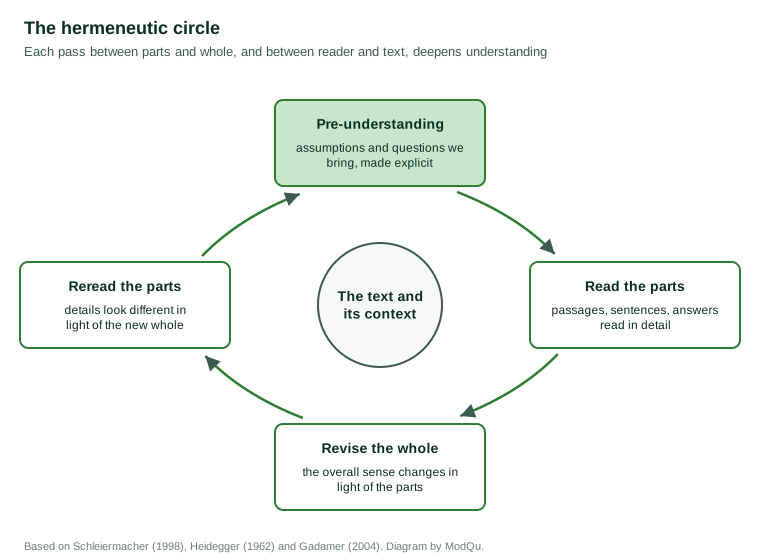
The circle is not vicious, because each pass adds something. Martin Heidegger (1962) gave the circle a deeper meaning: all understanding, he argued, begins from a "fore-structure" of assumptions and expectations, and "what is decisive is not to get out of the circle but to come into it in the right way" (p. 195). The task is not to eliminate prior assumptions, which is impossible, but to make them explicit and let the text correct them.
Gadamer: prejudice, tradition and the fusion of horizons
Hans-Georg Gadamer's Truth and Method, first published in 1960, is the most influential modern work of hermeneutics (Gadamer, 2004). Gadamer argued that the Enlightenment had wrongly condemned all prejudice. Prejudice, in its literal sense of "pre-judgement", is a condition of understanding, not an obstacle to it. We understand a text because we bring to it questions, concepts and expectations formed by our own tradition. Some prejudices are productive and lead to understanding; others are misleading and must be revised. The difference can only be discovered in the encounter with the text.
Gadamer described understanding as a fusion of horizons. A horizon is the range of vision that includes everything visible from a particular point. The text has its horizon, shaped by its time and place; the interpreter has another. Understanding occurs when the two horizons meet and the interpreter's horizon is enlarged by what the text discloses. The aim is not to escape into the author's mind, as Schleiermacher hoped, but to reach an understanding of the subject matter that both the text and the interpreter are concerned with.
Gadamer also gave priority to the question. Following R. G. Collingwood (1939), he held that to understand a text is to understand it as an answer to a question, and that the interpreter must reconstruct the question the text was answering. In doing so, the interpreter's own questions are also put to the test.
Critics and developments
Gadamer's emphasis on tradition drew criticism. Jürgen Habermas (1971) argued that traditions can be distorted by power, so that what passes for shared understanding may reflect domination. Interpretation must therefore be complemented by critique, which asks whose interests a tradition serves. E. D. Hirsch (1967) defended the opposite worry: without the author's intended meaning as a standard, he argued, there is no basis for saying that one interpretation is more valid than another.
Paul Ricoeur tried to reconcile these positions. He distinguished a hermeneutics of faith, which aims to recover the meaning a text offers, from a hermeneutics of suspicion, associated with Marx, Nietzsche and Freud, which looks behind stated meanings for hidden causes and interests (Ricoeur, 1970). Good interpretation, Ricoeur suggested, needs both. He also argued that meaningful action can be read like a text, which opened hermeneutic methods to the study of social life generally (Ricoeur, 1981). Quentin Skinner (1969) brought related ideas to the history of ideas, arguing that to understand what a historical author meant, we must recover what they were doing in writing: which debate they were joining and what move they were making in it.
Explanation and understanding today
The old dispute between explanation and understanding has softened, but it has not disappeared. Many social scientists now regard the two as complementary. Statistical analysis can show that a pattern exists, for example that customers who contact support twice are much more likely to leave, while interpretive analysis shows what the pattern means to the people involved: frustration at repeating themselves, a sense that the company does not remember them, or simply the discovery that a competitor answered faster. Ricoeur (1981) argued that explanation and understanding form a single arc of interpretation, in which explanatory methods help to test and refine an initial understanding, and a deeper understanding then guides further explanation.
For practical research this means that hermeneutic and quantitative methods are not rivals. Numbers can tell an organisation where to look, and interpretation can tell it what it is looking at. Research programmes that combine the two, for example by following a survey with interviews designed to interpret its most surprising results, draw on the strengths of both traditions.
Hermeneutics in the social sciences
From the 1970s onwards, hermeneutic ideas spread into anthropology, psychology and sociology. Charles Taylor (1971) argued that social science must interpret the meanings that actions and institutions have for the people involved, because those meanings are part of what the social world is. Clifford Geertz (1973) described culture as "webs of significance" and anthropology as "an interpretive [science] in search of meaning". His method of thick description, describing behaviour together with the layers of meaning that make it intelligible, became widely influential. Martin Packer (1985) proposed hermeneutic inquiry as an alternative to experimental methods in psychology, arguing that human conduct is best studied by interpreting it in its practical context.
The sociologist Anthony Giddens (1984) added a further twist. Social scientists, he argued, face a double hermeneutic. They interpret a world that is already interpreted by the people who live in it, and their own concepts then flow back into that world and change how people understand themselves. Terms such as "stakeholder", "burnout" or "customer journey" began as analysts' concepts and are now part of how people describe their own experience. Researchers therefore cannot treat their interpretive categories as neutral labels; they become part of the reality they describe.
Several qualitative methods now draw explicitly on hermeneutics. Interpretative phenomenological analysis describes a "double hermeneutic": the researcher is trying to make sense of participants trying to make sense of their experience (Smith et al., 2009). Max van Manen's (1990) hermeneutic phenomenology combines careful description of lived experience with reflective writing that interprets it. Susann Laverty (2003) compares hermeneutic and descriptive phenomenology, noting that the hermeneutic version does not ask researchers to set aside their assumptions but to acknowledge and examine them. Elizabeth Anne Kinsella (2006) sets out practical features of hermeneutic inquiry, including attention to context, to language, to the researcher's own position and to the possibility of multiple valid interpretations.
Doing hermeneutic inquiry
A hermeneutic approach to texts or interviews typically involves the following moves:
- Make pre-understanding explicit. Before analysis, write down what you expect to find and why. This turns hidden prejudices into hypotheses that the material can challenge.
- Read the whole first. Read or listen to the full material before coding parts of it, to form an initial sense of its overall meaning.
- Move between parts and whole. Examine particular passages in detail, then return to the whole to see whether the overall interpretation still holds, and repeat.
- Attend to context. Ask who produced the text, for whom, when and for what purpose. What question was it answering?
- Look for what does not fit. Passages that resist the current interpretation are the most valuable, because they show where pre-understanding is wrong.
- Consider suspicion as well as faith. Ask both what the text is trying to say and what interests or pressures might shape what it says.
- Document the interpretive path. Record how and why the interpretation changed, so that others can judge its validity.
Application: interpreting open-ended responses
These principles apply directly to commercial research. Consider open-ended survey responses, such as answers to "What is the main reason for your rating?" A purely mechanical approach counts words or assigns each response to a code. A hermeneutic approach reads responses in context: alongside the respondent's rating and other answers, and against the background of what was happening in the market at the time. The comment "too slow", for example, means something different from a customer who gave a high rating and one who gave a low rating, and different again if a service outage occurred that week.
Methods such as thematic analysis (Braun & Clarke, 2006) and content analysis (Krippendorff, 2004) provide systematic procedures for this kind of work. Both, in different ways, require the analyst to move back and forth between individual responses and the developing set of themes, which is the hermeneutic circle in practical form.
A worked example: one interview, three readings
Suppose a researcher interviews a small-business owner who has recently switched banks. Asked why, the owner says: "Honestly, it was the fees. They kept adding charges, and nobody ever explained them."
A first reading takes the statement at face value: the reason was fees. But the hermeneutic circle asks how this part fits the whole interview. Earlier, the owner spent several minutes describing how their long-standing contact at the old bank had retired and how calls were now routed to a central line. Read against that whole, "nobody ever explained them" takes on more weight. The complaint may be less about the level of fees than about the loss of a relationship in which someone could be asked.
A second reading adds context. The interview took place a month after the old bank announced branch closures that were widely reported in the local press. The owner may be giving the reason that is easiest to state and most socially acceptable, while the underlying cause is a broader sense of being abandoned. This is Ricoeur's hermeneutics of suspicion applied modestly: not assuming the respondent is wrong, but asking what else might shape the account.
A third reading tests the interpretation against the rest of the data. Do other customers who left mention fees together with the loss of personal contact? Do customers who stayed but had their contact retire show signs of dissatisfaction? If they do, the interpretation gains support; if not, the researcher returns to the transcript with a revised pre-understanding. At each step the interpretation becomes richer and more open to checking, which is what the circle is supposed to achieve.
Validity in interpretation
The most common objection to hermeneutic inquiry is that interpretations cannot be checked. Hermeneutic theorists reply that interpretations can be better or worse even without a single correct answer. A good interpretation accounts for more of the text, especially the parts that seem not to fit; it is consistent with what is known about the context; it makes sense of the text as a coherent whole; and it can be defended in discussion with other interpreters (Hirsch, 1967; Kinsella, 2006). These criteria are demanding. They also have counterparts in the standards of qualitative research, such as transparency about the analytic process and checking interpretations with participants.
Conclusion
Hermeneutic inquiry generates knowledge by interpreting meaningful expressions: texts, conversations, actions and institutions. Its central insights are that understanding always starts from assumptions, that it proceeds in a circle between parts and whole, and that it improves when the interpreter's assumptions are exposed to the material and tested against it. For researchers working with words rather than numbers, these insights are not optional extras. They describe what careful interpretation already involves, and they offer a vocabulary for doing it more deliberately and more transparently.
References
Braun, V., & Clarke, V. (2006). Using thematic analysis in psychology. Qualitative Research in Psychology, 3(2), 77–101. https://doi.org/10.1191/1478088706qp063oa
Collingwood, R. G. (1939). An autobiography. Oxford University Press.
Dilthey, W. (2002). The formation of the historical world in the human sciences (R. A. Makkreel & F. Rodi, Eds.). Princeton University Press.
Gadamer, H.-G. (2004). Truth and method (2nd rev. ed.; J. Weinsheimer & D. G. Marshall, Trans.). Continuum. (Original work published 1960)
Geertz, C. (1973). The interpretation of cultures: Selected essays. Basic Books.
Giddens, A. (1984). The constitution of society: Outline of the theory of structuration. Polity Press.
Grondin, J. (1994). Introduction to philosophical hermeneutics (J. Weinsheimer, Trans.). Yale University Press.
Habermas, J. (1971). Knowledge and human interests (J. J. Shapiro, Trans.). Beacon Press.
Heidegger, M. (1962). Being and time (J. Macquarrie & E. Robinson, Trans.). Harper & Row. (Original work published 1927)
Hirsch, E. D., Jr. (1967). Validity in interpretation. Yale University Press.
Kinsella, E. A. (2006). Hermeneutics and critical hermeneutics: Exploring possibilities within the art of interpretation. Forum Qualitative Sozialforschung / Forum: Qualitative Social Research, 7(3), Article 19. https://doi.org/10.17169/fqs-7.3.145
Krippendorff, K. (2004). Content analysis: An introduction to its methodology (2nd ed.). Sage.
Laverty, S. M. (2003). Hermeneutic phenomenology and phenomenology: A comparison of historical and methodological considerations. International Journal of Qualitative Methods, 2(3), 21–35. https://doi.org/10.1177/160940690300200303
Packer, M. J. (1985). Hermeneutic inquiry in the study of human conduct. American Psychologist, 40(10), 1081–1093. https://doi.org/10.1037/0003-066X.40.10.1081
Palmer, R. E. (1969). Hermeneutics: Interpretation theory in Schleiermacher, Dilthey, Heidegger, and Gadamer. Northwestern University Press.
Ricoeur, P. (1970). Freud and philosophy: An essay on interpretation (D. Savage, Trans.). Yale University Press.
Ricoeur, P. (1981). Hermeneutics and the human sciences: Essays on language, action and interpretation (J. B. Thompson, Ed. & Trans.). Cambridge University Press.
Schleiermacher, F. (1998). Hermeneutics and criticism and other writings (A. Bowie, Ed. & Trans.). Cambridge University Press. https://doi.org/10.1017/CBO9780511814945
Skinner, Q. (1969). Meaning and understanding in the history of ideas. History and Theory, 8(1), 3–53. https://doi.org/10.2307/2504188
Smith, J. A., Flowers, P., & Larkin, M. (2009). Interpretative phenomenological analysis: Theory, method and research. Sage.
Taylor, C. (1971). Interpretation and the sciences of man. The Review of Metaphysics, 25(1), 3–51.
van Manen, M. (1990). Researching lived experience: Human science for an action sensitive pedagogy. State University of New York Press.