
Inquiry · Logic and reasoning
Foundations of Logical Reasoning
Logic studies what follows from what. This article explains the foundations of logical reasoning, from deduction, validity and soundness to induction, abduction and probability, and what psychology has learned about how people actually reason and how they can reason better.
Every inquiry involves reasoning: moving from what is known to what follows from it, from evidence to conclusions, from observations to explanations. Logic is the study of which of these moves are good ones. It distinguishes reasoning that guarantees its conclusions from reasoning that only makes them likely, and reasoning that is sound from reasoning that merely looks persuasive. This article introduces the foundations of logical reasoning, explains the main forms of inference and summarises what psychological research has found about how people reason in practice.
Arguments, premises and conclusions
The basic unit of logical analysis is the argument: a set of statements, called premises, offered in support of another statement, the conclusion. "All mammals breathe air. Whales are mammals. Therefore whales breathe air" is an argument with two premises and a conclusion. Logic asks whether the premises, if true, give good reason to accept the conclusion.
Arguments in real life are rarely set out so neatly. Premises are often unstated, conclusions are buried in the middle of paragraphs and much of the text is background or rhetoric. A large part of practical reasoning is simply identifying the argument: what is being claimed, and on what grounds? Stephen Toulmin (1958) argued that formal logic captures only part of real argument, and proposed a model in which a claim is supported by data through a warrant, with qualifiers and possible rebuttals, which better fits how people argue in law, science and everyday life.
Deduction: validity and soundness
In a deductive argument, the conclusion is claimed to follow necessarily from the premises. Aristotle, in the Prior Analytics, developed the first systematic theory of deduction, based on the syllogism: an argument with two premises and a conclusion, each relating two categories (Aristotle, 1989). The whale argument above is a syllogism.
Two concepts are central. An argument is valid if it is impossible for its premises to be true and its conclusion false. Validity depends only on the form of the argument, not on whether the premises are actually true. "All fish can fly. Whales are fish. Therefore whales can fly" is valid, because if the premises were true the conclusion would have to be true, although both premises are false. An argument is sound if it is valid and its premises are true. Only a sound argument guarantees a true conclusion.
Modern logic extends Aristotle's theory to the logic of statements connected by words such as "and", "or", "not" and "if… then" (Copi et al., 2014). Some argument forms are valid and widely used:
- Modus ponens: If P, then Q. P. Therefore Q.
- Modus tollens: If P, then Q. Not Q. Therefore not P.
Others look similar but are invalid:
- Affirming the consequent: If P, then Q. Q. Therefore P. ("If it rained, the street is wet. The street is wet. Therefore it rained." The street might be wet for another reason.)
- Denying the antecedent: If P, then Q. Not P. Therefore not Q.
Modus tollens is especially important for inquiry. Karl Popper (1959) argued that scientific hypotheses cannot be proved by confirming their predictions, which would be affirming the consequent, but can be refuted when their predictions fail, which is modus tollens. This asymmetry underlies his view that science advances by trying to falsify its theories.
Necessary and sufficient conditions
Many reasoning errors involve confusing two kinds of condition. A sufficient condition is one that, if present, guarantees the outcome: being a square is sufficient for being a rectangle. A necessary condition is one without which the outcome cannot occur: having four sides is necessary for being a rectangle, but not sufficient. "If P, then Q" says that P is sufficient for Q and that Q is necessary for P.
Confusing the two is common in practical reasoning. A report might show that every successful product launch in a company's history involved a large marketing budget, and conclude that a large budget will make the next launch succeed. But the evidence shows, at most, that a large budget may be necessary; it says nothing about whether it is sufficient, since many launches with large budgets may also have failed. Asking "is this necessary, sufficient, both or neither?" clarifies many arguments.
Induction: strength and uncertainty
Most reasoning in research is not deductive. Inductive arguments draw general conclusions from particular observations, or predictions from past patterns. "Every sample of this material tested so far has melted at 300 degrees, so the next one will too" is inductive. Its conclusion is not guaranteed, but the premises make it probable. Inductive arguments are judged not as valid or invalid but as strong or weak, depending on how much support the premises give the conclusion.
David Hume (2007) famously argued that induction cannot be justified by reason alone. Any attempt to justify the assumption that the future will resemble the past must itself rely on that assumption, since it appeals to past success. Hume concluded that induction rests on habit rather than logic. Nelson Goodman (1955) added a "new riddle of induction", showing that the same evidence can support incompatible generalisations depending on how predicates are defined, so that logic alone cannot tell us which patterns to project.
Philosophers have not resolved these problems, but in practice inductive reasoning is assessed by asking how large and representative the evidence is, whether there are counterexamples, and whether there is a plausible mechanism linking cases. Probability theory provides tools for quantifying inductive support. Ian Hacking (2001) explains how probability and inductive logic together offer a framework for reasoning under uncertainty, including Bayes' theorem, which describes how evidence should change the probability of a hypothesis.
Abduction: inference to the best explanation
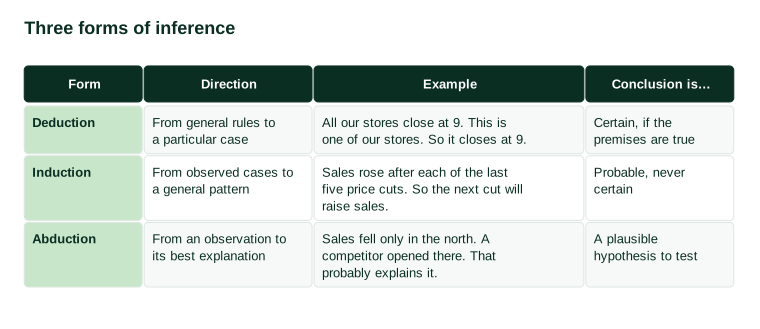
A third form of inference, which Charles Sanders Peirce called abduction, reasons from an observation to the hypothesis that would best explain it (Peirce, 1934). Gilbert Harman (1965) called this inference to the best explanation. A detective who infers from the evidence who committed a crime, or a doctor who infers a diagnosis from symptoms, is reasoning abductively. Abduction generates hypotheses; deduction works out their consequences; and induction tests those consequences against evidence. Figure 1 compares the three.
Informal logic
Formal logic deals with arguments whose structure can be written in symbols. Most real arguments, in meetings, reports, news and conversation, are less tidy. Informal logic studies these everyday arguments: how they are structured, what makes them strong or weak and how they can be evaluated in context. Douglas Walton (2008) describes how arguments in ordinary discourse often rely on argumentation schemes, recurring patterns such as argument from expert opinion, argument from analogy and argument from consequences. Each scheme comes with critical questions that test it. For an argument from expert opinion, for example: is the person really an expert in this field, do other experts agree and is the claim based on evidence? Informal logic does not abandon the standards of formal logic; it extends them to arguments that formal logic cannot easily capture.
A worked example
A hypothetical manager argues: "Our competitors who adopted remote working have seen staff turnover fall. If we adopt remote working, our turnover will fall too. So we should adopt it." Analysing this argument logically reveals several steps. The first premise is an observation, and its reliability depends on how many competitors were examined and whether turnover was measured consistently. The move from "competitors who adopted it saw turnover fall" to "if we adopt it, our turnover will fall" is an inductive generalisation and also an implicit causal claim; it assumes that remote working caused the fall, rather than, say, a general fall in turnover across the industry, and that the company is similar to its competitors. The conclusion "so we should adopt it" adds an unstated premise: that reducing turnover is worth whatever costs remote working brings. None of this shows the manager is wrong. It shows which parts of the argument need evidence, and which questions to ask before deciding.
How people actually reason
Psychologists have studied how well people reason, and the results are humbling. Peter Wason (1968) devised the selection task. People see four cards showing, for example, A, D, 4 and 7, and are told that each has a letter on one side and a number on the other. They are asked which cards they must turn over to test the rule "if a card has a vowel on one side, it has an even number on the other". The correct answer is A and 7: the A because it might have an odd number, the 7 because it might have a vowel. Most people choose A, or A and 4, and few choose 7. They look for confirming cases rather than cases that could falsify the rule, failing to apply modus tollens.
Performance improves dramatically when the same logical structure is presented in a familiar context. Cheng and Holyoak (1985) found that people reasoned well about rules framed as permissions, such as "if a passenger is to enter the country, they must have had a cholera vaccination". Leda Cosmides (1989) argued that people are particularly good at detecting violations of social contracts, such as people who take benefits without paying costs. The implication is that people do not reason by applying abstract logical rules, but by using knowledge and schemas tied to particular kinds of situation.
People's beliefs also interfere with logic. Evans et al. (1983) found that people judged syllogisms with believable conclusions to be valid much more often than those with unbelievable conclusions, regardless of actual validity. This belief bias means that people tend to accept arguments whose conclusions they agree with and reject arguments whose conclusions they disagree with.
Probabilistic reasoning shows similar weaknesses. Tversky and Kahneman (1983) described the conjunction fallacy: people judged that a woman described as a socially concerned former philosophy student was more likely to be "a bank teller who is active in the feminist movement" than "a bank teller", although a conjunction can never be more probable than one of its parts. Kahneman and Tversky (1973) also showed that people often neglect base rates, judging probabilities by how well a case resembles a category rather than by how common the category is.
Explaining reasoning errors
Several theories explain these patterns. Philip Johnson-Laird (1983) proposed that people reason by constructing mental models, representations of possible situations consistent with the premises. Errors arise when people construct only one model and fail to consider alternatives in which the premises are true but the conclusion false. Johnson-Laird (2010) reviewed evidence that this theory predicts which inferences people find easy and hard.
Dual-process theories distinguish fast, intuitive processes from slow, deliberate ones. Evans and Stanovich (2013) argued that many reasoning errors occur when an intuitive response is not checked by deliberate reasoning, and that people differ in their tendency to engage in such checking.
Mike Oaksford and Nick Chater (2007) argued that some apparent errors are not errors at all, if people are reasoning probabilistically about an uncertain world rather than deductively. In everyday life, rules usually have exceptions, and treating them as probabilistic may be more rational than treating them as certain.
Hugo Mercier and Dan Sperber (2011) proposed that human reasoning evolved primarily for argumentation, to persuade others and evaluate their arguments, rather than for solitary truth-seeking. This would explain why people are good at finding arguments for their own views and at spotting flaws in others', but poor at critically evaluating their own reasoning. It also suggests that reasoning works best in groups. Moshman and Geil (1998) found that groups discussing the Wason selection task solved it far more often than individuals working alone, and that the correct answer usually emerged through argument rather than majority vote.
Can reasoning be improved?
There is evidence that it can. Nisbett et al. (1987) found that training in statistical and methodological principles improved people's reasoning about everyday problems, and that such training transferred to new contexts better than training in formal logic. The findings on group reasoning suggest that structured argument with others improves reasoning. And awareness of common errors, combined with habits such as considering alternative models and looking for disconfirming evidence, helps people check their intuitions.
Logic in inquiry
For anyone engaged in research or decision making, the foundations of logic offer practical tools:
- Identify the argument. What is the conclusion, and what are the premises, including the unstated ones?
- Check validity. If the premises were true, would the conclusion have to be true? Look especially for affirming the consequent.
- Check the premises. Are they actually true? An argument is only as good as its weakest premise.
- Assess inductive strength. How large and representative is the evidence? Could the pattern be a coincidence?
- Consider alternative explanations. For abductive conclusions, what else could explain the evidence?
- Look for disconfirming evidence. Ask what would show the conclusion to be wrong, and look for it.
- Reason with others. Argument with people who disagree catches errors that individuals miss.
Conclusion
Logic provides the standards by which reasoning is judged: validity and soundness for deduction, strength for induction and explanatory quality for abduction. Psychology shows that people often fall short of these standards, especially when beliefs, abstract formats or probabilities are involved. But it also shows that reasoning improves with familiar contexts, training in key principles, the habit of considering alternatives and, above all, argument with others. Inquiry depends on all three forms of inference, and on knowing which one is in use.
References
Aristotle. (1989). Prior analytics (R. Smith, Trans.). Hackett.
Cheng, P. W., & Holyoak, K. J. (1985). Pragmatic reasoning schemas. Cognitive Psychology, 17(4), 391–416. https://doi.org/10.1016/0010-0285(85)90014-3
Copi, I. M., Cohen, C., & McMahon, K. (2014). Introduction to logic (14th ed.). Pearson.
Cosmides, L. (1989). The logic of social exchange: Has natural selection shaped how humans reason? Studies with the Wason selection task. Cognition, 31(3), 187–276. https://doi.org/10.1016/0010-0277(89)90023-1
Evans, J. St. B. T., Barston, J. L., & Pollard, P. (1983). On the conflict between logic and belief in syllogistic reasoning. Memory & Cognition, 11(3), 295–306. https://doi.org/10.3758/BF03196976
Evans, J. St. B. T., & Stanovich, K. E. (2013). Dual-process theories of higher cognition: Advancing the debate. Perspectives on Psychological Science, 8(3), 223–241. https://doi.org/10.1177/1745691612460685
Goodman, N. (1955). Fact, fiction, and forecast. Harvard University Press.
Hacking, I. (2001). An introduction to probability and inductive logic. Cambridge University Press. https://doi.org/10.1017/CBO9780511801297
Harman, G. H. (1965). The inference to the best explanation. The Philosophical Review, 74(1), 88–95. https://doi.org/10.2307/2183532
Hume, D. (2007). An enquiry concerning human understanding (P. Millican, Ed.). Oxford University Press. (Original work published 1748)
Johnson-Laird, P. N. (1983). Mental models: Towards a cognitive science of language, inference, and consciousness. Harvard University Press.
Johnson-Laird, P. N. (2010). Mental models and human reasoning. Proceedings of the National Academy of Sciences, 107(43), 18243–18250. https://doi.org/10.1073/pnas.1012933107
Kahneman, D., & Tversky, A. (1973). On the psychology of prediction. Psychological Review, 80(4), 237–251. https://doi.org/10.1037/h0034747
Mercier, H., & Sperber, D. (2011). Why do humans reason? Arguments for an argumentative theory. Behavioral and Brain Sciences, 34(2), 57–74. https://doi.org/10.1017/S0140525X10000968
Moshman, D., & Geil, M. (1998). Collaborative reasoning: Evidence for collective rationality. Thinking & Reasoning, 4(3), 231–248. https://doi.org/10.1080/135467898394148
Nisbett, R. E., Fong, G. T., Lehman, D. R., & Cheng, P. W. (1987). Teaching reasoning. Science, 238(4827), 625–631. https://doi.org/10.1126/science.3672116
Oaksford, M., & Chater, N. (2007). Bayesian rationality: The probabilistic approach to human reasoning. Oxford University Press. https://doi.org/10.1093/acprof:oso/9780198524496.001.0001
Peirce, C. S. (1934). Collected papers of Charles Sanders Peirce: Vol. 5. Pragmatism and pragmaticism (C. Hartshorne & P. Weiss, Eds.). Harvard University Press.
Popper, K. R. (1959). The logic of scientific discovery. Hutchinson.
Toulmin, S. E. (1958). The uses of argument. Cambridge University Press.
Tversky, A., & Kahneman, D. (1983). Extensional versus intuitive reasoning: The conjunction fallacy in probability judgment. Psychological Review, 90(4), 293–315. https://doi.org/10.1037/0033-295X.90.4.293
Walton, D. (2008). Informal logic: A pragmatic approach (2nd ed.). Cambridge University Press.
Wason, P. C. (1968). Reasoning about a rule. Quarterly Journal of Experimental Psychology, 20(3), 273–281. https://doi.org/10.1080/14640746808400161