
Inquiry · Logic and reasoning
Evidence and Justification: When Is a Belief Warranted?
When is it reasonable to believe something? This article explains how philosophers and practitioners think about evidence and justification, from the ethics of belief and the analysis of knowledge to evidence hierarchies, testimony and disagreement, and offers practical questions for judging whether a belief is warranted.
Every decision rests on beliefs, and every belief can be asked the same question: is it warranted? A manager believes a product will sell, an analyst believes a trend is real, a doctor believes a treatment works. Some of these beliefs are well supported; others rest on hope, habit or a single anecdote. Philosophers have long studied what makes a belief justified, and fields such as medicine and law have developed practical standards for weighing evidence. This article draws on both to explain when a belief is warranted and how to judge the evidence behind it.
The ethics of belief
In 1877 the mathematician William Clifford published an essay that opened with a story. A shipowner, about to send an emigrant ship to sea, suppresses his doubts about its seaworthiness, persuades himself it is sound and collects the insurance money when it sinks. Clifford argued that the shipowner was guilty even though he sincerely believed the ship was safe, because he "had no right to believe on such evidence as was before him". His conclusion was stark: "it is wrong always, everywhere, and for anyone, to believe anything upon insufficient evidence" (Clifford, 1877).
William James (1896) replied that Clifford's rule was too strict. Some questions cannot be settled by evidence before we must act, and in such cases, James argued, we are entitled to let our "passional nature" decide. The debate continues, but it established a point that matters for any inquiry: believing is not only a matter of psychology but of responsibility. We can be held to account for the care with which we form beliefs, especially when others rely on them.
David Hume (2007) put the principle more briefly: "A wise man, therefore, proportions his belief to the evidence." Strong evidence warrants confident belief; weak evidence warrants tentative belief; and no evidence warrants suspending judgement.
Knowledge and justification
Philosophers traditionally defined knowledge as justified true belief: to know something, one must believe it, it must be true and one must be justified in believing it. Edmund Gettier (1963) showed in a two-page paper that this definition is incomplete. He described cases in which a person has a justified, true belief that is true only by luck, so that we would not call it knowledge. The analysis of knowledge has been debated ever since, but the concept of justification remains central.
Two broad views of justification have dominated. Evidentialists, such as Earl Conee and Richard Feldman (2004), hold that a belief is justified if it fits the evidence the person has. Reliabilists, such as Alvin Goldman (1979), hold that a belief is justified if it was produced by a reliable process, one that tends to produce true beliefs, such as careful perception or valid reasoning. The two views often agree in practice, and both suggest useful questions: what is the evidence, and how reliable was the process that produced the belief?
A further debate concerns the structure of justification. Foundationalists hold that some beliefs, such as those based directly on perception, are justified without depending on other beliefs, and serve as foundations for the rest. Coherentists, such as Laurence BonJour (1985), hold that beliefs are justified by how well they fit together in a coherent system. Susan Haack (1993) proposed foundherentism, combining the two. She compared justification to a crossword puzzle: an entry is supported both by its clue, which is like experiential evidence, and by how well it fits with the intersecting entries, which is like coherence with other beliefs. Both kinds of support matter, and a belief that is strong on one but weak on the other should be held with caution.
Weighing evidence in practice
Practical fields have developed more specific standards. Evidence-based medicine, as defined by David Sackett and colleagues (1996), involves "the conscientious, explicit, and judicious use of current best evidence in making decisions about the care of individual patients", integrating research evidence with clinical expertise and patients' values. Medicine developed hierarchies of evidence, placing systematic reviews of randomised trials above individual trials, trials above observational studies and observational studies above expert opinion.
These hierarchies are useful but crude. The GRADE system (Guyatt et al., 2008) refines them by rating the overall quality of a body of evidence for a particular question. It starts from the study design but then lowers the rating for risk of bias, inconsistency between studies, indirectness (evidence about a somewhat different question or population), imprecision and publication bias, and can raise it for large effects or a clear dose–response relationship. The approach recognises that the strength of evidence depends on many factors, not just the type of study.
In law, David Schum (1994) analysed the properties of evidence that determine its force. He distinguished the relevance of evidence to a hypothesis, its credibility (whether the event it reports actually happened) and its inferential force (how much it changes the probability of the hypothesis). He also emphasised that items of evidence can combine in complex ways: two pieces of evidence may corroborate each other, or one may undermine the credibility of another.
Probability theory offers a framework for these ideas. On the Bayesian view, evidence supports a hypothesis to the extent that it is more likely if the hypothesis is true than if it is false (Howson & Urbach, 2006). Richard Royall (1997) argued that this likelihood ratio is the best measure of the strength of statistical evidence. A useful practical implication follows: evidence that would be equally likely whether or not a hypothesis is true provides no support for it, however much it seems to fit.
Questions for judging evidence
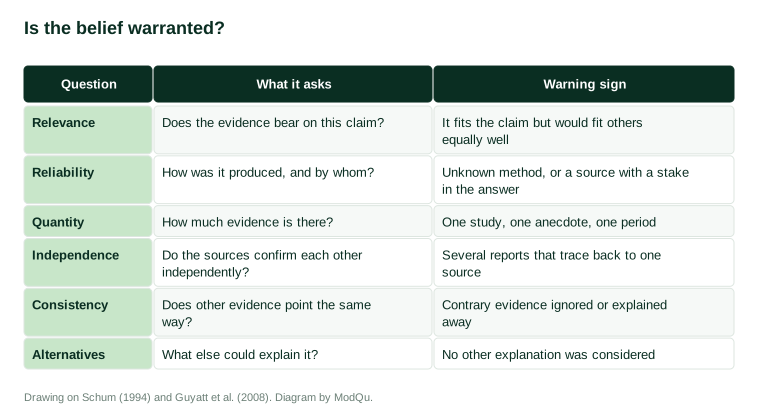
Drawing these strands together, Figure 1 sets out questions for judging whether a belief is warranted.
Testimony
Most of what anyone believes rests not on their own observation but on what others tell them. C. A. J. Coady (1992) argued that testimony is a basic source of knowledge, as fundamental as perception and memory, and that it would be impossible to check most of what we learn from others. Jennifer Lackey (2008) argued that we learn from what others say, not merely from their beliefs, and that the reliability of the speaker's statement matters as much as the hearer's reasons for trusting it.
The practical question is not whether to rely on testimony but how. Relevant considerations include whether the source is in a position to know, whether they have a record of accuracy, whether they have incentives to mislead and whether independent sources agree. A research report is a form of testimony, and the same questions apply: who produced it, by what methods, with what interests, and has it been checked?
Disagreement
What should one do when equally informed and capable people disagree? David Christensen (2007) argued that disagreement with someone one regards as an epistemic peer is itself evidence that one may have made a mistake, and should usually lead to reduced confidence. This conciliatory view has practical force. If two analysts with the same data reach different conclusions, each should treat the other's view as a reason to recheck their own reasoning, rather than assuming the other has erred.
Degrees of belief and calibration
Justification is not all or nothing. Hume's principle of proportioning belief to evidence implies that beliefs come in degrees, and that the right degree depends on the strength of the evidence. A useful way to think about this is in terms of calibration. A person is well calibrated if, among all the claims they hold with 70% confidence, about 70% turn out to be true. Research on judgement shows that people are often poorly calibrated, and in particular that they are too sure of their beliefs. Moore and Healy (2008) called this overprecision: excessive certainty that one's beliefs are correct. It is one of the most robust findings in research on judgement, and it matters because overprecise beliefs leave no room for the evidence that might correct them.
Calibration can be improved. Tetlock and Gardner (2015) describe how participants in long-running forecasting tournaments became better calibrated by expressing their beliefs as precise probabilities, updating them frequently as new evidence arrived and keeping score of how their forecasts turned out. The habit of attaching a number to a belief, and later checking it, turns the abstract principle of proportioning belief to evidence into a concrete practice.
For research and decision making, the lesson is to report not only what is believed but how strongly, and why. "We are fairly confident, about 80%, that the decline is due to the price change, because it began the week of the change and affected only the products whose prices rose" is more useful than "the decline is due to the price change", because it tells the reader both the conclusion and the weight it can bear.
Common failures of justification
Several common patterns lead to unwarranted beliefs. Daniel Kahneman (2011) described how people form confident judgements from whatever information is available, neglecting what they do not know, a tendency he summarised as "what you see is all there is". Beliefs based on a vivid anecdote, a single study or the testimony of one interested party are often held with more confidence than the evidence warrants. John Ioannidis (2005) showed that in fields with small studies, flexible analyses and many tested hypotheses, a large proportion of published positive findings may be false, so that even published research must be weighed rather than simply accepted.
A hypothetical example
A company's marketing director believes that a recent advertising campaign increased sales by 15%. How warranted is the belief? The evidence is that sales in the campaign period were 15% higher than in the previous period. Applying the questions in Figure 1 reveals weaknesses. The evidence is relevant but its force is limited: sales might have risen anyway, because of seasonality, a competitor's problems or a general economic upturn. There is only one comparison, with no control group. The source, the director's own team, has an interest in the campaign's success. A more warranted belief would be: "Sales rose 15% during the campaign; some of this may be due to the campaign, but we cannot say how much without a comparison." If the company wants a confident answer next time, it can design the campaign with a comparison region that does not receive it.
Conclusion
A belief is warranted when it fits the available evidence and was formed by a reliable process, and when the confidence with which it is held matches the strength of that evidence. Philosophy offers the concepts of justification, evidential fit and coherence; practical fields offer systematic ways of rating evidence and weighing testimony. Together they suggest a habit worth cultivating in any inquiry: before acting on a belief, ask what the evidence is, how reliable it is, what else could explain it and how confident it really entitles one to be.
References
BonJour, L. (1985). The structure of empirical knowledge. Harvard University Press.
Christensen, D. (2007). Epistemology of disagreement: The good news. The Philosophical Review, 116(2), 187–217. https://doi.org/10.1215/00318108-2006-035
Clifford, W. K. (1877). The ethics of belief. Contemporary Review, 29, 289–309.
Coady, C. A. J. (1992). Testimony: A philosophical study. Clarendon Press.
Conee, E., & Feldman, R. (2004). Evidentialism: Essays in epistemology. Oxford University Press. https://doi.org/10.1093/0199253722.001.0001
Gettier, E. L. (1963). Is justified true belief knowledge? Analysis, 23(6), 121–123. https://doi.org/10.1093/analys/23.6.121
Goldman, A. I. (1979). What is justified belief? In G. S. Pappas (Ed.), Justification and knowledge (pp. 1–23). Reidel. https://doi.org/10.1007/978-94-009-9493-5_1
Guyatt, G. H., Oxman, A. D., Vist, G. E., Kunz, R., Falck-Ytter, Y., Alonso-Coello, P., & Schünemann, H. J. (2008). GRADE: An emerging consensus on rating quality of evidence and strength of recommendations. BMJ, 336(7650), 924–926. https://doi.org/10.1136/bmj.39489.470347.AD
Haack, S. (1993). Evidence and inquiry: Towards reconstruction in epistemology. Blackwell.
Howson, C., & Urbach, P. (2006). Scientific reasoning: The Bayesian approach (3rd ed.). Open Court.
Hume, D. (2007). An enquiry concerning human understanding (P. Millican, Ed.). Oxford University Press. (Original work published 1748)
Ioannidis, J. P. A. (2005). Why most published research findings are false. PLoS Medicine, 2(8), Article e124. https://doi.org/10.1371/journal.pmed.0020124
James, W. (1896). The will to believe. The New World, 5, 327–347.
Kahneman, D. (2011). Thinking, fast and slow. Farrar, Straus and Giroux.
Lackey, J. (2008). Learning from words: Testimony as a source of knowledge. Oxford University Press. https://doi.org/10.1093/acprof:oso/9780199219162.001.0001
Moore, D. A., & Healy, P. J. (2008). The trouble with overconfidence. Psychological Review, 115(2), 502–517. https://doi.org/10.1037/0033-295X.115.2.502
Royall, R. (1997). Statistical evidence: A likelihood paradigm. Chapman & Hall.
Sackett, D. L., Rosenberg, W. M. C., Gray, J. A. M., Haynes, R. B., & Richardson, W. S. (1996). Evidence based medicine: What it is and what it isn't. BMJ, 312(7023), 71–72. https://doi.org/10.1136/bmj.312.7023.71
Schum, D. A. (1994). The evidential foundations of probabilistic reasoning. Wiley.
Tetlock, P. E., & Gardner, D. (2015). Superforecasting: The art and science of prediction. Crown.