
Inquiry · Logic and reasoning
Common Logical Fallacies and How to Recognise Them
A fallacy is an argument that seems persuasive but gives poor support for its conclusion. This article explains the main kinds of fallacy, from formal errors and informal tricks of relevance to the statistical fallacies common in research and business, and how to recognise and respond to them.
Some arguments are bad in ways that are easy to miss. They sound reasonable, they may even be convincing, but on inspection their premises do not support their conclusions. Logicians call these fallacies. Learning to recognise them is one of the most practical skills in critical thinking, because fallacies are common in advertising, politics, workplace debates and research reports, and because people commit them without intending to deceive. This article explains what fallacies are, describes the most common kinds, including the statistical fallacies that matter most for anyone who works with data, and discusses how to respond to them without becoming merely dismissive.
What is a fallacy?
The traditional definition, going back to Aristotle, is that a fallacy is an argument that seems valid but is not. Charles Hamblin (1970), in a critical history of the subject, showed that this "standard treatment" was confused: many so-called fallacies are not invalid in any formal sense, and many arguments with the same form are sometimes fallacious and sometimes reasonable. Douglas Walton (1995) proposed a pragmatic account, in which a fallacy is an argument that fails to contribute properly to the dialogue in which it occurs, for example by diverting attention, evading the burden of proof or exploiting an ambiguity. Frans van Eemeren and Rob Grootendorst (2004) similarly treated fallacies as violations of the rules for a reasonable critical discussion.
These newer accounts have an important implication. Whether an argument is fallacious often depends on context. An appeal to expert opinion is reasonable when the expert is genuine and speaking within their field, and fallacious when they are not. Ulrike Hahn and Mike Oaksford (2007) showed that many classical fallacies can be understood as arguments of varying strength, and that people's judgements of them are often sensible once the content is taken into account. Recognising fallacies is therefore not a matter of pattern-matching names but of asking whether the support offered is adequate.
Formal fallacies
Formal fallacies are errors in the logical structure of an argument, which make it invalid whatever its content (Copi et al., 2014). Two are especially common:
- Affirming the consequent: "If the campaign worked, sales would rise. Sales rose. So the campaign worked." Sales might have risen for another reason.
- Denying the antecedent: "If we cut prices, we will gain customers. We did not cut prices. So we will not gain customers." Customers might be gained in other ways.
Both confuse a sufficient condition with a necessary one. They are particularly tempting in evaluation, where a predicted outcome is taken as proof that the intervention caused it.
Informal fallacies
Informal fallacies are errors that depend on the content and context of an argument rather than its form. There are dozens of named fallacies, but they fall into a few families.
Fallacies of relevance
These offer premises that are not relevant to the conclusion, though they may be psychologically persuasive.
- Ad hominem: attacking the person rather than the argument ("She would say that; she works for the competitor"). Walton (1998) noted that questions about a person's reliability or bias are sometimes relevant, for example when assessing their testimony, but that they do not refute an argument whose reasoning can be checked independently.
- Straw man: misrepresenting an opponent's position to make it easier to attack.
- Appeal to popularity: "Everyone is adopting this technology, so it must be good."
- Appeal to tradition: "We have always done it this way."
- Red herring: introducing an irrelevant issue to divert attention.
Fallacies of presumption
These rely on an unjustified assumption.
- False dilemma: presenting two options as the only ones ("Either we cut staff or we go bankrupt").
- Begging the question: assuming what is to be proved ("This method is the most reliable because it gives the most trustworthy results").
- Slippery slope: claiming that one step will inevitably lead to a chain of extreme consequences, without showing why.
- Hasty generalisation: drawing a general conclusion from too few cases.
Fallacies of ambiguity
These exploit words or phrases with more than one meaning. Equivocation uses a word in two senses within the same argument. "Significant" is a common example in research: a statistically significant result is one unlikely to have arisen by chance, which is not the same as a result that is large or important.
Statistical and causal fallacies
For anyone who works with evidence, the most important fallacies are often statistical. Figure 1 lists several, with the question that exposes each.
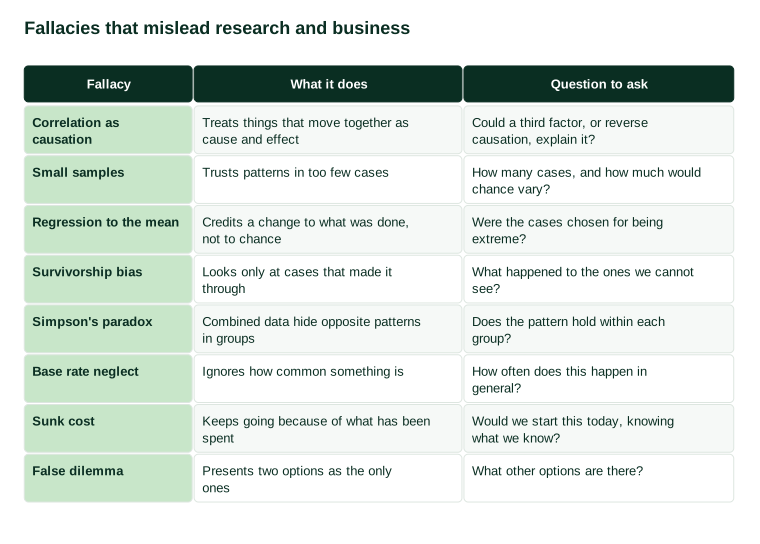
Correlation and causation. That two things vary together does not show that one causes the other. Franz Messerli (2012) published a tongue-in-cheek analysis showing a strong correlation between countries' chocolate consumption and their number of Nobel laureates, as a reminder that striking correlations can arise from confounding factors such as national wealth.
Small samples. Tversky and Kahneman (1971) found that even trained researchers expected small samples to resemble the population closely, a belief they called the "law of small numbers". Howard Wainer (2007) showed how ignoring the greater variability of small samples leads to errors, for example in concluding that small schools perform best because they appear at the top of league tables, when they also appear at the bottom.
Regression to the mean. Extreme results tend to be followed by less extreme ones, simply because extremes partly reflect chance. Francis Galton (1886) first described the phenomenon in the heights of parents and children. Barnett et al. (2005) explain how it misleads evaluations: if a programme is targeted at the worst performers, they will tend to improve whether or not the programme works.
Survivorship bias. Looking only at cases that survived a selection process gives a distorted picture. Mangel and Samaniego (1984) described how the statistician Abraham Wald, analysing damage on aircraft returning from missions in the Second World War, recognised that the areas without damage on returning planes were the ones where hits had been fatal, since planes hit there did not return.
Simpson's paradox. A pattern that appears in combined data can reverse when the data are split into groups. Edward Simpson (1951) described the mathematical conditions. In a famous case, Bickel et al. (1975) found that graduate admissions at the University of California, Berkeley, appeared to favour men overall, but that within most departments women were admitted at similar or higher rates. Women had applied disproportionately to more competitive departments.
Base rate neglect. Kahneman and Tversky (1973) showed that people judging probabilities often ignore how common something is in general, focusing instead on how well a case fits a description.
The conjunction fallacy. Tversky and Kahneman (1983) showed that people judge a specific combination of events as more probable than one of its components, because the combination tells a more representative story.
The hot hand. Gilovich et al. (1985) analysed basketball shooting records and concluded that the widespread belief in "hot streaks" was a fallacy, since successive shots appeared to be independent. Miller and Sanjurjo (2018) later showed that the original analysis contained a subtle statistical bias, and that correcting for it revealed evidence of a modest hot hand. The episode is a reminder that accusations of fallacy can themselves be mistaken.
Fallacies in research reports
Some fallacies are especially common in the way research findings are presented, and anyone who reads or commissions research benefits from knowing them.
Cherry-picking presents the evidence that supports a conclusion and omits the evidence that does not. A report that quotes the three most enthusiastic customer comments, or shows the one time period in which a metric rose, may be accurate in every detail and still misleading overall. The question to ask is what the full set of evidence looks like.
Moving the goalposts changes the criteria for success after the results are known. If a campaign was meant to increase sales and did not, it may be reported as having increased "awareness" instead. Agreeing in advance how success will be judged prevents this.
The ecological fallacy draws conclusions about individuals from data about groups. That regions with higher average incomes buy more of a product does not show that richer individuals buy more of it; the pattern could arise from other differences between regions.
Overgeneralising from a convenience sample treats the views of whoever was easy to reach, such as the customers who answer an email survey or the employees who attend a focus group, as if they represented everyone. The people who respond are often systematically different from those who do not.
Treating "not significant" as "no effect". A study that fails to find a statistically significant difference has not shown that there is no difference; it may simply have been too small to detect one. Absence of evidence is not always evidence of absence.
Each of these fallacies can occur without any intent to mislead. Researchers under pressure to deliver clear findings are especially prone to them, which is why reviewers who ask the exposing questions are valuable.
Fallacies in decision making
Some fallacies concern decisions rather than beliefs. The sunk cost fallacy is the tendency to continue an endeavour because of what has already been invested, rather than what will be gained in future. Arkes and Blumer (1985) found that people who had paid more for a theatre season ticket attended more performances, even though the money was already spent. In organisations, sunk costs keep failing projects alive because abandoning them feels like admitting waste. Tversky and Kahneman (1974) described further heuristics, such as anchoring on an initial number, that produce systematic errors in judgement.
Why fallacies persuade
Fallacies persuade because they exploit features of human reasoning. Ziva Kunda (1990) showed that people are less critical of arguments whose conclusions they want to believe, so fallacies that support a desired conclusion slip through. Many fallacies also work through shortcuts that are often reasonable: trusting experts, following others, generalising from experience. The error lies in applying them where they do not fit.
Recognising and responding to fallacies
Recognising fallacies is a skill that improves with practice. Some research suggests that people can be inoculated against misleading arguments by being exposed to weakened examples and shown how they work. Cook et al. (2017) found that explaining the misleading technique used in misinformation about climate change, before people encountered it, neutralised its effect. Roozenbeek and van der Linden (2019) found that playing an online game in which participants created misleading content, using common manipulation techniques, made them better at identifying such techniques afterwards.
When responding to a fallacy, the aim should be to improve the reasoning, not to score a point. Naming a fallacy ("that's an ad hominem") often ends a discussion without resolving it. Asking the question that exposes the weakness is usually more productive: "Is there evidence that the campaign caused the rise, rather than something else?" "Are those really the only two options?" "How many cases is that based on?" It is also important to remember that showing an argument is fallacious does not show that its conclusion is false. A bad argument for a true conclusion is still a bad argument; the conclusion may be supported in other ways. Treating the identification of a fallacy as a refutation of the conclusion is itself a fallacy, sometimes called the fallacy fallacy.
A hypothetical example
A product team presents its results to senior managers. "Customers who used the new feature in their first week renewed at a rate 20 percentage points higher than those who did not. The feature drives renewal, so we should make it mandatory for new customers." A manager who knows the common fallacies asks three questions. First, could the relationship run the other way, or be explained by a third factor? Customers who were already engaged may have been more likely both to try the feature and to renew. Second, how many customers are in each group, and is the difference stable over time? Third, are the customers who tried the feature similar to those who would be forced to use it? None of these questions dismisses the finding. Together they lead the team to run a randomised test, in which half of new customers are prompted to use the feature, before making it mandatory.
Conclusion
Fallacies are arguments that seem to support their conclusions but do not, or do so far less than they appear to. They include errors of form, of relevance, of presumption and of ambiguity, and a family of statistical and causal fallacies that are especially important in research and business. Whether an argument is fallacious often depends on context, so recognising fallacies means asking whether the support offered is adequate, not just matching patterns. Used well, knowledge of fallacies helps people ask the right questions of arguments, including their own.
References
Arkes, H. R., & Blumer, C. (1985). The psychology of sunk cost. Organizational Behavior and Human Decision Processes, 35(1), 124–140. https://doi.org/10.1016/0749-5978(85)90049-4
Barnett, A. G., van der Pols, J. C., & Dobson, A. J. (2005). Regression to the mean: What it is and how to deal with it. International Journal of Epidemiology, 34(1), 215–220. https://doi.org/10.1093/ije/dyh299
Bickel, P. J., Hammel, E. A., & O'Connell, J. W. (1975). Sex bias in graduate admissions: Data from Berkeley. Science, 187(4175), 398–404. https://doi.org/10.1126/science.187.4175.398
Cook, J., Lewandowsky, S., & Ecker, U. K. H. (2017). Neutralizing misinformation through inoculation: Exposing misleading argumentation techniques reduces their influence. PLoS ONE, 12(5), Article e0175799. https://doi.org/10.1371/journal.pone.0175799
Copi, I. M., Cohen, C., & McMahon, K. (2014). Introduction to logic (14th ed.). Pearson.
Galton, F. (1886). Regression towards mediocrity in hereditary stature. The Journal of the Anthropological Institute of Great Britain and Ireland, 15, 246–263. https://doi.org/10.2307/2841583
Gilovich, T., Vallone, R., & Tversky, A. (1985). The hot hand in basketball: On the misperception of random sequences. Cognitive Psychology, 17(3), 295–314. https://doi.org/10.1016/0010-0285(85)90010-6
Hahn, U., & Oaksford, M. (2007). The rationality of informal argumentation: A Bayesian approach to reasoning fallacies. Psychological Review, 114(3), 704–732. https://doi.org/10.1037/0033-295X.114.3.704
Hamblin, C. L. (1970). Fallacies. Methuen.
Kahneman, D., & Tversky, A. (1973). On the psychology of prediction. Psychological Review, 80(4), 237–251. https://doi.org/10.1037/h0034747
Kunda, Z. (1990). The case for motivated reasoning. Psychological Bulletin, 108(3), 480–498. https://doi.org/10.1037/0033-2909.108.3.480
Mangel, M., & Samaniego, F. J. (1984). Abraham Wald's work on aircraft survivability. Journal of the American Statistical Association, 79(386), 259–267. https://doi.org/10.1080/01621459.1984.10478038
Messerli, F. H. (2012). Chocolate consumption, cognitive function, and Nobel laureates. New England Journal of Medicine, 367(16), 1562–1564. https://doi.org/10.1056/NEJMon1211064
Miller, J. B., & Sanjurjo, A. (2018). Surprised by the hot hand fallacy? A truth in the law of small numbers. Econometrica, 86(6), 2019–2047. https://doi.org/10.3982/ECTA14943
Roozenbeek, J., & van der Linden, S. (2019). Fake news game confers psychological resistance against online misinformation. Palgrave Communications, 5, Article 65. https://doi.org/10.1057/s41599-019-0279-9
Simpson, E. H. (1951). The interpretation of interaction in contingency tables. Journal of the Royal Statistical Society: Series B (Methodological), 13(2), 238–241. https://doi.org/10.1111/j.2517-6161.1951.tb00088.x
Tversky, A., & Kahneman, D. (1971). Belief in the law of small numbers. Psychological Bulletin, 76(2), 105–110. https://doi.org/10.1037/h0031322
Tversky, A., & Kahneman, D. (1974). Judgment under uncertainty: Heuristics and biases. Science, 185(4157), 1124–1131. https://doi.org/10.1126/science.185.4157.1124
Tversky, A., & Kahneman, D. (1983). Extensional versus intuitive reasoning: The conjunction fallacy in probability judgment. Psychological Review, 90(4), 293–315. https://doi.org/10.1037/0033-295X.90.4.293
van Eemeren, F. H., & Grootendorst, R. (2004). A systematic theory of argumentation: The pragma-dialectical approach. Cambridge University Press. https://doi.org/10.1017/CBO9780511616389
Wainer, H. (2007). The most dangerous equation. American Scientist, 95(3), 249–256. https://doi.org/10.1511/2007.65.249
Walton, D. (1998). Ad hominem arguments. University of Alabama Press.
Walton, D. N. (1995). A pragmatic theory of fallacy. University of Alabama Press.