
Inquiry · Logic and reasoning
Argument Mapping and the Structure of Reasoning
Argument mapping turns reasoning into a diagram of claims, reasons, objections and evidence. This article explains how argument maps work, where they came from, what the research says about their effect on critical thinking and how to use them in research and decision making.
Most arguments are presented as prose: a paragraph, a report, a speech. Prose is good at persuading but poor at showing structure. Reasons, objections and evidence are interleaved with background and rhetoric, and readers must hold the whole argument in mind to judge it. Argument mapping addresses this problem by laying out the structure of reasoning as a diagram. A main claim sits at the top; reasons supporting it and objections against it branch below; and each reason or objection can have its own supporting evidence and counter-objections. The result shows at a glance what is being claimed, on what grounds and where the argument is weakest.
Origins
Diagramming arguments has a long history. The American legal scholar John Henry Wigmore (1913) developed an elaborate system of charts for analysing evidence in legal cases, showing how individual items of evidence bear on the facts in dispute. The philosopher Monroe Beardsley (1950) introduced simple diagrams of arguments into logic teaching, numbering each statement and drawing arrows to show which statements support which. Stephen Toulmin (1958) proposed a model of argument with distinct roles for the claim, the data supporting it, the warrant linking data to claim, the backing for the warrant, qualifiers and rebuttals, which influenced later mapping methods.
In the 1970s, Werner Kunz and Horst Rittel (1970) proposed issue-based information systems, in which complex planning discussions were structured as a network of issues, positions and arguments. Conklin and Begeman (1988) built a computer tool on this model to support policy discussions. Since then, computer software for argument mapping has been developed for education, law, intelligence analysis and organisational decision making (Kirschner et al., 2003; Reed et al., 2007).
How an argument map works
Figure 1 shows a simple hypothetical map.
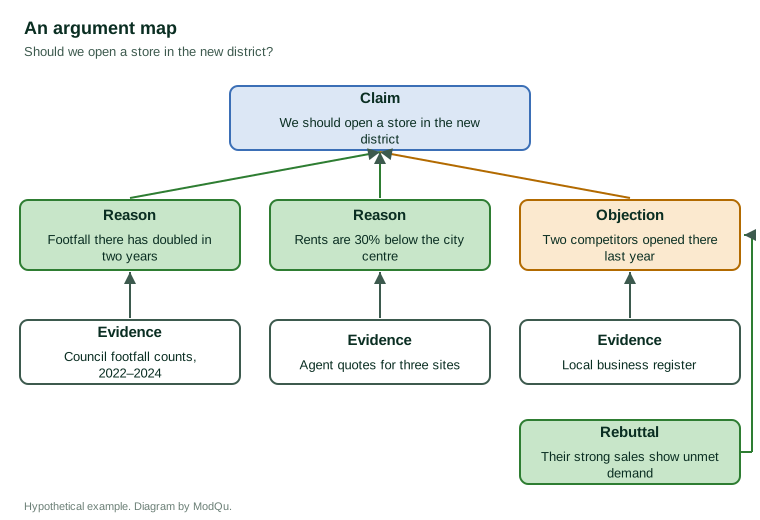
The basic elements are:
- The main claim (or contention): the conclusion being argued for.
- Reasons: claims that support the main claim.
- Objections: claims that count against it.
- Rebuttals: claims that count against an objection.
- Evidence: the data, sources or observations on which reasons and objections rest.
A key principle in many mapping methods is that each reason typically involves several premises that work together, not separately. A reason such as "the new market is growing fast" supports entering the market only together with an unstated premise such as "fast-growing markets offer good returns for new entrants". Making co-premises explicit is one of the most valuable effects of mapping, because hidden premises are often where arguments are weakest. Another principle is that every box should contain a single claim that could be true or false. This discipline forces vague statements to be made precise enough to evaluate, and it often reveals that a single sentence in the original argument contained two or three separate claims, each needing its own support. Douglas Walton (2008) describes how informal arguments rest on argumentation schemes, each with characteristic critical questions, which can be represented in a map.
Reading the example
The map in Figure 1 shows how mapping changes a discussion. In a meeting, the proposal to open a store might be presented as a list of attractive facts: footfall is up, rents are low. Objections might be raised and answered in passing. The map makes several things explicit that the discussion would leave hidden.
First, each reason needs a co-premise to support the claim. Rising footfall supports opening a store only if footfall translates into customers for this kind of store; low rents support it only if lower rents outweigh any disadvantages of the location. Neither co-premise appears on the surface of the argument, and both could be wrong.
Second, the evidence differs in quality. Council footfall counts are an independent source collected over time; quotes from property agents may be optimistic. The map invites the question of how much weight each piece of evidence can bear.
Third, the objection and its rebuttal can be weighed directly. The rebuttal claims that competitors' strong sales show unmet demand. But the evidence for the objection, a business register, says nothing about competitors' sales, so the rebuttal currently rests on no evidence at all. The map shows exactly where more information is needed before a decision.
Common mistakes
People new to argument mapping tend to make several mistakes. They write reasons as topics ("Rents") rather than as claims ("Rents are 30% below the city centre"); a topic cannot be true or false, so it cannot be evaluated. They combine several claims in one box, which hides the fact that some may be well supported and others not. They omit co-premises, so that the map looks complete while the weakest assumptions remain hidden. And they confuse an objection to the main claim with an objection to one of the reasons, placing it in the wrong part of the map. Practice, and comparing maps with others, corrects these mistakes quickly.
Why diagrams help
Larkin and Simon (1987) explained why diagrams can be better than text for some kinds of thinking. A diagram groups related information together in space, so that the reader does not have to search for it, and makes relationships visible that text leaves implicit. For arguments, this means that the reader can see which reasons support which claims, where objections attach and which parts of the argument lack evidence, without holding all of it in working memory.
Tim van Gelder (2005) argued that this reduction in cognitive load is the main reason argument mapping helps critical thinking. Reasoning about complex arguments in prose places heavy demands on working memory (Sweller, 1988), and a map externalises the structure so that attention can go to evaluation.
The evidence
Several studies have examined whether learning to map arguments improves critical thinking. Charles Twardy (2004) reported that students in an introductory philosophy course taught with argument mapping software improved substantially more on a standardised critical thinking test than was typical for such courses. Maralee Harrell (2011) found that students in introductory philosophy who learned to construct argument diagrams improved more in their ability to analyse and evaluate arguments than those who did not. Dwyer et al. (2012) compared students who studied material presented as argument maps with students who studied the same material as text, and found that argument mapping improved some aspects of critical thinking performance and memory for the material. Kunsch et al. (2014) found that business students who used argument mapping in their coursework showed improved critical thinking skills.
The evidence is encouraging but not conclusive. Many studies are small, some lack control groups and it is difficult to separate the effect of mapping from the effect of extra practice in analysing arguments. Martin Davies (2011) distinguished argument mapping from concept mapping and mind mapping, noting that each serves a different purpose and that argument mapping is specifically suited to representing inferential relationships, which is why it fits critical thinking better than the others.
Using argument maps in practice
Argument maps are useful well beyond the classroom. Intelligence analysts have long been encouraged to make their reasoning explicit, to lay out evidence for and against competing hypotheses and to identify the assumptions on which conclusions depend (Heuer, 1999). In organisations, a map can be used to:
- Clarify a proposal before a decision, by making its reasons, assumptions and evidence explicit.
- Structure a debate, so that each contribution is placed as a reason, objection or rebuttal rather than lost in discussion.
- Find gaps in evidence, by showing which reasons rest on assumption rather than data.
- Review research reports, by mapping the argument from findings to recommendations.
- Record the reasoning behind a decision, so that it can be revisited later.
There is also a social benefit. Hugo Mercier and Dan Sperber (2011) argued that people reason best when evaluating others' arguments in a group. A shared argument map gives a group a common object to examine, helping members to engage with the structure of each other's reasoning rather than with personalities.
How to build a map
A simple procedure works for most purposes:
- State the main claim as a single, clear sentence.
- List the reasons for it, each as a complete claim.
- Add the hidden premises that each reason needs to support the claim.
- List the objections, and any rebuttals to them.
- Attach the evidence for each reason and objection, noting where there is none.
- Evaluate, working from the bottom up: how strong is each piece of evidence, how well does each reason support the claim, and how serious are the objections?
The process often changes the argument. Writing out hidden premises reveals assumptions nobody had noticed; attaching evidence reveals reasons that rest on nothing more than confidence; and listing objections forces engagement with the other side.
Conclusion
Argument mapping makes the structure of reasoning visible. It separates claims from reasons, reveals hidden premises, shows where objections bite and makes gaps in evidence obvious. The research suggests that it can improve critical thinking, especially when learners construct maps themselves, though the evidence is still developing. In research and decision making, maps help individuals and groups reason more clearly about complex questions and leave a record of why conclusions were reached.
References
Beardsley, M. C. (1950). Practical logic. Prentice-Hall.
Conklin, J., & Begeman, M. L. (1988). gIBIS: A hypertext tool for exploratory policy discussion. ACM Transactions on Information Systems, 6(4), 303–331. https://doi.org/10.1145/58566.59297
Davies, M. (2011). Concept mapping, mind mapping and argument mapping: What are the differences and do they matter? Higher Education, 62(3), 279–301. https://doi.org/10.1007/s10734-010-9387-6
Dwyer, C. P., Hogan, M. J., & Stewart, I. (2012). An evaluation of argument mapping as a method of enhancing critical thinking performance in e-learning environments. Metacognition and Learning, 7(3), 219–244. https://doi.org/10.1007/s11409-012-9092-1
Harrell, M. (2011). Argument diagramming and critical thinking in introductory philosophy. Higher Education Research & Development, 30(3), 371–385. https://doi.org/10.1080/07294360.2010.502559
Heuer, R. J., Jr. (1999). Psychology of intelligence analysis. Center for the Study of Intelligence, Central Intelligence Agency.
Kirschner, P. A., Buckingham Shum, S. J., & Carr, C. S. (Eds.). (2003). Visualizing argumentation: Software tools for collaborative and educational sense-making. Springer. https://doi.org/10.1007/978-1-4471-0037-9
Kunsch, D. W., Schnarr, K., & van Tyle, R. (2014). The use of argument mapping to enhance critical thinking skills in business education. Journal of Education for Business, 89(8), 403–410. https://doi.org/10.1080/08832323.2014.925416
Kunz, W., & Rittel, H. W. J. (1970). Issues as elements of information systems (Working Paper No. 131). Institute of Urban and Regional Development, University of California, Berkeley.
Larkin, J. H., & Simon, H. A. (1987). Why a diagram is (sometimes) worth ten thousand words. Cognitive Science, 11(1), 65–100. https://doi.org/10.1111/j.1551-6708.1987.tb00863.x
Mercier, H., & Sperber, D. (2011). Why do humans reason? Arguments for an argumentative theory. Behavioral and Brain Sciences, 34(2), 57–74. https://doi.org/10.1017/S0140525X10000968
Reed, C., Walton, D., & Macagno, F. (2007). Argument diagramming in logic, law and artificial intelligence. The Knowledge Engineering Review, 22(1), 87–109. https://doi.org/10.1017/S0269888907001051
Sweller, J. (1988). Cognitive load during problem solving: Effects on learning. Cognitive Science, 12(2), 257–285. https://doi.org/10.1207/s15516709cog1202_4
Toulmin, S. E. (1958). The uses of argument. Cambridge University Press.
Twardy, C. R. (2004). Argument maps improve critical thinking. Teaching Philosophy, 27(2), 95–116. https://doi.org/10.5840/teachphil200427213
van Gelder, T. (2005). Teaching critical thinking: Some lessons from cognitive science. College Teaching, 53(1), 41–48. https://doi.org/10.3200/CTCH.53.1.41-48
Walton, D. (2008). Informal logic: A pragmatic approach (2nd ed.). Cambridge University Press.
Wigmore, J. H. (1913). The principles of judicial proof as given by logic, psychology, and general experience, and illustrated in judicial trials. Little, Brown.