
Inquiry · Philosophy of inquiry
Feminist Inquiry: Re-evaluating Traditional Modes of Knowledge Generation
Feminist inquiry asks who does the asking, whose experience counts as evidence and what gets left out. This article explains its three main approaches, the evidence of gender gaps in data and research, and what its methods offer all researchers.
For much of the twentieth century, cars were designed and tested using crash-test dummies modelled on an average adult man. When researchers later analysed real crashes in the United States, they found that a woman wearing a seatbelt had substantially higher odds of serious injury than a man in a comparable crash (Bose et al., 2011). Nobody had set out to design cars that were less safe for women. The gap arose because of who was assumed to be the typical driver, and therefore what questions were asked and what data were collected. The example is instructive because every individual step seemed reasonable. Engineers used the dummies available, regulators tested what the standards required, and analysts studied the data that existed. The bias lay in an assumption shared so widely that nobody thought to question it. Feminist inquiry is the tradition of research and philosophy that asks how assumptions like this enter the production of knowledge, and what can be done about them. Its questions are simple to state: who is doing the asking, whose experience is treated as typical, and what disappears from view as a result?
What makes inquiry "feminist"?
Feminist inquiry is not a single method. It is a set of commitments about how knowledge is produced. Elizabeth Anderson (1995) describes feminist epistemology as the study of how gender influences our conceptions of knowledge, the knower and practices of inquiry, and how these practices have tended to disadvantage women and other subordinated groups. Feminist researchers generally share three concerns: that research should take seriously the experiences of people who have been overlooked, that researchers should be aware of how their own position shapes their questions and interpretations, and that knowledge should be useful for reducing injustice (Hesse-Biber, 2012).
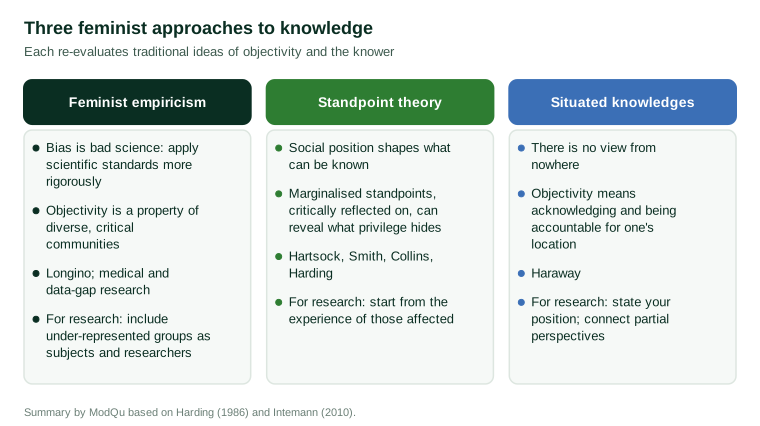
Sandra Harding (1986) set out three broad approaches that structured the field for decades (Figure 1).
Feminist empiricism: better science, not different science
The first approach holds that the problem is bad science, not science as such. Male bias in research is a failure to follow scientific standards properly, and it can be corrected by applying those standards more rigorously and by including women as researchers and research subjects. Helen Longino (1990) developed a sophisticated version of this view. Objectivity, she argued, is not a property of individual scientists but of scientific communities. It depends on critical scrutiny from people with diverse perspectives. A community whose members share the same background assumptions will not notice those assumptions, however careful each member is. Including different perspectives is therefore not a political concession but an epistemic requirement.
Medical research offers clear support for this argument. For many years women of childbearing age were routinely excluded from early-stage clinical trials, partly to avoid risks to pregnancies, with the result that drug doses and side-effect profiles were established mainly in men (Liu & Mager, 2016). Policies in the United States since the 1990s have required women's inclusion, but reviews show that the analysis of results by sex has lagged behind (Mazure & Jones, 2015). Caroline Criado Perez (2019) documents similar "gender data gaps" across transport planning, workplace safety, product design and economic statistics, where data were collected as if the default person were male.
Standpoint theory: knowledge from the margins
The second approach goes further. Standpoint theorists argue that social position affects what people can know, and that the perspectives of marginalised groups can reveal features of social life that are invisible from positions of privilege. Nancy Hartsock (1983) adapted the Marxist idea that the working class has a distinctive view of capitalism, arguing that women's work in caring for bodies and households gives them a standpoint from which the abstractions of dominant thought appear partial.
The sociologist Dorothy Smith (1987) argued that sociology had been built from the standpoint of men in positions of authority, and proposed a sociology that starts from the everyday experiences of women and traces how those experiences are organised by institutions they do not control. Patricia Hill Collins (1990) developed a Black feminist standpoint, showing that Black women's experience of overlapping systems of oppression gives them insights that neither white feminists nor Black men necessarily share. Kimberlé Crenshaw (1989) introduced the term intersectionality to describe how race and sex combine, in law and in life, in ways that cannot be understood by examining either alone.
Standpoint theory has been misread as claiming that oppressed people automatically know better. Its defenders reject that reading. A standpoint, in Harding's (1991) sense, is not simply a perspective but an achievement: it is reached through critical reflection on experience. Alison Wylie (2003) argues that standpoint theory makes a modest and testable claim, that social location can give epistemic advantages on particular questions, which must be established case by case.
Situated knowledges: objectivity without a view from nowhere
The third approach questions the very idea of a single objective viewpoint. Donna Haraway (1988) criticised the "god trick" of claiming to see everything from nowhere. All knowledge, she argued, is produced from somewhere, by embodied people using particular instruments and concepts. But this does not lead to relativism. Haraway proposed "situated knowledges" as a stronger form of objectivity: knowledge that acknowledges its location and is accountable for it, and that can be connected with knowledge from other locations to produce a fuller picture.
How assumptions shape research questions
Feminist inquiry has been especially effective in showing how cultural assumptions shape apparently neutral scientific descriptions. Emily Martin (1991) analysed biology textbooks and found that they described the egg as passive and the sperm as active and heroic, even after research had shown that the egg plays an active role in fertilisation. The language reflected cultural stereotypes rather than the evidence. Evelyn Fox Keller (1985) examined how ideas about masculinity and objectivity had shaped the history of science.
Carol Gilligan's (1982) work on moral development is a further example. Earlier research had found that women scored lower than men on a widely used scale of moral reasoning, which had been developed largely from studies of boys and men. Gilligan argued that the scale privileged reasoning based on rules and rights and overlooked reasoning based on care and relationships. Her conclusions remain debated, but her argument showed how the choice of a reference group can define what counts as mature reasoning.
Feminist methods in practice
Feminist researchers have also changed how research is done. Ann Oakley (1981) argued that the textbook model of interviewing, in which the interviewer remains detached and avoids answering respondents' questions, was unsuitable for interviewing women about intimate experiences such as becoming a mother. She found that a more reciprocal relationship produced richer and more honest accounts. Feminist research has also emphasised reflexivity, the practice of examining how the researcher's own position affects the research, and participatory approaches in which those being studied help shape the questions (Hesse-Biber, 2012).
Miranda Fricker (2007) introduced the concept of epistemic injustice to describe two related harms. Testimonial injustice occurs when a speaker's word is given less credibility because of prejudice about who they are. Hermeneutical injustice occurs when a group lacks the shared concepts needed to make sense of its own experience, as women did before terms such as "sexual harassment" were coined. Both forms of injustice affect what inquiry can discover.
Feminist inquiry and survey research
Survey research has been one of the main arenas in which feminist critiques have changed practice. Early household surveys often recorded a single "head of household", usually assumed to be a man, and collected information about the household's economic activity through that person. This made women's paid and unpaid work hard to see. Questions about employment that asked only about a respondent's "main job" missed the part-time, seasonal and informal work that women were more likely to do. Economic statistics that counted only market activity left out the very large volume of unpaid caring and household work, which is why many national statistical agencies now run dedicated time-use surveys that record what people do hour by hour.
Survey designers have also learned that the categories offered in a question shape the answers. A question that offers only two options for sex or gender, or that assumes respondents live in a household with one adult man and one adult woman, will misclassify people whose lives do not fit. Changes in these questions have been driven partly by the feminist insight that categories are not neutral: they reflect assumptions about who the typical respondent is.
The lesson for any survey is to ask, at the design stage, whose activities and experiences the questions are able to record, and whose they cannot. Pilot testing with diverse respondents and cognitive interviews, in which people explain how they understood each question, are practical ways to find out.
Criticisms
Feminist epistemology has its critics. Some argue that standpoint theory risks essentialism, treating "women" as a single group with a shared perspective, an objection that intersectional theorists themselves have pressed. Others worry that emphasising the political aims of research threatens its objectivity. Kristen Intemann (2010) argues that the two main approaches, feminist empiricism and standpoint theory, have converged over time: both now hold that diversity in research communities improves objectivity and that social values can legitimately guide which questions are asked, provided the evidence is assessed rigorously.
What feminist inquiry offers all researchers
The practical lessons of feminist inquiry apply well beyond gender.
- Ask who the "default" respondent is. Samples, product tests and data systems often assume a typical user. Checking who is missing or under-represented can reveal large blind spots.
- Analyse results by relevant groups. An average can hide important differences. Disaggregating by sex, age, ethnicity or other characteristics shows whether a finding holds for everyone.
- Examine the language of questions and findings. Wording can carry assumptions that shape answers and interpretations.
- Include diverse perspectives in the research team. Longino's argument implies that a team whose members share the same background is less likely to notice its own assumptions.
- Treat experience as evidence. People's accounts of their own experience are data worth taking seriously, especially when they conflict with official categories.
Conclusion
Feminist inquiry began as a critique of how women were excluded from and misrepresented in research. It has become a broader set of tools for examining how any research tradition's assumptions shape what it asks and finds. Its central claim, that who asks the questions affects what is known, is now supported by substantial evidence from medicine, engineering and social science. Taking it seriously does not mean abandoning objectivity. It means pursuing a more demanding version of it, in which the position of the inquirer is part of what inquiry must examine.
References
Anderson, E. (1995). Feminist epistemology: An interpretation and a defense. Hypatia, 10(3), 50–84. https://doi.org/10.1111/j.1527-2001.1995.tb00737.x
Bose, D., Segui-Gomez, M., & Crandall, J. R. (2011). Vulnerability of female drivers involved in motor vehicle crashes: An analysis of US population at risk. American Journal of Public Health, 101(12), 2368–2373. https://doi.org/10.2105/AJPH.2011.300275
Collins, P. H. (1990). Black feminist thought: Knowledge, consciousness, and the politics of empowerment. Unwin Hyman.
Crenshaw, K. (1989). Demarginalizing the intersection of race and sex: A Black feminist critique of antidiscrimination doctrine, feminist theory and antiracist politics. University of Chicago Legal Forum, 1989(1), 139–167.
Criado Perez, C. (2019). Invisible women: Exposing data bias in a world designed for men. Chatto & Windus.
Fricker, M. (2007). Epistemic injustice: Power and the ethics of knowing. Oxford University Press. https://doi.org/10.1093/acprof:oso/9780198237907.001.0001
Gilligan, C. (1982). In a different voice: Psychological theory and women's development. Harvard University Press.
Haraway, D. (1988). Situated knowledges: The science question in feminism and the privilege of partial perspective. Feminist Studies, 14(3), 575–599. https://doi.org/10.2307/3178066
Harding, S. (1986). The science question in feminism. Cornell University Press.
Harding, S. (1991). Whose science? Whose knowledge? Thinking from women's lives. Cornell University Press.
Hartsock, N. C. M. (1983). The feminist standpoint: Developing the ground for a specifically feminist historical materialism. In S. Harding & M. B. Hintikka (Eds.), Discovering reality (pp. 283–310). D. Reidel. https://doi.org/10.1007/0-306-48017-4_15
Hesse-Biber, S. N. (Ed.). (2012). Handbook of feminist research: Theory and praxis (2nd ed.). Sage. https://doi.org/10.4135/9781483384740
Intemann, K. (2010). 25 years of feminist empiricism and standpoint theory: Where are we now? Hypatia, 25(4), 778–796. https://doi.org/10.1111/j.1527-2001.2010.01138.x
Keller, E. F. (1985). Reflections on gender and science. Yale University Press.
Liu, K. A., & Mager, N. A. D. (2016). Women's involvement in clinical trials: Historical perspective and future implications. Pharmacy Practice, 14(1), Article 708. https://doi.org/10.18549/PharmPract.2016.01.708
Longino, H. E. (1990). Science as social knowledge: Values and objectivity in scientific inquiry. Princeton University Press.
Martin, E. (1991). The egg and the sperm: How science has constructed a romance based on stereotypical male-female roles. Signs, 16(3), 485–501. https://doi.org/10.1086/494680
Mazure, C. M., & Jones, D. P. (2015). Twenty years and still counting: Including women as participants and studying sex and gender in biomedical research. BMC Women's Health, 15, Article 94. https://doi.org/10.1186/s12905-015-0251-9
Oakley, A. (1981). Interviewing women: A contradiction in terms. In H. Roberts (Ed.), Doing feminist research (pp. 30–61). Routledge & Kegan Paul.
Smith, D. E. (1987). The everyday world as problematic: A feminist sociology. Northeastern University Press.
Wylie, A. (2003). Why standpoint matters. In R. Figueroa & S. Harding (Eds.), Science and other cultures: Issues in philosophies of science and technology (pp. 26–48). Routledge.