
Inquiry · Inquiry in education and learning
Critical Thinking: Definitions and Components
Critical thinking is one of the most valued and least clearly defined goals of education and work. This article reviews the main definitions, the skills and dispositions they share, the debate over whether critical thinking is general or subject-specific, and how it can be assessed.
Employers list critical thinking among the skills they most want. Universities promise to develop it. Governments include it in national curricula. Yet when asked what critical thinking actually is, people give strikingly different answers. Some mean the ability to analyse arguments; others mean scepticism towards claims; others mean independent judgement, problem solving or simply thinking well. This vagueness matters, because it is hard to teach, assess or practise something that is not clearly defined. This article reviews how philosophers and psychologists have defined critical thinking, the components most definitions share, the main debates about its nature and what is known about measuring it.
Early definitions
The modern idea of critical thinking has roots in John Dewey's (1910) account of reflective thought, which he defined as "active, persistent, and careful consideration of any belief or supposed form of knowledge in the light of the grounds that support it, and the further conclusions to which it tends". Dewey's emphasis on examining the grounds for beliefs, rather than accepting them on authority or habit, remains central to most definitions.
Edward Glaser (1941) conducted one of the first experiments on teaching critical thinking and defined it as having three parts: an attitude of being disposed to consider problems thoughtfully, knowledge of the methods of logical inquiry and reasoning, and skill in applying those methods. This three-part structure of attitude, knowledge and skill anticipated much later work. Glaser went on to develop, with Goodwin Watson, one of the most widely used tests of critical thinking (Watson & Glaser, 1980).
Robert Ennis (1962) offered an early philosophical definition: critical thinking is "the correct assessing of statements". He listed twelve aspects, including judging whether a statement follows from premises, whether something is an assumption, whether an observation statement is reliable and whether a definition is adequate. Ennis later broadened his definition to "reasonable reflective thinking focused on deciding what to believe or do", which emphasised that critical thinking serves decisions and action, not only the evaluation of arguments. He also emphasised that critical thinking involves dispositions, such as seeking reasons and being open-minded, as well as abilities (Ennis, 1996).
The expert consensus
In the late 1980s the American Philosophical Association asked Peter Facione to coordinate a panel of 46 experts in philosophy, education and psychology, who worked through several rounds of a structured consultation known as the Delphi method to reach a consensus definition. The resulting report (Facione, 1990) defined critical thinking as "purposeful, self-regulatory judgment which results in interpretation, analysis, evaluation, and inference, as well as explanation of the evidential, conceptual, methodological, criteriological, or contextual considerations upon which that judgment is based".
The panel identified six core cognitive skills and a set of dispositions that characterise the ideal critical thinker. Figure 1 summarises them.
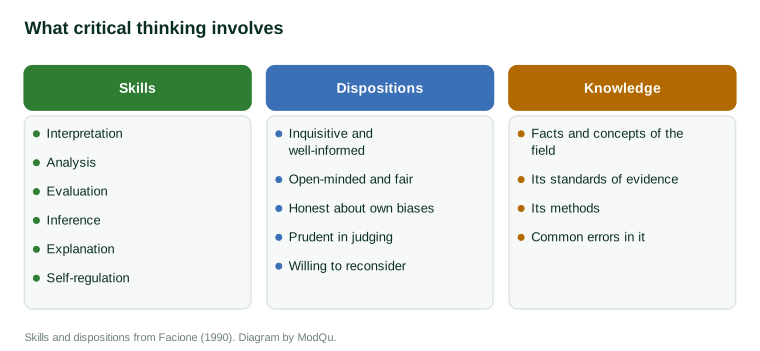
The six skills are:
- Interpretation: understanding and expressing the meaning of information, experiences and statements.
- Analysis: identifying the intended and actual relationships between statements, questions and concepts, including identifying arguments and their parts.
- Evaluation: assessing the credibility of claims and the logical strength of arguments.
- Inference: identifying what is needed to draw reasonable conclusions, forming hypotheses and drawing consequences from evidence.
- Explanation: stating the results of one's reasoning and justifying it in terms of evidence, concepts, methods and criteria.
- Self-regulation: monitoring one's own thinking and correcting it where necessary.
The dispositions included being inquisitive, well-informed, trustful of reason, open-minded, flexible, fair-minded in evaluation, honest in facing one's own biases, prudent in making judgements, willing to reconsider and clear about issues. Facione (2000) later argued that these dispositions are as important as the skills, and showed that measures of disposition and skill were related but distinct: some people have the skills but do not use them.
Skills, dispositions and knowledge
Most definitions now agree that critical thinking has at least three components.
Skills are the abilities to carry out particular kinds of thinking: analysing an argument, evaluating evidence, drawing a valid inference, identifying an assumption. Diane Halpern (1998) emphasised skills such as verbal reasoning, argument analysis, hypothesis testing, judging likelihood and uncertainty, and decision making and problem solving.
Dispositions are the tendencies to use those skills. Perkins et al. (1993) argued that many failures of thinking result not from a lack of ability but from a failure to notice that a situation calls for careful thought. They proposed that good thinking requires sensitivity to occasions for thinking, inclination to engage and ability to do it well. Ennis (1996) listed dispositions such as caring that one's beliefs are true and one's decisions justified, seeking alternatives, being well-informed and being open-minded.
Knowledge is the third component, and the most contested. To evaluate an argument about climate science, one needs some knowledge of climate science. To spot a flaw in a financial analysis, one needs to know something about finance. This raises the question of whether critical thinking is a general skill at all.
General or subject-specific?
John McPeck (1981) argued that critical thinking is always thinking about something, and that the standards for good thinking differ from field to field. What counts as good evidence in history differs from what counts in physics. On this view, there is no general skill of critical thinking that can be taught independently of subject matter; critical thinking in each field is learned by mastering that field's knowledge and methods.
Others disagreed. Harvey Siegel (1988) argued that, while subject knowledge is necessary, there are general principles of good reasoning, such as avoiding contradiction, proportioning belief to evidence and recognising common fallacies, that apply across subjects. Ennis (1996) took a middle position: some critical thinking abilities are general, but applying them well requires knowledge of the field.
Psychological research has added evidence to this debate. Daniel Willingham (2007) reviewed studies showing that people often fail to transfer reasoning skills from one context to another, and that the ability to think critically about a topic depends heavily on knowledge of that topic. He concluded that critical thinking is not a skill that can be taught in the abstract like riding a bicycle, but that general strategies can help when combined with knowledge and practice in a domain. Bailin et al. (1999) argued that critical thinking is best understood not as a set of general skills but as the competent use of intellectual resources, including background knowledge, concepts, standards and habits of mind, which are partly specific to fields.
The practical upshot is that critical thinking cannot be developed independently of knowledge, but it is not merely knowledge either. Someone with deep knowledge of a field can still accept a weak argument if they fail to examine it, and general habits such as asking for evidence and considering alternatives make that examination more likely.
Critical thinking and rationality
Research on reasoning and decision making has provided another perspective. Daniel Kahneman (2011) popularised the distinction between fast, intuitive thinking and slow, deliberate thinking, and described many ways in which intuitive judgement goes wrong, through biases such as anchoring, overconfidence and the neglect of base rates. Critical thinking can be understood partly as the ability and willingness to override intuitive responses when they are likely to be mistaken.
Keith Stanovich and Richard West have shown that people differ in this ability, and that the differences are only partly explained by intelligence. Stanovich and West (1997) found that people high in actively open-minded thinking, a disposition to seek out evidence against one's own beliefs, were better at evaluating arguments independently of their prior opinions. West et al. (2008) found that performance on tasks designed to detect cognitive biases was associated with critical thinking dispositions and only moderately with cognitive ability. Stanovich et al. (2016) developed a comprehensive assessment of rational thinking, arguing that it measures something important that intelligence tests miss.
Critical thinking as developmental
Deanna Kuhn (1999) proposed that critical thinking develops through levels of understanding about knowledge itself. Young children tend to be realists, assuming that knowledge is a direct copy of reality. Many adolescents and adults become absolutists, believing that claims are simply right or wrong and that experts can tell which. Some move to a multiplist position, in which all opinions are equally valid because knowledge is uncertain. Only some reach an evaluativist position, recognising that knowledge is uncertain but that some claims are better supported than others and can be judged by the quality of their evidence and reasoning. Kuhn argued that critical thinking in the full sense requires this evaluativist understanding, because without it there is no reason to weigh evidence carefully.
Argument as a core
Many accounts treat the analysis and evaluation of arguments as the core of critical thinking. Stephen Toulmin (1958) proposed a model of argument that has been widely used in teaching. An argument has a claim, supported by data (evidence), connected by a warrant (the reasoning that links the data to the claim), which may need backing. The claim may be qualified ("probably") and may be subject to rebuttals (conditions under which it would not hold). The model helps people analyse real-world arguments, which rarely take the form of formal logic, and identify where they are weak: the evidence may be poor, the warrant unstated or doubtful, or important rebuttals ignored.
Assessing critical thinking
Because critical thinking is defined in different ways, it is measured in different ways. Some tests, such as the Watson-Glaser Critical Thinking Appraisal (Watson & Glaser, 1980), use multiple-choice items assessing inference, recognition of assumptions, deduction, interpretation and evaluation of arguments. Others, such as the Halpern Critical Thinking Assessment, combine multiple-choice and open-ended responses about everyday situations. Butler (2012) found that scores on the Halpern assessment predicted real-world outcomes: people with higher scores reported fewer negative life events resulting from poor decisions, such as financial or health problems.
Kelly Ku (2009) argued that multiple-choice formats are limited, because they can show whether people recognise a good answer but not whether they would produce one, and recommended combining formats. Most researchers agree that dispositions are harder to measure than skills, because a test situation signals that careful thinking is expected, while real situations often do not.
Can critical thinking be taught?
A meta-analysis by Abrami et al. (2008) examined 117 studies of interventions intended to improve critical thinking. The average effect was positive but modest, and varied greatly. The most effective approaches combined explicit instruction in critical thinking principles with application in subject-matter teaching, and interventions where teachers had received training in teaching critical thinking produced larger gains. Simply hoping that critical thinking would develop as a by-product of subject teaching was the least effective approach. Halpern (1998) argued that teaching for transfer requires explicit attention to the structure of problems and practice in recognising when a skill applies, as well as attention to dispositions.
Common misconceptions
Several misunderstandings about critical thinking are widespread.
Critical thinking is not the same as criticism. The word "critical" suggests fault-finding, but critical thinking means judging well, which includes recognising strong arguments and good evidence as well as weak ones. A person who rejects every claim is no more a critical thinker than one who accepts every claim; both have stopped evaluating.
Critical thinking is not the same as intelligence. Stanovich et al. (2016) showed that people of high intelligence are not immune to biased reasoning, and that measures of rational thinking capture something that intelligence tests do not. Intelligence may make critical thinking easier, but it does not guarantee that a person will use it.
Critical thinking is not only applied to other people's views. Richard Paul and Linda Elder (2006) distinguished weak-sense critical thinking, which uses reasoning skills to defend one's own views and attack others', from strong-sense critical thinking, which applies the same standards to one's own beliefs. The distinction matters because skilled reasoners can be especially good at rationalising. Ziva Kunda (1990) reviewed evidence of motivated reasoning: people evaluate evidence more leniently when it supports conclusions they want to reach, and more harshly when it does not. Kahan et al. (2017) found that people with stronger numerical skills were better at interpreting data correctly when the conclusion was politically neutral, but that when the same data bore on a politically charged issue, their interpretations became more polarised, not less. Skill without the disposition to apply it even-handedly can make reasoning worse.
Critical thinking at work: an example
Consider a hypothetical marketing team presented with a report claiming that customers who use the company's mobile app spend 40% more than those who do not, and recommending a campaign to push all customers to the app. A critical thinker on the team would work through several questions. Interpretation: what exactly does "spend 40% more" mean, over what period and for which customers? Analysis: what is the argument? The report's claim is that using the app causes higher spending. Evaluation: how strong is the evidence for that causal claim? It rests on a comparison of app users with non-users, who probably differ in many ways; the most loyal customers may be both more likely to download the app and more likely to spend. Inference: what conclusion is justified? That app users spend more, but not that the app causes it. Explanation: the team member sets out this reasoning to colleagues. Self-regulation: they also check whether they are being sceptical because they doubted the campaign idea from the start.
The team decides to run a small experiment, encouraging a random sample of customers to download the app and comparing their subsequent spending with a control group. That is what critical thinking adds to inquiry: not a rejection of the original idea, but a better question and a way to answer it.
Why it matters for inquiry
Critical thinking and inquiry are closely linked. Inquiry generates questions and seeks evidence; critical thinking evaluates the evidence and the reasoning built on it. A research team that collects data without critical thinking may draw conclusions the data do not support. A team that thinks critically but does not inquire may become expert at finding flaws in others' work without producing anything new. In practice, the two are best seen as aspects of a single disposition: to want to know what is true, and to care about how we know it.
For organisations, this suggests some practical habits: asking for the evidence behind a claim, distinguishing between what the data show and what they suggest, considering alternative explanations, identifying the assumptions behind a recommendation and stating the confidence attached to a conclusion. None of these requires special training, but each requires the disposition to do it.
Conclusion
Critical thinking is hard to define precisely, but most definitions converge on a core: the skilled and disposed evaluation of claims, evidence and reasoning, in order to decide what to believe or do. It involves skills such as analysis, evaluation and inference; dispositions such as open-mindedness and a concern for truth; and knowledge of the subject at hand. It develops with understanding of how knowledge works, and it can be improved by explicit teaching combined with practice in real subjects. For anyone engaged in generating knowledge, it is the faculty that keeps inquiry honest.
References
Abrami, P. C., Bernard, R. M., Borokhovski, E., Wade, A., Surkes, M. A., Tamim, R., & Zhang, D. (2008). Instructional interventions affecting critical thinking skills and dispositions: A stage 1 meta-analysis. Review of Educational Research, 78(4), 1102–1134. https://doi.org/10.3102/0034654308326084
Bailin, S., Case, R., Coombs, J. R., & Daniels, L. B. (1999). Conceptualizing critical thinking. Journal of Curriculum Studies, 31(3), 285–302. https://doi.org/10.1080/002202799183133
Butler, H. A. (2012). Halpern Critical Thinking Assessment predicts real-world outcomes of critical thinking. Applied Cognitive Psychology, 26(5), 721–729. https://doi.org/10.1002/acp.2851
Dewey, J. (1910). How we think. D. C. Heath.
Ennis, R. H. (1962). A concept of critical thinking. Harvard Educational Review, 32(1), 81–111.
Ennis, R. H. (1996). Critical thinking dispositions: Their nature and assessability. Informal Logic, 18(2), 165–182. https://doi.org/10.22329/il.v18i2.2378
Facione, P. A. (1990). Critical thinking: A statement of expert consensus for purposes of educational assessment and instruction. California Academic Press.
Facione, P. A. (2000). The disposition toward critical thinking: Its character, measurement, and relationship to critical thinking skill. Informal Logic, 20(1), 61–84. https://doi.org/10.22329/il.v20i1.2254
Glaser, E. M. (1941). An experiment in the development of critical thinking. Teachers College, Columbia University.
Halpern, D. F. (1998). Teaching critical thinking for transfer across domains: Disposition, skills, structure training, and metacognitive monitoring. American Psychologist, 53(4), 449–455. https://doi.org/10.1037/0003-066X.53.4.449
Kahan, D. M., Peters, E., Dawson, E. C., & Slovic, P. (2017). Motivated numeracy and enlightened self-government. Behavioural Public Policy, 1(1), 54–86. https://doi.org/10.1017/bpp.2016.2
Kahneman, D. (2011). Thinking, fast and slow. Farrar, Straus and Giroux.
Ku, K. Y. L. (2009). Assessing students' critical thinking performance: Urging for measurements using multi-response format. Thinking Skills and Creativity, 4(1), 70–76. https://doi.org/10.1016/j.tsc.2009.02.001
Kuhn, D. (1999). A developmental model of critical thinking. Educational Researcher, 28(2), 16–46. https://doi.org/10.3102/0013189X028002016
Kunda, Z. (1990). The case for motivated reasoning. Psychological Bulletin, 108(3), 480–498. https://doi.org/10.1037/0033-2909.108.3.480
McPeck, J. E. (1981). Critical thinking and education. Martin Robertson.
Paul, R., & Elder, L. (2006). Critical thinking: Tools for taking charge of your learning and your life (2nd ed.). Pearson Prentice Hall.
Perkins, D. N., Jay, E., & Tishman, S. (1993). Beyond abilities: A dispositional theory of thinking. Merrill-Palmer Quarterly, 39(1), 1–21.
Siegel, H. (1988). Educating reason: Rationality, critical thinking, and education. Routledge.
Stanovich, K. E., & West, R. F. (1997). Reasoning independently of prior belief and individual differences in actively open-minded thinking. Journal of Educational Psychology, 89(2), 342–357. https://doi.org/10.1037/0022-0663.89.2.342
Stanovich, K. E., West, R. F., & Toplak, M. E. (2016). The rationality quotient: Toward a test of rational thinking. MIT Press.
Toulmin, S. E. (1958). The uses of argument. Cambridge University Press.
Watson, G., & Glaser, E. M. (1980). Watson-Glaser critical thinking appraisal manual. Psychological Corporation.
West, R. F., Toplak, M. E., & Stanovich, K. E. (2008). Heuristics and biases as measures of critical thinking: Associations with cognitive ability and thinking dispositions. Journal of Educational Psychology, 100(4), 930–941. https://doi.org/10.1037/a0012842
Willingham, D. T. (2007). Critical thinking: Why is it so hard to teach? American Educator, 31(2), 8–19.